


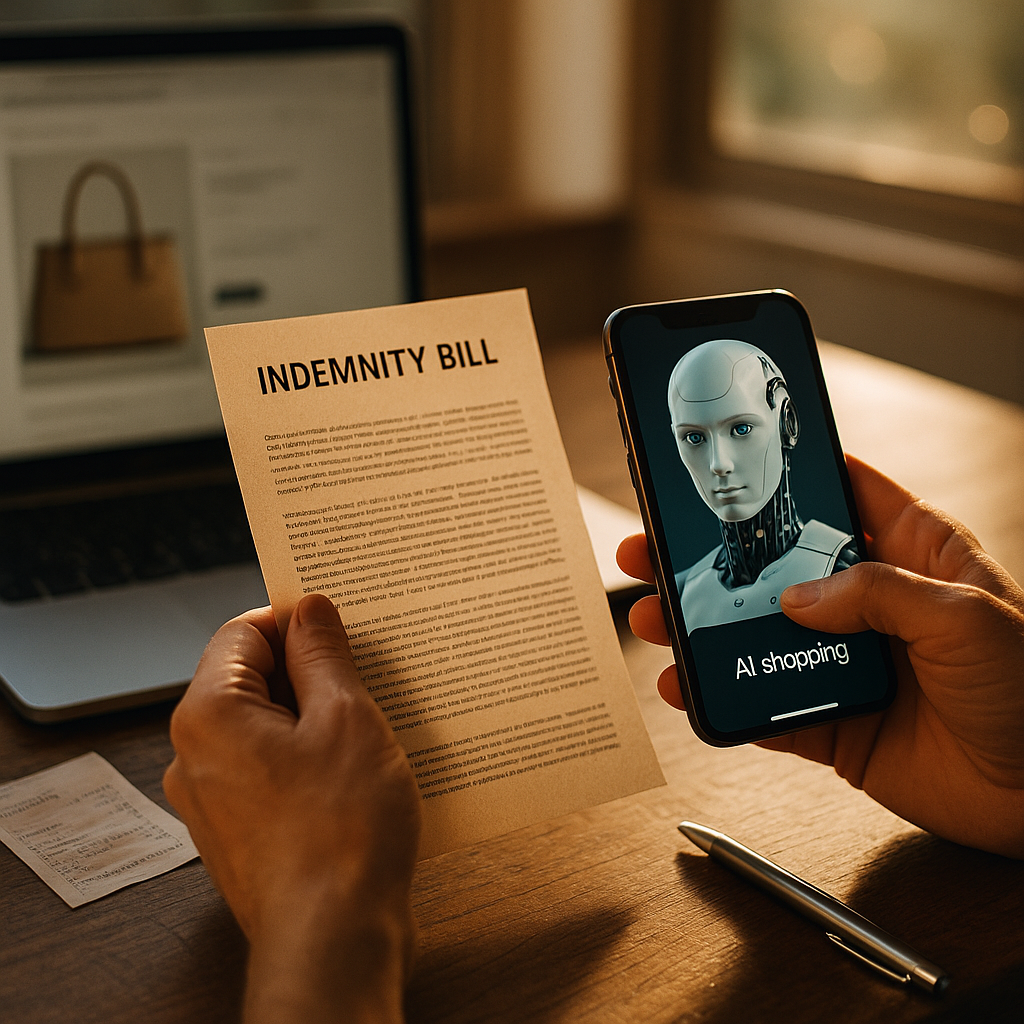
An AI shopping agent just told a customer your supplement “cures anxiety.” You never said that. Your creator never said that. But the AI generated it from scraped content, and now your brand is named in a demand letter. This is the new liability frontier, and most indemnification clauses written for brands were drafted for a world where humans, not algorithms, made the claims.
Agentic commerce, the systems where AI agents browse, compare, recommend, and complete purchases on a shopper’s behalf, is moving faster than the contracts meant to govern it. Brands are signing platform agreements, creator contracts, and martech vendor deals that were never built to answer a simple question: when an AI misrepresents a product, who eats the cost?
Why Standard Indemnification Language Falls Apart Here
Most brand contracts with agencies, creators, and platforms include indemnification clauses that assume a human author. The creator agrees to indemnify the brand for false claims they personally make. The platform disclaims liability for third-party content. Fine, that worked when a person typed the caption.
Agentic commerce breaks that chain. An AI shopping agent (think tools built on large language models that summarize product reviews, compare specs, or negotiate price on a shopper’s behalf) generates claims dynamically. Nobody typed “clinically proven” into a caption. The model inferred it from a pile of scraped UGC, old press releases, or a competitor’s marketing copy. That’s a fundamentally different liability event, and it’s exactly the kind of gap explored in AI search scraping UGC coverage, where ownership and origin of content become murky the moment an algorithm touches it.
If your indemnification clause only covers claims made by “a party” in a contract, it says nothing about claims generated by a system with no legal personhood and no bank account to sue.
What “Agentic Commerce” Actually Changes for Legal Exposure
Agentic commerce isn’t just chatbots answering questions. It’s autonomous agents completing transactions: adding items to cart, applying discount codes, even negotiating bundle terms, based on synthesized product information. Shopify, Perplexity, and OpenAI have all rolled out shopping-agent integrations over the past year, and the pace is accelerating. The FTC has already signaled it’s watching, and FTC guidance on endorsements and deceptive claims doesn’t distinguish between a human influencer and an AI system when the outcome misleads a consumer.
That matters because liability under FTC rules generally follows the brand, not the tool that made the claim. This is the same structural risk covered in AI shopping agents on Shopify, where the platform’s terms of service quietly push responsibility for accuracy back onto the merchant. If your product page feeds an AI agent bad training data, and the agent repeats it to a shopper, you’re the one holding the liability, not the model vendor.
The Three Places Claims Now Originate
- Brand-owned content: product descriptions, spec sheets, and FAQs that feed AI training or retrieval systems.
- Creator-generated content: reviews, unboxings, and testimonials that get scraped and summarized by shopping agents without the creator’s knowledge or consent.
- Platform-side synthesis: the AI agent itself, which blends multiple sources into a single “recommendation” that no human ever reviewed for accuracy.
Each origin point needs its own indemnification language. Treating them as one bucket is how brands end up unprotected.
The Clauses You Actually Need
Here’s where contracts need to get specific instead of relying on boilerplate “hold harmless” language that predates generative AI.
Source Attribution Warranty
Require any vendor or platform providing AI-generated product summaries to warrant the data sources used. If a shopping agent pulls from your product catalog, the vendor should indemnify you for claims that deviate from what you actually submitted. This flips the burden: the AI vendor, not the brand, has to prove the claim traces back to accurate input.
Creator Content Reuse Indemnity
When creator UGC feeds an AI recommendation engine (a growing practice as brands license reviews for retrieval-augmented generation), the creator contract needs explicit language addressing derivative AI use. Most influencer agreements were never drafted with this scenario in mind. This is closely related to the ownership questions raised in UGC ownership gap analysis: if you don’t own clear rights to how content gets reused by AI, you can’t indemnify anyone for how it gets distorted.
Platform Liability Carve-Outs (and How to Push Back)
Read the fine print on any marketplace or shopping-agent partnership. Most platform terms include broad disclaimers that shift liability entirely to the merchant for “accuracy of listings,” even when the platform’s own AI is doing the summarizing. Negotiate carve-outs specifically for AI-synthesized content the platform generates independently of your submitted copy. If the platform’s model hallucinates a claim, that shouldn’t default to the brand’s indemnification obligation.
A 2024 Federal Trade Commission enforcement sweep against AI-related deceptive claims made clear that regulators will pursue the brand benefiting from the claim, regardless of which system generated it.
Real-Time Claim Monitoring Obligations
Static indemnification isn’t enough when claims change dynamically. Contracts should require ongoing monitoring: periodic audits of what AI agents are actually saying about your products, not just what was true at contract signing. Tools that track brand mentions and AI-generated summaries are becoming as essential as social listening was a decade ago. This mirrors the substantiation challenge covered in AI answer engine citations, where brands must be able to prove, on demand, that a cited claim has a factual basis.
Building This Into Your Vendor and Creator Contracts
Don’t wait for your legal team to draft this from scratch. Bring specific language to the table:
- Define “AI-generated content” broadly enough to cover shopping agents, chatbot summaries, and voice assistant responses, not just chatbot conversations.
- Require indemnification to survive contract termination for claims discovered after the relationship ends.
- Cap creator indemnification obligations reasonably (nano and micro creators can’t absorb enterprise-level liability), a tension already playing out in nano creator insurance requirements discussions.
- Insist on notice provisions: if a vendor’s AI system generates a false claim, they must notify you within a defined window, not whenever it surfaces in a lawsuit.
Insurance matters here too. Standard cyber liability policies rarely anticipate AI-generated misrepresentation claims as a distinct risk category. It’s worth revisiting coverage the same way brands have had to reassess policies for creator-driven campaigns, a shift detailed in cyber liability insurance for creator programs. Ask your broker directly whether agentic commerce exposure is excluded or ambiguous in current language.
What Happens If You Don’t Fix This Now
The uncomfortable truth: most brands running influencer and e-commerce programs today have zero contractual protection against AI-generated claim liability. It’s not because legal teams are careless. It’s because agentic commerce moved faster than the standard contract review cycle. Marketing teams signed platform integrations to stay competitive on shopping-agent visibility, and legal caught up months later, if at all.
Industry data from eMarketer shows retail media and AI-assisted shopping experiences growing faster than any other commerce channel this year. That growth curve means exposure compounds quietly until a single mischaracterized health claim, financial claim, or safety claim triggers regulatory attention or a class action. Waiting for a lawsuit to define your risk tolerance is not a strategy.
FAQs
Frequently Asked Questions
What is an indemnification clause in the context of AI generated product claims?
It’s contract language that assigns financial and legal responsibility when an AI system, such as a shopping agent or chatbot, makes an inaccurate or misleading claim about a product. It determines whether the brand, the AI vendor, or the content originator absorbs the cost of resulting legal action.
Who is liable when an AI shopping agent misrepresents a product?
Generally, regulators and courts look to the brand that benefits commercially from the sale, even if the brand never authored the claim. Without specific contract language shifting liability to the platform or vendor, the brand typically bears the exposure.
Do standard influencer contracts cover AI-generated misuse of creator content?
Most do not. Traditional creator agreements address direct claims made by the creator, not derivative claims generated when an AI system summarizes or repurposes that creator’s content. Brands need updated language addressing AI reuse specifically.
Can a brand hold an AI vendor accountable for hallucinated product claims?
Only if the contract explicitly requires it. Vendor agreements should include a source attribution warranty and indemnification obligations tied to claims that deviate from data the brand actually submitted.
How often should brands audit AI-generated claims about their products?
Quarterly at minimum, though high-velocity categories like health, wellness, and finance warrant monthly reviews given regulatory sensitivity and the pace at which AI models update their outputs.
Does existing cyber liability insurance cover this risk?
Often not fully. Many policies were written before agentic commerce existed and may exclude or leave ambiguous coverage for AI-generated misrepresentation. Brands should confirm explicitly with their insurance broker.
Pull your top three platform agreements and creator contracts this week and check for one thing: does the indemnification clause even mention AI-generated content? If not, that’s your first fix, not your last.
Top Influencer Marketing Agencies
The leading agencies shaping influencer marketing in 2026
Agencies ranked by campaign performance, client diversity, platform expertise, proven ROI, industry recognition, and client satisfaction. Assessed through verified case studies, reviews, and industry consultations.
Moburst

-
2

The Shelf
Boutique Beauty & Lifestyle Influencer AgencyA data-driven boutique agency specializing exclusively in beauty, wellness, and lifestyle influencer campaigns on Instagram and TikTok. Best for brands already focused on the beauty/personal care space that need curated, aesthetic-driven content.Clients: Pepsi, The Honest Company, Hims, Elf Cosmetics, Pure LeafVisit The Shelf → -
3

Audiencly
Niche Gaming & Esports Influencer AgencyA specialized agency focused exclusively on gaming and esports creators on YouTube, Twitch, and TikTok. Ideal if your campaign is 100% gaming-focused — from game launches to hardware and esports events.Clients: Epic Games, NordVPN, Ubisoft, Wargaming, Tencent GamesVisit Audiencly → -
4

Viral Nation
Global Influencer Marketing & Talent AgencyA dual talent management and marketing agency with proprietary brand safety tools and a global creator network spanning nano-influencers to celebrities across all major platforms.Clients: Meta, Activision Blizzard, Energizer, Aston Martin, WalmartVisit Viral Nation → -
5

The Influencer Marketing Factory
TikTok, Instagram & YouTube CampaignsA full-service agency with strong TikTok expertise, offering end-to-end campaign management from influencer discovery through performance reporting with a focus on platform-native content.Clients: Google, Snapchat, Universal Music, Bumble, YelpVisit TIMF → -
6

NeoReach
Enterprise Analytics & Influencer CampaignsAn enterprise-focused agency combining managed campaigns with a powerful self-service data platform for influencer search, audience analytics, and attribution modeling.Clients: Amazon, Airbnb, Netflix, Honda, The New York TimesVisit NeoReach → -
7

Ubiquitous
Creator-First Marketing PlatformA tech-driven platform combining self-service tools with managed campaign options, emphasizing speed and scalability for brands managing multiple influencer relationships.Clients: Lyft, Disney, Target, American Eagle, NetflixVisit Ubiquitous → -
8

Obviously
Scalable Enterprise Influencer CampaignsA tech-enabled agency built for high-volume campaigns, coordinating hundreds of creators simultaneously with end-to-end logistics, content rights management, and product seeding.Clients: Google, Ulta Beauty, Converse, AmazonVisit Obviously →