


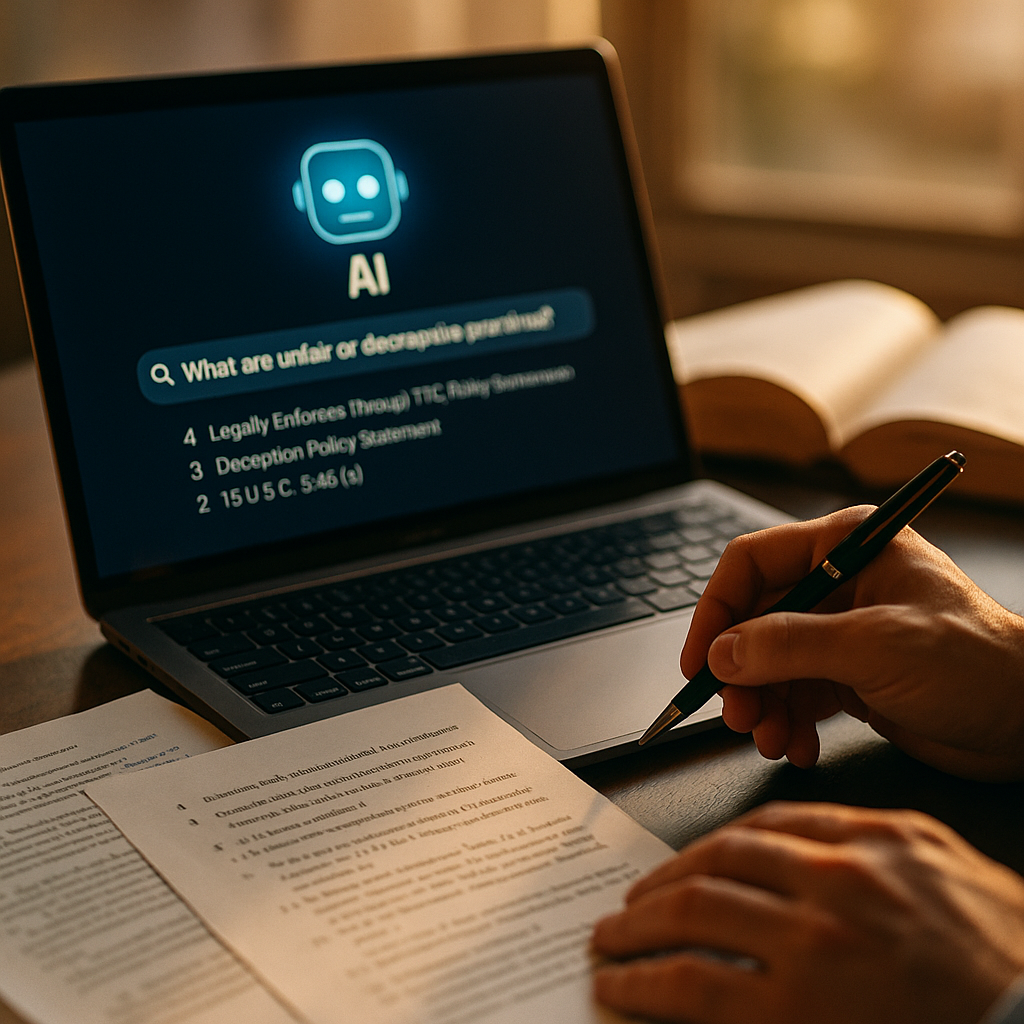
Ask ChatGPT or Google’s AI Overviews which skincare serum “reduces wrinkles in two weeks” and you’ll get a confident, sourced answer, sometimes pulled straight from your product page. Nobody fact checked it first. That’s the problem: AI answer engine citations are now surfacing brand claims to millions of consumers without a human editor, a legal reviewer, or a substantiation file anywhere in sight. The FTC has made clear it doesn’t care how the claim traveled. It only cares whether you can prove it.
The Claim Traveled Further Than Your Compliance Team Did
For decades, substantiation was a fairly contained problem. Your legal and regulatory team reviewed the ad copy, the landing page, the press release. If a claim needed backup (clinical data, lab results, survey numbers) someone signed off before it went live. That workflow assumed a finite number of channels where your claims could appear.
AI answer engines blew that assumption apart. Tools like ChatGPT, Perplexity, and Google’s AI Overviews now scrape, summarize, and rank brand claims from product pages, press releases, influencer content, and third-party review sites, then serve them as direct answers. A shopper never has to click through. They just get told “Brand X’s supplement supports 30% faster recovery” as if it were settled fact, sourced from a blog post your team never vetted for substantiation.
The FTC has repeatedly stated that its substantiation standard is channel neutral: if a claim reaches a consumer and influences a purchase decision, the advertiser is on the hook, regardless of whether a human or an algorithm delivered it.
That’s the shift marketing leaders need to internalize. It’s not about whether you wrote the words. It’s about whether your brand’s claim, in any form, anywhere, is backed by competent and reliable evidence at the moment an AI engine repeats it.
Why This Isn’t Just a “Wait and See” Regulatory Risk
Some brand teams are treating AI citation exposure as theoretical, something legal will “get to” once the FTC issues formal guidance. That’s a mistake for three reasons.
- Unsubstantiated claims are already actionable. The FTC Act’s Section 5 prohibition on deceptive practices doesn’t require new rulemaking to apply here. Existing enforcement authority covers AI-amplified claims today.
- AI engines don’t cite disclaimers. Even if your original content included careful hedging (“results may vary,” “based on internal testing”), the summarized AI answer often strips that nuance out entirely, leaving a bald claim with none of your protective language attached.
- Competitors and watchdogs are watching the same outputs you are. A rival brand or consumer advocacy group can screenshot an AI Overview citing your product and file a complaint, using the AI’s own summary as evidence of the deceptive claim reaching consumers.
This mirrors the pattern we’ve already seen with AI generated reviews, where synthetic content created a disclosure gap regulators are now actively closing. Answer engine citations are the next wave of the same problem: content generated or amplified by AI, carrying real legal exposure back to the brand that originated the underlying claim.
What Counts as a Substantiated Claim in an AI Context?
The FTC’s traditional substantiation framework still applies. You need a “reasonable basis” for a claim before you make it, and the level of evidence required scales with the claim’s specificity. A vague claim like “customers love our product” needs less backing than “clinically proven to reduce fine lines by 40% in four weeks.”
What’s new is the surface area. Your substantiation obligation now extends to:
- Product pages and metadata that AI crawlers index directly
- Press releases and earned media that get summarized into answer engine responses
- Influencer and creator content that repeats or amplifies brand claims, which AI tools treat as a legitimate source
- Customer review aggregations that AI engines synthesize into “consensus” statements about your product
That last category is particularly thorny. If an AI engine aggregates hundreds of reviews and outputs “most users report significant weight loss within a month,” and your product never made that specific claim, you may still bear responsibility if your marketing seeded the expectation. This is where consistent, documented disclosure detection practices across creator content matter more than ever. Every piece of amplified content is a potential input into an AI-generated claim about your brand.
Building a Substantiation File That Survives an AI Audit
Marketing and legal teams need a documented, retrievable substantiation file for every material claim your brand makes, not just in ads, but anywhere the claim could plausibly be scraped and repeated. Here’s what that looks like operationally.
- Inventory active claims across every owned channel. Product pages, packaging copy, press releases, sponsored posts, and influencer briefs all count. If AI engines can crawl it, it’s in scope.
- Attach evidence to each claim at the source. Don’t let substantiation live only in a legal binder. Tag the evidence (study citation, sample size, methodology) directly to the content asset so it’s retrievable when a regulator or journalist asks “where did this come from?”
- Audit creator and influencer content for claim drift. Creators paraphrase. A brand’s “supports healthy digestion” becomes a creator’s “fixes your gut in a week.” That drift is exactly what AI engines pick up and repeat as if it were the brand’s own language.
- Set a review cadence, not a one-time check. AI training data updates constantly. A claim that was substantiated last quarter but has since been superseded by new research needs to be updated everywhere it lives, not just in your current ad campaign.
- Retain records longer than you think you need to. If a complaint surfaces eighteen months after a piece of content was published, you need to show what you knew and when. This is the same logic driving stricter content retention requirements industry wide.
Brands that treat substantiation as a static, pre-launch checkbox are building exposure they won’t discover until an AI engine has already broadcast the unsupported claim to a mass audience.
The Creator Content Blind Spot
Here’s the uncomfortable part for anyone running an influencer program: your creators are generating a huge share of the raw material that AI answer engines cite. A sponsored post claiming a supplement “boosted my energy instantly” isn’t just an FTC disclosure issue anymore, it’s a substantiation liability that can get algorithmically laundered into a seemingly authoritative AI answer.
Brand and agency teams should be reviewing creator briefs with the same rigor as ad copy. That means explicit claim guidelines in every contract, a pre-publish review step for any performance or efficacy language, and ongoing monitoring, not just at campaign launch, but for the life of the content. Evergreen influencer posts don’t expire from an AI crawler’s perspective. A claim made three years ago can resurface in an answer engine response tomorrow.
This connects directly to broader compliance infrastructure brands are already building. If you’re running disclosure audits at scale, extending that same audit logic to substantiation is a natural next step, not a separate program.
Operational Fixes: What Legal and Marketing Should Do This Quarter
You don’t need to wait for formal FTC guidance on generative AI citations to start reducing exposure. A few concrete moves:
- Run your own AI answer engine audit. Query ChatGPT, Perplexity, and Google’s AI Overviews with your brand name and top product claims. See what’s being surfaced and check it against your actual substantiation file. This takes an afternoon and often surfaces claims you didn’t know existed.
- Standardize claim language across creator and owned content. Vague, hedge-heavy language is genuinely more defensible in an AI-summarized world than punchy, specific stats you can’t fully back.
- Loop legal into content strategy earlier. The old model of legal reviewing finished ads is too slow. Claims need vetting at the brief stage, before they enter the content pipeline that AI engines eventually crawl.
- Build a rapid correction workflow. If you discover an AI engine misrepresenting your claim, you need a documented process for requesting correction and, more importantly, for correcting the underlying source content that caused the misrepresentation in the first place.
For a useful benchmark on how quickly AI is reshaping consumer research behavior, eMarketer’s research on AI search adoption is worth tracking quarterly, not annually. The pace of change here outstrips the traditional compliance review cycle most brands still operate on.
It’s also worth reviewing the FTC’s own guidance directly rather than relying on secondhand summaries. The agency’s enforcement actions and business guidance pages get updated with real case examples that show exactly what “reasonable basis” looks like in practice.
Where This Is Headed
Expect the FTC to eventually issue AI-specific guidance addressing answer engine citations directly, but don’t hold your breath for a fast timeline. Regulatory guidance historically lags technology adoption by years, not months. In the meantime, enforcement can and does proceed under existing deceptive practices authority.
The brands that come out ahead won’t be the ones waiting for a rulebook. They’ll be the ones who already treat every public claim, wherever it lives, as something they need to defend on demand. Platforms like Sprout Social and HubSpot are increasingly building AI visibility tracking into their reporting suites, which gives marketing teams a practical starting point for monitoring how their claims surface across answer engines without building a monitoring stack from scratch.
Next Step
Run an AI citation audit on your top ten product claims this week, then cross reference each one against a documented substantiation file. If you can’t produce the backup in an hour, assume a regulator or competitor won’t be able to either, and fix it before an AI engine broadcasts the gap for you.
Frequently Asked Questions
Does the FTC have specific rules for AI answer engine citations?
Not yet as standalone rules, but the FTC applies its existing Section 5 deceptive practices authority regardless of how a claim reaches consumers. A claim surfaced by an AI answer engine is treated the same as one in a traditional ad if it influences purchase decisions and lacks substantiation.
Who is liable if an AI engine misstates a brand’s claim?
Liability generally traces back to the advertiser that originated or amplified the underlying claim, including through creator or influencer content. Brands can’t shift responsibility to the AI platform simply because the summarization introduced errors.
How often should brands audit AI answer engines for their own claims?
Quarterly at minimum, given how frequently AI models update their training and retrieval data. High-visibility product categories or heavily marketed claims may warrant monthly checks.
Does influencer content create separate substantiation risk from brand-owned content?
Yes. Creators often paraphrase or exaggerate brand claims, and AI engines treat that amplified language as a legitimate source. Brands need claim guidelines in creator contracts and ongoing review, not just disclosure compliance.
What’s the fastest way to reduce exposure without a full legal overhaul?
Start by running manual queries against major AI answer engines using your brand name and key product claims, then match what’s surfaced against your existing substantiation documentation. Gaps found this way can usually be fixed at the source content level within days.
Top Influencer Marketing Agencies
The leading agencies shaping influencer marketing in 2026
Agencies ranked by campaign performance, client diversity, platform expertise, proven ROI, industry recognition, and client satisfaction. Assessed through verified case studies, reviews, and industry consultations.
Moburst

-
2

The Shelf
Boutique Beauty & Lifestyle Influencer AgencyA data-driven boutique agency specializing exclusively in beauty, wellness, and lifestyle influencer campaigns on Instagram and TikTok. Best for brands already focused on the beauty/personal care space that need curated, aesthetic-driven content.Clients: Pepsi, The Honest Company, Hims, Elf Cosmetics, Pure LeafVisit The Shelf → -
3

Audiencly
Niche Gaming & Esports Influencer AgencyA specialized agency focused exclusively on gaming and esports creators on YouTube, Twitch, and TikTok. Ideal if your campaign is 100% gaming-focused — from game launches to hardware and esports events.Clients: Epic Games, NordVPN, Ubisoft, Wargaming, Tencent GamesVisit Audiencly → -
4

Viral Nation
Global Influencer Marketing & Talent AgencyA dual talent management and marketing agency with proprietary brand safety tools and a global creator network spanning nano-influencers to celebrities across all major platforms.Clients: Meta, Activision Blizzard, Energizer, Aston Martin, WalmartVisit Viral Nation → -
5

The Influencer Marketing Factory
TikTok, Instagram & YouTube CampaignsA full-service agency with strong TikTok expertise, offering end-to-end campaign management from influencer discovery through performance reporting with a focus on platform-native content.Clients: Google, Snapchat, Universal Music, Bumble, YelpVisit TIMF → -
6

NeoReach
Enterprise Analytics & Influencer CampaignsAn enterprise-focused agency combining managed campaigns with a powerful self-service data platform for influencer search, audience analytics, and attribution modeling.Clients: Amazon, Airbnb, Netflix, Honda, The New York TimesVisit NeoReach → -
7

Ubiquitous
Creator-First Marketing PlatformA tech-driven platform combining self-service tools with managed campaign options, emphasizing speed and scalability for brands managing multiple influencer relationships.Clients: Lyft, Disney, Target, American Eagle, NetflixVisit Ubiquitous → -
8

Obviously
Scalable Enterprise Influencer CampaignsA tech-enabled agency built for high-volume campaigns, coordinating hundreds of creators simultaneously with end-to-end logistics, content rights management, and product seeding.Clients: Google, Ulta Beauty, Converse, AmazonVisit Obviously →