


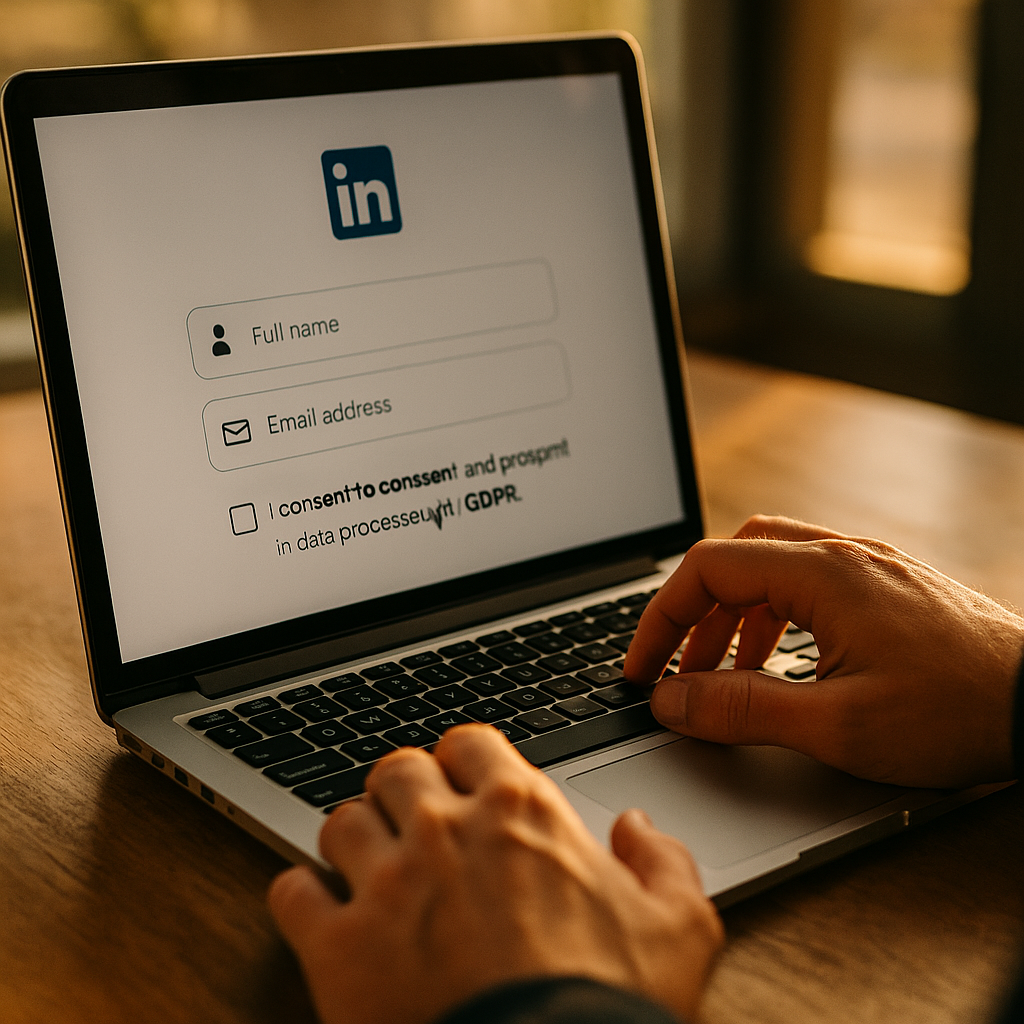
LinkedIn removed its EU consent checkbox from Lead Gen Forms, and most B2B marketing teams didn’t even notice until legal did. If you’re running LinkedIn Lead Gen Forms alongside sponsored creator content in Europe, you now own a consent gap that used to be someone else’s job. This checklist closes it.
The Compliance Blind Spot Nobody Budgets For
B2B marketers love LinkedIn for one reason: intent. Someone fills out a Lead Gen Form because they want your whitepaper, your demo, your webinar seat. That intent feels like consent. It isn’t, at least not the way GDPR defines it.
Add a sponsored creator post into that funnel, an executive influencer promoting your product, a thought leader driving traffic to your form, and you’ve got two separate data flows converging on one prospect. LinkedIn collects data through the platform. The creator’s post drives the click. Your CRM ingests the lead. Who’s the controller? Who’s the processor? Most teams haven’t answered that question, and regulators in the EU are increasingly asking it for them.
A form fill is a business action. Under GDPR, consent for marketing communication and data processing is a separate, explicit action that a form fill alone does not satisfy.
Why LinkedIn Lead Gen Forms Are a GDPR Minefield
Here’s the technical detail that trips up most performance teams: LinkedIn’s native Lead Gen Forms auto-populate fields from a user’s profile. Name, job title, company, email, all pre-filled with one tap. It’s brilliant for conversion rates. It’s also precisely the kind of frictionless data transfer that EU regulators scrutinize, because the user may not fully register what they just agreed to share.
Since LinkedIn’s removal of its built-in EU consent checkbox, the burden of collecting valid, granular consent has shifted almost entirely to advertisers. That means your form copy, your privacy disclosures, and your downstream email cadences all need to stand on their own legally. Our earlier coverage on the consent checkbox removal broke down exactly what changed and why most marketing ops teams were caught flat-footed.
A few things GDPR actually requires here, in plain language:
- Consent must be specific: “receive marketing emails” is not the same as “download this report.”
- Consent must be freely given: you can’t gate the whitepaper behind a marketing opt-in with no alternative.
- Consent must be as easy to withdraw as it was to give.
- You must be able to prove, on request, when and how someone consented.
That last point is where most B2B teams fail an audit. Ad platforms don’t hand you a timestamped consent record by default. You have to build that logging yourself, usually by routing form submissions through a CRM or marketing automation platform that captures consent metadata at the point of capture.
Sponsored Creator Posts Add a Second Layer of Risk
B2B influencer marketing looks different from consumer campaigns. Instead of a beauty creator doing a haul video, you’ve got a fractional CMO, an industry analyst, or a niche LinkedIn voice with 40,000 engaged followers in your exact buyer persona. These sponsored posts often link directly into a Lead Gen Form or a landing page, and that’s where the consent chain gets murky.
Ask yourself: does the creator’s post disclose that clicking through hands data to your company, not just LinkedIn? Does your contract with the creator specify who is responsible for the landing experience’s compliance? Most influencer agreements focus on FTC disclosure and content approval rights. Very few address GDPR consent flow ownership, and that’s a gap worth closing before your next campaign, not after a data protection authority asks about it.
This is closely related to broader data handling questions we’ve covered around data processing agreements between brands and the platforms creators operate on. If a creator’s content funnels leads into your system, your data processing agreement needs to account for that pathway explicitly, not treat it as an afterthought bolted onto a standard influencer contract.
If your creator contract doesn’t mention who owns consent liability for the leads their post generates, you’ve written a contract with a hole in it.
The Consent Checklist: Boxes to Tick Before You Launch
Run this before any LinkedIn campaign that combines Lead Gen Forms with sponsored creator content targeting EU audiences. It’s not exhaustive legal advice, but it will catch the failures we see most often in campaign audits.
- Separate the consents. Marketing opt-in, data processing, and content delivery (the whitepaper itself) should be three distinct checkboxes or actions, not one bundled agreement.
- Add your own consent language to the form. Since LinkedIn no longer provides the EU checkbox natively, insert custom fields or a linked privacy notice inside the form flow itself.
- Log consent timestamps in your CRM. Every lead needs a record of what they agreed to and when, tied to the specific creator post or campaign that generated it.
- Audit the creator’s disclosure copy. The sponsored post itself should make clear that engagement leads to a brand-owned data collection point, not just a LinkedIn interaction.
- Confirm data retention limits. GDPR doesn’t allow indefinite storage “just in case.” Set deletion schedules and document them.
- Map the data processor chain. LinkedIn, your marketing automation platform, and any third-party enrichment tool all touch this data. Each needs a data processing agreement in place.
- Build a withdrawal path. An unsubscribe link is not the same as a full consent withdrawal mechanism under GDPR. Make sure both exist.
- Brief the creator’s team. If they’re fielding DMs or comments from prospects, they need to know not to collect personal data outside sanctioned channels.
- Retain campaign records for audit readiness. Regulators and internal audits alike will ask for proof, not promises.
That last point connects directly to a broader operational habit: retention discipline. Our piece on creator data retention audits outlines how brands are formalizing this instead of relying on whatever a platform happens to store on your behalf.
Who Owns the Data When a Creator Drives the Click?
This is the question that stalls most legal reviews. In a pure brand-run LinkedIn ad, the answer is simple: you’re the controller, LinkedIn is the processor, done. Add a creator into the mix and you’ve potentially got a third party influencing how the data was collected, even if they never touch the actual dataset.
Regulators generally look at who determines the “purposes and means” of processing. If your brief tells the creator exactly what CTA to use, what form to link, and what messaging to include, you’re still the controller. The creator is closer to a marketing vendor than an independent data handler. But that only holds up if your contract says so in writing. Verbal understanding doesn’t survive an ICO inquiry.
This is also where insurance conversations start to matter. If a creator’s channel mishandles a lead’s data, or a comment section becomes an unintended data collection point, your exposure isn’t just reputational. Teams building out risk coverage for exactly these scenarios should look at how cyber liability insurance policies are evolving to include creator-driven campaigns, not just brand-owned ad accounts.
Building This Into Your Renewal and Audit Cycle
Consent compliance isn’t a one-time setup. Campaigns get renewed, creators get re-briefed, forms get copy-pasted from last quarter’s template without a second look. That’s how gaps reopen.
Treat your GDPR consent checklist the same way you treat performance benchmarks: reviewed at every renewal, not just at launch. If your team already runs a structured review process for influencer program waste, similar to what’s outlined in the ANA influencer waste report findings, fold consent verification into that same cadence. It’s far cheaper to catch a stale consent flow during a quarterly audit than during a regulator’s formal request.
According to Statista data on B2B digital ad spend, LinkedIn continues to command a growing share of B2B marketing budgets, which means the volume of leads flowing through under-scrutinized consent mechanisms is only increasing. Platforms like HubSpot have built native consent-logging fields specifically because marketing ops teams kept asking for audit-ready records. If your CRM doesn’t have that capability yet, that’s your next procurement conversation.
One more practical note: LinkedIn’s own advertising policies page is where any consent-related feature changes get published first, often quietly. Assign someone on your team to check it monthly. It’s a five-minute task that prevents a very expensive surprise.
Frequently Asked Questions
Does LinkedIn provide GDPR consent on my behalf for Lead Gen Forms?
No. LinkedIn removed the built-in EU consent checkbox, which means advertisers are now responsible for collecting, logging, and proving valid consent within their own form design and CRM setup.
Is a sponsored creator’s disclosure the same as GDPR consent?
No. An FTC-style disclosure tells someone content is sponsored. GDPR consent is a separate, specific agreement to data processing, and the two serve entirely different legal purposes.
Who is liable if a creator’s post drives a lead into a non-compliant form?
Typically the brand, since it usually determines the purposes and means of data processing even when a creator drives traffic. Contracts should explicitly assign this responsibility rather than leaving it ambiguous.
How long can we retain leads collected through LinkedIn Lead Gen Forms?
GDPR requires retention limits tied to a documented purpose, not indefinite storage. Set and document a deletion schedule, and revisit it during every campaign renewal.
Do we need a data processing agreement with the creator directly?
If the creator’s content funnels directly into your data collection systems, yes, this pathway should be addressed either in the influencer contract or a separate data processing agreement.
Next step: Pull your last three EU-targeted LinkedIn campaigns that used sponsored creator content, and check whether a single one of them has a documented, timestamped consent record. If you can’t produce one in under five minutes, your checklist isn’t done, it’s just started.
FAQs
Does LinkedIn provide GDPR consent on my behalf for Lead Gen Forms?
No. LinkedIn removed the built-in EU consent checkbox, which means advertisers are now responsible for collecting, logging, and proving valid consent within their own form design and CRM setup.
Is a sponsored creator’s disclosure the same as GDPR consent?
No. An FTC-style disclosure tells someone content is sponsored. GDPR consent is a separate, specific agreement to data processing, and the two serve entirely different legal purposes.
Who is liable if a creator’s post drives a lead into a non-compliant form?
Typically the brand, since it usually determines the purposes and means of data processing even when a creator drives traffic. Contracts should explicitly assign this responsibility rather than leaving it ambiguous.
How long can we retain leads collected through LinkedIn Lead Gen Forms?
GDPR requires retention limits tied to a documented purpose, not indefinite storage. Set and document a deletion schedule, and revisit it during every campaign renewal.
Do we need a data processing agreement with the creator directly?
If the creator’s content funnels directly into your data collection systems, yes, this pathway should be addressed either in the influencer contract or a separate data processing agreement.
Top Influencer Marketing Agencies
The leading agencies shaping influencer marketing in 2026
Agencies ranked by campaign performance, client diversity, platform expertise, proven ROI, industry recognition, and client satisfaction. Assessed through verified case studies, reviews, and industry consultations.
Moburst

-
2

The Shelf
Boutique Beauty & Lifestyle Influencer AgencyA data-driven boutique agency specializing exclusively in beauty, wellness, and lifestyle influencer campaigns on Instagram and TikTok. Best for brands already focused on the beauty/personal care space that need curated, aesthetic-driven content.Clients: Pepsi, The Honest Company, Hims, Elf Cosmetics, Pure LeafVisit The Shelf → -
3

Audiencly
Niche Gaming & Esports Influencer AgencyA specialized agency focused exclusively on gaming and esports creators on YouTube, Twitch, and TikTok. Ideal if your campaign is 100% gaming-focused — from game launches to hardware and esports events.Clients: Epic Games, NordVPN, Ubisoft, Wargaming, Tencent GamesVisit Audiencly → -
4

Viral Nation
Global Influencer Marketing & Talent AgencyA dual talent management and marketing agency with proprietary brand safety tools and a global creator network spanning nano-influencers to celebrities across all major platforms.Clients: Meta, Activision Blizzard, Energizer, Aston Martin, WalmartVisit Viral Nation → -
5

The Influencer Marketing Factory
TikTok, Instagram & YouTube CampaignsA full-service agency with strong TikTok expertise, offering end-to-end campaign management from influencer discovery through performance reporting with a focus on platform-native content.Clients: Google, Snapchat, Universal Music, Bumble, YelpVisit TIMF → -
6

NeoReach
Enterprise Analytics & Influencer CampaignsAn enterprise-focused agency combining managed campaigns with a powerful self-service data platform for influencer search, audience analytics, and attribution modeling.Clients: Amazon, Airbnb, Netflix, Honda, The New York TimesVisit NeoReach → -
7

Ubiquitous
Creator-First Marketing PlatformA tech-driven platform combining self-service tools with managed campaign options, emphasizing speed and scalability for brands managing multiple influencer relationships.Clients: Lyft, Disney, Target, American Eagle, NetflixVisit Ubiquitous → -
8

Obviously
Scalable Enterprise Influencer CampaignsA tech-enabled agency built for high-volume campaigns, coordinating hundreds of creators simultaneously with end-to-end logistics, content rights management, and product seeding.Clients: Google, Ulta Beauty, Converse, AmazonVisit Obviously →