


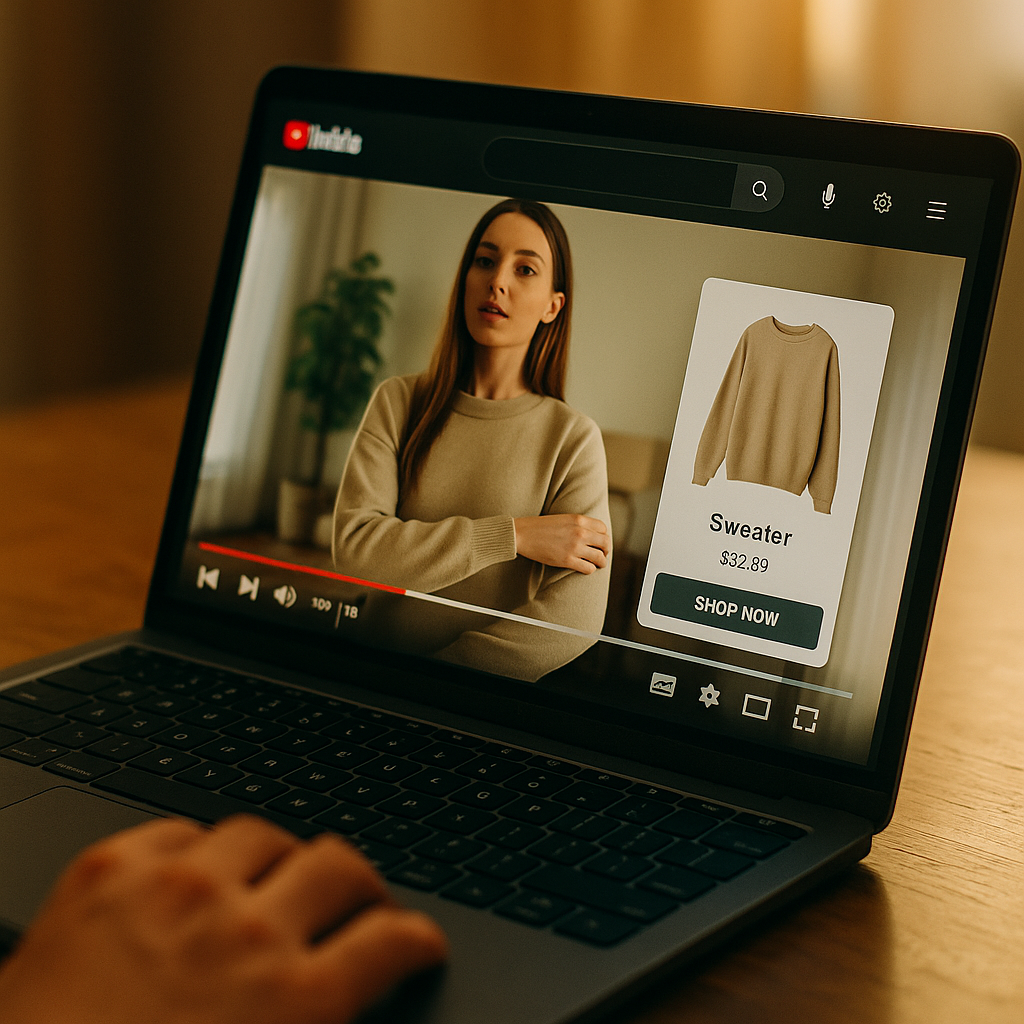
YouTube’s own product overlays can cover up to 20% of the bottom third of a Short, the exact zone where most creators drop their disclosure text. If your influencer program is running shoppable Shorts and nobody has checked whether that overlay is eating your “#ad” tag, you’re not running a campaign. You’re running an exposure event waiting for a complaint to trigger it.
YouTube Shopping overlay ads have quietly become one of the fastest-growing formats in the platform’s commerce stack, and the FTC hasn’t published a single Shorts-specific rule to match. That gap is where brands get hurt.
What Makes Shopping Overlay Ads Different From Standard Disclosures
Traditional YouTube disclosure guidance assumed a stable viewing surface. A long-form video has a description box, a paid partnership label at the top, and enough runtime for a verbal callout. Shoppable Shorts break all three assumptions at once.
Overlay ads inject a dynamic product carousel directly onto the video canvas, usually anchored to the lower third or a side rail depending on device orientation. That carousel isn’t static. It can appear seconds into playback, shift position on scroll, and stack multiple product cards if a creator tags more than one SKU. Text a creator placed at the bottom of frame to satisfy disclosure requirements can end up sitting directly underneath a shopping card that YouTube inserted after the video was uploaded.
The creator didn’t do anything wrong in the traditional sense. The platform’s monetization layer changed the visual real estate after the fact. But from an FTC enforcement standpoint, intent doesn’t matter. Visibility does.
The FTC’s Endorsement Guides don’t care who covered the disclosure, the creator’s caption choice or the platform’s ad overlay. If a “reasonable consumer” can’t see it, the disclosure legally didn’t happen.
Where the FTC Actually Wants Your Disclosure to Sit
The FTC’s guidance on endorsements has always centered on “clear and conspicuous” placement, a standard that predates Shorts, overlays, and even TikTok. The agency defines conspicuous as unavoidable: the disclosure has to be difficult for an ordinary viewer to miss, not technically present somewhere in the metadata.
For video, that historically meant a few concrete practices held up under scrutiny:
- Disclosure appears in the video itself, not only in the description or pinned comment.
- Text stays on screen long enough to be read, generally the full duration a claim is visible, not a two-second flash.
- Placement avoids areas where platform UI elements (captions, progress bars, tap zones, and yes, shopping overlays) routinely render.
- Verbal disclosure accompanies visual disclosure whenever the content includes spoken claims about the product.
None of that is new. What’s new is that shoppable Shorts introduce a UI element specifically designed to sit where creators have always placed their disclosure text: bottom center, low third of frame. YouTube’s own Shopping features documentation confirms product tags and overlay cards render dynamically based on device and orientation, which means the same video can display a clean disclosure on one phone and a fully obscured one on another.
The Overlay Problem: When Product Tags Cover Your Disclosure
Here’s the operational reality most brand teams miss. A creator uploads a Short with a disclosure banner burned into the bottom third at second three. YouTube’s Shopping product then auto-generates an overlay card for the tagged product, which renders in that same region for a portion of the runtime. On mobile, where over 70% of Shorts viewing happens according to recent eMarketer viewing behavior data, that overlap is nearly guaranteed on smaller screens.
The result: a technically compliant disclosure that’s practically invisible for the exact window when the shopping call to action appears. That’s the moment a viewer is most likely to notice the ad relationship matters, and it’s the moment it’s most likely hidden.
This isn’t hypothetical. It mirrors the same structural problem that surfaced with TikTok Shop commission tagging, where product cards and disclosure text competed for the same screen space. The lesson from that format carries directly over: platform commerce UI and disclosure UI were never designed to coexist, and brands that assume the platform will sort it out are the ones who end up explaining themselves to regulators.
Shorts Format Shrinks the Margin for Error
Long-form video gives you room to breathe. A ten-minute review can carry a disclosure banner for fifteen seconds and still leave the message clear across the rest of the runtime. Shorts don’t offer that luxury. Most run under 60 seconds, and shoppable Shorts often compress the actual product pitch into the first ten seconds to catch swipe-happy viewers before they scroll away.
That compression means disclosure timing has to be front-loaded, not tucked in wherever there’s a gap. If your creator guidelines still reference “somewhere early in the video,” that instruction is too vague for a format this tight.
Brands running high-volume Shorts programs should treat disclosure placement the same way they’d treat a legal contract term: specific, testable, and verified per asset rather than per creator. A blanket instruction in a brand brief doesn’t survive contact with YouTube’s rendering engine.
Building an Audit Process Before the FTC Does It For You
Waiting for a complaint is not a strategy. It’s a bet that nobody watching your content cares enough to report it, and that bet gets worse the bigger your creator roster gets. A practical audit workflow for shoppable Shorts should include:
- Device-level spot checks. Review the same Short on at least two screen sizes before it goes live, since overlay rendering varies by device.
- Disclosure duration logging. Track how long the disclosure text remains visible relative to overlay ad appearance, not just whether it was included.
- Post-publish re-checks. YouTube can update Shopping features after upload. A compliant video today can render differently next month.
- Creator contract language specific to overlays. Generic “disclose per FTC guidelines” clauses don’t address platform-specific UI conflicts. Name the overlay risk explicitly.
- Retention of dated screenshots. If enforcement ever questions a specific asset, you need proof of what the disclosure looked like at publish time, not just what the creator claims they posted.
That last point connects directly to a broader gap a lot of brands are only now closing. Content changes, platforms update rendering, and creators delete or edit posts. Without a retention system, you have no way to prove compliance after the fact. The framework laid out in FTC audit content retention practices applies directly here: if you can’t produce the asset as it appeared to a real viewer, your defense collapses regardless of what your brief said.
An FTC investigation doesn’t ask what your creator guidelines said. It asks what the viewer actually saw. Screenshot evidence beats brief language every time.
Nano and Mid-Tier Rosters Multiply the Risk
Enterprise creator partnerships usually get legal review before publishing. Nano and micro-tier programs, the ones now driving a growing share of shoppable content according to Sprout Social’s creator marketing benchmarks, rarely get that same scrutiny. Volume replaces oversight. If you’re running fifty nano creators through a shoppable Shorts push, manually checking overlay placement on every asset isn’t realistic without a system.
This is the same scaling problem covered in nano creator disclosure audit approaches: sampling isn’t enough when a single overlooked overlay conflict can apply across dozens of near-identical posts using the same template. Brands need automated flagging tools or a third-party audit vendor built for volume, not spot checks run by a single coordinator between other tasks.
There’s also a monetization angle worth watching. As YouTube’s monetization threshold changes pull more mid-tier creators into eligible territory for Shopping features, the pool of accounts running overlay ads is expanding fast. More eligible creators means more shoppable Shorts means more surface area for a disclosure to get buried under a product card nobody checked twice.
What Compliant Placement Actually Looks Like
Skip the vague instructions. Direct creators to place disclosure text in the upper third of frame, away from the bottom zone where shopping overlays consistently render. Pair it with a verbal mention in the first three seconds, since audio disclosure survives visual overlay conflicts that text alone can’t. Require a device preview before publish, not after. And build the overlay risk into your standard influencer agreement language rather than treating it as a one-off note in a Slack message.
None of this requires new legal theory. It requires treating YouTube’s Shopping product as what it is: a rendering layer that can override your creative decisions after the fact.
Next step: pull your last thirty days of shoppable Shorts, check disclosure visibility against actual overlay placement on mobile, and flag anything where the two zones overlap. Fix the template before you scale the spend.
Frequently Asked Questions
What counts as a “clear and conspicuous” disclosure on a YouTube Shopping overlay ad?
It means a disclosure a typical viewer would notice without searching for it, visible for the duration the claim or product tag is shown, and not obscured by platform UI elements including shopping overlay cards. Placement in a description box alone does not meet this standard for video content.
Can a disclosure in the video description satisfy FTC requirements for shoppable Shorts?
No. The FTC has consistently held that description-only disclosures are insufficient for video because many viewers never open or scroll to the description, especially in a swipe-based format like Shorts. Disclosure needs to appear within the video itself, ideally reinforced verbally.
Who is liable if a creator’s disclosure gets covered by YouTube’s product overlay?
Brands typically carry the primary compliance burden, since the FTC holds advertisers responsible for ensuring their sponsored content is properly disclosed regardless of platform-side rendering issues. Contracts should assign specific overlay-placement responsibilities to creators, but the brand remains the accountable party in an investigation.
Do unpaid product tags in YouTube Shopping still require disclosure?
If the creator received free product, a commission, or any material connection to the brand, disclosure is required regardless of whether the post is a paid ad placement. Simply tagging a product without compensation disclosed is a common gap that regulators flag during reviews.
How should brands audit disclosure compliance across a large creator roster?
Use device-level spot checks across multiple screen sizes, log disclosure duration relative to overlay appearance, retain dated screenshots at publish time, and build overlay-specific language into creator contracts rather than relying on generic FTC compliance clauses.
Top Influencer Marketing Agencies
The leading agencies shaping influencer marketing in 2026
Agencies ranked by campaign performance, client diversity, platform expertise, proven ROI, industry recognition, and client satisfaction. Assessed through verified case studies, reviews, and industry consultations.
Moburst

-
2

The Shelf
Boutique Beauty & Lifestyle Influencer AgencyA data-driven boutique agency specializing exclusively in beauty, wellness, and lifestyle influencer campaigns on Instagram and TikTok. Best for brands already focused on the beauty/personal care space that need curated, aesthetic-driven content.Clients: Pepsi, The Honest Company, Hims, Elf Cosmetics, Pure LeafVisit The Shelf → -
3

Audiencly
Niche Gaming & Esports Influencer AgencyA specialized agency focused exclusively on gaming and esports creators on YouTube, Twitch, and TikTok. Ideal if your campaign is 100% gaming-focused — from game launches to hardware and esports events.Clients: Epic Games, NordVPN, Ubisoft, Wargaming, Tencent GamesVisit Audiencly → -
4

Viral Nation
Global Influencer Marketing & Talent AgencyA dual talent management and marketing agency with proprietary brand safety tools and a global creator network spanning nano-influencers to celebrities across all major platforms.Clients: Meta, Activision Blizzard, Energizer, Aston Martin, WalmartVisit Viral Nation → -
5

The Influencer Marketing Factory
TikTok, Instagram & YouTube CampaignsA full-service agency with strong TikTok expertise, offering end-to-end campaign management from influencer discovery through performance reporting with a focus on platform-native content.Clients: Google, Snapchat, Universal Music, Bumble, YelpVisit TIMF → -
6

NeoReach
Enterprise Analytics & Influencer CampaignsAn enterprise-focused agency combining managed campaigns with a powerful self-service data platform for influencer search, audience analytics, and attribution modeling.Clients: Amazon, Airbnb, Netflix, Honda, The New York TimesVisit NeoReach → -
7

Ubiquitous
Creator-First Marketing PlatformA tech-driven platform combining self-service tools with managed campaign options, emphasizing speed and scalability for brands managing multiple influencer relationships.Clients: Lyft, Disney, Target, American Eagle, NetflixVisit Ubiquitous → -
8

Obviously
Scalable Enterprise Influencer CampaignsA tech-enabled agency built for high-volume campaigns, coordinating hundreds of creators simultaneously with end-to-end logistics, content rights management, and product seeding.Clients: Google, Ulta Beauty, Converse, AmazonVisit Obviously →