


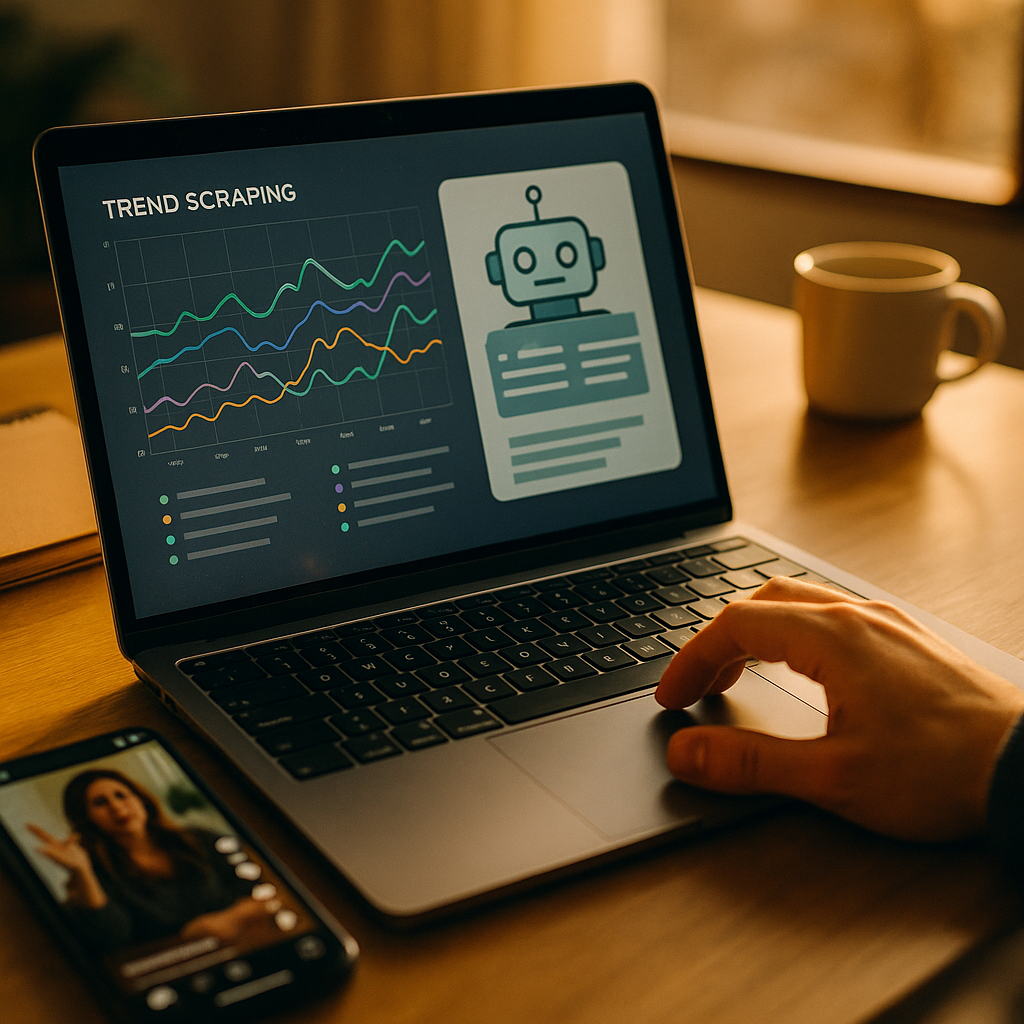
A hook that works on TikTok today is dead in 72 hours. That is not an exaggeration, it is the median lifecycle Sprout Social and internal creator agency data have both pointed to for short-form audio and format trends. So the real question for brand marketers is not “should we chase trends” but “can our team physically move fast enough to matter.” That is exactly the gap AI trend scraping tools were built to close, and the brands using them well are turning around branded versions of viral hooks in under 48 hours.
Why 48 Hours Is the Line Between Relevant and Irrelevant
Trend velocity on TikTok and Instagram Reels has compressed hard. A sound or format spikes, peaks, and gets flooded with saturated content inside a window that used to take weeks. Miss it and your “trend-jacked” post reads like a dad joke at a company all-hands. Brands that still route trend spotting through a weekly social meeting are, functionally, opting out of trend marketing altogether.
This is where scraping tools earn their budget line. They are not creative tools. They are detection and prioritization engines that tell a team this specific hook is about to break wide, hours or sometimes days before it hits a “For You” page saturation point that a human strategist would notice on their own.
Teams using automated trend detection report shipping trend-based content 3 to 5 times faster than teams relying on manual scrolling and screenshotting, according to agency workflow benchmarks circulating among influencer marketing operations leads.
What an AI Trend Scraping Tool Actually Does
Strip away the marketing language and these tools do three things well.
- Signal detection: continuous scraping of hashtag velocity, sound usage curves, caption pattern repetition, and engagement acceleration across TikTok, Reels, and increasingly YouTube Shorts.
- Pattern extraction: isolating the actual mechanical hook, the first 1.5 seconds of a video, the specific phrase structure, the visual cut pattern, so a creative team can reverse-engineer it rather than copy the surface content.
- Fit scoring: ranking which trends match a brand’s category, tone, and past performance data so teams are not burning production hours on a trend that will never fit the brand voice.
Platforms like Trendtok, Exolyt, and Pentos operate in this lane, alongside newer entrants building directly on TikTok’s Creative Center API and Meta’s Content Library data. Some agencies build proprietary scrapers on top of these APIs to add brand-specific scoring layers, which is where a lot of the real competitive advantage now sits.
The 48-Hour Workflow, Broken Down
Here is roughly how a brand team with a functioning trend scraping stack moves from “we saw this” to “we posted this.”
- Hour 0 to 4, detection. The tool flags a hook based on velocity thresholds you have pre-set (say, a sound used in 2,000+ videos with a 40 percent week-over-week growth rate). An alert hits Slack or a dashboard, not an inbox nobody checks.
- Hour 4 to 12, scoring and brief. A strategist reviews fit score, checks brand safety flags, and greenlights or kills it. If it passes, a lightweight brief goes to either an in-house creator or a UGC partner. This is the step most teams skip and regret, because trend-jacking without a filter is how brands end up attached to a meme they did not fully understand.
- Hour 12 to 30, production. Filming, usually vertical, usually one take, usually with a creator who already has the trend’s cadence in their muscle memory. Brands that keep a bench of always-on creators move fastest here, because there is no negotiation cycle eating the clock.
- Hour 30 to 40, review and edit. Legal and brand safety pass, captions written, sound cleared if it is a licensed track.
- Hour 40 to 48, publish and monitor. Post, then watch the first two hours of performance data to decide whether to boost with paid spend.
That is the whole loop. It sounds simple written out. It is not simple to build organizationally, because it requires creators on retainer, a legal sign-off process that can turn around same-day, and a strategist empowered to greenlight without three layers of approval.
Where the Real ROI Comes From (It’s Not Views)
Views on a trend-jacked post are vanity theater unless they are tied to something measurable. The brands getting genuine value from trend scraping tools are pairing detection speed with the same rigor they apply to paid media: cost per acquisition, click-through against branded landing pages, and creator-level attribution.
This is also where a lot of trend scraping investment quietly fails. Teams get fast at spotting and producing trend content, then have no attribution model that ties a specific hook variant back to revenue. If your campaign data schema cannot isolate trend-jacked posts from evergreen content, you are flying blind on whether the speed investment is paying off. The tool solved a speed problem and exposed a measurement problem.
Some teams are now feeding trend scraping output directly into predictive tools that forecast which creator, hook, and format combination is likely to convert before a single dollar is spent on production, similar to the logic covered in predictive conversion engines. That is the next maturity step: not just reacting fast, but predicting which reactions are worth having.
Speed Without Guardrails Is a Liability
Fast is not automatically good. A brand that jumps on a trend without checking origin context has, more than once, ended up attached to a sound tied to a controversy, a meme with a darker backstory, or a format that was already dying by the time it published. Trend scraping tools give you velocity data, not context judgment. That still requires a human.
The FTC has been increasingly explicit about disclosure requirements applying regardless of how fast content is produced, and speed is not a defense in a compliance review. Build a checklist into your 48-hour workflow, even a three-item one: origin check, brand safety flag, disclosure tagging. Skipping this step to save two hours is a bad trade almost every time. Teams running high-volume creator content should also look at how verification frameworks for AI-driven creator spend apply here, because trend velocity content is exactly the category most likely to slip through unreviewed.
Speed is the feature. Judgment is still the moat. Any brand can buy the detection tool, but the fit-scoring and risk-filtering layer around it is what actually differentiates output.
Building the Stack: What to Actually Buy
Do not buy a “trend tool” as a single line item. Think in three layers.
- Detection layer: Trendtok, Exolyt, Pentos, or a custom scraper built on platform APIs. This is your radar.
- Production layer: a creator roster or UGC marketplace that can turn a brief into footage inside 24 hours. Retainer relationships beat one-off bookings here, every time.
- Measurement layer: attribution tooling that tags trend content separately so you can compare its performance against your evergreen baseline. Without this, you are guessing.
Budget-wise, expect detection tools to run in the low thousands per month for mid-market brands, production costs to scale with your creator retainer structure, and the measurement layer to piggyback on whatever attribution stack you already run, assuming it has the granularity to support it. If it does not, that is worth fixing before adding more speed on top of a broken measurement base, a point covered in more depth in real time attribution orchestration approaches.
A Quick Gut Check Before You Greenlight
Ask three questions before any trend-jacked post goes live: does this fit our brand voice without forcing it, do we understand where this trend originated, and can we measure its performance separately from baseline content. If the answer to any of those is no, slow down. The 48-hour window is a target, not a mandate to skip diligence.
Teams building creator rosters specifically for rapid-turnaround trend content should also weigh which creators compound value over time versus which are one-hit trend performers, since a bench built entirely on trend-chasing talent burns out fast and rarely builds the kind of audience loyalty that supports longer campaigns. Research from eMarketer and ongoing platform guidance from TikTok for Business both point to the same conclusion: velocity tools work best paired with a stable creator relationship, not a revolving door of one-off gigs.
Trend scraping tools are not optional anymore for brands serious about short-form. But the tool is 30 percent of the system. The other 70 percent is the creator bench, the approval speed, and the measurement discipline wrapped around it. Build all three, or the 48-hour window will not save you.
Next Step
Audit your current trend-to-post timeline this week: if it is longer than 48 hours, the bottleneck is almost never the detection tool, it is your approval chain and creator availability, so fix those two before buying another dashboard.
FAQs
What is an AI trend scraping tool?
It is software that continuously monitors platforms like TikTok and Instagram for rising hashtags, sounds, and content formats, using engagement velocity data to flag trends before they peak, giving brands a head start on production.
How fast can brands realistically replicate a viral hook?
Teams with a pre-built workflow, an on-call creator roster, and fast legal sign-off can go from detection to published post in 24 to 48 hours. Without those pieces in place, the same process often takes a week or more.
Are these tools expensive?
Detection platforms typically cost a few hundred to a few thousand dollars monthly depending on scale. The bigger cost driver is usually the production and measurement layers around the tool, not the software itself.
Do trend scraping tools guarantee good content?
No. They flag opportunity, not fit. Brand judgment, context checks, and disclosure compliance still require human review before publishing.
Which platforms do these tools monitor?
Most focus on TikTok and Instagram Reels, with growing coverage of YouTube Shorts. Coverage depth varies significantly by vendor, so it is worth confirming platform support before committing to a tool.
How do brands measure ROI on trend-jacked content?
By tagging trend-based posts separately in their attribution stack and comparing click-through, conversion, and cost per acquisition against evergreen content baselines rather than judging performance on views alone.
Top Influencer Marketing Agencies
The leading agencies shaping influencer marketing in 2026
Agencies ranked by campaign performance, client diversity, platform expertise, proven ROI, industry recognition, and client satisfaction. Assessed through verified case studies, reviews, and industry consultations.
Moburst

-
2

The Shelf
Boutique Beauty & Lifestyle Influencer AgencyA data-driven boutique agency specializing exclusively in beauty, wellness, and lifestyle influencer campaigns on Instagram and TikTok. Best for brands already focused on the beauty/personal care space that need curated, aesthetic-driven content.Clients: Pepsi, The Honest Company, Hims, Elf Cosmetics, Pure LeafVisit The Shelf → -
3

Audiencly
Niche Gaming & Esports Influencer AgencyA specialized agency focused exclusively on gaming and esports creators on YouTube, Twitch, and TikTok. Ideal if your campaign is 100% gaming-focused — from game launches to hardware and esports events.Clients: Epic Games, NordVPN, Ubisoft, Wargaming, Tencent GamesVisit Audiencly → -
4

Viral Nation
Global Influencer Marketing & Talent AgencyA dual talent management and marketing agency with proprietary brand safety tools and a global creator network spanning nano-influencers to celebrities across all major platforms.Clients: Meta, Activision Blizzard, Energizer, Aston Martin, WalmartVisit Viral Nation → -
5

The Influencer Marketing Factory
TikTok, Instagram & YouTube CampaignsA full-service agency with strong TikTok expertise, offering end-to-end campaign management from influencer discovery through performance reporting with a focus on platform-native content.Clients: Google, Snapchat, Universal Music, Bumble, YelpVisit TIMF → -
6

NeoReach
Enterprise Analytics & Influencer CampaignsAn enterprise-focused agency combining managed campaigns with a powerful self-service data platform for influencer search, audience analytics, and attribution modeling.Clients: Amazon, Airbnb, Netflix, Honda, The New York TimesVisit NeoReach → -
7

Ubiquitous
Creator-First Marketing PlatformA tech-driven platform combining self-service tools with managed campaign options, emphasizing speed and scalability for brands managing multiple influencer relationships.Clients: Lyft, Disney, Target, American Eagle, NetflixVisit Ubiquitous → -
8

Obviously
Scalable Enterprise Influencer CampaignsA tech-enabled agency built for high-volume campaigns, coordinating hundreds of creators simultaneously with end-to-end logistics, content rights management, and product seeding.Clients: Google, Ulta Beauty, Converse, AmazonVisit Obviously →