


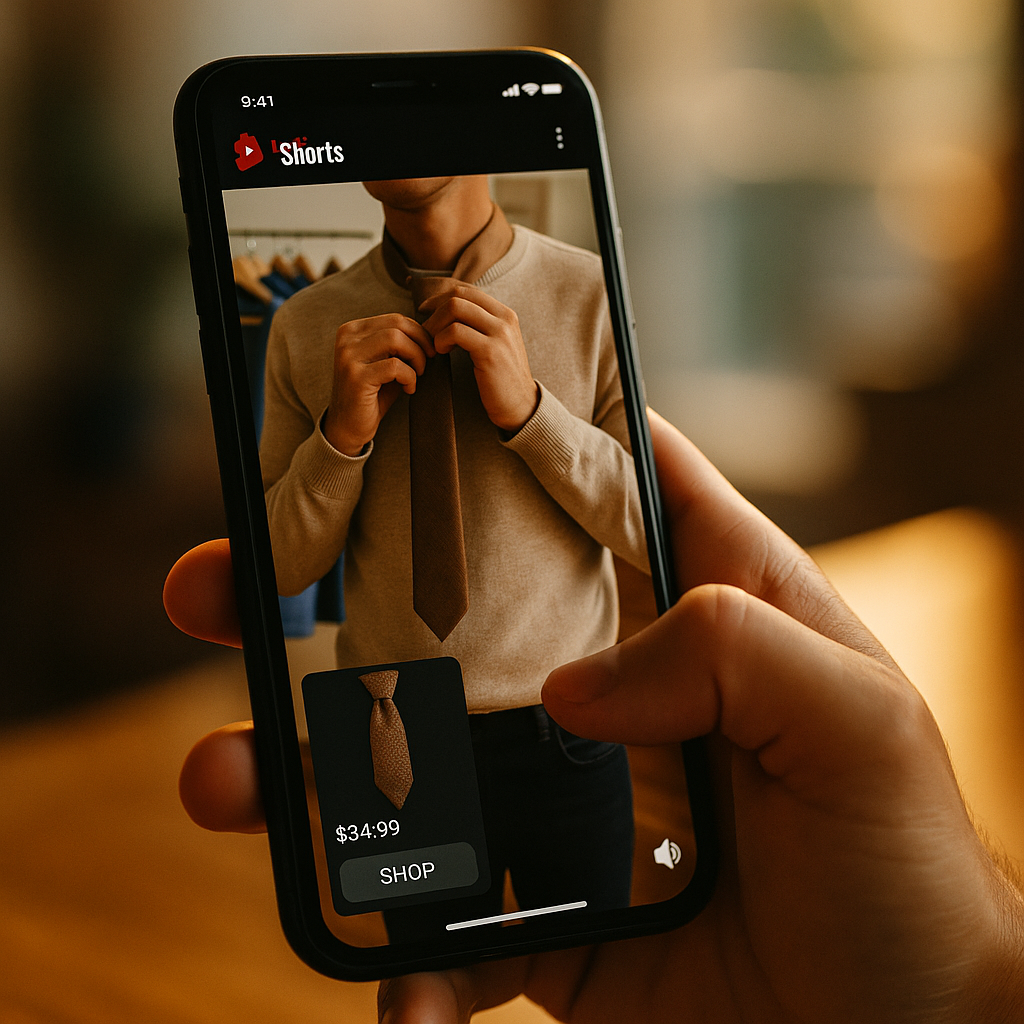
Seventy percent of a Short’s shopping performance may soon come down to something creators can’t fake: whether people actually keep watching. YouTube’s expanded Shorts Shop overlays now tie merchant link placement and prominence to watch-time signals, not just clicks or captions. For brands running affiliate and shoppable programs on the platform, this quietly rewrites the briefing process, the creator scorecard, and the budget math behind every Shorts campaign.
What Changed in the Overlay Logic
Until recently, Shorts Shop overlays worked on a fairly blunt mechanic. A creator tagged a product, the overlay appeared, viewers tapped or scrolled past. Placement was largely static and driven by creator input, not viewer behavior.
The updated system introduces a dynamic layer. YouTube now uses retention curves, specifically how long viewers stay on a Short before swiping away, to determine when and how prominently a merchant link surfaces. A Short that holds attention past the three-second mark gets a more persistent, higher-visibility overlay. A Short with steep early drop-off sees the link suppressed or delayed, even if the product tag is identical.
Watch-time weighted overlays mean the same product tag can perform completely differently depending on the first three seconds of the video, not the caption or the discount code attached to it.
This is consistent with YouTube’s broader Shorts monetization push, which has leaned on Google’s creator support documentation to signal that retention metrics increasingly govern both ad load and commerce features. It’s not a stretch to say Shorts is starting to treat shopping overlays the way it treats ad breaks: earned placement, not guaranteed real estate.
Why Retention Now Outranks Clicks
Clicks are easy to game. A flashy thumbnail, a misleading hook, an aggressive CTA in the first frame, all of these can inflate click-through without producing a buyer who sticks around long enough to convert. YouTube’s data science teams have apparently concluded what performance marketers have suspected for years: a click without sustained attention is a weak signal, and a weak signal makes for a bad recommendation loop.
By weighting overlays toward watch time, YouTube is optimizing for viewers who are genuinely absorbed, the ones statistically more likely to complete a purchase rather than bounce off a landing page. This mirrors a pattern already playing out across the industry. Marketing teams have grown skeptical of surface-level engagement numbers, a trend well documented in recent reporting on performance data trust. Watch-time weighting is essentially YouTube’s own admission that clicks alone were never a reliable proxy for commercial intent.
The Brand-Side Implication: Briefs Need a Retention Clause
Here’s the uncomfortable part for brand teams. Most influencer briefs for Shorts still emphasize hook style, hashtag inclusion, and product placement timing without a single line about retention benchmarks. That gap is now a revenue leak.
If your merchant link only surfaces meaningfully once a Short crosses a retention threshold, then a creator brief that ignores pacing, hook structure, and mid-video engagement is functionally incomplete. Brands need to start treating the first five seconds of a Short as a conversion gate, not just a creative flourish.
- Require creators to submit retention data (average view duration, audience retention graph) from prior Shorts before campaign approval.
- Build hook testing into the pre-production phase rather than leaving it to creator instinct.
- Set minimum watch-time benchmarks as a KPI alongside click-through and conversion rate.
- Reward creators whose Shorts consistently clear retention thresholds with better rates or renewal priority.
This isn’t a wholesale departure from what’s already happening across other formats. It echoes the shift documented in how brands are pre-approving content to manage trend decay, where speed and format discipline became as important as the creative concept itself.
Casting Gets Harder, and More Data-Driven
Follower count was never a great proxy for sales performance, but it’s about to get even less useful for Shorts specifically. A creator with a large audience and mediocre retention habits could see merchant links underperform relative to a smaller creator whose content structure keeps viewers locked in.
This pushes casting decisions toward the same data-fluency shift already reshaping creator hiring more broadly, a trend covered in how data fluency now rivals video talent in creator roles. Brands running Shorts-first commerce campaigns should be pulling retention benchmarks the same way they’d pull engagement rate or audience demographics, as a standard part of vetting.
Practically, that means agencies and in-house teams need access to creator-level retention analytics, not just platform-reported vanity metrics. Some of this data lives in YouTube Studio and can be shared directly by creators; some requires third-party measurement tools. Either way, the old model of casting off audience size and past brand deals is no longer sufficient for Shorts commerce specifically.
Attribution Gets Messier Before It Gets Cleaner
Watch-time weighted overlays introduce a wrinkle for attribution modeling. If the same creator, same product, and same script can produce different overlay visibility depending on pacing choices in editing, then performance comparisons across creators or even across multiple Shorts from the same creator become harder to normalize.
Brands already dealing with fragmented attribution across platforms will feel this acutely. The challenge resembles what’s playing out in how platform fragmentation breaks global attribution models, except here the fragmentation is happening within a single platform’s own feature set. A Short that gets full overlay treatment converts on a different curve than one that gets suppressed placement, even if every other input variable is identical.
Transaction-level tracking becomes more important, not less, in this environment. Brands need to know not just whether a sale happened, but whether it happened despite a suppressed overlay or because of a fully surfaced one. That level of granularity is consistent with the direction outlined in transaction-level attribution reporting on ROAS, and it’s likely to become table stakes for any brand serious about Shorts commerce.
Compliance and Disclosure Still Apply, Watch-Time or Not
None of this changes disclosure obligations. Merchant links inside Shorts, regardless of overlay visibility, still count as commercial endorsements under most regulatory frameworks. The FTC’s endorsement guidelines don’t carve out an exception for algorithmically suppressed placements, and brands should assume the same is true for equivalents like the UK’s ICO guidance on advertising transparency.
If anything, the retention-weighting mechanic adds a layer of risk brands should watch closely. A creator incentivized to maximize watch time might lean into slower reveals or misleading hooks purely to game the algorithm, not because it serves the viewer. That’s a disclosure and brand-safety conversation worth having explicitly in contracts, not assuming it’ll sort itself out.
Budget Reallocation: Fewer Creators, More Testing
The operational response most brand teams are landing on isn’t more creators, it’s fewer creators with more testing budget per creator. If overlay visibility depends on watch-time performance that varies Short to Short, then running three or four variants per creator to find the retention-optimized version makes more financial sense than spreading budget across a dozen one-off placements.
This mirrors the budget model shift already underway in commerce-enabled feeds elsewhere, detailed in how commerce-enabled feeds are forcing budget model rebuilds. The unit economics of Shorts commerce increasingly favor iteration over volume.
Expect performance marketing teams to request access to platform analytics dashboards like those referenced in Sprout Social’s platform reporting tools or eMarketer’s benchmark data to build internal retention benchmarks specific to their category, since YouTube hasn’t published category-level thresholds publicly.
What This Means for Creator Compensation
If watch time now gates commerce performance, creator rate cards may need a retention component built in, separate from follower count or historical brand deal rates. A creator who consistently produces high-retention Shorts is worth more to a shoppable campaign than one who produces high-view, low-retention content, even if their overall audience size looks similar on paper.
This is a natural extension of the scoring shift already happening in delivery-based casting, covered in how delivery scoring rubrics are replacing follower-based casting. Brands that build retention into compensation structures now will have a data advantage over competitors still paying flat rates based on reach alone.
FAQs
Frequently Asked Questions
What are YouTube Shorts Shop overlays?
They are the on-screen merchant link and product tag elements that appear during a Short, allowing viewers to tap through to a purchase page without leaving the app.
How do watch-time signals affect overlay visibility?
YouTube now adjusts when and how prominently a merchant overlay appears based on audience retention data for that specific Short. Higher retention in the early seconds correlates with more persistent, visible overlay placement.
Does this replace click-through rate as a performance metric?
No, but it changes how much weight click-through carries on its own. Watch time now functions as a gating signal that influences whether the merchant link is even fully visible, making it a precondition rather than a separate metric.
Should brands change their creator briefs because of this?
Yes. Briefs should include retention benchmarks, hook structure guidance, and pacing expectations alongside the usual product placement and disclosure requirements.
Does this change disclosure requirements for creators?
No. Endorsement and disclosure rules from regulators like the FTC apply regardless of overlay visibility or watch-time performance.
How can brands measure retention before signing a creator?
Request average view duration and audience retention graphs from the creator’s YouTube Studio analytics, or use third-party social analytics platforms that track this data across past content.
The takeaway is simple: retention is now a commerce metric, not just a content metric. Brands that update their briefs, casting criteria, and compensation models to reflect watch-time weighting will convert more efficiently than those still optimizing for clicks alone.
Top Influencer Marketing Agencies
The leading agencies shaping influencer marketing in 2026
Agencies ranked by campaign performance, client diversity, platform expertise, proven ROI, industry recognition, and client satisfaction. Assessed through verified case studies, reviews, and industry consultations.
Moburst

-
2

The Shelf
Boutique Beauty & Lifestyle Influencer AgencyA data-driven boutique agency specializing exclusively in beauty, wellness, and lifestyle influencer campaigns on Instagram and TikTok. Best for brands already focused on the beauty/personal care space that need curated, aesthetic-driven content.Clients: Pepsi, The Honest Company, Hims, Elf Cosmetics, Pure LeafVisit The Shelf → -
3

Audiencly
Niche Gaming & Esports Influencer AgencyA specialized agency focused exclusively on gaming and esports creators on YouTube, Twitch, and TikTok. Ideal if your campaign is 100% gaming-focused — from game launches to hardware and esports events.Clients: Epic Games, NordVPN, Ubisoft, Wargaming, Tencent GamesVisit Audiencly → -
4

Viral Nation
Global Influencer Marketing & Talent AgencyA dual talent management and marketing agency with proprietary brand safety tools and a global creator network spanning nano-influencers to celebrities across all major platforms.Clients: Meta, Activision Blizzard, Energizer, Aston Martin, WalmartVisit Viral Nation → -
5

The Influencer Marketing Factory
TikTok, Instagram & YouTube CampaignsA full-service agency with strong TikTok expertise, offering end-to-end campaign management from influencer discovery through performance reporting with a focus on platform-native content.Clients: Google, Snapchat, Universal Music, Bumble, YelpVisit TIMF → -
6

NeoReach
Enterprise Analytics & Influencer CampaignsAn enterprise-focused agency combining managed campaigns with a powerful self-service data platform for influencer search, audience analytics, and attribution modeling.Clients: Amazon, Airbnb, Netflix, Honda, The New York TimesVisit NeoReach → -
7

Ubiquitous
Creator-First Marketing PlatformA tech-driven platform combining self-service tools with managed campaign options, emphasizing speed and scalability for brands managing multiple influencer relationships.Clients: Lyft, Disney, Target, American Eagle, NetflixVisit Ubiquitous → -
8

Obviously
Scalable Enterprise Influencer CampaignsA tech-enabled agency built for high-volume campaigns, coordinating hundreds of creators simultaneously with end-to-end logistics, content rights management, and product seeding.Clients: Google, Ulta Beauty, Converse, AmazonVisit Obviously →