


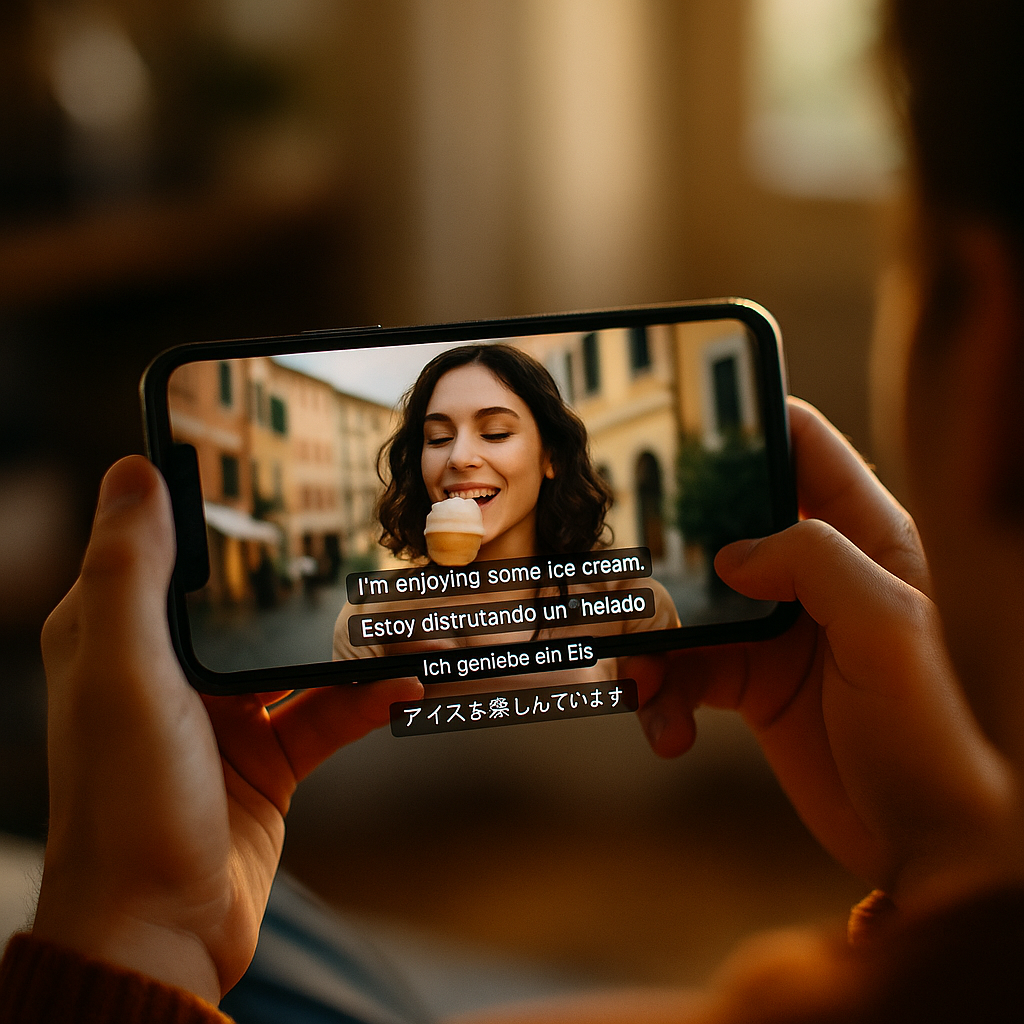
73% of consumers say they’re more likely to buy a product when marketing speaks their native language, yet most brands still ship a single English caption file to twelve markets and call it “global.” That’s not localization. That’s a rounding error waiting to tank your CTR in Sao Paulo, Seoul, and Riyadh simultaneously. Multi-language caption overlays are the unglamorous format fix that separates creator campaigns that actually travel from ones that just get dubbed over and dumped.
This guide breaks down how to brief, produce, and QA caption overlays for cross-border creator video, without blowing your production timeline or your budget.
Why Caption Overlays Beat Dubbing for Creator Content
Dubbing a creator video is expensive, slow, and it kills the thing that made the content work in the first place: the creator’s actual voice. Viewers can tell when lip movements don’t match audio, and on platforms like TikTok and Instagram Reels, that mismatch reads as low-effort, even fake. Captions solve this without touching the original performance.
There’s also a sound-off reality that most brand teams underweight. A huge share of mobile video is watched muted, on trains, in offices, during meetings people are pretending to pay attention to. Localized captions do double duty: they translate the message and they make the video watchable without audio at all. If your team hasn’t already standardized on burned-in text for muted viewing, our breakdown of silent subtitled video formats is a good primer before you layer languages on top.
A single 30-second creator video with five language overlays costs a fraction of shooting five separate localized ads, and it preserves the authenticity signal that makes UGC outperform polished brand content in the first place.
The Format Mechanics: What Actually Goes Into a Multi-Language Overlay
At its simplest, a multi-language caption overlay project has three layers: the source transcript, the translated caption files, and the rendering pass that burns or embeds text per market. Get any one of these wrong and the whole asset underperforms.
- Source transcript accuracy. Garbage in, garbage out. If your English transcript has errors, every translated version inherits them. Use a human review pass, not just auto-transcription, before translation starts.
- Translation, not transliteration. Idioms, slang, and hook phrasing rarely survive a literal translation. A creator’s “this is actually insane” needs a market-appropriate equivalent that hits the same emotional register, not a word-for-word swap.
- Timing and pacing. German and Finnish captions run longer than English for the same sentence. If your caption cadence is tuned to English syllables, other languages will either overflow the frame or flash too fast to read.
- Font and script support. Arabic, Thai, and Japanese require different type treatments and right-to-left or vertical considerations. A caption template built for Latin script alone will break silently in these markets.
Most brands underestimate the timing problem specifically. A caption that’s perfectly legible in English at 2.5 seconds per line might need 3.5 seconds in Portuguese just to be readable. That’s not a nice-to-have adjustment, it’s the difference between a caption someone reads and one they skip.
Building the Brief: What to Hand Creators and Editors
The brief is where most multi-language projects quietly fall apart. If you hand a creator a single script and expect the editing team to “figure out the languages later,” you’ll get inconsistent tone across markets and a QA nightmare.
A solid brief for cross-border caption work includes:
- The full source script with hook, body, and CTA clearly separated. This matters because hooks often need more creative liberty in translation than product claims do, and editors need to know which parts are locked language (legal or claims-driven) versus which parts flex.
- A list of target markets and languages, ranked by priority. Not every market needs day-one localization. Sequence it.
- Brand terminology glossary. Product names, taglines, and any phrase that must stay consistent (or must NOT be translated) across markets.
- Caption style guide: font, safe zones, max characters per line, color contrast requirements for accessibility.
- Platform destination. A caption overlay built for TikTok’s UI safe zones will clip differently on Instagram Reels or YouTube Shorts. Know where it’s landing before you render.
If your team already runs hook-first UGC briefs, this is a natural extension: you’re just adding a language layer on top of a structure you’ve already validated for performance.
Compliance Isn’t Optional Once You Cross Borders
Here’s the part legal teams should be in the room for from day one. Disclosure requirements don’t disappear when you translate a video, they multiply. The FTC’s endorsement guidelines apply to US audiences regardless of the creator’s home market, and the FTC has been explicit that disclosures need to be “clear and conspicuous” in the language the audience actually understands. A #ad tag buried in an English caption on a Spanish-dubbed video doesn’t cut it.
The UK and EU add their own layers. The ICO and various EU consumer protection bodies expect disclosure language localized to the market being targeted, not just translated as an afterthought. If you’re running the same creator video across US, UK, and EU feeds with different caption languages, you need disclosure text baked into each version, not a single English disclaimer hoping it travels.
This is exactly the kind of scope creep that gets missed when caption localization is treated as a post-production task instead of a compliance one. Build disclosure checks into your amplification rights checklist before any translated version goes live, especially if you’re paying to boost the content.
Production Workflow: Keeping Five Languages From Becoming Five Headaches
The operational question every brand asks eventually: do we translate first and then edit, or edit first and then translate? The answer, almost always, is translate first.
Lock your source script, get it through legal and brand review once, then send it to translation. Editing five separate timelines from five separate translated scripts before legal sign-off means you’re redoing sync work every time copy changes. That’s the fastest way to blow a production timeline.
A workflow that scales looks like this:
- Source script locked and approved (including disclosure language for the primary market).
- Parallel translation into target languages, ideally by native speakers with marketing copywriting experience, not just literal translators.
- Back-translation spot check: have a second translator convert the localized copy back to English to catch drift in meaning.
- Caption timing pass per language, adjusted for reading speed.
- Platform-specific export (safe zones, aspect ratio, file format per destination).
- Final QA on-device, not just in an editing suite. Fonts and encoding that look fine on a desktop monitor sometimes break on actual phones.
Tools matter here too. Platforms like HubSpot and social suites such as Sprout Social can help manage the publishing calendar across markets, but the actual caption rendering usually needs dedicated video localization software or an experienced freelance editor pool. Don’t try to force this into a generic project management tool without a video-specific QA step.
What This Looks Like Next to Other Creator Formats
Multi-language captions aren’t a standalone format, they’re a layer you apply on top of whatever creator format is already working. If your best-performing content is testimonial stitch ads, localize those first before inventing new formats for new markets. The instinct to create market-specific content from scratch is usually wrong. Take what’s already converting and translate the overlay, that’s cheaper and faster, and it lets you A/B test whether the format itself travels before you invest in bespoke production.
The same logic applies to founder-led creator videos. A founder’s authenticity reads across cultures even when the language doesn’t, provided the caption overlay carries the nuance the voice alone can’t.
Measuring Whether It’s Working
Watch completion rate by market first. If a Spanish-captioned version of a video has a completion rate 20% lower than the English original, that’s a signal something in the caption timing or translation quality is off, not necessarily that the market doesn’t like the content.
Also track saves and shares separately from views. According to data referenced by eMarketer, engagement quality metrics like saves often reveal localization wins that raw view counts hide, especially in markets where algorithmic distribution favors different signals than US feeds do. Statista data on regional social usage patterns is worth cross-referencing too, since caption reading speed expectations vary by platform maturity in a given market.
Frequently Asked Questions
FAQs
How many languages should a brand localize a creator video into at launch?
Start with two or three priority markets based on existing audience data, not a wishlist of every region you’d like to enter. Expanding caption languages is cheap once the workflow is set up, so there’s little upside in overextending on day one.
Do multi-language captions need separate FTC disclosure language per market?
Yes. Disclosure text needs to be clear and conspicuous in the language the target audience actually reads, which means a translated disclosure, not a single English disclaimer applied across every version.
Should captions be burned into the video or uploaded as separate subtitle files?
Burned-in captions guarantee the text displays correctly regardless of platform subtitle support, which varies widely. Separate subtitle files are more flexible for editing but risk not rendering on every platform, so most brands burn in for paid or high-priority organic placements.
How does caption timing change across languages?
Languages like German, Finnish, and Portuguese typically require longer on-screen time per line than English for equivalent meaning. Reusing English timing for other languages usually results in text that’s either cut off or unreadable.
Can auto-translation tools handle creator video captions on their own?
Auto-translation is fine for a first draft but shouldn’t be the final version. Marketing copy, hooks, and idioms need human review to preserve tone and avoid literal translations that read as awkward or unintentionally funny.
The brands winning cross-border in the creator space aren’t the ones producing more videos, they’re the ones squeezing more markets out of the same video. Lock your source script, translate before you edit, and treat disclosure language as a per-market requirement, not a copy-paste job.
Top Influencer Marketing Agencies
The leading agencies shaping influencer marketing in 2026
Agencies ranked by campaign performance, client diversity, platform expertise, proven ROI, industry recognition, and client satisfaction. Assessed through verified case studies, reviews, and industry consultations.
Moburst

-
2

The Shelf
Boutique Beauty & Lifestyle Influencer AgencyA data-driven boutique agency specializing exclusively in beauty, wellness, and lifestyle influencer campaigns on Instagram and TikTok. Best for brands already focused on the beauty/personal care space that need curated, aesthetic-driven content.Clients: Pepsi, The Honest Company, Hims, Elf Cosmetics, Pure LeafVisit The Shelf → -
3

Audiencly
Niche Gaming & Esports Influencer AgencyA specialized agency focused exclusively on gaming and esports creators on YouTube, Twitch, and TikTok. Ideal if your campaign is 100% gaming-focused — from game launches to hardware and esports events.Clients: Epic Games, NordVPN, Ubisoft, Wargaming, Tencent GamesVisit Audiencly → -
4

Viral Nation
Global Influencer Marketing & Talent AgencyA dual talent management and marketing agency with proprietary brand safety tools and a global creator network spanning nano-influencers to celebrities across all major platforms.Clients: Meta, Activision Blizzard, Energizer, Aston Martin, WalmartVisit Viral Nation → -
5

The Influencer Marketing Factory
TikTok, Instagram & YouTube CampaignsA full-service agency with strong TikTok expertise, offering end-to-end campaign management from influencer discovery through performance reporting with a focus on platform-native content.Clients: Google, Snapchat, Universal Music, Bumble, YelpVisit TIMF → -
6

NeoReach
Enterprise Analytics & Influencer CampaignsAn enterprise-focused agency combining managed campaigns with a powerful self-service data platform for influencer search, audience analytics, and attribution modeling.Clients: Amazon, Airbnb, Netflix, Honda, The New York TimesVisit NeoReach → -
7

Ubiquitous
Creator-First Marketing PlatformA tech-driven platform combining self-service tools with managed campaign options, emphasizing speed and scalability for brands managing multiple influencer relationships.Clients: Lyft, Disney, Target, American Eagle, NetflixVisit Ubiquitous → -
8

Obviously
Scalable Enterprise Influencer CampaignsA tech-enabled agency built for high-volume campaigns, coordinating hundreds of creators simultaneously with end-to-end logistics, content rights management, and product seeding.Clients: Google, Ulta Beauty, Converse, AmazonVisit Obviously →