


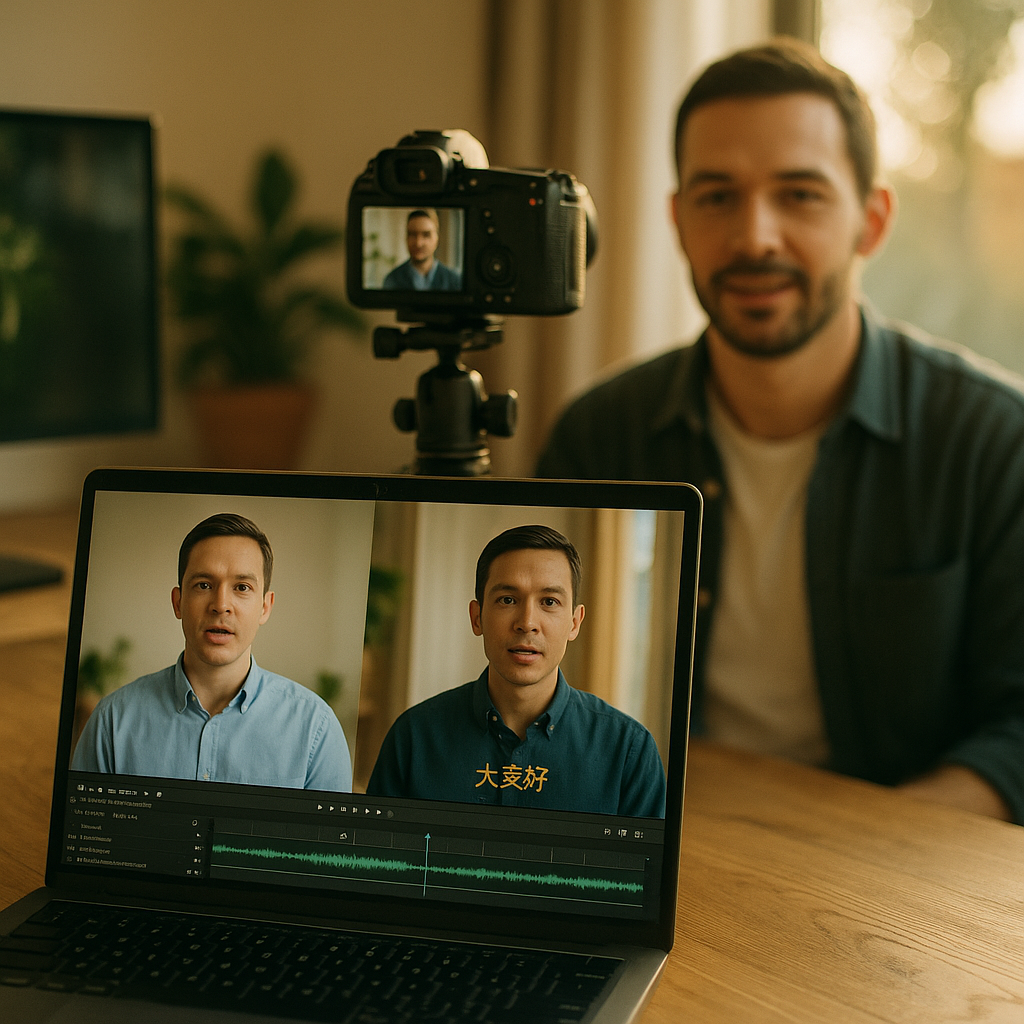
A single piece of creator content, translated into eight languages, used to mean eight separate shoots, eight briefs, and eight invoices. Now it means one upload and a render queue. AI video avatars are quietly rewriting the economics of creator localization, and brands that ignore this shift are paying a “reshoot tax” their competitors no longer owe.
If you run influencer programs across more than one market, you already know the pain. A hero creator video performs brilliantly in the US, and then someone in the Paris office asks for a French version. Suddenly you’re rebooking the creator, rewriting the script, coordinating time zones, and waiting three weeks for a deliverable that should have taken three days. AI video avatar technology is closing that gap, and it’s forcing marketing leaders to rethink what “localization” even means.
What AI Video Avatars Actually Do
AI video avatars are synthetic or digitally cloned versions of a real creator (or a fully generated presenter) that can deliver new scripts in new languages, with lip sync, tone matching, and gesture continuity, without the original person stepping in front of a camera again. Tools like Synthesia, HeyGen, and Colossyan have moved from novelty demo reels to production pipelines that agencies actually bill against.
The mechanics are simple enough to explain in a board meeting: a creator records one base video (or licenses their likeness for avatar use), the brand feeds new copy into the platform, and the system generates a localized output that preserves the creator’s face, voice cadence, and on-screen presence. Dubbing used to sound robotic. Now the better platforms handle lip-sync realism and regional accent variation well enough to pass casual scrutiny on a scrolling feed.
The real unlock isn’t translation. It’s that brands can now localize at the speed of a content calendar instead of the speed of a production schedule.
Why Reshoots Were Never Sustainable at Scale
Think about what a traditional reshoot actually costs. You’re paying creator fees again, sometimes at a premium because the talent knows you need the deliverable fast. You’re covering studio or location costs, editing hours, and a second round of legal review. And you’re doing all of that per market. Run a campaign across five regions and the multiplier effect turns a five-figure content budget into something that needs a finance sign-off.
There’s also the opportunity cost nobody puts in the deck. By the time the German version is shot, edited, and approved, the trend that made the English version work has often moved on. Creator content has a shelf life measured in days, not quarters. Reshoot cycles were built for a slower media environment that doesn’t exist anymore.
Agencies have felt this pain acutely because it’s their margin that erodes when a “simple localization request” turns into a full production sprint. That’s part of why generative tools that compress production timelines, similar to the shift covered in our piece on turning hooks into brand safe briefs, have found such fast adoption inside agency workflows.
The ROI Math Brands Actually Care About
Let’s talk numbers, because that’s what gets this approved above the marketing director’s desk. A typical reshoot for a mid-tier creator deliverable, including talent fee, production, and editing, can run anywhere from $3,000 to $15,000 depending on market and usage rights. Multiply that across six target markets and you’re looking at a six-figure localization bill for a single campaign asset.
AI avatar platforms typically charge on a subscription or per-minute basis, often landing localized output at a fraction of reshoot cost once you’re past the initial setup. Some enterprise teams report cutting localization spend by more than 70% while also compressing turnaround from weeks to days. Even if your actual savings land lower than that, the time compression alone changes what’s strategically possible. You can react to a trending audio or a competitor’s move in near real time instead of waiting for the next shoot window.
There’s a secondary ROI lever too: attribution clarity. When localized variants are tagged and tracked consistently across markets, you get cleaner data on which script, hook, or CTA performs where. That kind of unified view connects directly to the attribution challenges discussed in creator attribution data work, where fragmented localized assets have historically made cross-market comparison messy.
Where This Gets Complicated: Consent, Likeness, and Creator Trust
Here’s the part brand teams skip until legal forces the conversation. Using a creator’s face and voice to generate content they never actually performed requires explicit, contract-level consent. Not a vague usage clause buried in a rate card. A clear agreement covering avatar training, script approval rights, market restrictions, and duration of use.
Creators are increasingly savvy about this, and rightly so. Several high-profile disputes over unauthorized AI likeness use have made talent managers cautious, and some creators now demand separate compensation tiers for avatar licensing versus standard content fees. Build that into your contract templates now, because negotiating it after the fact is expensive and reputationally risky. This is closely related to the negotiation dynamics explored in AI negotiation and creator trust, where automation without transparency tends to backfire.
There’s also a disclosure question regulators care about. The FTC has been explicit that synthetic endorsements need to be clearly flagged so audiences aren’t misled about who’s actually speaking. Check current guidance at the FTC’s official site before you launch anything across borders, because disclosure expectations vary by jurisdiction. The UK’s ICO has similar likeness and data guidance worth reviewing if you’re running European campaigns.
An avatar without a disclosed AI label isn’t a shortcut. It’s a liability waiting for a regulator or a competitor to point at it.
Building a Localization Workflow That Doesn’t Break Brand Safety
Rolling out AI avatars across a creator program isn’t a plug-and-play decision. It needs a workflow, and honestly, most brands are figuring this out in real time. Here’s a structure that’s holding up in practice:
- Base asset library: Record the highest-quality source video once, with lighting and framing that the avatar engine can work with cleanly across markets.
- Script localization, not direct translation: Idioms don’t survive literal translation. Bring in native-market copywriters or regional agency partners to adapt tone, not just words.
- Approval gates per market: Route localized outputs through regional legal and brand safety review before publishing, especially for regulated categories like finance or health.
- Disclosure tagging: Apply platform-native AI content labels consistently, matching whatever TikTok, Meta, or YouTube currently requires for synthetic media.
- Performance tracking by variant: Tag each localized version distinctly in your analytics stack so you can compare hook retention and conversion market by market.
That last point matters more than teams expect. Without clean tagging, you end up with a pile of “German version” files and no idea which one actually drove sales. Server-side tracking approaches, like those detailed in our coverage of tracking creator links post-cookie, pair well with avatar-based localization because both depend on consistent variant identification across markets.
Where Human Creators Still Win
None of this means human creators are replaceable. Audiences can smell synthetic content that’s trying too hard, and platforms are getting better at flagging it automatically. AI avatars work best for scaling reach of content that’s already proven, not for generating a brand’s entire creator strategy from scratch.
Live formats, community engagement, and anything requiring real-time improvisation still belong to actual people. That’s consistent with findings in our review of AI hosts trailing human creators on conversion, where synthetic presenters underperform on formats that reward spontaneity and trust. The smart play is hybrid: humans create and perform the original, AI handles the multiplication.
Industry data backs the caution. According to eMarketer research on AI-generated content trust, audiences still rate human-presented content higher on authenticity metrics, even when they can’t consciously identify what’s different about an avatar version. That trust gap matters most at the top of the funnel, where a creator’s credibility does the heavy lifting.
What to Pilot Before You Commit Budget
Don’t roll this out across your entire creator roster on day one. Pick one high-performing piece of content, license avatar rights from that one creator, and localize it into two or three markets where you already have baseline performance data to compare against. Measure watch-through rate, CTR, and conversion against the original English asset’s performance in those same markets historically.
If the localized avatar version holds within 80 to 90% of a comparable human reshoot’s performance at a fraction of the cost and time, you’ve got your business case. If it underperforms significantly, you’ve learned that cheaply, before committing to a platform contract or a roster-wide consent renegotiation.
Platforms are moving fast here, and vendor selection matters. Compare lip-sync quality, language support depth, and API integration options before signing anything longer than a quarter. The tools reviewed in our coverage of AI platforms turning footage into ad variants offer a useful framework for evaluating vendor claims against actual output quality.
FAQs
Frequently Asked Questions
What are AI video avatars in creator marketing?
AI video avatars are digitally generated or creator-licensed synthetic presenters that can deliver new scripts, including in different languages, using a real creator’s face and voice without requiring that creator to film new footage.
How much can brands save by using AI avatars instead of reshoots?
Costs vary by platform and market count, but brands commonly report reducing localization spend significantly compared to traditional reshoots, while also cutting turnaround time from weeks to days.
Do creators need to consent to AI avatar use?
Yes. Explicit, contract-level consent covering avatar training, script approval, market restrictions, and usage duration is essential, both for legal protection and to maintain creator trust.
Do localized AI avatar videos need an AI disclosure label?
In most cases yes. Platforms and regulators, including the FTC, increasingly expect synthetic or AI-generated endorsement content to be clearly labeled so audiences aren’t misled about who is speaking.
Can AI avatars fully replace human creators for localization?
Not entirely. AI avatars work well for scaling already-proven content across markets, but live engagement, community interaction, and spontaneous formats still perform better with real human creators.
Which industries benefit most from AI avatar localization?
Brands running multi-market campaigns in consumer tech, beauty, travel, and ecommerce tend to see the fastest ROI, since these categories rely heavily on high-volume, fast-turnaround creator content.
Start with one asset, one avatar-licensed creator, and two markets. Measure it against reshoot baselines before you touch your broader roster contracts, and let the pilot numbers, not the vendor pitch, decide your rollout pace.
Top Influencer Marketing Agencies
The leading agencies shaping influencer marketing in 2026
Agencies ranked by campaign performance, client diversity, platform expertise, proven ROI, industry recognition, and client satisfaction. Assessed through verified case studies, reviews, and industry consultations.
Moburst

-
2

The Shelf
Boutique Beauty & Lifestyle Influencer AgencyA data-driven boutique agency specializing exclusively in beauty, wellness, and lifestyle influencer campaigns on Instagram and TikTok. Best for brands already focused on the beauty/personal care space that need curated, aesthetic-driven content.Clients: Pepsi, The Honest Company, Hims, Elf Cosmetics, Pure LeafVisit The Shelf → -
3

Audiencly
Niche Gaming & Esports Influencer AgencyA specialized agency focused exclusively on gaming and esports creators on YouTube, Twitch, and TikTok. Ideal if your campaign is 100% gaming-focused — from game launches to hardware and esports events.Clients: Epic Games, NordVPN, Ubisoft, Wargaming, Tencent GamesVisit Audiencly → -
4

Viral Nation
Global Influencer Marketing & Talent AgencyA dual talent management and marketing agency with proprietary brand safety tools and a global creator network spanning nano-influencers to celebrities across all major platforms.Clients: Meta, Activision Blizzard, Energizer, Aston Martin, WalmartVisit Viral Nation → -
5

The Influencer Marketing Factory
TikTok, Instagram & YouTube CampaignsA full-service agency with strong TikTok expertise, offering end-to-end campaign management from influencer discovery through performance reporting with a focus on platform-native content.Clients: Google, Snapchat, Universal Music, Bumble, YelpVisit TIMF → -
6

NeoReach
Enterprise Analytics & Influencer CampaignsAn enterprise-focused agency combining managed campaigns with a powerful self-service data platform for influencer search, audience analytics, and attribution modeling.Clients: Amazon, Airbnb, Netflix, Honda, The New York TimesVisit NeoReach → -
7

Ubiquitous
Creator-First Marketing PlatformA tech-driven platform combining self-service tools with managed campaign options, emphasizing speed and scalability for brands managing multiple influencer relationships.Clients: Lyft, Disney, Target, American Eagle, NetflixVisit Ubiquitous → -
8

Obviously
Scalable Enterprise Influencer CampaignsA tech-enabled agency built for high-volume campaigns, coordinating hundreds of creators simultaneously with end-to-end logistics, content rights management, and product seeding.Clients: Google, Ulta Beauty, Converse, AmazonVisit Obviously →