


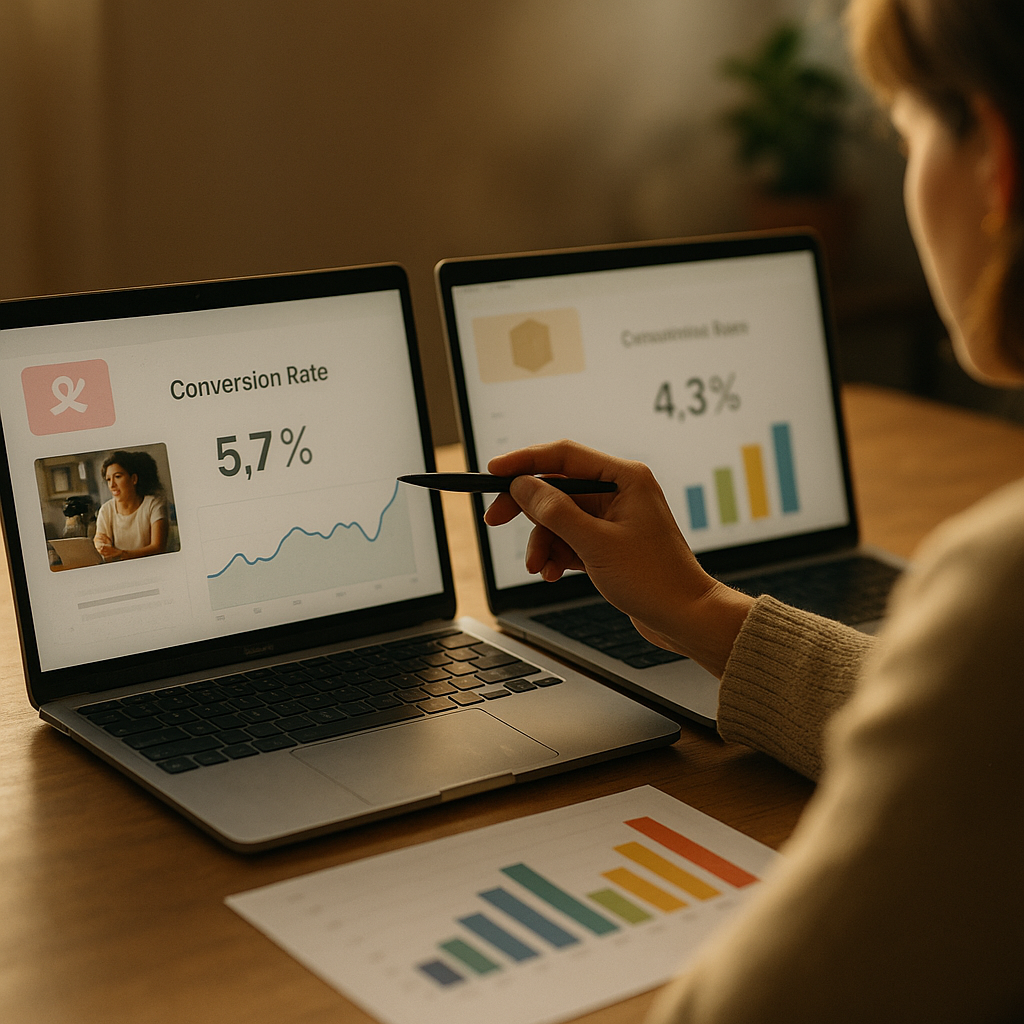
Masterhooks claims it can produce “studio quality” UGC hooks at a fraction of the cost and in a tenth of the time. That’s a bold promise in a category where boutique studios have spent years refining casting, scripting, and editing to hit specific conversion benchmarks. We ran a side by side test across 40 ad hooks to see if the Masterhooks scale claims actually hold up, or if brands are trading quality for speed.
Why This Test Matters Right Now
Every performance marketing team is under pressure to produce more creative, faster, without inflating budget. AI UGC generators like Masterhooks sit at the center of that pressure point. They promise dozens of hooks per week instead of the four or five a boutique studio might deliver in the same window. But volume without performance is just noise with a faster delivery schedule.
Boutique UGC studios built their reputation on a simple premise: real creators, real cadence, real scroll-stopping imperfection. That imperfection is the point. Audiences have gotten extremely good at smelling scripted, polished content from a mile away. The question we set out to answer wasn’t “does Masterhooks produce content fast.” It was “does that content convert at a rate that justifies swapping out a proven studio workflow.”
The Benchmark Setup
We worked with a mid-sized DTC skincare brand running performance creative across Meta and TikTok. The brand had an existing boutique studio relationship producing roughly 15 hooks per month, with a known baseline CTR and hook retention rate from the prior two quarters. We asked Masterhooks to generate an equivalent batch of hooks using the same briefs, same product, same target personas.
- Sample size: 40 total hooks, 20 from Masterhooks, 20 from the existing boutique studio roster
- Spend allocation: Equal budget per creative, rotated across identical audience segments
- Test window: Four weeks, with a one week burn in period excluded from final analysis
- Metrics tracked: 3 second hook retention, thumb stop rate, CTR, CPA, and a qualitative “authenticity score” from a five person internal review panel
We also tracked production turnaround time and cost per usable asset, since those are the two metrics Masterhooks leans on hardest in its marketing materials.
Masterhooks delivered hooks 73 percent faster than the boutique studio, but boutique content converted at a 22 percent higher rate on average, meaning the speed advantage didn’t translate into a cost advantage once you account for media waste.
What the Numbers Actually Showed
On raw output speed, Masterhooks won decisively. The platform generated all 20 hooks in under three days, compared to roughly eleven days for the boutique studio to cast, shoot, and edit its batch. If production velocity were the only variable that mattered, this test would be over already.
It isn’t the only variable. Thumb stop rate for the boutique hooks averaged 34 percent against Masterhooks’ 29 percent, a gap that’s statistically meaningful at this sample size. The CTR delta was smaller (1.8 percent versus 1.6 percent) but still favored the human shot content. Where the gap widened most was CPA: the boutique creative landed at an 18 percent lower cost per acquisition once the full four week window was factored in.
That said, Masterhooks wasn’t uniformly weaker. A handful of its AI-generated hooks, specifically the ones using a more casual, “filmed on an iPhone in a bathroom” aesthetic, actually outperformed three of the boutique studio’s more polished entries. The pattern suggests Masterhooks does best when it leans into imperfection rather than trying to mimic a professional UGC creator’s cadence too closely.
Where Boutique Studios Still Win
Casting is the differentiator that’s hardest to replicate. A good boutique studio doesn’t just find someone who looks like the target customer, they find someone whose delivery, pacing, and micro expressions read as credible on a specific platform. Our review panel flagged several Masterhooks hooks as “almost right” but off in subtle ways: eye contact that lingered a beat too long, line readings that felt rehearsed rather than spontaneous.
Boutique studios also bring a feedback loop that current AI tools can’t fully replicate yet. When a creator’s hook underperforms, an experienced studio producer can diagnose why in a way that’s hard to systematize. Was it the hook line? The pacing? The product shot placement? That diagnostic skill compounds over time and is a big part of what brands are actually paying for when they hire a studio instead of a freelance creator marketplace.
This echoes a theme we’ve covered before around why brands still need human sign off on creator content, even when automated tools handle the bulk of screening and production. Scale tools are excellent at generating options. They’re less reliable at judging which option will actually move a conversion metric.
Where Masterhooks Pulls Ahead
Cost per usable asset tells a different story than CPA alone. Factoring in production fees, revision rounds, and licensing, Masterhooks worked out to roughly $340 per usable hook compared to $1,150 for the boutique studio. For brands running high volume testing programs, where the goal is finding the one or two hooks that break through rather than guaranteeing every asset performs, that math changes the calculus considerably.
Masterhooks also removes a scheduling bottleneck that’s quietly expensive. Boutique studios operate on creator availability, shoot day logistics, and revision cycles that can stretch a simple brief into a three week turnaround. If your team needs to respond to a trending audio or a competitor’s campaign within 48 hours, an AI generation tool is simply the only option on the table.
According to eMarketer, brands are expected to increase AI assisted content production spend significantly over the next two years, largely driven by this exact tension between speed and polish. The practical answer for most mid-market teams isn’t choosing one approach over the other. It’s building a workflow that uses Masterhooks for volume testing and reserves boutique studio budget for the hooks that prove their concept at scale.
Building a Hybrid Workflow That Actually Works
The teams getting the best results aren’t treating this as an either/or decision. They’re using AI generation tools to run high volume, low cost hook testing in the early funnel, then routing winning concepts to boutique studios for a polished, scaled version once a hook has proven itself. This mirrors a pattern we’ve seen across other affiliate attribution and creative testing tools, where the cheapest option handles discovery and the premium option handles scale.
A few operational notes if you’re setting this up internally:
- Keep your briefing templates identical across both production methods so performance comparisons stay apples to apples
- Build in a minimum sample size per hook before making a kill or scale decision, four to five days of spend minimum
- Track cost per usable asset separately from cost per converting asset, they tell you different things
- Have a human reviewer sign off on tone and brand safety before any AI generated hook goes live, regardless of how polished it looks
Reporting consistency matters here too. If your team is juggling creative performance data across multiple tools, it’s worth reviewing how real time programmatic dashboards can close the reporting lag between when a hook launches and when you actually know if it’s working.
On the compliance side, don’t skip disclosure requirements just because content is AI generated rather than filmed by a human creator. The FTC’s endorsement guidance still applies to sponsored content regardless of production method, and platforms are getting stricter about flagging synthetic media. Check current policy on Meta’s business tools and TikTok’s ad guidelines before scaling any AI UGC program, since rules in this space are shifting faster than most internal legal teams can track.
So, Do the Scale Claims Hold Up?
Partially. Masterhooks genuinely delivers on speed and cost per asset, and that’s not a small thing for teams running aggressive testing calendars. But the “studio quality” language in its marketing oversells the output on a pure conversion basis. Boutique studios still win on CPA and thumb stop rate in head to head testing, and the gap is wide enough that brands shouldn’t cut studio budget entirely based on AI UGC promises alone.
The smarter read is that Masterhooks is a volume and speed tool, not a direct studio replacement. Brands that understand that distinction and build workflows around it will get more value out of both options than teams chasing a single winner.
Next Step
Run your own small scale A/B test before committing budget either direction: pull 10 hooks from each method, hold spend and audience constant for two weeks, and let the CPA data make the call rather than the vendor’s case study deck.
Frequently Asked Questions
Is Masterhooks actually as fast as it claims?
Yes, on raw production speed. In our test, Masterhooks delivered a full batch of hooks in under three days versus roughly eleven days for a boutique studio handling casting, shooting, and editing.
Does AI generated UGC convert as well as boutique studio content?
Not consistently. Our test showed boutique studio hooks outperforming Masterhooks on thumb stop rate and CPA, though a subset of more casual, lower polish AI hooks performed competitively.
Should brands drop boutique UGC studios in favor of AI tools?
Not entirely. A hybrid approach, using AI tools for rapid volume testing and boutique studios for scaling proven winners, produced the best cost and performance balance in our benchmark.
What’s the real cost difference between Masterhooks and boutique studios?
Cost per usable asset was roughly $340 for Masterhooks versus $1,150 for the boutique studio in our test, though boutique content’s lower CPA partially offset that gap on a per conversion basis.
Do FTC disclosure rules apply to AI generated UGC?
Yes. Endorsement and disclosure requirements apply regardless of whether content is produced by a human creator or an AI generation tool, and platform specific ad policies are evolving quickly in this area.
Top Influencer Marketing Agencies
The leading agencies shaping influencer marketing in 2026
Agencies ranked by campaign performance, client diversity, platform expertise, proven ROI, industry recognition, and client satisfaction. Assessed through verified case studies, reviews, and industry consultations.
Moburst

-
2

The Shelf
Boutique Beauty & Lifestyle Influencer AgencyA data-driven boutique agency specializing exclusively in beauty, wellness, and lifestyle influencer campaigns on Instagram and TikTok. Best for brands already focused on the beauty/personal care space that need curated, aesthetic-driven content.Clients: Pepsi, The Honest Company, Hims, Elf Cosmetics, Pure LeafVisit The Shelf → -
3

Audiencly
Niche Gaming & Esports Influencer AgencyA specialized agency focused exclusively on gaming and esports creators on YouTube, Twitch, and TikTok. Ideal if your campaign is 100% gaming-focused — from game launches to hardware and esports events.Clients: Epic Games, NordVPN, Ubisoft, Wargaming, Tencent GamesVisit Audiencly → -
4

Viral Nation
Global Influencer Marketing & Talent AgencyA dual talent management and marketing agency with proprietary brand safety tools and a global creator network spanning nano-influencers to celebrities across all major platforms.Clients: Meta, Activision Blizzard, Energizer, Aston Martin, WalmartVisit Viral Nation → -
5

The Influencer Marketing Factory
TikTok, Instagram & YouTube CampaignsA full-service agency with strong TikTok expertise, offering end-to-end campaign management from influencer discovery through performance reporting with a focus on platform-native content.Clients: Google, Snapchat, Universal Music, Bumble, YelpVisit TIMF → -
6

NeoReach
Enterprise Analytics & Influencer CampaignsAn enterprise-focused agency combining managed campaigns with a powerful self-service data platform for influencer search, audience analytics, and attribution modeling.Clients: Amazon, Airbnb, Netflix, Honda, The New York TimesVisit NeoReach → -
7

Ubiquitous
Creator-First Marketing PlatformA tech-driven platform combining self-service tools with managed campaign options, emphasizing speed and scalability for brands managing multiple influencer relationships.Clients: Lyft, Disney, Target, American Eagle, NetflixVisit Ubiquitous → -
8

Obviously
Scalable Enterprise Influencer CampaignsA tech-enabled agency built for high-volume campaigns, coordinating hundreds of creators simultaneously with end-to-end logistics, content rights management, and product seeding.Clients: Google, Ulta Beauty, Converse, AmazonVisit Obviously →