


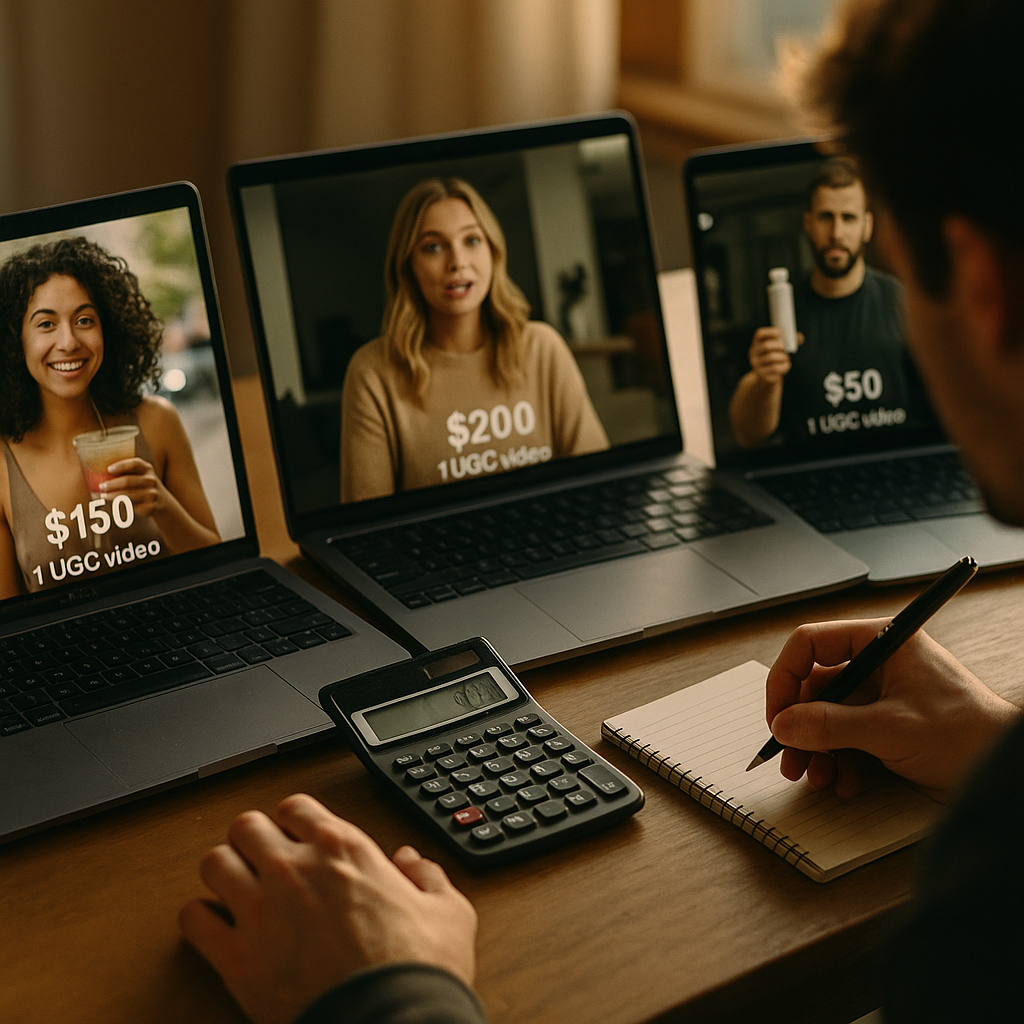
A single branded UGC clip can cost anywhere from $25 to $1,500 depending on where you source it. That spread isn’t random, it reflects three fundamentally different operating models. If your team is still picking a UGC vendor based on vibes or a cold DM, you’re probably overpaying, underperforming, or both. Choosing between Insense, Billo, and Fiverr for sourcing UGC creators is really a decision about risk tolerance, speed, and how much quality control you’re willing to manage in-house.
Why the Price Tier Question Actually Matters
Most brands treat UGC sourcing as a line item, not a strategic decision. That’s a mistake. The platform you choose determines your creative velocity, your vetting burden, and whether you’re buying usage rights or just a video file. Price tier isn’t just about budget, it’s a proxy for how much operational risk the platform absorbs on your behalf.
Fiverr is the marketplace model: low cost, high variance, minimal structure. Billo sits in the middle, a managed UGC-as-a-service layer with built-in briefs and revisions. Insense occupies the premium tier, blending influencer-grade creators with paid social amplification and whitelisting tools. Understanding which problem each one actually solves saves you from buying a Fiverr solution when you needed Insense, or vice versa.
Fiverr: The Bottom of the Funnel on Price
Fiverr is a general freelance marketplace, not a dedicated UGC platform, and that distinction matters more than people assume. You’re searching through gig listings, reading reviews, and negotiating scope directly with individual sellers. Prices for a single UGC video often start under $50 and rarely exceed $200 unless you’re bundling multiple deliverables or buying rush turnaround.
The appeal is obvious: it’s cheap, fast to access, and there’s no minimum spend or subscription. For a startup testing whether UGC-style ads even work for their product, Fiverr is a reasonable sandbox. But the tradeoffs are real. There’s no vetting layer for brand safety, no standardized usage rights language, and quality consistency depends entirely on which seller you happen to pick. You’re also doing all the briefing, revision management, and rights negotiation yourself.
Fiverr works as a testing ground for UGC concepts, not as a scalable pipeline for a brand running continuous paid social creative.
Teams running multiple campaigns a month usually hit a wall here. Sourcing ten creators on Fiverr means ten separate negotiations, ten different contract interpretations, and no centralized performance data. That’s manageable at a trickle, unsustainable at volume.
Billo: Built Specifically for Branded UGC
Billo exists because Fiverr’s structural gaps were obvious to enough marketers that a purpose-built alternative made sense. Pricing typically runs in the $100 to $300 range per video, packaged into credits or subscription tiers rather than one-off gigs. You submit a brief, Billo matches you with pre-vetted creators from its talent pool, and you get a structured revision process baked into the workflow.
This is the “UGC-as-a-service” layer, and it’s designed for brands that need a repeatable pipeline without managing creator relationships manually. Usage rights are typically clearer upfront, which matters enormously if you plan to run these clips as paid ads rather than organic posts only. The creator pool is still largely non-influencer, meaning you’re buying content, not reach or an existing audience.
The limitation: Billo creators generally don’t have followings you’re borrowing credibility from. You’re paying for production quality and brief adherence, not influence. That’s fine if your funnel is paid-media-driven and the content exists purely as ad creative. It’s less useful if part of your goal is organic discovery or creator-led storytelling with an audience attached.
Insense: Where UGC Meets Influencer Infrastructure
Insense sits at the top of the price tier for a reason: it’s not purely a UGC marketplace, it’s a hybrid platform connecting brands with creators who often have genuine social followings, plus built-in tools for whitelisting and paid amplification through Meta and TikTok ad accounts. Per-video costs frequently land between $300 and $1,500, scaling with creator tier and usage rights duration.
What you’re actually paying for is the integration layer. Insense lets you push creator content directly into paid campaigns using the creator’s handle for boosted reach, something Fiverr and Billo generally can’t facilitate natively. That matters a lot for brands running spark ads or partnership ads where the algorithm rewards content tied to an authentic creator account.
The vetting is also more rigorous. Insense screens creators for platform compliance and historical performance, which reduces the brand safety homework your team would otherwise do manually. If you’ve read our creator risk scans coverage, you already know automated vetting isn’t a substitute for human sign-off, but it does cut the volume of manual review needed before a creator touches your brand account.
Comparing the Three on What Actually Drives ROI
- Cost per asset: Fiverr wins on raw price. Billo wins on price-to-structure ratio. Insense wins on price-to-amplification potential.
- Usage rights clarity: Fiverr requires manual negotiation every time. Billo and Insense both build licensing terms into the platform workflow, reducing legal friction.
- Vetting and brand safety: Fiverr offers none built in. Billo pre-screens for production quality. Insense screens for both quality and platform compliance history.
- Paid amplification: Only Insense natively supports whitelisting and spark ad style boosting through creator handles.
- Time to first asset: Fiverr can be fastest for a single off, but slowest at scale due to manual coordination. Billo and Insense both reduce coordination overhead through structured briefs.
None of this means one platform is objectively “best.” It means the right choice depends on what stage your program is at. A brand still validating product-market fit for paid social shouldn’t be spending Insense money. A brand running six-figure monthly ad spend shouldn’t be relying on unvetted Fiverr gigs for creative that touches a paid account.
How Brands Should Actually Decide
Start by asking what the content is for. If it’s organic-only, low-stakes testing, Fiverr’s price point makes the experimentation cheap enough to justify the operational overhead. If you need a repeatable monthly pipeline of ad-ready UGC without managing individual creator relationships, Billo’s structure earns its premium. If the plan involves running the content as paid ads through the creator’s own account for algorithmic lift, Insense is close to the only option that handles that natively.
Budget allocation should follow the same logic brands apply elsewhere in the martech stack: match the tool’s structure to the operational complexity of the task, not just the sticker price. This is the same reasoning covered in our comparison of boutique UGC studios versus automated tools, where conversion data, not cost per asset, ultimately determined which option paid for itself.
The cheapest UGC source isn’t the lowest cost per video, it’s the one that requires the least internal labor to turn raw footage into a compliant, performing ad.
There’s also a hidden cost most brands underestimate: internal hours spent briefing, chasing revisions, and chasing usage rights clarifications. A $50 Fiverr video that takes three rounds of back-and-forth and still arrives without clear licensing language can easily cost more in staff time than a $300 Billo asset that arrives brief-compliant on the first pass. Run the math on fully loaded cost, not just invoice price, before deciding your sourcing strategy.
Brands managing creator relationships across multiple vendors also run into a data fragmentation problem, where performance metrics, contracts, and content rights live in three disconnected systems. If that’s already happening on your team, it’s worth reading how other marketers are thinking about where creator partnership data should live before adding a fourth vendor to the mix.
A Quick Note on Compliance
Regardless of platform, usage rights and disclosure obligations don’t disappear because content is labeled “UGC” rather than “influencer content.” The FTC’s endorsement guidance still applies anytime compensation or free product changes the nature of the content, and that obligation sits with the brand, not the platform. Confirm licensing terms in writing before you run any sourced UGC as a paid ad, especially on Fiverr where contracts are negotiated gig by gig rather than standardized.
Industry data from sources like eMarketer and Sprout Social consistently shows UGC-style creative outperforming polished brand content on cost per click, but that lift only materializes when usage rights and disclosure are handled correctly on the front end. Skipping that step to save a negotiation cycle is a false economy.
FAQs
Next step: Run a small test batch, five assets on Fiverr, five on Billo, against the same brief and ad placement, then compare cost per acquisition after two weeks before committing budget to a single vendor.
Frequently Asked Questions
Which platform is cheapest for sourcing UGC creators?
Fiverr is generally the cheapest, with single UGC videos often priced under $100. Billo and Insense cost more because they include structured briefs, vetting, and in Insense’s case, paid amplification tools.
Is Insense worth the higher price compared to Billo?
It depends on whether you plan to run the content as paid ads through the creator’s handle. If spark ads or whitelisting are part of your strategy, Insense’s native integration typically justifies the premium. If you only need polished UGC-style footage for your own ad account, Billo is usually sufficient.
Do Fiverr creators offer usage rights for paid ads?
Usage rights on Fiverr are negotiated individually with each seller and aren’t standardized across the platform. Brands need to confirm licensing terms in writing before running any Fiverr-sourced content as paid media.
Can small brands use all three platforms at once?
Yes, many brands tier their sourcing by use case, using Fiverr for quick organic tests, Billo for a steady ad-creative pipeline, and Insense when a campaign calls for paid amplification through a creator’s own account.
What’s the biggest hidden cost when sourcing UGC on a budget?
Internal labor. Chasing revisions, clarifying usage rights, and vetting creators manually on low-cost marketplaces often adds more staff hours than the platform’s structured alternatives, which can erase the apparent savings.
Top Influencer Marketing Agencies
The leading agencies shaping influencer marketing in 2026
Agencies ranked by campaign performance, client diversity, platform expertise, proven ROI, industry recognition, and client satisfaction. Assessed through verified case studies, reviews, and industry consultations.
Moburst

-
2

The Shelf
Boutique Beauty & Lifestyle Influencer AgencyA data-driven boutique agency specializing exclusively in beauty, wellness, and lifestyle influencer campaigns on Instagram and TikTok. Best for brands already focused on the beauty/personal care space that need curated, aesthetic-driven content.Clients: Pepsi, The Honest Company, Hims, Elf Cosmetics, Pure LeafVisit The Shelf → -
3

Audiencly
Niche Gaming & Esports Influencer AgencyA specialized agency focused exclusively on gaming and esports creators on YouTube, Twitch, and TikTok. Ideal if your campaign is 100% gaming-focused — from game launches to hardware and esports events.Clients: Epic Games, NordVPN, Ubisoft, Wargaming, Tencent GamesVisit Audiencly → -
4

Viral Nation
Global Influencer Marketing & Talent AgencyA dual talent management and marketing agency with proprietary brand safety tools and a global creator network spanning nano-influencers to celebrities across all major platforms.Clients: Meta, Activision Blizzard, Energizer, Aston Martin, WalmartVisit Viral Nation → -
5

The Influencer Marketing Factory
TikTok, Instagram & YouTube CampaignsA full-service agency with strong TikTok expertise, offering end-to-end campaign management from influencer discovery through performance reporting with a focus on platform-native content.Clients: Google, Snapchat, Universal Music, Bumble, YelpVisit TIMF → -
6

NeoReach
Enterprise Analytics & Influencer CampaignsAn enterprise-focused agency combining managed campaigns with a powerful self-service data platform for influencer search, audience analytics, and attribution modeling.Clients: Amazon, Airbnb, Netflix, Honda, The New York TimesVisit NeoReach → -
7

Ubiquitous
Creator-First Marketing PlatformA tech-driven platform combining self-service tools with managed campaign options, emphasizing speed and scalability for brands managing multiple influencer relationships.Clients: Lyft, Disney, Target, American Eagle, NetflixVisit Ubiquitous → -
8

Obviously
Scalable Enterprise Influencer CampaignsA tech-enabled agency built for high-volume campaigns, coordinating hundreds of creators simultaneously with end-to-end logistics, content rights management, and product seeding.Clients: Google, Ulta Beauty, Converse, AmazonVisit Obviously →