


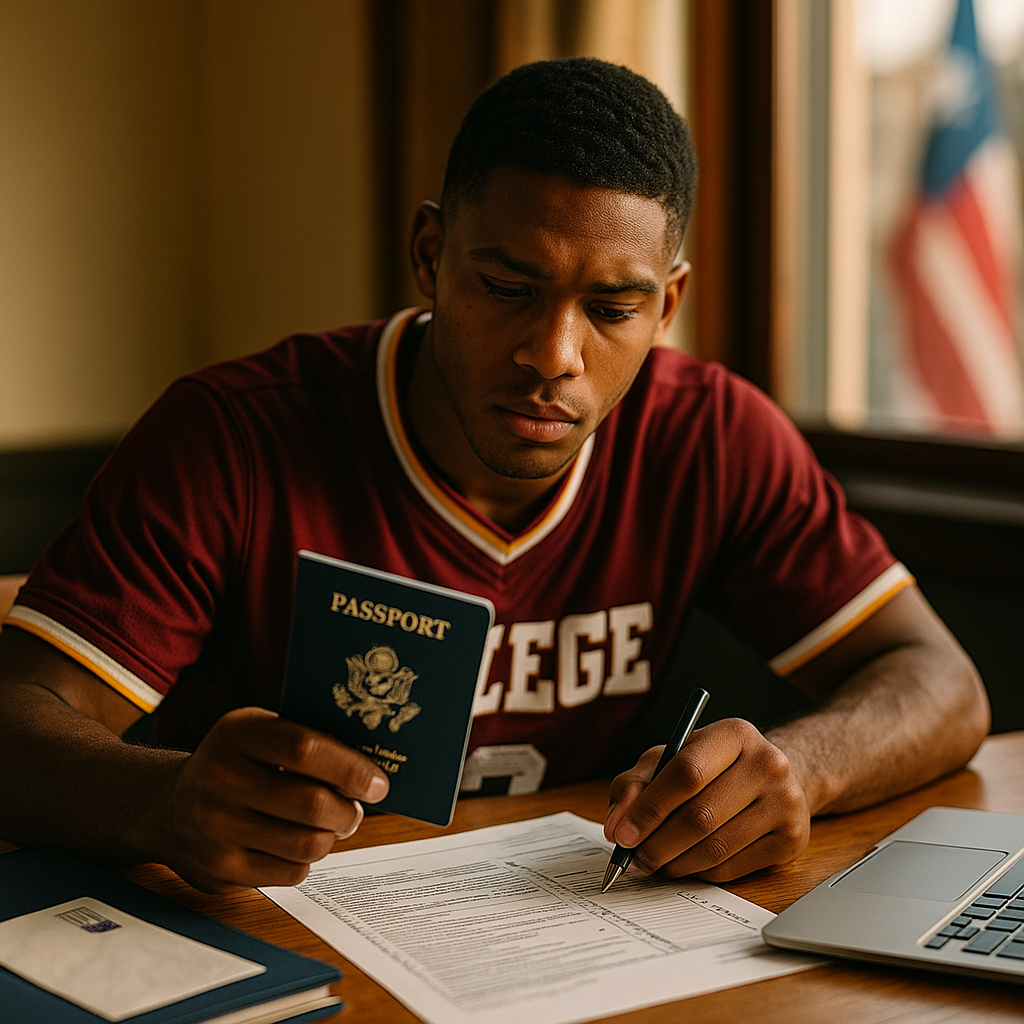
Roughly 25% of Division I athletes on major rosters now hold international student status, and most NIL contracts brands sign with them were drafted for a purely domestic athlete. That mismatch is not a technicality. It is a live compliance gap that can unravel a sponsorship, trigger tax penalties, or void a visa. International NIL rights sit at the intersection of immigration law, tax code, and publicity rights, and almost nobody has built a contract that covers all three at once.
The NIL Patchwork Just Went Global
When NCAA rules opened the door to name, image, and likeness deals, the conversation was almost entirely domestic. State laws varied, sure, but everyone assumed the athlete was a U.S. citizen, paid in dollars, filing a standard 1099. That assumption is now wrong often enough to matter.
International students make up a growing share of rosters in college basketball, soccer, tennis, and track. Add in creators who split time between countries, athletes who transfer to European clubs mid-career, and brand ambassadors who livestream from three continents in a single quarter, and you get a compliance picture that looks nothing like the template most legal teams are still using.
Brands love the reach these athletes bring. A European basketball recruit with a following back home plus a growing U.S. fanbase is a marketer’s dream for cross-border campaigns. But that same dual presence means two tax authorities, two sets of publicity law, and sometimes two conflicting disclosure regimes are all watching the same Instagram post.
Why a Foreign Student-Athlete’s NIL Deal Isn’t the Same Contract
Here’s the uncomfortable part: a standard NIL agreement written for a U.S.-born athlete does not automatically work for an international one, even if every clause looks identical on paper. Three things change immediately.
- Visa terms restrict compensated activity. F-1 and J-1 visa holders face strict limits on what counts as employment. An NIL payment that looks like a simple endorsement fee to a brand’s legal team can look like unauthorized employment to U.S. Citizenship and Immigration Services.
- Tax residency determines withholding. A non-resident alien athlete is subject to different withholding rules than a U.S. citizen, and the brand (or its agency) is often the party responsible for getting that withholding right.
- Home-country law may still apply. An athlete’s NIL rights might be governed, in part, by the publicity or personality rights framework of their country of citizenship, not just the state where the school sits.
A brand that treats every athlete’s NIL deal as a copy-paste contract is one cross-border payment away from an IRS inquiry, a visa violation, or an unenforceable image rights clause.
None of this is theoretical. Agencies running multi-market NIL campaigns have already run into frozen payments and delayed activations because nobody flagged visa status before the deal was signed. We’ve covered the domestic version of this problem before: our breakdown of foreign creator payments and 1099 pitfalls applies directly to any NIL deal involving a non-citizen athlete, and it’s worth reading before you draft your next contract.
Tax Withholding: The Part Everyone Forgets
Most marketing teams treat payment logistics as an afterthought, something finance handles after legal signs off. With international NIL, that order of operations backfires.
A non-resident alien athlete is typically subject to a 30% withholding rate on U.S.-source income unless a tax treaty reduces it. Getting that treaty benefit applied correctly requires the athlete to file the right forms (often a W-8BEN) before the first payment goes out, not after. Miss that step, and the brand either over-withholds (annoying the athlete and their agent) or under-withholds (creating liability for the paying entity).
Agencies that manage NIL payouts at scale are increasingly building tax residency checks into onboarding, the same way they’d verify a domestic athlete’s state of residence for state tax purposes. If your program doesn’t have that step, you’re gambling on every international signing.
Image Rights Don’t Travel the Same Way Everywhere
U.S. publicity law is built around state-by-state right of publicity statutes, and we’ve written at length about how fragmented that landscape already is for right of publicity across states. Now stretch that patchwork across borders and it gets messier.
The UK and much of the EU use a “personality rights” framework that is conceptually similar but procedurally different. Enforcement mechanisms, remedies available, and even what counts as commercial use can diverge from U.S. law. A UK-based athlete signing an NIL deal with a U.S. brand may have personality rights protections under their home jurisdiction that the standard American contract never contemplates.
This matters most when content gets repurposed. A campaign asset filmed for U.S. social channels, later used in paid media running in the athlete’s home country, can trigger consent and compensation obligations that weren’t part of the original scope. Brands that license footage broadly need image rights language that accounts for multi-jurisdictional reuse, not a single boilerplate grant tied to U.S. law.
Data protection adds another layer. If an athlete’s likeness or biometric data touches EU audiences, GDPR-adjacent obligations can apply even when the brand itself is U.S.-based. The UK Information Commissioner’s Office has been clear that image and likeness data used in targeted advertising can fall under data protection rules, not just publicity law.
Visa Status Can Void the Whole Deal
Immigration compliance is probably the least understood piece of international NIL, and it’s the one with the sharpest consequences. A student-athlete on an F-1 visa who accepts compensation structured incorrectly risks their visa status entirely, not just the deal.
The safer structures typically route payments through properly classified arrangements that don’t read as “employment” under immigration rules: licensing fees for name and image use, royalty-style payments, or third-party collective structures rather than direct work-for-hire contracts. Brands and agencies should loop in immigration counsel before finalizing deal structure, not after the athlete has already posted the content.
An NIL deal that technically violates an athlete’s visa terms doesn’t just expose the athlete. It exposes the brand to reputational fallout and the school to NCAA scrutiny, all from a contract clause nobody double-checked.
This is also where agency liability questions get sharp. If an agency structures the deal, who absorbs the risk when the structure turns out to violate immigration rules? Our piece on agency vicarious liability walks through how courts and regulators have started assigning responsibility up the chain, and the same logic increasingly applies to cross-border NIL deal architecture.
Building a Compliance Checklist for Cross-Border NIL
Most of this risk is manageable if it’s caught early. The problem is almost never malice, it’s sequencing. Legal, finance, and the athlete’s representation need to sync before the contract is signed, not during the first payment cycle. A workable pre-signing checklist looks like this:
- Confirm the athlete’s visa or residency status and flag any restrictions on compensated activity.
- Determine tax residency and collect the correct withholding documentation before any payment is scheduled.
- Identify every jurisdiction where the athlete holds citizenship or legal residency, and check whether local image rights or personality rights law applies.
- Scope content usage rights explicitly for each market where the asset might run, including paid media repurposing.
- Build in disclosure language that satisfies both U.S. FTC requirements and any home-country advertising regulator the athlete is subject to.
- Route payments through structures reviewed by immigration counsel if the athlete holds a student visa.
That last point connects to a broader disclosure problem. U.S. brands already struggle to keep endorsement disclosures consistent across domestic campaigns, as regulators made clear in the recent FTC endorsement sweep. Add a second country’s advertising standards authority into the mix, and disclosure compliance stops being a checkbox and becomes an actual legal review step.
Industry data on the creator economy’s international growth backs up why this matters now rather than later. eMarketer’s creator economy research consistently shows cross-border influencer spend climbing faster than domestic spend, and NIL athletes are increasingly part of that same global pipeline, not a separate category. Meanwhile, benchmarking data from Statista’s influencer marketing data shows international brand deals growing as a share of total athlete endorsement revenue, which means the compliance exposure described here isn’t a niche edge case. It’s becoming the norm.
The FTC’s endorsement guidance remains the baseline for any U.S.-facing disclosure, but it was never written with dual-jurisdiction athletes in mind. Brands that assume FTC compliance covers them globally are leaving a gap wide open.
Frequently Asked Questions
FAQs
Do international student-athletes have the same NIL rights as U.S. citizens?
Not automatically. NCAA NIL policy applies broadly, but an international student-athlete’s visa status can restrict what counts as permissible compensated activity, which means the practical scope of their NIL rights is narrower than a U.S. citizen’s in some respects.
Who is responsible for tax withholding on an international athlete’s NIL payment?
The paying party, typically the brand, agency, or NIL collective, generally bears responsibility for correct withholding on payments to non-resident alien athletes. Getting treaty-reduced rates applied correctly requires proper documentation collected before payment, not after.
Can a foreign athlete’s home country image rights affect a U.S. brand deal?
Yes. If the athlete holds citizenship or residency in a country with its own personality rights or publicity law framework, that law can apply to how their image is used, especially if campaign content gets repurposed into that market.
What happens if an NIL deal violates an athlete’s visa terms?
Consequences can include visa revocation for the athlete, NCAA eligibility issues for the school, and reputational or contractual fallout for the brand or agency that structured the deal. Immigration counsel review before signing is the standard safeguard.
Does FTC disclosure guidance cover international NIL campaigns?
FTC rules apply to content reaching U.S. audiences, but they don’t override a second country’s advertising disclosure requirements. Campaigns running across borders often need disclosure language that satisfies both regulatory frameworks simultaneously.
Next step: Before signing another international NIL deal, route the contract through a three-point review, immigration status, tax residency, and home-country image rights, before finance schedules the first payment. That single sequencing fix closes most of the compliance gap outlined above.
Top Influencer Marketing Agencies
The leading agencies shaping influencer marketing in 2026
Agencies ranked by campaign performance, client diversity, platform expertise, proven ROI, industry recognition, and client satisfaction. Assessed through verified case studies, reviews, and industry consultations.
Moburst

-
2

The Shelf
Boutique Beauty & Lifestyle Influencer AgencyA data-driven boutique agency specializing exclusively in beauty, wellness, and lifestyle influencer campaigns on Instagram and TikTok. Best for brands already focused on the beauty/personal care space that need curated, aesthetic-driven content.Clients: Pepsi, The Honest Company, Hims, Elf Cosmetics, Pure LeafVisit The Shelf → -
3

Audiencly
Niche Gaming & Esports Influencer AgencyA specialized agency focused exclusively on gaming and esports creators on YouTube, Twitch, and TikTok. Ideal if your campaign is 100% gaming-focused — from game launches to hardware and esports events.Clients: Epic Games, NordVPN, Ubisoft, Wargaming, Tencent GamesVisit Audiencly → -
4

Viral Nation
Global Influencer Marketing & Talent AgencyA dual talent management and marketing agency with proprietary brand safety tools and a global creator network spanning nano-influencers to celebrities across all major platforms.Clients: Meta, Activision Blizzard, Energizer, Aston Martin, WalmartVisit Viral Nation → -
5

The Influencer Marketing Factory
TikTok, Instagram & YouTube CampaignsA full-service agency with strong TikTok expertise, offering end-to-end campaign management from influencer discovery through performance reporting with a focus on platform-native content.Clients: Google, Snapchat, Universal Music, Bumble, YelpVisit TIMF → -
6

NeoReach
Enterprise Analytics & Influencer CampaignsAn enterprise-focused agency combining managed campaigns with a powerful self-service data platform for influencer search, audience analytics, and attribution modeling.Clients: Amazon, Airbnb, Netflix, Honda, The New York TimesVisit NeoReach → -
7

Ubiquitous
Creator-First Marketing PlatformA tech-driven platform combining self-service tools with managed campaign options, emphasizing speed and scalability for brands managing multiple influencer relationships.Clients: Lyft, Disney, Target, American Eagle, NetflixVisit Ubiquitous → -
8

Obviously
Scalable Enterprise Influencer CampaignsA tech-enabled agency built for high-volume campaigns, coordinating hundreds of creators simultaneously with end-to-end logistics, content rights management, and product seeding.Clients: Google, Ulta Beauty, Converse, AmazonVisit Obviously →