


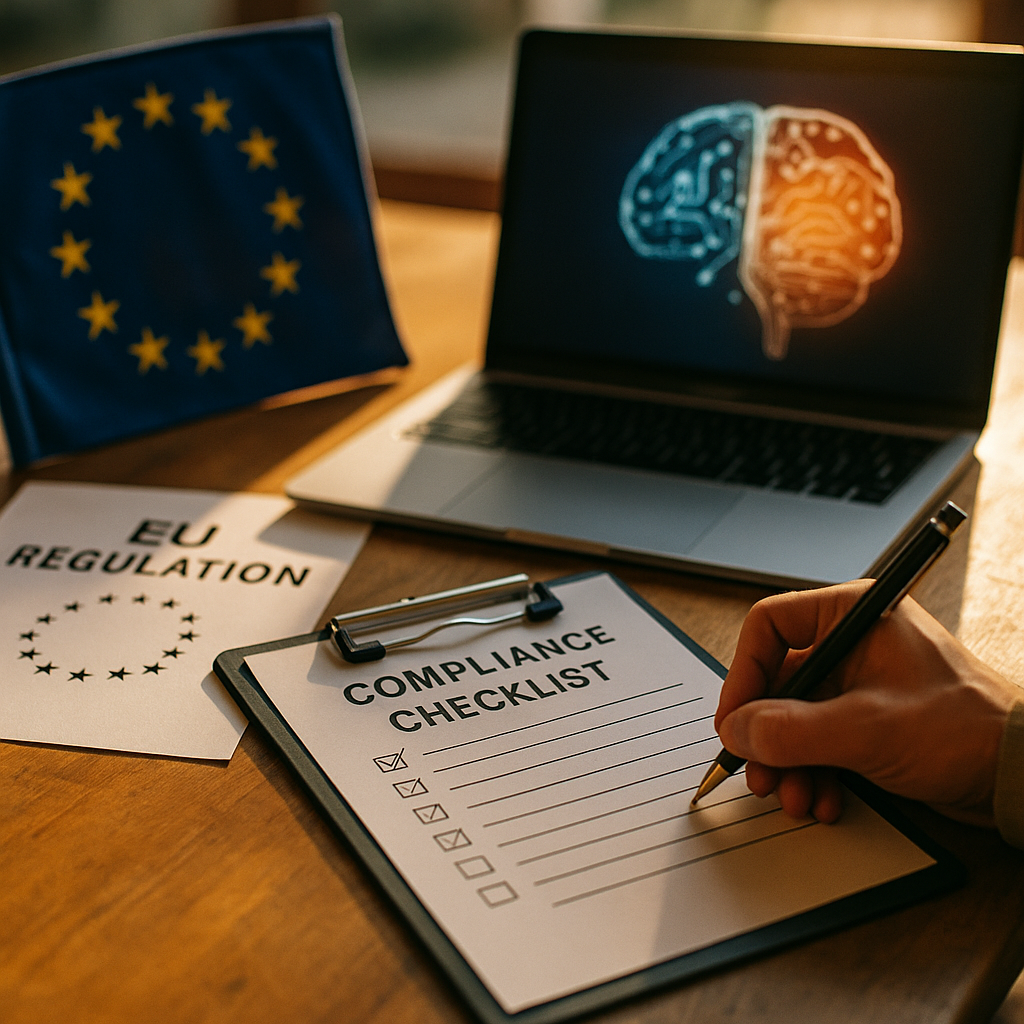
Brands running AI generated ads in the EU now face fines of up to 7% of global annual turnover for non-compliance. That’s not a typo, and it’s not a distant threat anymore. The EU AI transparency rules took effect this year, and most marketing teams still don’t have a working disclosure process. If your creative pipeline touches generative AI at any stage, this checklist is your starting point.
What the EU AI Transparency Rules Actually Require
The rules, anchored in the EU AI Act’s transparency obligations, require clear and machine readable labeling of AI generated or AI manipulated content, including advertising. This covers synthetic voiceovers, AI generated avatars, deepfake style product demos, and even “lightly touched” content where AI handled background removal or face swaps on real creators.
The key phrase regulators keep repeating is “reasonably informed consumer.” If an average viewer could mistake AI generated content for authentic, unedited footage, disclosure is mandatory. That threshold is lower than most brand legal teams assumed when they first scanned the regulation.
Regulators aren’t asking whether you used AI. They’re asking whether a reasonable consumer could tell the difference without being told.
This builds directly on labeling frameworks that platforms already rolled out. Our earlier coverage of how EU AI content labeling changed creator workflows showed this was coming months before enforcement began. The difference now is that enforcement has teeth, and it applies to brands, not just the creators or platforms distributing the content.
Why This Isn’t Just a Legal Problem
Here’s the uncomfortable part: compliance and performance are now the same conversation. A 2024 Statista consumer trust survey found a majority of EU respondents said they’d trust a brand less if they discovered undisclosed AI content after the fact. Disclosure done well doesn’t tank performance. Disclosure done badly, or skipped entirely, creates a trust crater that’s expensive to climb out of.
There’s also an operational angle most CMOs underestimate. Every agency, freelancer, and AI tool in your creative supply chain is a potential compliance gap. If your retainer agency uses an AI voice clone vendor you’ve never vetted, you’re still liable. The multi agent AI workflows powering a lot of modern ad production make this harder to track, not easier, because no single team owns the full disclosure trail anymore.
The Overlap With Existing Influencer Disclosure Rules
If your brand already runs FTC-compliant influencer programs in the US, you’ll recognize the shape of this problem. The EU rules function like a stricter, AI-specific cousin of the FTC’s endorsement guidelines. Teams that struggled with inconsistent state AI disclosure laws domestically are now facing a second, separate compliance layer for EU markets, and the labeling standards don’t always match.
The Brand Checklist: What to Verify Before You Launch
Treat this as a pre-flight list, not a one-time audit. Run it on every campaign touching EU audiences.
- Map every AI touchpoint. Script generation, voice synthesis, image upscaling, avatar creation, and automated dubbing all count. List the tool and vendor for each.
- Confirm disclosure placement meets “clear and machine readable” standards. A tiny caption buried in a video description won’t survive scrutiny. Labels need to be visible on the content itself, not just in metadata.
- Audit creator contracts for AI disclosure clauses. If an influencer uses AI editing tools independently, your brand can still be on the hook if the final asset runs as a paid ad.
- Document consent for any AI likeness use. This includes voice cloning and digital doubles of real people, including your own employees in UGC-style content.
- Build a vendor disclosure rider into every AI tool contract. Require vendors to confirm their outputs meet labeling thresholds before assets reach your media buyers.
- Train media buying teams on regional variance. What passes in the US won’t necessarily pass under EU standards, especially around synthetic voice.
- Keep an audit trail per asset. Regulators and platform trust and safety teams will ask for proof, not promises.
That last point matters more than brands realize. An audit trail isn’t bureaucratic overhead, it’s your legal defense if a regulator or a competitor files a complaint.
Where Brands Get Tripped Up
Most compliance failures aren’t malicious. They’re structural. Three patterns show up repeatedly:
Agency blind spots. Brands assume their agency of record is handling disclosure because “that’s their job.” Agencies assume the brand’s legal team is reviewing final assets. Nobody owns it. This same ownership gap shows up in retail media network ad placements, where attribution for who approved the final creative gets murky fast.
Platform-native tools create invisible AI usage. If a creator uses a platform’s built-in AI background generator or auto-dub feature, your brand might not even know AI touched the asset. That doesn’t exempt you from disclosure requirements, it just makes the audit harder.
Watermarking gets treated as optional. Technical watermarking standards are becoming a baseline expectation, not a nice-to-have. Our breakdown of AI watermarking mandates covers how fast this shifted from recommended practice to contractual requirement in creator agreements.
How This Connects to GDPR
Disclosure rules don’t exist in a vacuum. Many AI tools process biometric or likeness data to generate synthetic content, which pulls GDPR consent requirements into the same conversation. The recent EU Digital Omnibus proposal is reshaping how creator consent gets documented, and brands that treat AI disclosure and GDPR consent as separate workstreams are going to duplicate effort or miss something entirely.
What Happens If You Ignore It?
Enforcement so far has followed a pattern: warnings first, fines for repeat or egregious violations. But regulators across member states are coordinating more tightly than they did during early GDPR enforcement, which means the “we didn’t know” defense has a shorter shelf life this time. The UK’s ICO has signaled similar coordination on AI transparency even outside full EU jurisdiction, so don’t assume Brexit creates a safe harbor.
The fastest way to turn a labeling oversight into a full regulatory investigation is to have no documentation when asked.
Think about this domestically too. State AG enforcement has already shown that regulators will move faster than federal guidance updates, and the FTC has signaled growing interest in AI-specific endorsement cases. If you’re building a compliance process for the EU, build it to scale globally. It’s cheaper than rebuilding it region by region.
Operationalizing This Without Slowing Down Production
None of this requires grinding your production calendar to a halt. Most brands that get this right build a lightweight disclosure checkpoint into their existing creative approval workflow, the same stage where legal already reviews claims and substantiation. According to eMarketer, brands increasing AI content production fastest are also the ones investing earliest in compliance tooling, not treating it as an afterthought.
Practical move: assign one person per campaign as the “AI disclosure owner.” Not a committee, one accountable person who signs off before media spend goes live. It sounds simple because it is, and it’s the single fastest fix for the ownership gaps that cause most violations.
FAQs
Do the EU AI transparency rules apply to brands outside the EU?
Yes, if your ads reach EU consumers. Jurisdiction is based on audience location, not where your company is headquartered, so US and UK brands running EU-targeted campaigns are fully in scope.
What counts as “AI generated” for disclosure purposes?
Any content created or substantially altered by AI, including synthetic voices, AI generated visuals, deepfake-style edits, and automated dubbing. Minor AI-assisted edits like color correction generally fall outside the requirement, but the line isn’t always clear, so err toward disclosure when uncertain.
Does this apply to influencer content or only brand-produced ads?
Both. If a creator’s AI generated content runs as a paid ad or sponsored placement, the brand carries disclosure responsibility alongside the creator, regardless of who technically produced the asset.
What’s the penalty for non-compliance?
Fines can reach up to 7% of global annual turnover for the most serious violations, though enforcement to date has prioritized warnings and corrective orders before escalating to maximum penalties.
How is this different from existing FTC influencer disclosure rules?
FTC rules focus on material connections and endorsement honesty. The EU AI transparency rules specifically target whether content is AI generated or manipulated, independent of any paid relationship. A fully organic post using AI avatars still requires disclosure under EU rules even without a brand deal.
Start with one campaign, one market, one disclosure owner. Run the checklist above against it this week, document every gap you find, and use that audit to build the template you’ll apply everywhere else before your next EU media buy goes live.
Top Influencer Marketing Agencies
The leading agencies shaping influencer marketing in 2026
Agencies ranked by campaign performance, client diversity, platform expertise, proven ROI, industry recognition, and client satisfaction. Assessed through verified case studies, reviews, and industry consultations.
Moburst

-
2

The Shelf
Boutique Beauty & Lifestyle Influencer AgencyA data-driven boutique agency specializing exclusively in beauty, wellness, and lifestyle influencer campaigns on Instagram and TikTok. Best for brands already focused on the beauty/personal care space that need curated, aesthetic-driven content.Clients: Pepsi, The Honest Company, Hims, Elf Cosmetics, Pure LeafVisit The Shelf → -
3

Audiencly
Niche Gaming & Esports Influencer AgencyA specialized agency focused exclusively on gaming and esports creators on YouTube, Twitch, and TikTok. Ideal if your campaign is 100% gaming-focused — from game launches to hardware and esports events.Clients: Epic Games, NordVPN, Ubisoft, Wargaming, Tencent GamesVisit Audiencly → -
4

Viral Nation
Global Influencer Marketing & Talent AgencyA dual talent management and marketing agency with proprietary brand safety tools and a global creator network spanning nano-influencers to celebrities across all major platforms.Clients: Meta, Activision Blizzard, Energizer, Aston Martin, WalmartVisit Viral Nation → -
5

The Influencer Marketing Factory
TikTok, Instagram & YouTube CampaignsA full-service agency with strong TikTok expertise, offering end-to-end campaign management from influencer discovery through performance reporting with a focus on platform-native content.Clients: Google, Snapchat, Universal Music, Bumble, YelpVisit TIMF → -
6

NeoReach
Enterprise Analytics & Influencer CampaignsAn enterprise-focused agency combining managed campaigns with a powerful self-service data platform for influencer search, audience analytics, and attribution modeling.Clients: Amazon, Airbnb, Netflix, Honda, The New York TimesVisit NeoReach → -
7

Ubiquitous
Creator-First Marketing PlatformA tech-driven platform combining self-service tools with managed campaign options, emphasizing speed and scalability for brands managing multiple influencer relationships.Clients: Lyft, Disney, Target, American Eagle, NetflixVisit Ubiquitous → -
8

Obviously
Scalable Enterprise Influencer CampaignsA tech-enabled agency built for high-volume campaigns, coordinating hundreds of creators simultaneously with end-to-end logistics, content rights management, and product seeding.Clients: Google, Ulta Beauty, Converse, AmazonVisit Obviously →