


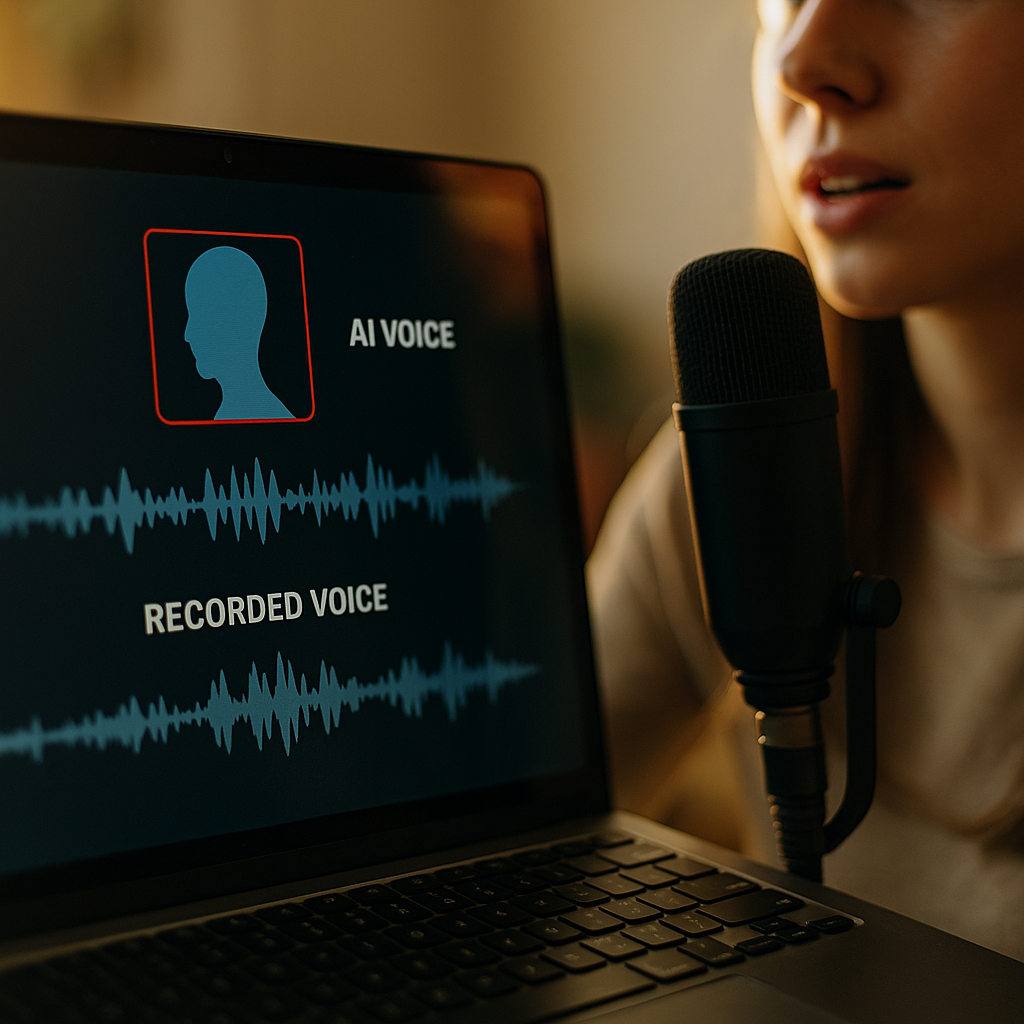
Nearly 40% of consumers say they cannot reliably tell a cloned voice from a real one in a 15-second ad clip. That gap is exactly why AI voice clone disclosure has become one of the fastest-moving compliance issues in influencer marketing. If your brand is running audio ads, podcast reads, or voiceover content generated or altered by AI, the question isn’t whether you need to disclose it. It’s whether your current workflow can prove you did.
Why AI Voice Clones Changed the Disclosure Game
Voice cloning used to be a novelty. Now it’s a production shortcut. Brands use it to scale podcast ad reads across markets, localize a creator’s voice into five languages without booking five creators, or revive a legacy spokesperson’s tone for a new campaign. The tech is good enough that listeners often can’t tell the difference, which is precisely the problem regulators are circling.
Unlike a visual deepfake, which gets flagged the moment someone zooms in on a weird hand or glitchy jawline, a cloned voice can sail through untouched. There’s no visual tell. That makes audio disclosure a different animal than the image and video labeling rules brands have spent the last year adapting to under frameworks like the EU AI content labeling requirements.
If a listener can’t visually confirm what they’re hearing, the burden of disclosure shifts entirely onto the brand’s audio production process, not the platform’s content moderation tools.
What Counts as a “Voice Clone” Under Current Rules?
This is where a lot of legal and marketing teams talk past each other. “Voice clone” isn’t just a synthetic voice built from scratch in a tool like ElevenLabs. Regulators and platform policies increasingly define it broadly enough to cover:
- A real creator’s voice trained on a model and reused in content they didn’t personally record
- AI-assisted pitch correction or accent modification applied to a human read
- Dubbing a creator’s original voice into another language using their own vocal likeness
- Splicing archived audio of a creator or spokesperson into a new script
That last category trips up more brands than any other. Marketing teams assume that because the “real” voice was recorded by a real person at some point, reusing it isn’t synthetic. Regulators disagree when the final output misrepresents context, timing, or consent.
The FTC’s Position (and Where It’s Silent)
The Federal Trade Commission has made clear that deceptive AI-generated endorsements fall under existing rules against misleading advertising, even without a dedicated voice clone statute. The core test hasn’t changed: would a reasonable consumer be misled about who is actually speaking? If a listener believes they’re hearing an unscripted, authentic endorsement from a real creator and it’s actually a synthetic reconstruction, that’s a material omission.
What the FTC hasn’t done is issue audio-specific labeling format requirements the way some state laws and the EU have for visual AI content. That ambiguity is a trap, not a loophole. Brands that read FTC silence as permission tend to discover otherwise during an investigation, not before one. For a broader view of how enforcement has shifted from federal to state actors, the piece on state AG enforcement surges is worth a close read.
State Laws Are Moving Faster Than Washington
Several states have passed or advanced legislation specifically targeting synthetic voice and likeness use in commercial content, often extending existing right-of-publicity protections to cover AI-generated vocal likeness. Tennessee’s ELVIS Act was an early mover on this front, explicitly protecting voice as a property right against unauthorized AI replication. Other states have followed with broader AI disclosure mandates that sweep in audio alongside video and image content.
This creates a patchwork problem for any brand running national campaigns. A disclosure approach that satisfies one state’s threshold might fall short in another. Our breakdown of state AI disclosure laws maps out which jurisdictions have the strictest audio-specific requirements right now, and it’s not the states most brands assume.
Building a Disclosure Workflow That Actually Holds Up
Verbal disclaimers get skipped. Fine print in show notes gets ignored. If your AI voice disclosure strategy depends on a listener actively seeking out a label, it’s not a disclosure strategy, it’s a liability waiting to surface. Here’s what a defensible workflow actually looks like:
- Disclose at the point of listening, not just in metadata. An audio tag at the start or a verbal cue (“this ad uses an AI-generated voice”) performs far better under scrutiny than a buried text disclaimer.
- Document creator consent separately from usage rights. A creator agreeing to be recorded isn’t the same as a creator agreeing to have their voice cloned and reused in future content. Get this in writing, every time.
- Keep a generation log. Which tool produced the audio, what source material trained the voice, and who approved the final cut. If regulators ask, “prove it,” you need an answer faster than your legal team can draft one.
- Align disclosure language with platform policy, not just law. Meta and TikTok have their own AI content labeling requirements that can be stricter than the legal minimum.
This mirrors the broader shift happening across AI-generated creator content. The same consent-trail logic driving requirements around AI decisioning tools, covered in our look at AI decisioning and consent trails, applies just as directly to synthetic audio.
A verbal disclosure buried at the 58-second mark of a 60-second audio ad will not survive a deceptive advertising complaint. Disclosure has to happen before the persuasive content, not after it.
The Contract Clause Brands Keep Forgetting
Most influencer agreements were written for human performance, not voice licensing. If your contract template doesn’t explicitly address AI voice cloning, you don’t have a usage right, you have ambiguity, and ambiguity is exactly what plaintiffs’ attorneys look for. A proper clause should spell out:
- Whether the creator’s voice can be used to train a model at all
- How long the license lasts and whether it survives contract termination
- Geographic and language scope for dubbed or localized synthetic audio
- Revocation rights if the creator wants the voice model deleted
This is the same gap that’s been showing up across AI-generated content categories more broadly. The indemnification issues raised in AI indemnification coverage apply directly here: if a creator’s cloned voice ends up in content they never approved, who absorbs the legal exposure, the brand or the agency that produced it? Get that answer in writing before production starts, not after a complaint lands.
Watermarking is becoming part of this conversation too. As more jurisdictions move toward mandatory AI content tagging, similar to the direction outlined in AI watermarking mandate coverage, voice-specific watermarking tech is likely to become a contract requirement rather than a nice-to-have within the next product cycle.
What Happens If You Skip This?
Beyond FTC enforcement and state right-of-publicity claims, there’s a reputational cost that’s harder to quantify but just as real. Consumers who feel deceived by a cloned voice don’t just distrust that single ad, they extend that distrust to the brand and the platform. A 2024 eMarketer survey found trust in AI-generated marketing content drops sharply the moment consumers learn disclosure was skipped, even if the underlying claims in the ad were accurate. The deception itself becomes the story, not the product.
Agencies and brands running performance audio at scale should also check how their reporting stack handles disclosure verification. If CPM and engagement reporting doesn’t flag which assets used synthetic voice, you’ve got a substantiation gap similar to the one described in blended CPM reporting and FTC substantiation. Compliance and performance tracking need to live in the same system, not two separate spreadsheets nobody cross-checks.
Visible FAQ
FAQs
Do I need to disclose AI voice cloning if the creator approved it?
Yes. Creator approval covers usage rights, not consumer disclosure obligations. Regulators care about whether the listener was misled, regardless of whether the voice owner consented to the cloning.
Is a written disclaimer in the show notes enough?
Generally, no. Disclosure needs to reach the listener at the point of consumption. A verbal cue at the start of the audio or an audible tag performs far better under regulatory scrutiny than text-only disclaimers buried in metadata.
Does AI voice disclosure apply to dubbed or translated content?
Yes, if the dubbing uses a cloned version of the creator’s voice rather than a separate human voiceover artist. Translating a creator’s actual recorded voice using AI still counts as synthetic audio under most current frameworks.
What’s the difference between voice enhancement and voice cloning?
Basic pitch correction or noise reduction on a human-recorded track typically isn’t considered cloning. The line gets crossed when AI generates speech patterns, cadence, or vocal characteristics the creator didn’t actually perform in that specific recording.
Can brands be held liable if an agency produced the cloned audio?
Often yes, especially if the brand is the advertiser of record. Indemnification clauses in production contracts matter here, but regulators frequently pursue both the brand and the production vendor.
Are platform AI labeling policies the same as legal disclosure requirements?
No. Platforms like Meta and TikTok have their own content labeling rules that can be stricter or differently scoped than state or federal law. Compliance with one doesn’t guarantee compliance with the other.
The brands that stay ahead of this won’t be the ones waiting for a federal voice cloning statute. They’ll be the ones auditing every piece of AI-touched audio now, tightening creator contracts this quarter, and treating disclosure as a production step, not a legal afterthought.
Top Influencer Marketing Agencies
The leading agencies shaping influencer marketing in 2026
Agencies ranked by campaign performance, client diversity, platform expertise, proven ROI, industry recognition, and client satisfaction. Assessed through verified case studies, reviews, and industry consultations.
Moburst

-
2

The Shelf
Boutique Beauty & Lifestyle Influencer AgencyA data-driven boutique agency specializing exclusively in beauty, wellness, and lifestyle influencer campaigns on Instagram and TikTok. Best for brands already focused on the beauty/personal care space that need curated, aesthetic-driven content.Clients: Pepsi, The Honest Company, Hims, Elf Cosmetics, Pure LeafVisit The Shelf → -
3

Audiencly
Niche Gaming & Esports Influencer AgencyA specialized agency focused exclusively on gaming and esports creators on YouTube, Twitch, and TikTok. Ideal if your campaign is 100% gaming-focused — from game launches to hardware and esports events.Clients: Epic Games, NordVPN, Ubisoft, Wargaming, Tencent GamesVisit Audiencly → -
4

Viral Nation
Global Influencer Marketing & Talent AgencyA dual talent management and marketing agency with proprietary brand safety tools and a global creator network spanning nano-influencers to celebrities across all major platforms.Clients: Meta, Activision Blizzard, Energizer, Aston Martin, WalmartVisit Viral Nation → -
5

The Influencer Marketing Factory
TikTok, Instagram & YouTube CampaignsA full-service agency with strong TikTok expertise, offering end-to-end campaign management from influencer discovery through performance reporting with a focus on platform-native content.Clients: Google, Snapchat, Universal Music, Bumble, YelpVisit TIMF → -
6

NeoReach
Enterprise Analytics & Influencer CampaignsAn enterprise-focused agency combining managed campaigns with a powerful self-service data platform for influencer search, audience analytics, and attribution modeling.Clients: Amazon, Airbnb, Netflix, Honda, The New York TimesVisit NeoReach → -
7

Ubiquitous
Creator-First Marketing PlatformA tech-driven platform combining self-service tools with managed campaign options, emphasizing speed and scalability for brands managing multiple influencer relationships.Clients: Lyft, Disney, Target, American Eagle, NetflixVisit Ubiquitous → -
8

Obviously
Scalable Enterprise Influencer CampaignsA tech-enabled agency built for high-volume campaigns, coordinating hundreds of creators simultaneously with end-to-end logistics, content rights management, and product seeding.Clients: Google, Ulta Beauty, Converse, AmazonVisit Obviously →