


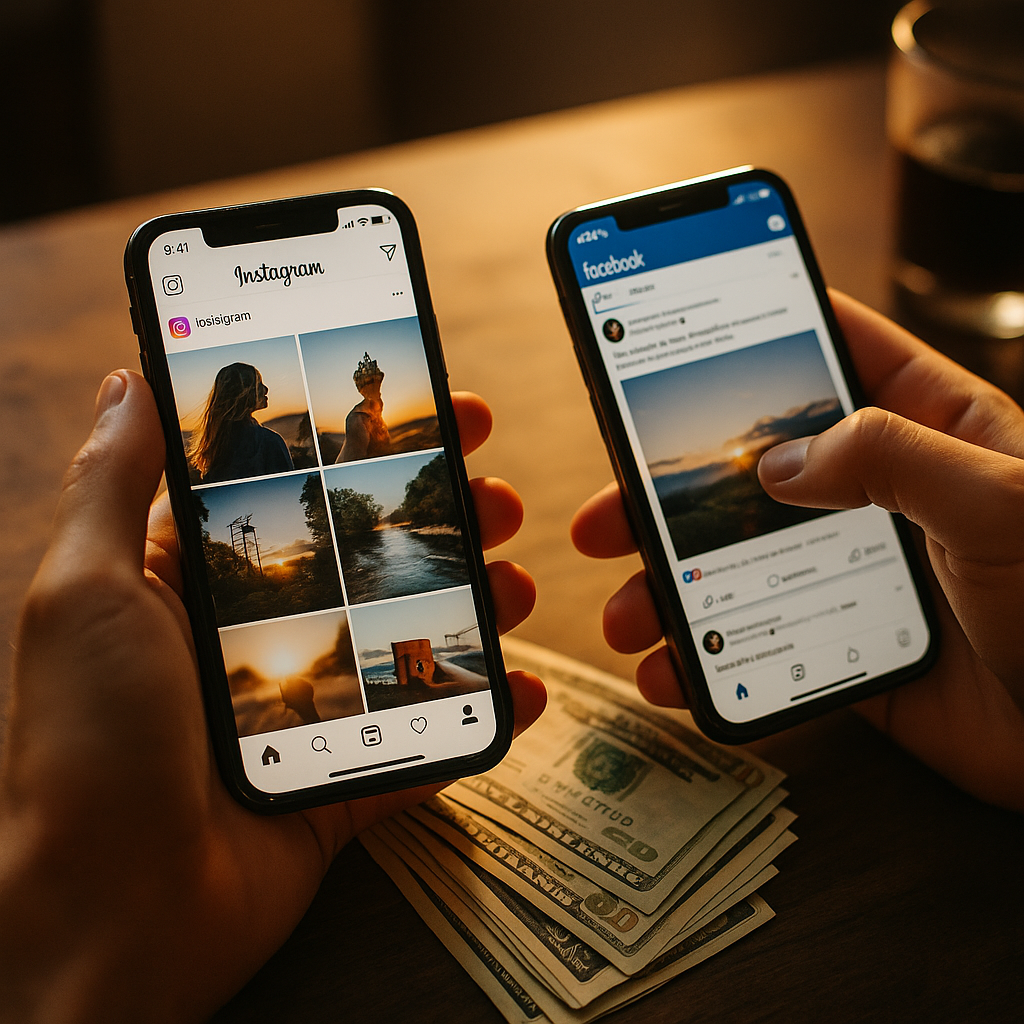
Instagram influencer posts now average $5,000, while comparable Facebook posts fetch just $1,250. That’s not a rounding error or a fluke in one agency’s rate card. It’s a structural four-to-one pricing gap that’s reshaping how brands allocate creator budgets heading into next year. If you’re still splitting spend evenly across Meta’s two platforms out of habit, you’re almost certainly overpaying on one and underinvesting in the other.
The Numbers Behind the Gap
Rate card data circulating among talent agencies and creator marketplaces puts the average Instagram sponsored post at roughly $5,000, with mid-tier creators (100k to 500k followers) often landing between $2,500 and $8,000 depending on niche and production complexity. Facebook, by contrast, hovers around $1,250 for comparable reach and follower tiers. That’s not a small discount. It’s a pricing structure that tells you exactly where attention, and therefore commercial value, actually lives.
The gap widens further at the top end. Macro and celebrity-tier creators on Instagram can command $20,000 to $50,000 per post for product launches or campaign anchors. Facebook rarely sees pricing in that range outside of legacy media partnerships or boosted post arrangements that blur the line between organic creator content and paid media.
A four-to-one pricing gap between platforms isn’t a pricing anomaly. It’s the market telling you where engagement, purchase intent, and creative format fit actually converge.
Why Instagram Commands the Premium
Three forces explain most of the differential, and none of them are mysterious once you look at platform mechanics side by side.
- Format fit: Instagram’s Reels, Stories, and carousel formats are built for the exact kind of short-form, aspirational content that performs in sponsored partnerships. Facebook’s feed still skews toward link shares, group discussions, and an older demographic that engages differently with branded content.
- Audience composition: Instagram’s user base trends younger and more purchase-ready for the categories that dominate influencer spend: beauty, fashion, fitness, food, and lifestyle. Facebook’s audience, while massive, is increasingly older and less responsive to creator-led product discovery.
- Discovery and algorithmic reach: Instagram’s Explore and Reels algorithms actively surface creator content to non-followers, extending organic reach beyond a creator’s existing base. Facebook’s algorithm prioritizes content from friends and groups, which structurally limits how far a sponsored post travels without paid boosting.
Put simply, Instagram has engineered a content environment where influencer posts perform like native advertising. Facebook hasn’t, at least not to the same degree. According to eMarketer’s platform engagement data, Instagram continues to outpace Facebook on time spent per session among adults under 45, the exact demographic most brands are chasing with influencer budgets.
What This Means for Budget Allocation
If you’re a brand strategist building a creator media plan for the year ahead, the pricing gap isn’t just a line item curiosity. It’s a signal about where to concentrate spend and where to pull back.
Here’s the uncomfortable truth: many brands still run Facebook influencer campaigns because the platform is familiar, the ad manager integrates cleanly with existing media buys, and legacy agency relationships default to it. But familiarity isn’t performance. If your Facebook sponsored posts are generating a fraction of the engagement per dollar that Instagram delivers, you’re paying a “comfort tax” on an underperforming channel.
That doesn’t mean abandon Facebook entirely. Certain categories, particularly those skewing toward older demographics (home improvement, financial services, health and wellness for 45+ audiences), still see reasonable returns on Facebook creator content. The key is matching platform spend to where your actual buyer persona spends time, not where your media plan has always defaulted.
The CAC Reality Check
Pricing per post is only half the story. What matters more is customer acquisition cost once you account for conversion rates, not just reach. A $5,000 Instagram post that drives strong click-through and conversion can easily beat a $1,250 Facebook post that generates passive impressions but little action. Our recent breakdown of platform CAC benchmarks found that brands frequently misjudge true cost-per-acquisition because they anchor on sticker price rather than downstream performance.
This is where attribution models matter enormously. If your measurement stack still relies on last-click attribution, you’re likely undercounting Instagram’s influence on purchase decisions that happen days or weeks after initial exposure. Our piece on attribution failures in creator journeys digs into why brands need multi-touch models to see the real ROI gap between platforms.
Negotiating Rates in a Widening Gap
For brands and agencies negotiating directly with creators or through talent management firms, the pricing gap creates leverage opportunities on both ends.
- Bundle platforms strategically. Creators who post across both Instagram and Facebook from the same content shoot often discount the Facebook add-on significantly, since production costs are already sunk. Negotiate bundled packages rather than paying full rate card for each platform separately.
- Push back on inflated Instagram quotes. Not every creator’s audience justifies the $5,000 average. Ask for platform-specific engagement rate data, not just follower counts, before agreeing to top-of-range pricing.
- Watch for AI-driven rate compression. Agencies are increasingly defending fee structures against AI-driven discounting pressure. Our coverage of agencies resisting AI rate cuts shows how talent reps are framing pricing as risk control rather than a negotiable line item, which affects how much flexibility you’ll actually get at the table.
Smart brands also look at category-specific pricing benchmarks before entering negotiations. A supplement brand, for instance, operates under very different economics than a SaaS company running thought-leadership content. Our look at how the supplement category structures creator spend for margin protection is a useful model even outside that specific vertical.
Is the Gap Sustainable, or Will It Close?
Some media buyers argue the Instagram-Facebook pricing gap will narrow as Meta continues integrating the two platforms’ ad infrastructure and cross-posting tools. That’s possible, but unlikely in the near term. Instagram’s cultural relevance among creators and younger consumers isn’t something an ad tech merger fixes. Meta’s own business platform resources continue to position Instagram and Facebook as distinct audience environments with separate creative best practices, which suggests even Meta doesn’t expect convergence anytime soon.
There’s also a broader shift happening beneath this specific pricing comparison. As retail media networks and platforms like TikTok Shop absorb a growing share of creator budgets, both Instagram and Facebook are competing against an expanding set of alternatives, not just each other. Our analysis of how retail media is absorbing creator budgets is worth reading alongside this pricing comparison, since it changes the denominator brands are working with entirely.
For benchmarking purposes, industry pricing surveys from sources like HubSpot’s marketing research and Sprout Social’s platform reports are good cross-checks before finalizing any rate card assumptions internally.
Practical Takeaway
Run a quick audit this quarter: compare your last six months of Instagram and Facebook influencer spend against actual conversion data, not just engagement metrics. If Facebook isn’t delivering proportionate return relative to its lower cost, shift that budget toward Instagram or test it against emerging platforms where creator economics are still favorable. The pricing gap is real, it’s documented, and it’s not closing fast enough to justify waiting.
Frequently Asked Questions
Why is the Instagram influencer post rate so much higher than Facebook’s?
Instagram commands higher rates because of stronger algorithmic discovery, a younger and more purchase-ready audience, and content formats (Reels, Stories) that are better suited to sponsored partnerships than Facebook’s feed-driven, link-heavy environment.
Does a higher post rate mean better ROI?
Not automatically. Post rate reflects reach and demand, not conversion. Brands need to evaluate cost-per-acquisition and attribution data alongside sticker price to determine true ROI on either platform.
Should brands stop using Facebook for influencer marketing entirely?
No. Facebook still performs reasonably well for categories skewing toward older demographics, such as financial services or home improvement. The decision should be based on audience match, not platform prestige.
How can brands negotiate better creator rates given this pricing gap?
Bundle Instagram and Facebook deliverables from the same content shoot, request platform-specific engagement data before agreeing to rate card pricing, and benchmark against category-specific spend models rather than generic averages.
Will the pricing gap between Instagram and Facebook narrow over time?
It’s unlikely to close significantly in the near term. Meta continues to treat the two platforms as distinct audience environments, and Instagram’s cultural relevance among creators remains a structural advantage that ad tech integration alone won’t erase.
Top Influencer Marketing Agencies
The leading agencies shaping influencer marketing in 2026
Agencies ranked by campaign performance, client diversity, platform expertise, proven ROI, industry recognition, and client satisfaction. Assessed through verified case studies, reviews, and industry consultations.
Moburst

-
2

The Shelf
Boutique Beauty & Lifestyle Influencer AgencyA data-driven boutique agency specializing exclusively in beauty, wellness, and lifestyle influencer campaigns on Instagram and TikTok. Best for brands already focused on the beauty/personal care space that need curated, aesthetic-driven content.Clients: Pepsi, The Honest Company, Hims, Elf Cosmetics, Pure LeafVisit The Shelf → -
3

Audiencly
Niche Gaming & Esports Influencer AgencyA specialized agency focused exclusively on gaming and esports creators on YouTube, Twitch, and TikTok. Ideal if your campaign is 100% gaming-focused — from game launches to hardware and esports events.Clients: Epic Games, NordVPN, Ubisoft, Wargaming, Tencent GamesVisit Audiencly → -
4

Viral Nation
Global Influencer Marketing & Talent AgencyA dual talent management and marketing agency with proprietary brand safety tools and a global creator network spanning nano-influencers to celebrities across all major platforms.Clients: Meta, Activision Blizzard, Energizer, Aston Martin, WalmartVisit Viral Nation → -
5

The Influencer Marketing Factory
TikTok, Instagram & YouTube CampaignsA full-service agency with strong TikTok expertise, offering end-to-end campaign management from influencer discovery through performance reporting with a focus on platform-native content.Clients: Google, Snapchat, Universal Music, Bumble, YelpVisit TIMF → -
6

NeoReach
Enterprise Analytics & Influencer CampaignsAn enterprise-focused agency combining managed campaigns with a powerful self-service data platform for influencer search, audience analytics, and attribution modeling.Clients: Amazon, Airbnb, Netflix, Honda, The New York TimesVisit NeoReach → -
7

Ubiquitous
Creator-First Marketing PlatformA tech-driven platform combining self-service tools with managed campaign options, emphasizing speed and scalability for brands managing multiple influencer relationships.Clients: Lyft, Disney, Target, American Eagle, NetflixVisit Ubiquitous → -
8

Obviously
Scalable Enterprise Influencer CampaignsA tech-enabled agency built for high-volume campaigns, coordinating hundreds of creators simultaneously with end-to-end logistics, content rights management, and product seeding.Clients: Google, Ulta Beauty, Converse, AmazonVisit Obviously →