


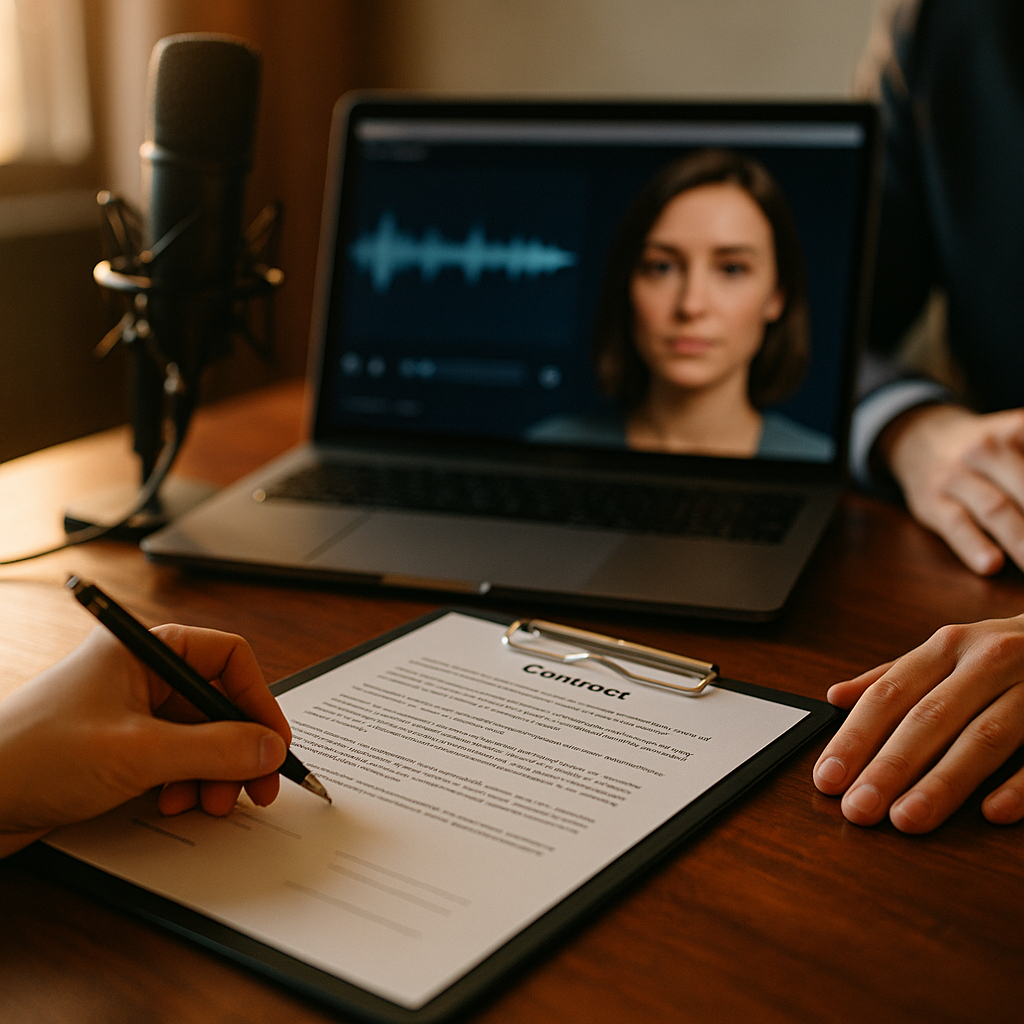
A cloned voice can now close a $40,000 ad read in under ten minutes, no studio, no creator approval loop, no second take. That speed is exactly the problem. AI voice clone consent has become the thinnest layer of protection in creator contracts, and most brands don’t realize how thin until a creator’s lawyer calls. If your influencer agreements still treat voice as an afterthought to “likeness,” you’re sitting on a liability gap wide enough to swallow a campaign budget.
Why Voice Got Left Out of the Likeness Conversation
For years, brand contracts bundled voice under broad “likeness and image” clauses, the same boilerplate used for photo usage and video appearances. That made sense when voice couldn’t be separated from the creator’s physical presence. It can now. Tools built on commercial text-to-speech models can isolate a creator’s vocal signature from a single sponsored video and generate new dialogue they never recorded, in languages they don’t speak, endorsing products they’ve never touched.
The legal frameworks haven’t caught up cleanly. Biometric privacy statutes in states like Illinois and Texas increasingly treat voiceprints as protected biometric identifiers, not just intellectual property. That reclassification matters enormously for brands. A likeness release that covers image use doesn’t automatically cover biometric data processing, and regulators are starting to notice the distinction. Our earlier breakdown of biometric laws and brand exposure walks through how fast this exposure is expanding state by state.
A standard likeness release signed in 2023 almost certainly does not authorize voice cloning, because the technology to isolate and reuse a voiceprint at scale didn’t exist in deployable form when most of those contracts were drafted.
The Gap, In Plain Terms
Here’s the uncomfortable math. A brand licenses a creator’s content for a campaign. The content includes audio. The brand’s AI vendor (or an overzealous internal marketing team) uses that audio to train a voice model for localization, for evergreen ad variants, or for a chatbot persona. The creator never agreed to any of that, because the original contract never mentioned voice cloning as a distinct use case. Nobody did anything maliciously. But the consent trail doesn’t exist, and that absence is what plaintiffs’ attorneys are learning to exploit.
- Original contract covers “use of recorded content” but not “derivative synthetic audio.”
- No separate opt-in for voice model training versus voice model deployment.
- No expiration or scope limit on how long a cloned voice asset can be reused.
- No creator approval checkpoint before a new script is generated from the clone.
Each of those gaps is fixable. Most brands just haven’t gotten around to fixing them, because voice cloning still feels like an edge case rather than a core production tool. It isn’t anymore. TikTok’s advertising ecosystem and similar platforms are actively building AI dubbing and voice localization features directly into creator campaign tooling, which means the use case is arriving whether your legal team is ready or not.
What Regulators Are Already Signaling
The FTC has made its position on synthetic endorsements fairly explicit: if a consumer can’t reasonably tell that a voice or face was AI generated, that’s a deceptive practice problem, not just a privacy problem. The agency’s enforcement posture around impersonation and AI-generated content has been tightening, and voice clones sit squarely in that crosshair because audio-only deception is harder for consumers to catch than a visibly synthetic video.
The EU’s approach layers transparency obligations on top of consent requirements, meaning brands operating across markets need both a signed release and a disclosure mechanism. We’ve covered the mechanics of that dual obligation in our piece on EU transparency rules and creator approval, and the disclosure side specifically in our analysis of audio labeling requirements for cloned voice. Consent and disclosure are two different compliance tracks, and brands that solve one while ignoring the other are still exposed.
South Korea’s recent penalty escalation for undisclosed ad content offers a preview of where enforcement dollars are heading globally. Regulators are no longer satisfied with a quiet settlement; they’re signaling that penalty structures will scale with the sophistication of the deception. A cloned voice reading an undisclosed ad is, by that logic, a more severe violation than a text caption that simply forgot a hashtag. Our coverage of the penalty hike and its budget implications is worth a close read if you run campaigns in Asia-Pacific markets.
Building a Consent Clause That Actually Holds Up
A workable AI voice clone consent clause needs to do more than grant permission. It needs to define scope, duration, and revocation in language specific enough that a court doesn’t have to guess what the parties intended. Vague consent is functionally no consent once litigation starts.
At minimum, the clause should separate:
- Training rights, whether the brand or its vendor can use the creator’s recorded voice to train or fine-tune a voice model at all.
- Generation rights, what categories of new scripted content the resulting clone can produce (ad reads only, versus open-ended marketing copy).
- Approval checkpoints, whether the creator or their agent must review and sign off on each new piece of generated audio before publication.
- Duration and sunset, how long the clone can be used and what happens to the model file when the contract ends.
- Compensation triggers, whether reuse beyond the original campaign requires additional payment, similar to usage rights renewals in traditional talent deals.
Brands that skip the approval checkpoint are taking on the most risk for the least operational gain. It costs almost nothing to route a generated script back to the creator for a thumbs up. It costs a great deal to explain in a deposition why you didn’t. If you’re still working from indemnification language that predates synthetic media, our guide to indemnification clauses for AI liability pairs naturally with the consent provisions discussed here, since the two usually need to be negotiated together.
Revocation Is the Clause Everyone Forgets
Creators change their minds. They leave agencies, they sign exclusivity deals with competitors, they simply decide a synthetic version of their voice makes them uncomfortable. A consent clause without a clear revocation mechanism puts the brand in an impossible position: either honor a verbal request immediately (and scramble to pull assets) or point to a contract that technically still permits use (and absorb the reputational hit when the creator goes public about it). Build the revocation process into the original agreement, with a defined notice period and a clear obligation to stop generating new content, even if previously published material has a wind down window.
Operationalizing Consent Across a Creator Roster
Legal language is only half the battle. The other half is tracking which creators have granted which permissions, across potentially hundreds of active contracts. This is where most mid-size programs fall apart, not because the contracts are bad, but because nobody built a system to enforce them at scale.
A consent clause that lives only in a signed PDF, with no corresponding entry in a rights management system, is effectively unenforceable the moment your creative team moves fast and forgets to check.
Practical steps that close this gap:
- Maintain a centralized rights database that flags voice clone permissions separately from image and video usage rights, searchable by creator and campaign.
- Require your production and AI vendors to confirm consent status before any voice asset enters a generation pipeline, not after.
- Build voice clone consent into your existing disclosure matrix rather than treating it as a one-off legal exception. Our framework for building one compliance matrix across platforms extends naturally to synthetic media permissions.
- Schedule recurring reviews. A quarterly audit cadence, like the one we outline for TikTok compliance reviews, catches expired or ambiguous consent before a campaign ships, not after a complaint lands.
None of this requires exotic tooling. Most brands already have contract management software or a creator CRM capable of tagging consent categories. The failure isn’t technical capacity, it’s that nobody assigned ownership of the tag. Someone on your legal or operations team needs to own “voice clone consent status” as a field, the same way someone owns payment status or deliverable tracking.
Insurance Won’t Save You, But It Helps
Several brands have started asking whether existing influencer marketing insurance policies cover voice clone disputes. The honest answer is: sometimes, and usually not fully. Standard media liability riders were written before synthetic voice was a mainstream production tool, and many policies explicitly exclude claims arising from AI generated content unless you’ve negotiated an endorsement for it. Before you assume you’re covered, read your policy’s definitions section line by line, and compare it against the risk categories outlined in our overview of closing the risk transfer gap. Insurance is a backstop, not a substitute for clean consent language. A policy that pays out after a lawsuit still leaves you with a creator relationship in ruins and a brand reputation hit that a settlement check doesn’t undo.
Industry benchmarking from firms like eMarketer and ongoing creator economy research from Sprout Social both point to the same trend: AI-assisted content production is scaling faster than the legal infrastructure around it. That mismatch is exactly where liability accumulates quietly until it becomes a headline.
The Takeaway
Treat voice as its own consent category, not a subset of likeness, and build the approval checkpoint into your production pipeline before your next AI-assisted campaign, not after a creator’s attorney finds the gap first.
FAQs
Does a standard likeness release cover AI voice cloning?
Generally no. Most likeness releases were drafted before voice cloning technology was widely deployable, so they don’t address training rights, generation scope, or revocation specific to synthetic audio. Brands need a separate clause or explicit addendum.
Who owns a creator’s cloned voice once it’s generated?
Ownership depends entirely on contract language. Without explicit terms, courts increasingly treat voiceprints as tied to the individual’s biometric identity, meaning the creator retains significant control even if the brand paid for the original recording session.
Can a creator revoke voice clone consent after signing a contract?
Yes, if the contract includes a revocation mechanism. Without one, the brand may technically retain usage rights, but continuing to use a voice clone against a creator’s explicit objection carries significant reputational and legal risk regardless of contract technicalities.
Does insurance cover lawsuits related to unauthorized voice cloning?
Only if the policy specifically includes an endorsement for AI-generated content claims. Many standard media liability policies exclude synthetic media disputes by default, so brands should verify coverage before assuming they’re protected.
How is voice clone consent different from disclosure requirements?
Consent governs whether a brand is legally permitted to create and use a cloned voice at all. Disclosure governs whether consumers are told the audio they’re hearing is AI generated. Brands need to satisfy both separately, since one does not substitute for the other.
Top Influencer Marketing Agencies
The leading agencies shaping influencer marketing in 2026
Agencies ranked by campaign performance, client diversity, platform expertise, proven ROI, industry recognition, and client satisfaction. Assessed through verified case studies, reviews, and industry consultations.
Moburst

-
2

The Shelf
Boutique Beauty & Lifestyle Influencer AgencyA data-driven boutique agency specializing exclusively in beauty, wellness, and lifestyle influencer campaigns on Instagram and TikTok. Best for brands already focused on the beauty/personal care space that need curated, aesthetic-driven content.Clients: Pepsi, The Honest Company, Hims, Elf Cosmetics, Pure LeafVisit The Shelf → -
3

Audiencly
Niche Gaming & Esports Influencer AgencyA specialized agency focused exclusively on gaming and esports creators on YouTube, Twitch, and TikTok. Ideal if your campaign is 100% gaming-focused — from game launches to hardware and esports events.Clients: Epic Games, NordVPN, Ubisoft, Wargaming, Tencent GamesVisit Audiencly → -
4

Viral Nation
Global Influencer Marketing & Talent AgencyA dual talent management and marketing agency with proprietary brand safety tools and a global creator network spanning nano-influencers to celebrities across all major platforms.Clients: Meta, Activision Blizzard, Energizer, Aston Martin, WalmartVisit Viral Nation → -
5

The Influencer Marketing Factory
TikTok, Instagram & YouTube CampaignsA full-service agency with strong TikTok expertise, offering end-to-end campaign management from influencer discovery through performance reporting with a focus on platform-native content.Clients: Google, Snapchat, Universal Music, Bumble, YelpVisit TIMF → -
6

NeoReach
Enterprise Analytics & Influencer CampaignsAn enterprise-focused agency combining managed campaigns with a powerful self-service data platform for influencer search, audience analytics, and attribution modeling.Clients: Amazon, Airbnb, Netflix, Honda, The New York TimesVisit NeoReach → -
7

Ubiquitous
Creator-First Marketing PlatformA tech-driven platform combining self-service tools with managed campaign options, emphasizing speed and scalability for brands managing multiple influencer relationships.Clients: Lyft, Disney, Target, American Eagle, NetflixVisit Ubiquitous → -
8

Obviously
Scalable Enterprise Influencer CampaignsA tech-enabled agency built for high-volume campaigns, coordinating hundreds of creators simultaneously with end-to-end logistics, content rights management, and product seeding.Clients: Google, Ulta Beauty, Converse, AmazonVisit Obviously →