


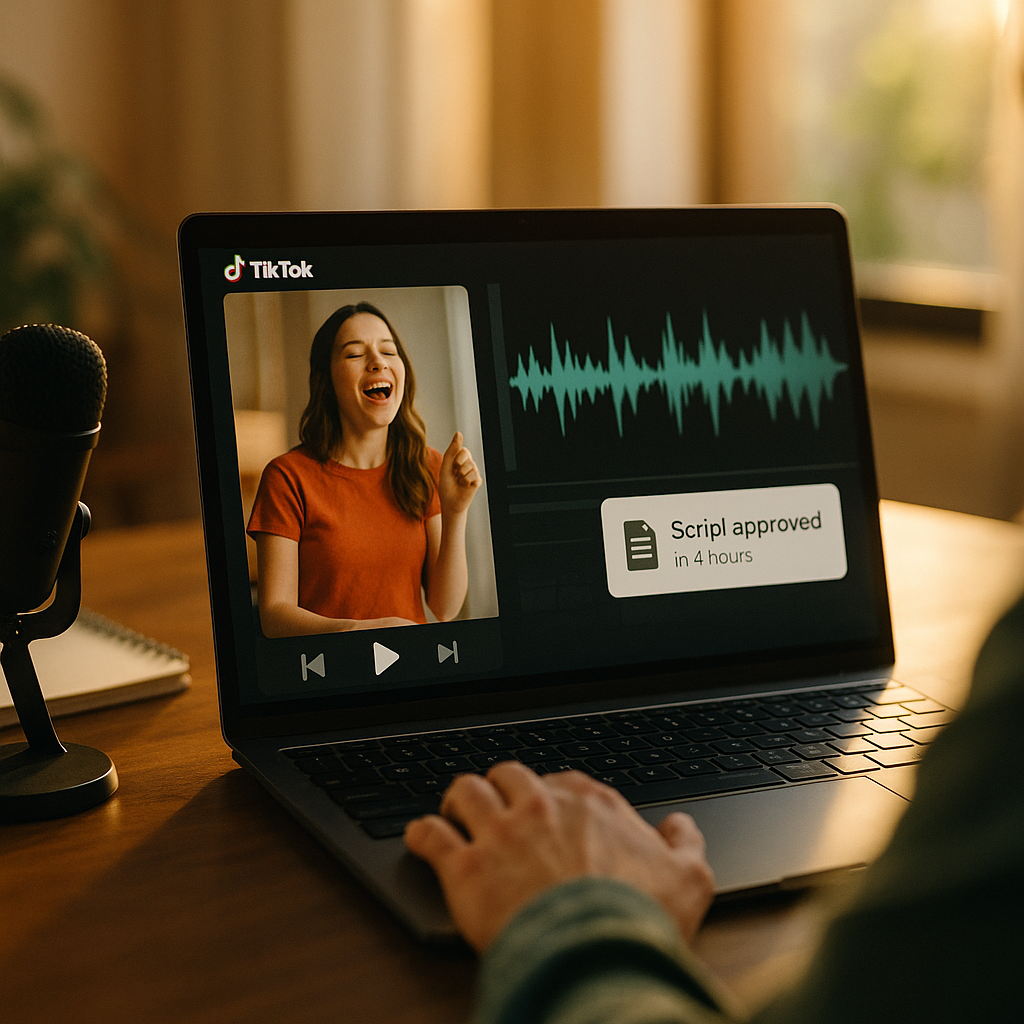
Trends die in about 72 hours now. By the time most brand approval chains finish round two of feedback, the audio’s already saturated and the algorithm has moved on. Trend audio jacking isn’t about being first, it’s about having a framework that lets your team move in hours instead of weeks, without triggering a legal review nightmare or a brand safety incident. Most brands don’t have that framework. This is one you can steal.
Why “Fast” Usually Means “Reckless” Right Now
Here’s the uncomfortable truth: speed and safety are usually treated as opposites inside brand marketing teams. Legal wants three days to review a sound’s licensing status. Social wants to post in three hours. Somebody loses, and it’s usually the trend.
The result is a pattern every social manager knows too well. A brand either sits out trending audio entirely (safe but invisible) or jumps in with zero vetting and ends up tied to a sound with a copyright strike, an offensive originator, or a meme context that doesn’t match the brand voice at all. Neither outcome is good for the business.
Treating trend speed and brand risk as a tradeoff is the single biggest reason brands miss 90% of viral audio windows entirely.
A real framework removes that false choice. It builds the vetting into the speed, so the checks happen in minutes, not meetings.
What Trend Audio Jacking Actually Means for Brands
Trend audio jacking is the practice of identifying a rising sound before it peaks, and rapidly producing branded content against it while the algorithmic boost is still strong. It’s distinct from general trend audio hijacking tactics in one key way: this is a governance framework, not a content tactic. It’s the operational system that makes hijacking safe to run at scale, repeatedly, across multiple markets or product lines without reinventing the approval process every single time.
Think of it like a pre-cleared playbook for a fire drill. Nobody debates the evacuation route when the alarm goes off. The route was decided in advance. Trend audio jacking works the same way: decide your risk thresholds, your approval tiers, and your production templates before the trend shows up, so when it does, you’re executing, not deliberating.
The Three Risk Categories Every Trend Carries
Not every trending sound carries the same exposure. Sorting incoming trends into three buckets before anyone touches a camera saves hours of back-and-forth.
- Green (low risk): Platform-native sounds with no identifiable controversial origin, no copyrighted music stems, and neutral or positive sentiment in top comments.
- Yellow (moderate risk): Audio tied to a meme format with ambiguous tone, or sounds pulled from licensed music libraries where usage rights need a quick check.
- Red (high risk): Audio tied to a controversial creator, a political moment, or any sound where the top comments show split or negative sentiment.
Green trends should be approved within an hour. Yellow trends need a single named approver, not a committee. Red trends get skipped, full stop. No trend is worth a brand safety crisis, and there’s always another sound next week.
Build the 4 Hour Decision Window
Most brands lose the trend race in the decision phase, not the production phase. Filming and editing a 15 second clip takes an hour with a decent creator or in-house team. Deciding whether to do it at all takes two days. Flip that ratio.
A 4 hour window works like this:
- Hour 1: Detection. Someone on the team (or a monitoring tool) flags the audio and logs it with a screenshot of current usage volume and top comment sentiment.
- Hour 2: Risk tagging. The social lead applies the green/yellow/red framework above. Yellow trends go to the single named approver immediately, not into a queue.
- Hour 3: Script and shoot. Using a pre-approved content template (more on this below), the creator or in-house talent films against a rough script adapted to the sound’s format.
- Hour 4: Publish. Caption, post, and tag for internal tracking. No extra review loop if the trend was tagged green.
This only works if production templates already exist. Which brings us to the part most brands skip.
Pre-Approved Formats Are the Real Unlock
You cannot write a brand-new script from scratch in hour three and still hit a four hour window. The fix is having a library of format skeletons ready to adapt to whatever audio shows up. A POV script template, an expectation versus reality structure, or a quick myth-busting format can all be mapped onto most trending sounds with minor tweaks.
Build four to six of these templates in advance, get them legally pre-cleared for tone and claims, and your creative team isn’t starting from a blank page every time a sound takes off. They’re doing format matching, which is a five minute job, not a five hour one.
This also solves a second problem: brand voice consistency. When five different team members are jumping on trends independently, without shared templates, the brand ends up sounding like five different accounts. Templates keep the voice tight even when the turnaround is fast.
Who Should Own the Button?
Speed dies the moment five people need to sign off. Assign one person per region or product line as the sole approver for green and yellow trends. That person should have a standing one-page brief covering banned topics, legal red flags, and brand tone guardrails, so they’re not calling legal every single time.
This is uncomfortable for brands used to committee-based approval. But committees are built for quarterly campaigns, not for content with a 72 hour shelf life. A single named owner with clear guardrails is the only structure fast enough to matter.
The Legal and Platform Risk Nobody Talks About
Trend audio isn’t automatically free to use commercially, even when it’s trending on the platform’s own sound library. Original music stems, remixed tracks, and audio pulled from films or TV often carry copyright protections that platform trending status doesn’t override. The FTC’s disclosure guidance also applies here: if a creator is paid to use the sound in a branded context, standard disclosure rules still apply regardless of how organic the trend looks.
Check each platform’s commercial use terms before greenlighting anything in the yellow bucket. TikTok’s ad platform and Meta’s business tools both have separate licensing rules for branded content versus organic posts, and the two aren’t interchangeable. A sound cleared for an organic post on a creator’s personal account isn’t necessarily cleared for a paid spark ad or boosted post.
The fastest way to turn a viral win into a legal liability is assuming “trending” means “licensed.” They are not the same thing.
Measuring Whether It’s Actually Working
Speed for its own sake isn’t a strategy. Track these three metrics to know if the framework is paying off:
- Time-to-publish: the gap between detection and posting. If this is creeping past six hours, the framework is leaking somewhere.
- Saturation timing: did you post while the sound was still climbing, or after it peaked? Tools and platform analytics both show usage volume trends over time.
- Engagement relative to account baseline: a trend jack should outperform your normal content, not just match it. If it doesn’t, the format match was probably weak.
According to Sprout Social’s platform research, brands that respond to trends within the first 48 hours of emergence see meaningfully higher engagement rates than those who post after the trend has plateaued. Speed isn’t a vanity metric here, it’s the whole mechanism.
Where This Fits Alongside Other Fast-Turnaround Formats
Trend audio jacking works best as one lane in a broader rapid-response content system. Pair it with stitch and reply formats for reactive content, and low cost UGC briefs for when you need volume without a full production crew. The common thread across all of these is pre-approval. Every fast format needs its guardrails built before the moment arrives, not during it.
Next Step
Don’t wait for the next trend to test this. Build your risk tiers, name your single approver, and pre-clear three content templates this week, so the next viral sound is a four hour execution, not a four day debate.
FAQs
What is trend audio jacking in influencer marketing?
Trend audio jacking is a brand framework for quickly identifying rising trending sounds and producing approved branded content against them before the trend saturates, using pre-set risk tiers and approval rules to keep the process fast and compliant.
How fast should a brand respond to a trending sound?
Ideally within 4 to 6 hours of detecting early momentum, and no later than 48 hours, since engagement on trend-based content drops sharply once a sound saturates or plateaus.
Is it legal to use trending audio for branded content?
Not automatically. Platform trending status doesn’t guarantee commercial licensing, especially for paid or branded posts. Brands should check each platform’s commercial use terms and confirm whether the audio involves copyrighted music stems before using it in sponsored content.
Who should approve trend-based content inside a brand?
A single named approver per region or product line, working from a pre-written brief covering banned topics and brand tone guardrails, moves faster and more consistently than a committee-based review process.
How do you know if a trending sound is too risky to use?
Check the sound’s origin and top comment sentiment. Audio tied to controversial creators, political moments, or mixed and negative sentiment should be classified as high risk and skipped entirely, regardless of its trending volume.
FAQs
What is trend audio jacking in influencer marketing?
Trend audio jacking is a brand framework for quickly identifying rising trending sounds and producing approved branded content against them before the trend saturates, using pre-set risk tiers and approval rules to keep the process fast and compliant.
How fast should a brand respond to a trending sound?
Ideally within 4 to 6 hours of detecting early momentum, and no later than 48 hours, since engagement on trend-based content drops sharply once a sound saturates or plateaus.
Is it legal to use trending audio for branded content?
Not automatically. Platform trending status doesn’t guarantee commercial licensing, especially for paid or branded posts. Brands should check each platform’s commercial use terms and confirm whether the audio involves copyrighted music stems before using it in sponsored content.
Who should approve trend-based content inside a brand?
A single named approver per region or product line, working from a pre-written brief covering banned topics and brand tone guardrails, moves faster and more consistently than a committee-based review process.
How do you know if a trending sound is too risky to use?
Check the sound’s origin and top comment sentiment. Audio tied to controversial creators, political moments, or mixed and negative sentiment should be classified as high risk and skipped entirely, regardless of its trending volume.
Top Influencer Marketing Agencies
The leading agencies shaping influencer marketing in 2026
Agencies ranked by campaign performance, client diversity, platform expertise, proven ROI, industry recognition, and client satisfaction. Assessed through verified case studies, reviews, and industry consultations.
Moburst

-
2

The Shelf
Boutique Beauty & Lifestyle Influencer AgencyA data-driven boutique agency specializing exclusively in beauty, wellness, and lifestyle influencer campaigns on Instagram and TikTok. Best for brands already focused on the beauty/personal care space that need curated, aesthetic-driven content.Clients: Pepsi, The Honest Company, Hims, Elf Cosmetics, Pure LeafVisit The Shelf → -
3

Audiencly
Niche Gaming & Esports Influencer AgencyA specialized agency focused exclusively on gaming and esports creators on YouTube, Twitch, and TikTok. Ideal if your campaign is 100% gaming-focused — from game launches to hardware and esports events.Clients: Epic Games, NordVPN, Ubisoft, Wargaming, Tencent GamesVisit Audiencly → -
4

Viral Nation
Global Influencer Marketing & Talent AgencyA dual talent management and marketing agency with proprietary brand safety tools and a global creator network spanning nano-influencers to celebrities across all major platforms.Clients: Meta, Activision Blizzard, Energizer, Aston Martin, WalmartVisit Viral Nation → -
5

The Influencer Marketing Factory
TikTok, Instagram & YouTube CampaignsA full-service agency with strong TikTok expertise, offering end-to-end campaign management from influencer discovery through performance reporting with a focus on platform-native content.Clients: Google, Snapchat, Universal Music, Bumble, YelpVisit TIMF → -
6

NeoReach
Enterprise Analytics & Influencer CampaignsAn enterprise-focused agency combining managed campaigns with a powerful self-service data platform for influencer search, audience analytics, and attribution modeling.Clients: Amazon, Airbnb, Netflix, Honda, The New York TimesVisit NeoReach → -
7

Ubiquitous
Creator-First Marketing PlatformA tech-driven platform combining self-service tools with managed campaign options, emphasizing speed and scalability for brands managing multiple influencer relationships.Clients: Lyft, Disney, Target, American Eagle, NetflixVisit Ubiquitous → -
8

Obviously
Scalable Enterprise Influencer CampaignsA tech-enabled agency built for high-volume campaigns, coordinating hundreds of creators simultaneously with end-to-end logistics, content rights management, and product seeding.Clients: Google, Ulta Beauty, Converse, AmazonVisit Obviously →