


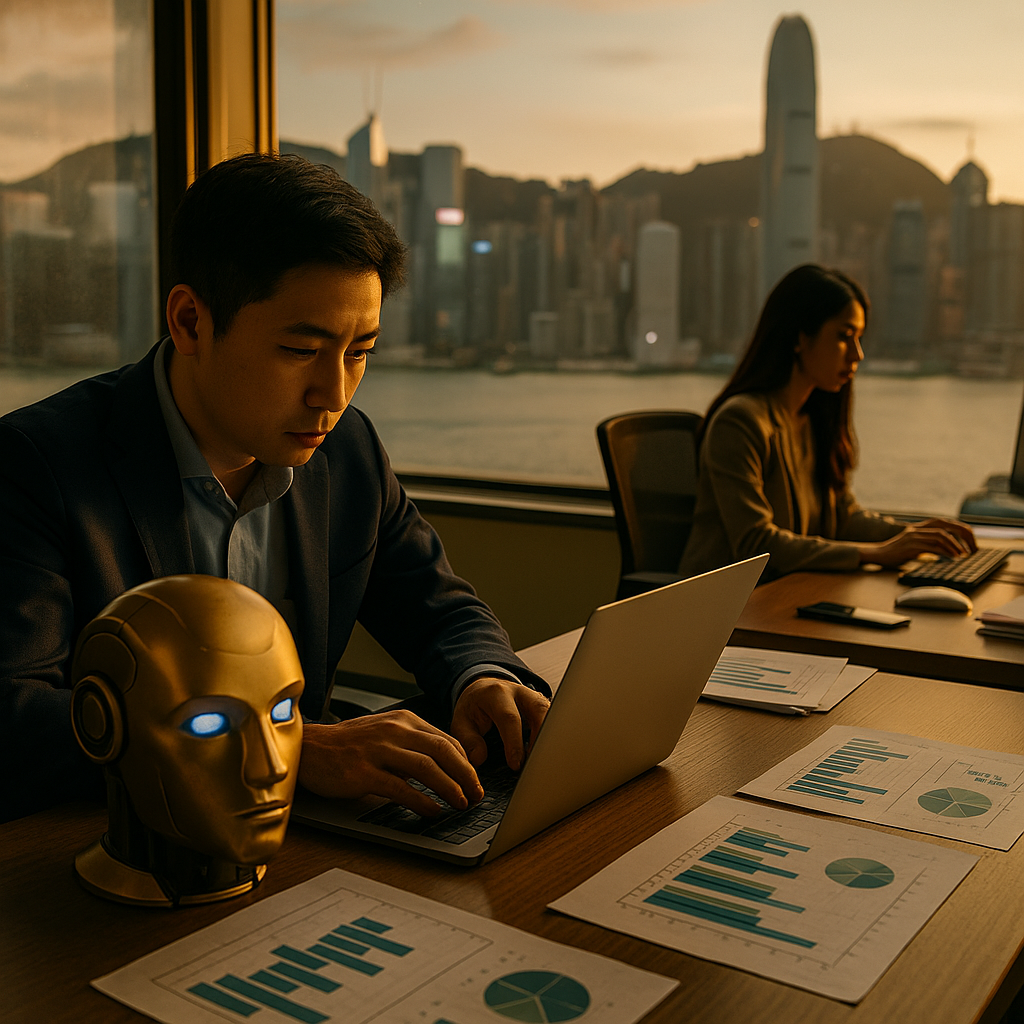
Hong Kong is handing out public money to brands that adopt AI marketing tools, and the early data shows a widening gap between adopters and everyone else. Some marketing teams have already cut campaign turnaround by half. Others are still debating whether AI generated content needs a disclaimer. Hong Kong AI marketing adoption isn’t just a regional curiosity anymore, it’s a preview of how subsidy driven markets will reshape budget allocation everywhere.
If you run a brand or agency outside Hong Kong, this matters more than it looks. Government incentives tend to accelerate behaviors that were already inevitable. Watching who wins and who stalls in a subsidized market gives you a cheat sheet for your own rollout, minus the trial and error.
The Subsidy That Started It
Hong Kong’s government has been funding AI tool adoption for marketing teams, a move we covered in detail when the program first signaled a global budget shift. The logic is straightforward. Local brands, particularly SMEs in retail, F&B, and beauty, have historically underinvested in martech compared to regional peers in Singapore or Seoul. Subsidies lower the cost of experimentation, which in theory should flatten adoption curves across company size.
In practice, it hasn’t worked that way. The brands that moved fastest were the ones that already had a data infrastructure in place, meaning clean customer lists, tagged creative assets, and at least one analytics person on staff. Subsidy money accelerated winners. It didn’t create new ones from scratch.
Government subsidies don’t level the playing field, they amplify whatever operational maturity already exists. Brands with clean data and defined workflows pulled ahead fast. Brands without either spent their subsidy dollars on tools nobody used.
What Early Adopters Actually Did Differently
Talk to marketing directors in Hong Kong who moved early and a pattern emerges. It’s not about which AI platform they picked. It’s about sequencing.
- They started with measurement, not content generation. The fastest movers used AI first to clean up attribution and audience segmentation, then layered in creative tools once they understood where budget was actually working. This mirrors a broader trend we’ve tracked as brands rebuild scorecards because reach no longer predicts sales.
- They treated creator content as a data source, not just an output. AI tools trained on past campaign performance needed labeled creative to learn from. Brands that had already organized their creator content libraries got usable AI recommendations within weeks. Brands that hadn’t were feeding the models garbage.
- They kept a human in the loop for anything customer facing. No early adopter brand in Hong Kong’s retail or F&B sectors let AI generated copy or video go live without a reviewer. This wasn’t caution for caution’s sake, it was risk management given how fast AI slop gets called out publicly.
- They budgeted for failure. Teams that saw gains treated the first quarter as a sandbox. They expected some tools to flop and built that into the plan rather than panicking when one vendor underdelivered.
None of this is exotic. It’s the same discipline that separates good influencer programs from bad ones: data hygiene, clear ownership, and realistic timelines. AI just exposes the gap faster because it compounds existing process failures at machine speed.
Why the Laggards Stalled
The brands that took the subsidy and still haven’t moved the needle share a different set of habits, and they’re worth naming because they’re common everywhere, not just Hong Kong.
First, they bought tools before defining the problem. A retail chain might sign up for an AI content platform because a competitor did, without first asking what specific bottleneck it’s solving. Second, they centralized decision making in a way that slowed everything down. In small and mid sized Hong Kong brands, marketing often reports through a general manager who also owns operations and finance. AI tool approval got stuck behind unrelated priorities.
Third, and this is the big one, they underestimated compliance exposure. Hong Kong’s Personal Data (Privacy) Ordinance applies to AI driven customer targeting the same way it applies to any data processing activity. Brands that skipped a privacy review before deploying AI personalization tools are now dealing with retroactive audits. That’s an expensive way to learn a lesson that a two hour legal consult would have prevented.
There’s also a simpler explanation some marketers won’t say out loud: fear of looking replaceable. Teams worried that adopting AI tools too visibly would invite headcount cuts slowed their own rollout, sometimes deliberately. That’s a management problem dressed up as a technology problem, and it shows up in every market, not just Hong Kong.
The Creator Economy Angle Nobody’s Talking About
Here’s where this gets specifically relevant to influencer marketing teams. Hong Kong’s AI subsidy program has an uneven effect on creator partnerships, and it’s worth watching closely if you manage creator budgets anywhere.
Brands using AI tools for content scaling are shifting spend toward micro and nano creators because AI assisted editing and captioning make smaller creator content production ready faster. This tracks with what we’ve seen globally as micro creators cut CPM and reshape how budgets get allocated. The math is simple: if AI tools cut your post production time by 40 percent, you can afford to work with twice as many smaller creators for the same output cost.
But there’s a risk side too. As AI generated and AI edited creator content floods feeds, audience trust in authenticity is becoming the differentiator, not production quality. We’ve already documented how niche first creator accounts outpace branded feeds on trust, and that gap widens further when AI polish makes branded content look interchangeable. Hong Kong brands leaning too hard into AI generated creator content without disclosure are already seeing engagement softness, according to agency sources tracking local campaign performance.
The smart move, and this is what separates serious adopters from brands just chasing subsidy dollars, is using AI to handle production logistics (captioning, format resizing, A/B variant generation) while keeping the creative judgment and authenticity signals human. That’s consistent with how UGC production studios are replacing solo creators at scale elsewhere: scale the mechanics, protect the voice.
What This Means for Your Budget Planning
If you’re a marketing leader outside Hong Kong watching this play out, the practical takeaway isn’t “go get a government subsidy.” It’s about sequencing your own AI adoption the way the winners did, without waiting for free money to force the issue.
Start with an audit of your data infrastructure before you shop for AI tools. According to eMarketer research on marketing technology adoption, the single biggest predictor of AI ROI isn’t tool sophistication, it’s data readiness. If your creator content library isn’t tagged by performance, platform, and format, fix that first. AI recommendations are only as good as what they’re trained on.
Second, budget for a compliance review before launch, not after a complaint. The FTC and equivalent bodies in other markets are increasingly scrutinizing AI generated marketing content for disclosure violations, and Hong Kong’s early stumbles on this front are a preview of enforcement patterns likely to spread.
Third, reconsider how you’re allocating creator budget. If AI tools are genuinely cutting your production costs, that savings should flow into creator diversity and frequency, not just margin. This is the same calculus brands made when European influencer budgets jumped toward higher medians, except now the lever is AI efficiency instead of raw spend increases.
Finally, don’t mistake tool adoption for strategy. Hong Kong’s laggard brands didn’t fail because they picked bad software. They failed because they never answered the basic question: what specific marketing problem is this AI tool supposed to solve, and how will we know if it worked? Answer that first, subsidy or not.
Frequently Asked Questions
FAQs
What is Hong Kong’s AI marketing subsidy program?
It’s a government funded initiative that offsets the cost of AI marketing tool adoption for local businesses, aimed primarily at SMEs in retail, F&B, and consumer brands that have historically lagged in martech investment compared to regional peers.
Why are some Hong Kong brands succeeding with AI marketing while others aren’t?
Success correlates strongly with pre-existing data maturity. Brands with organized customer data and tagged creative assets saw fast gains. Brands without that foundation spent subsidy money on tools that produced unreliable or unusable output.
How does AI adoption affect influencer and creator marketing budgets?
AI tools that speed up content editing and production are letting brands work with more micro and nano creators for the same budget, since post production costs drop. The risk is over-reliance on AI polish, which can erode the authenticity that makes creator content work in the first place.
What compliance risks come with AI marketing adoption?
Data privacy exposure is the biggest one. In Hong Kong, the Personal Data (Privacy) Ordinance applies to AI driven targeting the same way it applies to other data processing. Brands elsewhere should check local equivalents, including guidance from bodies like the FTC or ICO, before deploying AI personalization at scale.
Should brands outside Hong Kong wait for similar subsidies before adopting AI marketing tools?
No. The data readiness and sequencing lessons from Hong Kong’s early adopters apply regardless of subsidy availability. Waiting for funding delays a transition that’s already reshaping competitive positioning in creator and content marketing.
The brands winning in Hong Kong’s AI marketing moment aren’t the ones with the biggest subsidy checks, they’re the ones that fixed their data and workflow problems first. Audit your creator content library and attribution setup before you buy a single AI tool, and you’ll skip the expensive detour the laggards are stuck in now.
Top Influencer Marketing Agencies
The leading agencies shaping influencer marketing in 2026
Agencies ranked by campaign performance, client diversity, platform expertise, proven ROI, industry recognition, and client satisfaction. Assessed through verified case studies, reviews, and industry consultations.
Moburst

-
2

The Shelf
Boutique Beauty & Lifestyle Influencer AgencyA data-driven boutique agency specializing exclusively in beauty, wellness, and lifestyle influencer campaigns on Instagram and TikTok. Best for brands already focused on the beauty/personal care space that need curated, aesthetic-driven content.Clients: Pepsi, The Honest Company, Hims, Elf Cosmetics, Pure LeafVisit The Shelf → -
3

Audiencly
Niche Gaming & Esports Influencer AgencyA specialized agency focused exclusively on gaming and esports creators on YouTube, Twitch, and TikTok. Ideal if your campaign is 100% gaming-focused — from game launches to hardware and esports events.Clients: Epic Games, NordVPN, Ubisoft, Wargaming, Tencent GamesVisit Audiencly → -
4

Viral Nation
Global Influencer Marketing & Talent AgencyA dual talent management and marketing agency with proprietary brand safety tools and a global creator network spanning nano-influencers to celebrities across all major platforms.Clients: Meta, Activision Blizzard, Energizer, Aston Martin, WalmartVisit Viral Nation → -
5

The Influencer Marketing Factory
TikTok, Instagram & YouTube CampaignsA full-service agency with strong TikTok expertise, offering end-to-end campaign management from influencer discovery through performance reporting with a focus on platform-native content.Clients: Google, Snapchat, Universal Music, Bumble, YelpVisit TIMF → -
6

NeoReach
Enterprise Analytics & Influencer CampaignsAn enterprise-focused agency combining managed campaigns with a powerful self-service data platform for influencer search, audience analytics, and attribution modeling.Clients: Amazon, Airbnb, Netflix, Honda, The New York TimesVisit NeoReach → -
7

Ubiquitous
Creator-First Marketing PlatformA tech-driven platform combining self-service tools with managed campaign options, emphasizing speed and scalability for brands managing multiple influencer relationships.Clients: Lyft, Disney, Target, American Eagle, NetflixVisit Ubiquitous → -
8

Obviously
Scalable Enterprise Influencer CampaignsA tech-enabled agency built for high-volume campaigns, coordinating hundreds of creators simultaneously with end-to-end logistics, content rights management, and product seeding.Clients: Google, Ulta Beauty, Converse, AmazonVisit Obviously →