


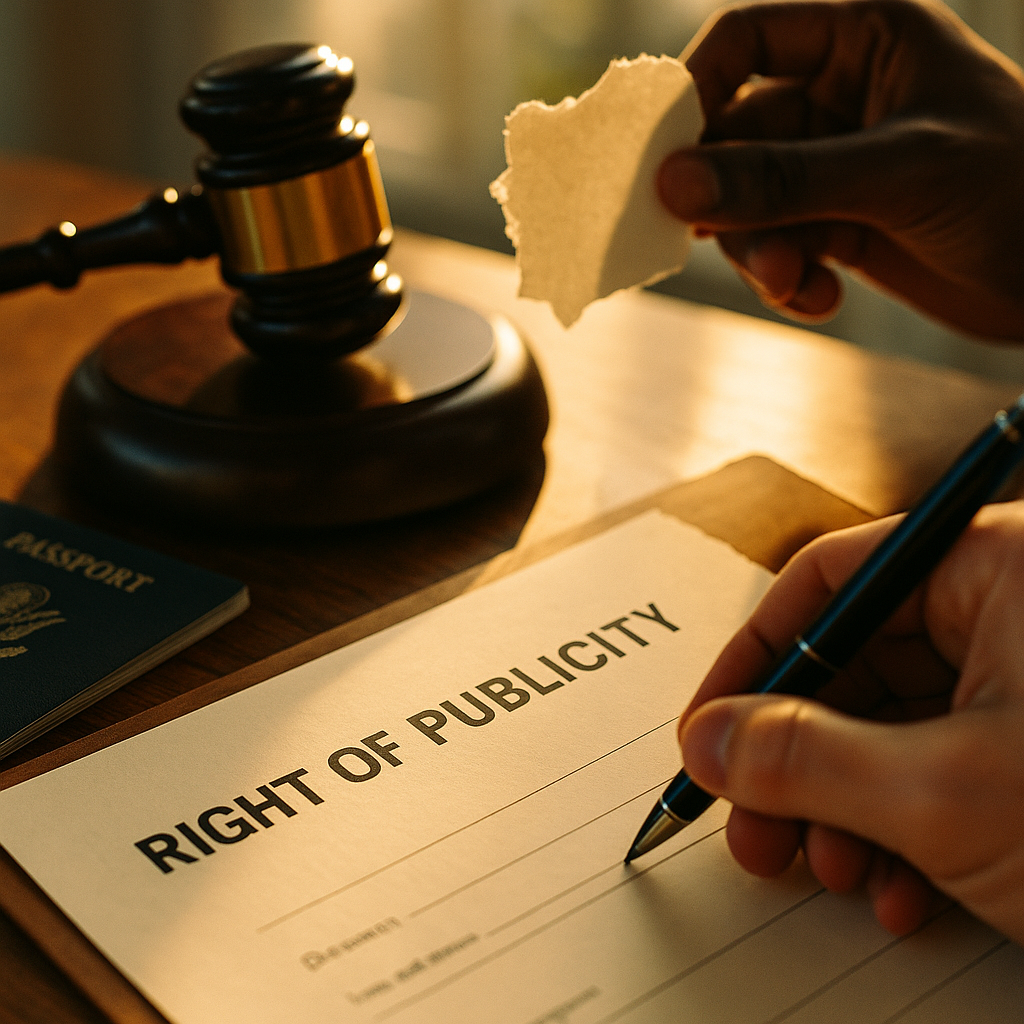
Forty six states have some form of right of publicity protection, and no two of them agree on what it actually covers. Some give a person’s heirs control over their image for a decade after death. Others extend it for a century. If your UGC contracts use one boilerplate clause for every creator, you’re gambling on jurisdictions you’ve probably never read closely. That gamble is getting more expensive as AI-generated likeness disputes and influencer campaigns cross state lines by default.
What Right of Publicity Actually Protects
Right of publicity is not copyright. Copyright protects the content itself: the video, the photo, the audio file. Right of publicity protects the person inside that content, specifically their name, image, likeness, voice, and sometimes even their signature gesture or catchphrase from unauthorized commercial use. A brand can own the copyright to a UGC video and still get sued for using it, if the creator’s consent didn’t cover the specific commercial context the brand ended up using it for.
This distinction trips up marketing teams constantly. Legal signs off on usage rights language, assumes “we have the content licensed” means “we’re covered,” and nobody checks whether the underlying publicity consent matches the actual campaign use. Repurposing a TikTok testimonial into a paid Meta ad, for instance, is a different commercial use than the organic post the creator originally agreed to. In states with aggressive publicity statutes, that gap is where lawsuits live.
Right of publicity claims don’t require proof of defamation or false statements, only unauthorized commercial use of someone’s identity. That lower bar is exactly why it’s becoming the preferred legal angle in creator and AI likeness disputes.
The State Patchwork: Where Brands Get Burned
There is no federal right of publicity statute. That means you’re dealing with a quilt of state laws, common law precedent, and in some states, almost nothing codified at all. A few examples that matter for any brand running national UGC campaigns:
- California has one of the most robust statutes in the country (Civil Code Section 3344), covering living persons and extending postmortem rights for 70 years. California also recognizes a common law right of publicity, giving plaintiffs two separate legal theories to pursue.
- New York amended its Civil Rights Law to add postmortem rights for deceased performers and public figures, a notable shift from its historically narrower, living-persons-only approach.
- Indiana is famously creator-friendly on the plaintiff side: its statute extends postmortem publicity rights for 100 years, among the longest in the nation, and covers a wide range of personal attributes.
- Tennessee passed the ELVIS Act, specifically targeting unauthorized AI-generated voice and likeness replication, a direct response to synthetic media and voice cloning concerns in the music and entertainment industry.
- Texas and Florida both have statutory protections but with narrower postmortem windows and different exemptions for news, commentary, and fair use contexts.
Some states, meanwhile, rely entirely on common law with no statute at all, which means outcomes depend heavily on how local courts have historically ruled. If your legal team is drafting one standard UGC release and applying it nationwide, you’re effectively ignoring that half the country has materially different rules than the other half.
Why This Matters More Now Than It Did a Few Years Ago
Three trends are colliding to make right of publicity variance an active operational risk rather than a theoretical one.
First, UGC campaigns now routinely cross state lines by design. A brand runs a creator program with talent based in a dozen different states, repurposes the best-performing content into paid social, and distributes it nationally. The creator’s home state, the state where content was filmed, and the states where ads actually run can all differ, and courts have not fully settled which jurisdiction’s law controls.
Second, AI tools make it trivially easy to extend, remix, or synthetically recreate a creator’s likeness beyond the original scope of consent. Voice cloning for dubbed ad versions, AI-generated “digital twins” for scaled content, and face-swapped product demos all raise publicity questions that didn’t exist when most standard UGC releases were drafted. Our coverage of voice cloning consent clauses breaks down exactly where generic releases fall short on this point.
Third, postmortem rights are becoming a live issue for brands running long-term ambassador deals or licensing historical UGC. If a creator dies mid-contract or years after content was produced, states like Indiana and California can extend their estate’s control over continued commercial use well beyond what most marketers assume.
Rewriting UGC Contract Clauses for Multi-State Reality
You don’t need fifty separate contract templates. You need a handful of clauses that are deliberately built to flex across jurisdictions instead of silently assuming one state’s rules apply everywhere.
- Specify governing law explicitly, and pick it deliberately. Don’t leave governing law blank or default to “the state where the brand is headquartered” without thinking it through. If you’re routinely running creator programs with talent in Indiana or Tennessee, your standard governing law clause should account for their stronger protections, not quietly override them with weaker language that a court may refuse to enforce anyway.
- Define “commercial use” broadly and specifically. Vague language like “promotional purposes” invites disputes. List the actual use cases: organic social, paid social, email, out-of-home, retail displays, third-party licensing. If AI remixing or synthetic extension is even remotely possible, name it directly rather than hoping a broad license clause covers it by implication.
- Build in postmortem and estate provisions. Long-term usage rights and evergreen content libraries need language addressing what happens if the creator becomes incapacitated, dies, or revokes consent through an estate. This is especially critical for campaigns using usage rights expiration tracking to manage large content libraries over multi-year horizons.
- Separate the copyright license from the publicity release. These should be two distinct, clearly labeled sections in the contract. Treating them as one bundled “rights grant” is exactly how brands end up with content they can legally reproduce but not legally use to depict the person in it.
- Add an AI and synthetic use clause with explicit opt-in. Default to requiring separate written consent for any AI-generated extension, dubbing, or digital twin use of a creator’s likeness. This aligns with the direction states like Tennessee are already moving, and it closes the gap our analysis of AI synthetic endorsers flagged as a growing disclosure and liability exposure.
A contract that doesn’t name AI remixing, dubbing, or likeness extension as a distinct licensed use is effectively silent on it, and silence favors the creator’s estate, not the brand, in most state courts.
Operational Fixes Beyond the Contract
Good clauses mean nothing if nobody tracks what they cover. A few practical steps worth building into your creator ops workflow:
Maintain a central rights ledger that tags each piece of UGC with the creator’s home state, the governing law selected, the specific commercial uses approved, and any expiration or renewal date. This is the same discipline we’ve recommended for UGC rights chain of custody, and it pays off directly here because publicity disputes almost always hinge on exactly what was agreed to, by whom, and under which state’s framework.
Loop legal into media planning earlier. If paid media wants to repurpose organic UGC for a national ad buy, that decision should trigger a quick publicity rights check, not happen after the campaign is already live. A five-minute review catches most mismatches before they become claims.
Finally, if you work through agencies or talent management firms, confirm they’re actually verifying state-specific consent language rather than using a single generic release across their entire roster. This is a known gap; our piece on talent agency licensing covers how brands end up inheriting risk they never directly created.
Industry data from eMarketer shows influencer marketing spend continuing to climb year over year, which means more contracts, more creators, and more states involved in any given campaign. Meanwhile, FTC enforcement around disclosure and endorsement is intensifying in parallel, meaning the compliance surface area brands need to manage keeps expanding on two fronts at once. Staying current on both matters more than most marketing teams currently budget for; resources like HubSpot’s marketing research and Statista’s creator economy data are useful for benchmarking how fast this space is scaling.
Frequently Asked Questions
FAQs
What is the difference between right of publicity and copyright in UGC contracts?
Copyright protects ownership of the actual content, like the video or photo file. Right of publicity protects the person appearing in that content from having their name, image, voice, or likeness used commercially without consent. A brand can hold full copyright to a piece of UGC and still face a publicity claim if the usage exceeds what the creator agreed to.
Which states have the strongest right of publicity protections for brands to worry about?
California and Indiana are generally considered the strongest, with broad statutory coverage and long postmortem rights (70 years and 100 years respectively). Tennessee’s ELVIS Act adds specific protection against unauthorized AI voice and likeness replication, making it increasingly relevant for brands using synthetic media.
Do UGC contracts need to specify which state’s law governs the agreement?
Yes. Leaving governing law undefined or vague creates uncertainty about which state’s publicity statute applies, especially when the creator, the brand, and the ad placement are all in different states. Explicit governing law clauses reduce the chance of a dispute landing in an unfavorable jurisdiction.
Can a creator’s estate control usage rights after they pass away?
In states with postmortem right of publicity statutes, yes. Indiana extends this control for a century, and California for 70 years. Brands running long-term UGC libraries or evergreen ambassador content should build estate and succession language directly into their contracts.
Does right of publicity apply to AI-generated or AI-modified creator content?
Increasingly, yes. States like Tennessee have passed legislation specifically addressing AI-driven voice cloning and likeness replication. Brands should treat any AI remixing, dubbing, or digital twin use of a creator’s identity as a separate licensed use requiring explicit written consent, not an extension automatically covered by a standard UGC release.
Pull your current UGC template and check two things this week: does it separate the publicity release from the copyright license, and does it name a specific governing state. If either answer is no, you’re running national campaigns on a contract that was never built for one.
Top Influencer Marketing Agencies
The leading agencies shaping influencer marketing in 2026
Agencies ranked by campaign performance, client diversity, platform expertise, proven ROI, industry recognition, and client satisfaction. Assessed through verified case studies, reviews, and industry consultations.
Moburst

-
2

The Shelf
Boutique Beauty & Lifestyle Influencer AgencyA data-driven boutique agency specializing exclusively in beauty, wellness, and lifestyle influencer campaigns on Instagram and TikTok. Best for brands already focused on the beauty/personal care space that need curated, aesthetic-driven content.Clients: Pepsi, The Honest Company, Hims, Elf Cosmetics, Pure LeafVisit The Shelf → -
3

Audiencly
Niche Gaming & Esports Influencer AgencyA specialized agency focused exclusively on gaming and esports creators on YouTube, Twitch, and TikTok. Ideal if your campaign is 100% gaming-focused — from game launches to hardware and esports events.Clients: Epic Games, NordVPN, Ubisoft, Wargaming, Tencent GamesVisit Audiencly → -
4

Viral Nation
Global Influencer Marketing & Talent AgencyA dual talent management and marketing agency with proprietary brand safety tools and a global creator network spanning nano-influencers to celebrities across all major platforms.Clients: Meta, Activision Blizzard, Energizer, Aston Martin, WalmartVisit Viral Nation → -
5

The Influencer Marketing Factory
TikTok, Instagram & YouTube CampaignsA full-service agency with strong TikTok expertise, offering end-to-end campaign management from influencer discovery through performance reporting with a focus on platform-native content.Clients: Google, Snapchat, Universal Music, Bumble, YelpVisit TIMF → -
6

NeoReach
Enterprise Analytics & Influencer CampaignsAn enterprise-focused agency combining managed campaigns with a powerful self-service data platform for influencer search, audience analytics, and attribution modeling.Clients: Amazon, Airbnb, Netflix, Honda, The New York TimesVisit NeoReach → -
7

Ubiquitous
Creator-First Marketing PlatformA tech-driven platform combining self-service tools with managed campaign options, emphasizing speed and scalability for brands managing multiple influencer relationships.Clients: Lyft, Disney, Target, American Eagle, NetflixVisit Ubiquitous → -
8

Obviously
Scalable Enterprise Influencer CampaignsA tech-enabled agency built for high-volume campaigns, coordinating hundreds of creators simultaneously with end-to-end logistics, content rights management, and product seeding.Clients: Google, Ulta Beauty, Converse, AmazonVisit Obviously →