


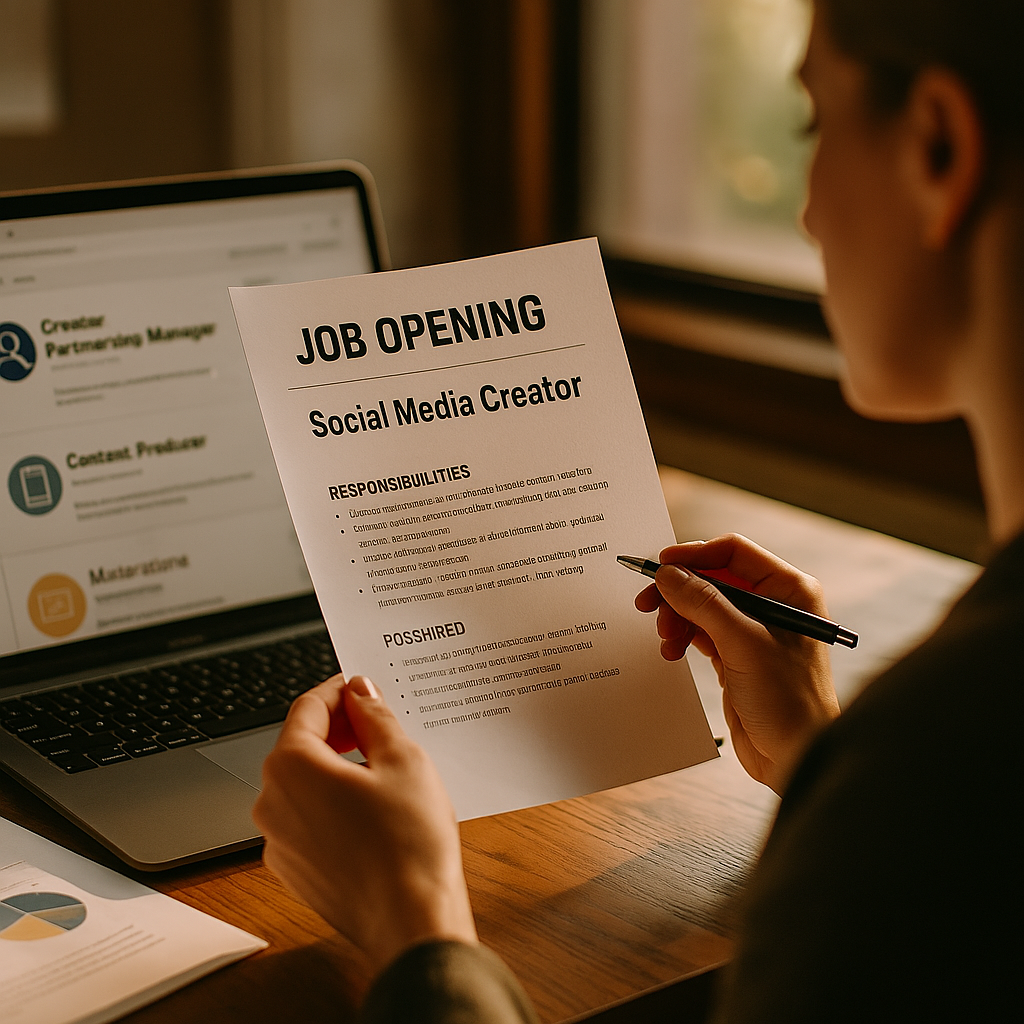
Open LinkedIn Jobs and search “creator marketing manager.” You’ll find more than a few hundred live postings from brands that, three years ago, outsourced the entire function to an agency. That shift in hiring is the clearest signal available right now of where real budget is landing. Job postings don’t lie the way press releases do: someone has to pay that salary every month, and finance doesn’t approve headcount for channels it plans to deprioritize.
This matters because creator marketing job postings have become a leading indicator, arguably a better one than survey data, for where brand investment is actually headed next.
Why Job Postings Beat Surveys for Reading Budget Intent
Ask a CMO where budget is going next year and you’ll get an aspirational answer shaped by whatever trend deck landed on their desk last quarter. Ask a company’s applicant tracking system and you get a different story: cold, line-item commitment. A new full-time hire typically represents $90,000 to $160,000 in fully loaded annual cost once you include benefits, tools, and management overhead. Brands don’t absorb that kind of recurring expense on a whim.
That’s why recruiting data has become something analysts at firms tracking marketing trends quietly monitor alongside ad spend reports. eMarketer’s ongoing coverage of influencer spend has noted the function maturing from campaign-based spend into retained, in-house capability, and job postings are the paper trail of that maturity.
A company posting for a dedicated creator operations role isn’t testing a channel anymore. It’s committing to running the channel like a business unit.
The Roles Multiplying Right Now
Three job categories are expanding faster than generic “social media manager” postings, and each tells its own story about where the discipline is heading.
- Creator partnerships / relations manager. This role sits between procurement and talent management, negotiating rates and managing rosters that increasingly run into the dozens or hundreds. The rise of this title tracks directly with the trend toward larger creator rosters that spread spend across more, smaller deals instead of fewer celebrity-tier ones.
- Creator ops / production coordinator. Brands running always-on content calendars need someone managing briefs, usage rights, deliverable tracking, and payment schedules across dozens of simultaneous contracts. This is the unglamorous backbone role nobody posts about on LinkedIn but every scaled program needs.
- AI-fluent content strategist. This is the newest title, often blending creative direction with prompt literacy and a working knowledge of generative tools. It didn’t exist as a standalone req two years ago. Now it’s showing up inside consumer brands, agencies, and even B2B marketing teams.
Notice what’s missing from that list: pure “influencer marketing manager” generalist roles are actually flattening. The function is specializing, which is exactly what happens when a discipline graduates from experiment to infrastructure.
In-House Teams Are Replacing Agency Retainers, Not Supplementing Them
For years, the standard model was simple. Brand sets strategy, agency executes. That division of labor is eroding fast, and the hiring data shows why. Companies building internal creator teams aren’t adding headcount on top of their agency spend, they’re reallocating it. A retainer that once funded an agency’s junior staff now funds an internal coordinator who knows the brand’s product, tone, and legal constraints natively.
This isn’t unique to influencer marketing. It mirrors what’s happened with PR, where PR agencies have pushed into creator budgets even as brands simultaneously build internal capability to compete for that same spend. The function is being fought over from both directions: agencies want in, brands want control. Headcount is the tiebreaker.
It also explains why UGC creators are increasingly treated as vendors rather than one-off gig workers. Someone internally has to manage that vendor relationship, track deliverables, and handle contracts at scale. That someone is the new hire showing up in the job postings.
What the Geography of These Postings Tells You
Location data inside job postings is arguably more revealing than the titles themselves. Roles are clustering in markets where creator economics already favor the brand: lower production costs, deep talent pools, and favorable currency dynamics. This tracks with broader patterns already visible in rate data, where pay gaps between cities are reshaping where brands hire both creators and the staff who manage them.
Europe is a particularly interesting case. Budgets there have reportedly jumped sharply, with median influencer budgets climbing 72 percent to a 175,000 median according to recent industry survey data. You’d expect hiring to follow, and it has, but unevenly. Postings concentrate in a handful of hub cities rather than spreading evenly across the continent, largely because rate disparities across markets, as seen in the gap between Spain and France UGC rates, make centralized management more cost-effective than hiring locally everywhere.
The AI Factor Is Reshaping Job Descriptions, Not Just Headcount
Here’s where it gets interesting for anyone writing these job descriptions right now. Even roles that have existed for years are being rewritten to include AI fluency as a baseline requirement, not a nice-to-have. Content strategist postings now routinely list generative tools, prompt engineering, or AI content workflows as required skills.
But hiring managers should be cautious about overcorrecting. Adoption numbers look impressive on paper, but as covered in the reporting on AI adoption hitting 88 percent with efficiency gains still unproven, the tools are everywhere while the productivity case remains murky. Brands hiring for “AI-first” creator roles should be explicit about what success looks like: faster turnaround on briefs, lower cost per asset, or better creative testing velocity. Vague mandates to “use AI more” produce vague job performance.
The brands getting real value from AI-fluent hires are the ones pairing the tool skill with a measurable output target, not treating AI literacy as a credential in itself.
This connects directly to the broader production shift happening across the industry, where hybrid live and short-form content models are cutting cost per asset. New hires are increasingly judged on their ability to operate across that hybrid format rather than specializing in one content type.
What This Means for Your Org Chart
If you’re a marketing leader building next year’s headcount plan, the job postings data suggests a few practical moves worth considering.
- Stop hiring generalists for a specializing function. The market is moving toward distinct roles for partnerships, operations, and content strategy. A single “influencer marketing manager” trying to do all three will burn out or underperform on each.
- Budget for operations before you budget for strategy. Brands running large rosters need someone managing contracts and payments more urgently than someone writing brand voice guidelines. The ops layer is what breaks first at scale, and it’s where platform ROI claims tend to crumble under CFO scrutiny when nobody can produce clean reporting.
- Write AI requirements with teeth. Don’t just ask for “AI tool familiarity.” Specify the workflow outcome you expect, whether that’s faster asset turnaround or expanded creative testing volume.
- Watch adjacent functions for talent raids. PR, newsrooms, and even B2B sales teams are now poaching creator talent for their own content needs. If you’re not actively retaining your creator-savvy staff, someone else is actively recruiting them.
None of this is theoretical. Recruiting platforms like LinkedIn’s talent solutions and HR benchmarking tools from firms like HubSpot are already being used by smart ops teams to benchmark exactly this kind of hiring velocity against competitors. If your team isn’t doing the same, you’re planning headcount blind while your competitors plan with a map.
FAQs
Frequently Asked Questions
What job titles should I watch to track creator marketing hiring trends?
Watch for creator partnerships manager, creator operations coordinator, and AI-fluent content strategist. These three titles are growing faster than generic influencer marketing manager roles, and they indicate the function is specializing rather than consolidating under one generalist hire.
Are brands replacing agencies with in-house creator teams?
In many cases, yes. Hiring data suggests budget is being reallocated from agency retainers into internal headcount rather than added on top of existing agency spend, particularly for operational and partnerships roles that benefit from brand-specific product and legal knowledge.
Why are AI skills showing up in creator marketing job descriptions now?
Generative AI tools have become standard in content production workflows, so hiring managers are listing AI fluency as a baseline requirement. However, brands should pair this requirement with specific performance targets, since adoption rates remain far ahead of proven efficiency gains.
How much does a creator marketing hire typically cost a brand?
Fully loaded costs, including salary, benefits, tools, and management overhead, typically run between $90,000 and $160,000 annually depending on seniority and market. This recurring cost is why job postings are considered a strong indicator of genuine budget commitment rather than experimental spend.
Which markets are seeing the fastest growth in creator marketing job postings?
Hiring is clustering in a handful of hub cities with favorable production economics and deep talent pools rather than spreading evenly across regions, a pattern that mirrors existing disparities in creator pay rates across different markets.
Next step: Pull your own hiring plan against this list of growing titles, and if your current org chart still has one generalist managing partnerships, operations, and content strategy, that’s the first role to split before next budget cycle.
FAQs
Frequently Asked Questions
What job titles should I watch to track creator marketing hiring trends?
Watch for creator partnerships manager, creator operations coordinator, and AI-fluent content strategist. These three titles are growing faster than generic influencer marketing manager roles, and they indicate the function is specializing rather than consolidating under one generalist hire.
Are brands replacing agencies with in-house creator teams?
In many cases, yes. Hiring data suggests budget is being reallocated from agency retainers into internal headcount rather than added on top of existing agency spend, particularly for operational and partnerships roles that benefit from brand-specific product and legal knowledge.
Why are AI skills showing up in creator marketing job descriptions now?
Generative AI tools have become standard in content production workflows, so hiring managers are listing AI fluency as a baseline requirement. However, brands should pair this requirement with specific performance targets, since adoption rates remain far ahead of proven efficiency gains.
How much does a creator marketing hire typically cost a brand?
Fully loaded costs, including salary, benefits, tools, and management overhead, typically run between $90,000 and $160,000 annually depending on seniority and market. This recurring cost is why job postings are considered a strong indicator of genuine budget commitment rather than experimental spend.
Which markets are seeing the fastest growth in creator marketing job postings?
Hiring is clustering in a handful of hub cities with favorable production economics and deep talent pools rather than spreading evenly across regions, a pattern that mirrors existing disparities in creator pay rates across different markets.
Top Influencer Marketing Agencies
The leading agencies shaping influencer marketing in 2026
Agencies ranked by campaign performance, client diversity, platform expertise, proven ROI, industry recognition, and client satisfaction. Assessed through verified case studies, reviews, and industry consultations.
Moburst

-
2

The Shelf
Boutique Beauty & Lifestyle Influencer AgencyA data-driven boutique agency specializing exclusively in beauty, wellness, and lifestyle influencer campaigns on Instagram and TikTok. Best for brands already focused on the beauty/personal care space that need curated, aesthetic-driven content.Clients: Pepsi, The Honest Company, Hims, Elf Cosmetics, Pure LeafVisit The Shelf → -
3

Audiencly
Niche Gaming & Esports Influencer AgencyA specialized agency focused exclusively on gaming and esports creators on YouTube, Twitch, and TikTok. Ideal if your campaign is 100% gaming-focused — from game launches to hardware and esports events.Clients: Epic Games, NordVPN, Ubisoft, Wargaming, Tencent GamesVisit Audiencly → -
4

Viral Nation
Global Influencer Marketing & Talent AgencyA dual talent management and marketing agency with proprietary brand safety tools and a global creator network spanning nano-influencers to celebrities across all major platforms.Clients: Meta, Activision Blizzard, Energizer, Aston Martin, WalmartVisit Viral Nation → -
5

The Influencer Marketing Factory
TikTok, Instagram & YouTube CampaignsA full-service agency with strong TikTok expertise, offering end-to-end campaign management from influencer discovery through performance reporting with a focus on platform-native content.Clients: Google, Snapchat, Universal Music, Bumble, YelpVisit TIMF → -
6

NeoReach
Enterprise Analytics & Influencer CampaignsAn enterprise-focused agency combining managed campaigns with a powerful self-service data platform for influencer search, audience analytics, and attribution modeling.Clients: Amazon, Airbnb, Netflix, Honda, The New York TimesVisit NeoReach → -
7

Ubiquitous
Creator-First Marketing PlatformA tech-driven platform combining self-service tools with managed campaign options, emphasizing speed and scalability for brands managing multiple influencer relationships.Clients: Lyft, Disney, Target, American Eagle, NetflixVisit Ubiquitous → -
8

Obviously
Scalable Enterprise Influencer CampaignsA tech-enabled agency built for high-volume campaigns, coordinating hundreds of creators simultaneously with end-to-end logistics, content rights management, and product seeding.Clients: Google, Ulta Beauty, Converse, AmazonVisit Obviously →