


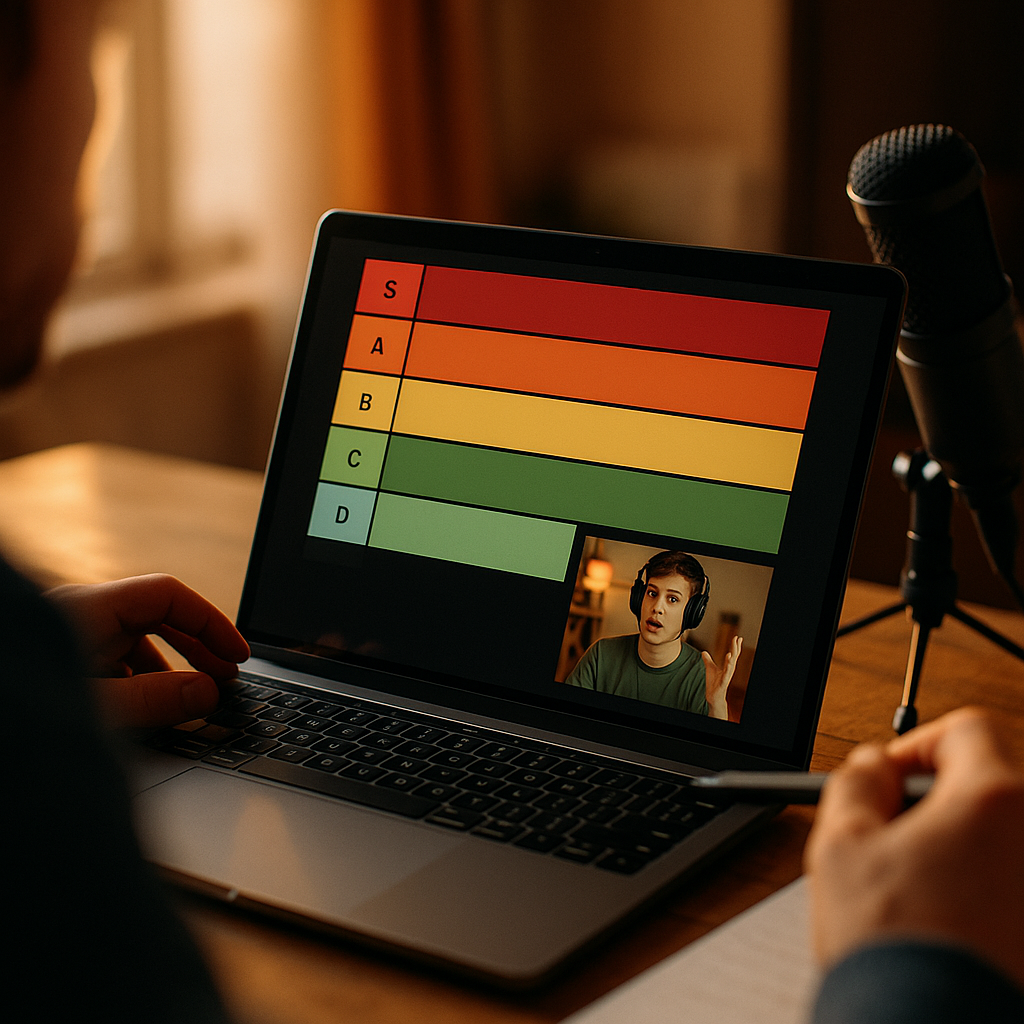
Tier list videos now drive more product discovery than traditional “top 10” roundups, and the format shows no sign of slowing down. TikTok’s own creator tools team has leaned into ranking templates because they keep viewers watching until the final reveal. For brands, that completion rate matters more than any other engagement metric. A well-scripted tier list video doesn’t just entertain, it builds a decision framework that viewers carry straight into their next shopping session.
The format feels casual. S-tier, A-tier, trash tier, the meme energy is baked in. But underneath the humor is a persuasion structure that mirrors exactly how consumers make comparison decisions: gather options, rank by criteria, eliminate weak choices, commit to a winner. Brands that understand this structure can script tier list content that feels native to the platform while quietly doing the job of a comparison chart.
Why Tier Lists Outperform Standard Review Formats
A straight product review asks viewers to trust one opinion. A tier list asks viewers to watch a sorting process, and sorting is inherently more engaging than declaring. Viewers mentally argue with the ranking as it happens. They pause to see if their favorite product made S-tier. They comment to defend a brand that got dropped to B-tier. That friction is the engagement engine.
Comparison shopping behavior is already baked into how people browse. Shoppers rarely buy the first product they see, they want to know how it stacks up. Tier lists simply externalize that internal comparison process and make it entertaining. According to eMarketer, social commerce continues to grow as a discovery channel, and ranking formats are a big part of why short video platforms convert browsing into purchase intent so effectively.
A tier list video doesn’t sell one product. It sells a decision-making framework, and the brand that controls that framework controls the comparison.
This is the real opportunity for brand strategists. If your product shows up inside a creator’s tier list, you’re not just getting a mention, you’re getting positioned inside a mental model the viewer will reuse. That’s worth more than a standalone ad.
Scripting the Rank, Not Just the Reveal
Most brands make the mistake of briefing creators on “what to say about the product” without thinking about where it lands in the hierarchy. That’s backwards. The script should start with the ranking logic, then build commentary around it.
- Define the criteria up front. Price, performance, ease of use, whatever matters to the category. State it in the first eight seconds so the ranking feels justified, not arbitrary.
- Order the reveal for retention. Save the most surprising placement for the middle, not the end. Viewers drop off once they guess the ending, so a mid-video twist keeps completion rates high.
- Script the defense, not just the verdict. Every tier placement needs one sentence of reasoning. “This one’s A-tier because it actually lasted through a humid summer” does more work than “this one’s great.”
- Leave room for disagreement. A tier list that invites debate in the comments earns more algorithmic reach than one that feels final and closed.
This structure overlaps heavily with how brands approach dupe comparison videos, where the ranking logic has to survive scrutiny as much as it has to entertain. The same discipline applies here: rank with reasons, not vibes.
What Tier Placement Signals to Viewers
Placement is a trust signal. S-tier reads as “tested and proven.” Bottom tier reads as “buyer beware.” If your product lands in the middle tiers, the script needs to explain why it’s still worth buying for a specific use case, otherwise the ranking reads as a soft rejection. Smart creators script a “best for” qualifier onto every tier, so even B-tier products get a reason to exist. That nuance keeps the content credible, and credibility is what makes the comparison shopping behavior actually convert.
Compliance: Where Tier Lists Get Risky
Ranking content walks a thin line between opinion and implied claim. If a creator ranks a skincare brand above a competitor “because it clears breakouts faster,” that’s a performance claim, not just an opinion, and it needs substantiation under FTC endorsement guidelines. Brands sponsoring or gifting product for a tier list video are still on the hook for how those claims are framed, even if the creator wrote the script themselves.
The safest approach is to pre-approve the ranking criteria, not the exact ranking. Let the creator keep creative control over where products land, but require that any comparative claim (“better than,” “faster than,” “lasts longer”) be tied to a testable attribute the brand can back up. This is the same logic used in dupe comparison videos and it applies just as directly to tier list formats.
The ranking itself is opinion and protected speech. The reason given for the ranking is where legal risk actually lives.
Disclosure still applies the normal way: #ad or #sponsored, clearly placed, not buried in a caption wall. If the brand supplied every product in the ranking, say so. A tier list that looks independent but was fully brand-funded is exactly the kind of thing regulators and the ICO flag when reviewing influencer marketing practices in markets with stricter consumer protection rules.
Building the Brief Creators Actually Want
Creators resist branded tier lists when the brief reads like a sales sheet. Nobody wants to fake a ranking where everything conveniently lands in S-tier. The brief should instead focus on:
- Category scope. Five to eight products max. More than that and retention drops because viewers lose track of the comparison.
- Tier labels that match the audience’s vocabulary. Gaming audiences expect S through F. Beauty audiences respond better to “holy grail, solid, skip it.” Match the format to the community.
- One sentence per product, scripted loosely. Give creators a fact bank, not a script to read verbatim. Authenticity collapses the moment a tier list sounds rehearsed.
- A CTA that doesn’t break the format. “Link in bio to shop the S-tier pick” works. A hard sell mid-ranking kills the credibility the whole format depends on.
This brief structure mirrors the approach outlined in nano creator briefs, where loose structure plus clear guardrails consistently outperforms rigid scripts. Tier lists are not exempt from that rule, they actually depend on it more than most formats.
Pairing Tier Lists With Other Comparison Formats
Tier lists work best as one piece of a broader comparison content strategy, not a standalone tactic. Brands running before and after reels can repurpose that proof footage inside a tier list’s reasoning. A brand running educational micro demos can feed those same demo clips into the “why it ranked here” moments of a tier video. The formats reinforce each other because they’re all solving the same problem: giving shoppers a reason to trust a comparison before they click buy.
Platforms are optimizing for this kind of content too. TikTok’s ad platform increasingly favors creative that holds attention through structured reveals, and tier lists fit that pattern almost perfectly. HubSpot’s research on short-form video consistently shows comparison and ranking formats outperform generic review content on watch time, which is exactly the signal brands should be optimizing creative briefs around.
Measuring Whether the Ranking Actually Moved Product
Views and comments tell you the format worked as content. They don’t tell you it worked as comparison shopping behavior. Track these instead:
- Click-through on the specific tier mentioned. If your product sat in A-tier, tag the link separately from a generic bio link so you can isolate performance by placement.
- Search lift for your product name paired with competitor names. A good tier list spikes branded comparison searches, which is a strong signal that viewers are carrying the ranking into their own research.
- Save rate relative to like rate. Tier lists that get saved more than liked are being used as reference material, exactly the behavior you want before a purchase decision.
If none of these move, the ranking probably wasn’t specific enough. Vague tier placements (“pretty good overall”) don’t give viewers anything to act on. Specific tier placements (“S-tier for oily skin, skip it if you’re sensitive”) give viewers a decision rule they can apply immediately, which is the entire point of scripting comparison content in the first place.
Next step: before your next creator brief, draft the tier criteria and the “best for” qualifier for every product first, then let the ranking write itself. Formats that start with reasoning survive both the algorithm and the legal review.
FAQs
What makes a tier list video different from a standard product review?
A tier list ranks multiple products against each other using stated criteria, which creates a comparison framework viewers can reuse while shopping. A standard review covers one product in isolation and asks for trust rather than comparison.
Are branded tier list videos required to disclose sponsorship?
Yes. If a brand paid for, gifted product for, or influenced the ranking in any way, standard disclosure rules apply under FTC endorsement guidelines, including a clear and visible #ad or #sponsored tag.
How many products should a tier list video include?
Five to eight products is the sweet spot. More than that and viewers lose track of the comparison, which hurts both retention and the clarity of the shopping decision the video is meant to support.
Can a brand request a specific tier placement for their product?
Brands can pre-approve ranking criteria and require that any comparative claim be substantiated, but dictating the exact placement undermines creator credibility and increases the risk of the content reading as a paid endorsement rather than an organic ranking.
What’s the biggest compliance risk in tier list content?
Comparative performance claims tied to a ranking, such as implying one product works better or faster than another, need to be backed by evidence. The ranking itself is opinion, but the stated reason behind it can trigger regulatory scrutiny if unsubstantiated.
Top Influencer Marketing Agencies
The leading agencies shaping influencer marketing in 2026
Agencies ranked by campaign performance, client diversity, platform expertise, proven ROI, industry recognition, and client satisfaction. Assessed through verified case studies, reviews, and industry consultations.
Moburst

-
2

The Shelf
Boutique Beauty & Lifestyle Influencer AgencyA data-driven boutique agency specializing exclusively in beauty, wellness, and lifestyle influencer campaigns on Instagram and TikTok. Best for brands already focused on the beauty/personal care space that need curated, aesthetic-driven content.Clients: Pepsi, The Honest Company, Hims, Elf Cosmetics, Pure LeafVisit The Shelf → -
3

Audiencly
Niche Gaming & Esports Influencer AgencyA specialized agency focused exclusively on gaming and esports creators on YouTube, Twitch, and TikTok. Ideal if your campaign is 100% gaming-focused — from game launches to hardware and esports events.Clients: Epic Games, NordVPN, Ubisoft, Wargaming, Tencent GamesVisit Audiencly → -
4

Viral Nation
Global Influencer Marketing & Talent AgencyA dual talent management and marketing agency with proprietary brand safety tools and a global creator network spanning nano-influencers to celebrities across all major platforms.Clients: Meta, Activision Blizzard, Energizer, Aston Martin, WalmartVisit Viral Nation → -
5

The Influencer Marketing Factory
TikTok, Instagram & YouTube CampaignsA full-service agency with strong TikTok expertise, offering end-to-end campaign management from influencer discovery through performance reporting with a focus on platform-native content.Clients: Google, Snapchat, Universal Music, Bumble, YelpVisit TIMF → -
6

NeoReach
Enterprise Analytics & Influencer CampaignsAn enterprise-focused agency combining managed campaigns with a powerful self-service data platform for influencer search, audience analytics, and attribution modeling.Clients: Amazon, Airbnb, Netflix, Honda, The New York TimesVisit NeoReach → -
7

Ubiquitous
Creator-First Marketing PlatformA tech-driven platform combining self-service tools with managed campaign options, emphasizing speed and scalability for brands managing multiple influencer relationships.Clients: Lyft, Disney, Target, American Eagle, NetflixVisit Ubiquitous → -
8

Obviously
Scalable Enterprise Influencer CampaignsA tech-enabled agency built for high-volume campaigns, coordinating hundreds of creators simultaneously with end-to-end logistics, content rights management, and product seeding.Clients: Google, Ulta Beauty, Converse, AmazonVisit Obviously →