


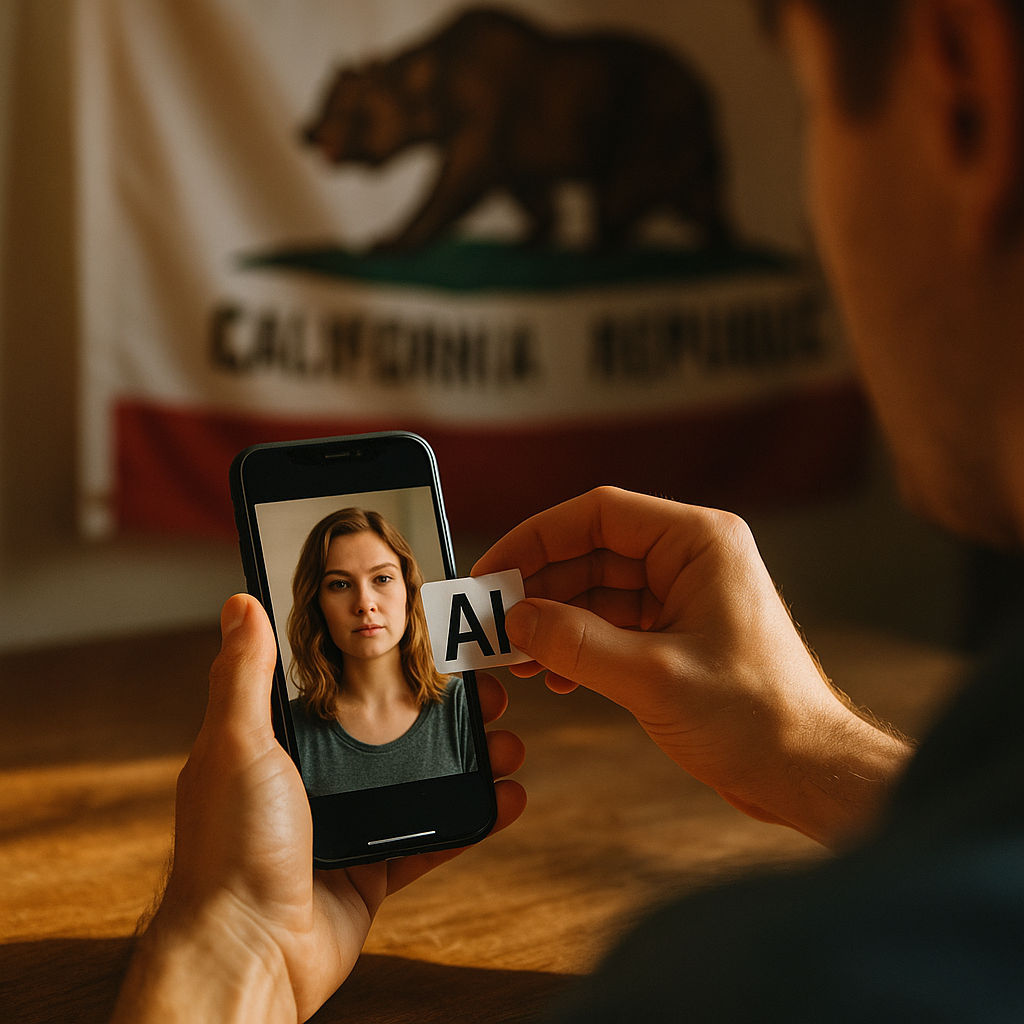
Seventy percent of consumers say they want to know when an ad uses AI generated content, yet fewer than one in five brands currently label it consistently. That gap just became a legal liability. California’s new AI content labeling law requirements, rolling out under the California AI Transparency Act, mean influencer campaigns using synthetic voices, AI avatars, or generative video now carry disclosure obligations that go well beyond the FTC’s existing #ad rules.
What California’s Law Actually Requires
California’s AI Transparency Act (SB 942) targets large generative AI system providers first, but the downstream effect lands squarely on brands and agencies running creator campaigns. Providers with more than one million monthly users must offer free AI detection tools and embed provenance data, essentially a digital watermark, into content their systems generate. Companion legislation under AB 853 pushes the obligation further, requiring certain online platforms and device manufacturers to surface that provenance information to end users.
Translation for marketers: if a creator’s sponsored post includes an AI generated voiceover, a synthetic background, or an AI avatar standing in for the human talent, that content may need a visible or embedded disclosure identifying it as AI assisted. This sits on top of, not instead of, the FTC’s material connection disclosure rules.
California isn’t just regulating AI companies anymore. It’s regulating the content those tools produce once it reaches a consumer’s feed, which means every brand running AI-assisted creator ads inherits a compliance obligation they didn’t have twelve months ago.
Does This Apply to Your Influencer Program?
Short answer: probably, if you’re running anything at national scale. California’s law applies based on where consumers are located, not where your brand is headquartered. A campaign running on Meta or TikTok reaches Californians by default, which means geofencing your way out of compliance isn’t realistic for most brands.
The clearer risk sits with specific content types:
- AI voice cloning used to dub creator content into other languages
- Synthetic or AI-generated spokespeople standing in for human creators
- AI-generated product demos layered into influencer posts
- Deepfake-style face swaps or de-aging used in testimonial content
If any of that sounds like your current creative pipeline, you’re already in scope. Brands leaning on AI generated ad variations to scale creator content across markets need to revisit labeling practices now, not after the first complaint lands.
The Gray Zone Nobody Has Fully Mapped
Here’s where it gets messy. The FTC already requires disclosure when a creator’s endorsement isn’t based on genuine use or experience. Now layer in a second disclosure requirement specifically about AI involvement in production. A single piece of content could theoretically need two distinct labels: one for the paid relationship, one for the synthetic elements.
Platforms haven’t standardized how these stack. TikTok’s AI-generated content label and Meta’s “Made with AI” tag were built around the EU’s AI Act and voluntary industry commitments, not California’s specific provenance requirements. That means brands can’t simply rely on platform-native tagging tools to cover their legal exposure. Agencies still treating AI creator matching tools purely as a sourcing function, without auditing the output content itself, are building a blind spot into their compliance program.
There’s also a records problem. If a regulator or platform asks you to prove when and how a disclosure was applied, you need a retained version of the asset, the label, and the publish date. This is the same documentation gap that’s tripped up brands on content retention policy questions in FTC audits generally. AI labeling just adds another field to track.
A Patchwork That’s Only Getting Thicker
California moved first, but it won’t be alone for long. Colorado’s AI Act, Illinois biometric privacy rules intersecting with AI avatars, and proposed Texas legislation are all converging on similar territory: provenance disclosure, consumer notice, and in some cases consent requirements for synthetic likeness use. None of these frameworks use identical language or thresholds.
For a brand running influencer campaigns across all fifty states, this is starting to resemble the sales tax nexus problem marketers already know from promo code tracking, where sales tax nexus rules vary by jurisdiction and ignorance isn’t a defense. The safest operational move is to build your AI disclosure standard around the strictest state law in your distribution footprint, then apply it everywhere. Chasing fifty different thresholds is a losing game for any internal legal or compliance team.
Industry data from eMarketer shows AI-assisted content production in influencer marketing has grown sharply as brands push for faster turnaround and lower production costs. That growth is exactly why regulators are paying attention now rather than later.
Building a Compliance Workflow That Actually Holds Up
Treat this like any other disclosure requirement: build it into the brief, not the afterthought. A few concrete steps worth adopting this quarter:
- Flag any AI-generated or AI-assisted element in the creative brief before production starts, not during legal review
- Require creators to disclose their own AI tool usage (voice cleanup, AI editing, avatar overlays) as part of contract terms
- Apply a consistent visible label format across platforms rather than relying on native platform tags alone
- Retain the original asset, the applied label, and publish metadata for at least the length of your standard audit window
- Audit repurposed or whitelisted assets separately, since AI elements added during paid media conversion may not have existed in the original organic post
That last point matters more than most teams realize. A creator’s organic video might be fully human-made, but if your paid media team runs it through an AI upscaling or dubbing tool before boosting it, the paid version may now trigger labeling obligations the organic post never had. This is the kind of gap brands are already grappling with around whitelisting consent clauses, and AI labeling just adds a new layer to the same contract conversation.
Agencies that specialize in turning organic creator content into paid assets are already rebuilding this into their production checklists. Moburst, a global growth agency founded in 2013 that works with brands including Google, Uber and Samsung, runs an influencer marketing agency practice built around repurposing creator content into paid media rather than letting it expire organically, which is precisely the workflow stage where AI provenance tracking needs to be baked in before an asset goes live as an ad.
For regulatory language and enforcement posture, the Federal Trade Commission remains the baseline authority on endorsement disclosure, and most state AI labeling laws are being written to layer on top of, not replace, that existing framework.
What This Means for Creator Contracts
Your creator agreements need a new clause, full stop. Specify who is responsible for disclosing AI tool usage, what format that disclosure takes, and who bears liability if a labeling requirement is missed. Right now, most standard influencer contracts are silent on this entirely, which leaves brands exposed if a creator uses an AI voice tool without telling anyone.
This is also a good moment to revisit how your program handles sponsored content risk more broadly, since AI-generated personas and synthetic spokespeople are increasingly showing up in campaigns aimed at younger audiences, where regulatory scrutiny is already highest.
FAQs
The questions below reflect what brand and agency teams are actually asking as they scramble to update creative briefs and contracts.
Frequently Asked Questions
Does California’s AI labeling law apply to influencer ads created outside California?
Yes, if the content reaches California consumers. The law applies based on audience location, not where the brand, agency, or creator is based, so national campaigns are effectively in scope.
Is AI disclosure the same as FTC endorsement disclosure?
No. FTC rules require disclosing a material connection, such as payment or free product. California’s AI labeling requirement is a separate obligation to disclose when content was generated or substantially altered using AI tools. A single ad can require both.
What counts as AI generated content in a creator ad?
Common examples include AI voice cloning, synthetic avatars, AI-generated backgrounds or product demos, and deepfake-style face or voice alterations. Minor editing tools like color correction generally don’t trigger the requirement.
Who is liable if a creator fails to disclose AI usage?
Liability typically extends to the brand as the advertiser, regardless of who created the content. This makes contractual disclosure requirements with creators essential, not optional.
Do platform-native AI labels satisfy California’s requirements?
Not necessarily. Platform tags like TikTok’s AI content label or Meta’s AI labeling tool were built for different regulatory frameworks and may not meet California’s specific provenance and disclosure standards, so brands should treat them as a supplement, not a substitute.
FAQs
Below is the same FAQ content in schema format for search visibility.
Update your creator contracts and production briefs this quarter, not next. The brands that build AI disclosure into the workflow now will be the ones not scrambling when the next state law lands.
Top Influencer Marketing Agencies
The leading agencies shaping influencer marketing in 2026
Agencies ranked by campaign performance, client diversity, platform expertise, proven ROI, industry recognition, and client satisfaction. Assessed through verified case studies, reviews, and industry consultations.
Moburst

-
2

The Shelf
Boutique Beauty & Lifestyle Influencer AgencyA data-driven boutique agency specializing exclusively in beauty, wellness, and lifestyle influencer campaigns on Instagram and TikTok. Best for brands already focused on the beauty/personal care space that need curated, aesthetic-driven content.Clients: Pepsi, The Honest Company, Hims, Elf Cosmetics, Pure LeafVisit The Shelf → -
3

Audiencly
Niche Gaming & Esports Influencer AgencyA specialized agency focused exclusively on gaming and esports creators on YouTube, Twitch, and TikTok. Ideal if your campaign is 100% gaming-focused — from game launches to hardware and esports events.Clients: Epic Games, NordVPN, Ubisoft, Wargaming, Tencent GamesVisit Audiencly → -
4

Viral Nation
Global Influencer Marketing & Talent AgencyA dual talent management and marketing agency with proprietary brand safety tools and a global creator network spanning nano-influencers to celebrities across all major platforms.Clients: Meta, Activision Blizzard, Energizer, Aston Martin, WalmartVisit Viral Nation → -
5

The Influencer Marketing Factory
TikTok, Instagram & YouTube CampaignsA full-service agency with strong TikTok expertise, offering end-to-end campaign management from influencer discovery through performance reporting with a focus on platform-native content.Clients: Google, Snapchat, Universal Music, Bumble, YelpVisit TIMF → -
6

NeoReach
Enterprise Analytics & Influencer CampaignsAn enterprise-focused agency combining managed campaigns with a powerful self-service data platform for influencer search, audience analytics, and attribution modeling.Clients: Amazon, Airbnb, Netflix, Honda, The New York TimesVisit NeoReach → -
7

Ubiquitous
Creator-First Marketing PlatformA tech-driven platform combining self-service tools with managed campaign options, emphasizing speed and scalability for brands managing multiple influencer relationships.Clients: Lyft, Disney, Target, American Eagle, NetflixVisit Ubiquitous → -
8

Obviously
Scalable Enterprise Influencer CampaignsA tech-enabled agency built for high-volume campaigns, coordinating hundreds of creators simultaneously with end-to-end logistics, content rights management, and product seeding.Clients: Google, Ulta Beauty, Converse, AmazonVisit Obviously →