


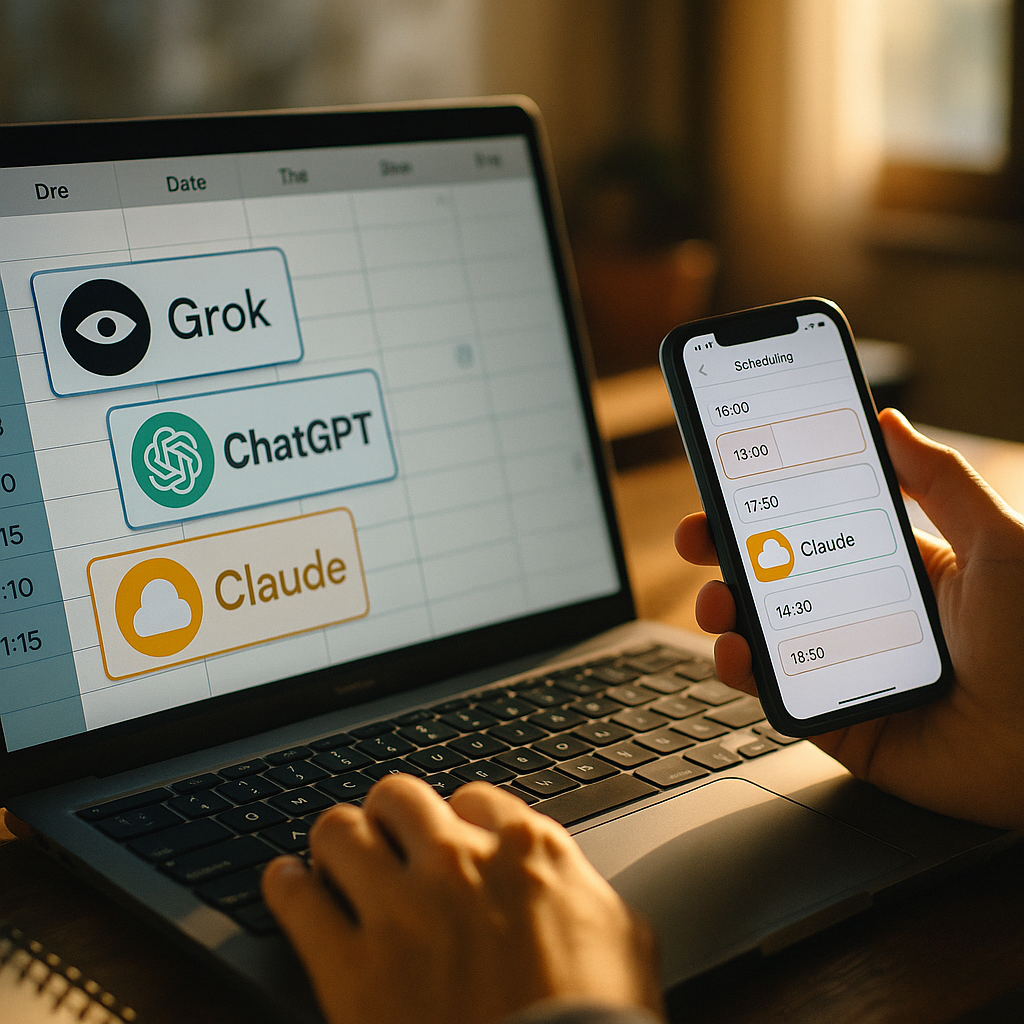
Brands now push out hundreds of UGC-style posts a week across TikTok, Instagram, and YouTube Shorts. No human team schedules that volume without help. So marketers are quietly handing the posting calendar to AI agents, and the choice of model (Grok, ChatGPT, or Claude) is becoming a real operational decision, not a novelty. The question isn’t whether AI should manage UGC scheduling. It’s which one won’t embarrass your brand at 2am.
Why Posting Management Became an AI Problem
UGC scheduling used to mean a social media manager with a spreadsheet and a Tuesday deadline. That era is over. Brands running creator programs at scale now generate dozens of content variants per week from a single creator shoot, and each variant needs captioning, hashtag logic, platform-specific formatting, and a publish window tied to audience activity data. That’s a lot of micro-decisions, repeated daily, across multiple time zones and multiple creators.
Agentic tools promise to absorb that grind. Feed them a content brief, a brand voice guide, and a publishing calendar, and they draft captions, suggest optimal send times, flag content gaps, and in some setups push directly to scheduling platforms via API. The appeal is obvious: lower headcount cost, faster turnaround, fewer missed windows. The risk is also obvious, and it’s the part vendors don’t put in the demo.
An AI agent that schedules UGC at scale isn’t just a productivity tool, it’s a compliance surface. Every autonomous post is a potential FTC disclosure gap, brand safety miss, or tone mismatch waiting to go live without a human in the loop.
Grok: Fast, Opinionated, and Riskier for Brand Voice
Grok’s integration with X gives it a structural advantage for real-time scheduling decisions tied to trending conversations. If a brand wants UGC timed to cultural moments, Grok’s access to live platform signal is genuinely useful. It can surface what’s trending on X in near real time and suggest a posting window before the moment cools off.
But Grok’s personality is also its liability. It’s been tuned for a looser, more opinionated tone, which is great for a meme account and terrible for a regulated financial services brand. Marketers testing Grok for caption drafting report it occasionally injects humor or edge that reads off-brand unless heavily constrained by a locked system prompt. For scheduling specifically, that’s less of an issue since the agent is placing content rather than writing final copy. But if your workflow lets Grok touch both drafting and scheduling, you need tight guardrails before it touches a publish button.
Grok also lags behind on enterprise integration maturity. Fewer native connectors to scheduling platforms like Sprout Social or Hootsuite mean more custom API work to make it function as a true posting manager, which raises the technical lift for mid-sized teams without dedicated engineering support.
ChatGPT: The Operational Default
ChatGPT, particularly through OpenAI’s agent and GPT builder tooling, is where most mid-market brands are actually running pilots right now. It has the broadest third-party integration ecosystem, the most documented enterprise use cases, and the most predictable output tone when given a clear brand voice document. For teams that just need a reliable workhorse to draft, tag, and queue UGC captions across a content calendar, ChatGPT is the safe default.
The catch is depth of reasoning on edge cases. ChatGPT handles routine scheduling logic well: posting cadence, hashtag rotation, caption variation to avoid platform fatigue detection. Where it struggles is nuanced judgment calls, like whether a specific creator clip needs a disclosure tag under updated FTC endorsement guidance or whether a caption drifts into a sensitive category a legal team would flag. It will often proceed confidently rather than flag uncertainty, which is exactly the failure mode brands need to design around.
This mirrors a pattern showing up across the broader AI copilot space. As one recent analysis put it, most AI copilots still need humans to check the work, and posting management is no exception. ChatGPT is fast and fluent, not infallible.
Claude: Slower, More Cautious, Better at Flagging Risk
Claude takes a noticeably more conservative posture, and for UGC scheduling at scale, that’s often a feature rather than a bug. Anthropic has built Claude around explicit reasoning and a willingness to say “I’m not confident about this” rather than guess. In practical terms, that means Claude is more likely to flag a caption that might need legal review, more likely to catch an inconsistent claim against a product’s actual spec sheet, and generally more conservative about autonomous publishing without a confirmation step.
That caution comes with a real speed tradeoff. Brands running high-volume programs where throughput is the priority (think a creator network pushing fifty pieces of UGC a day across multiple SKUs) may find Claude’s extra verification steps slow the pipeline. It’s a better fit for regulated categories like healthcare, finance, and alcohol, where a missed disclosure or an overstated claim carries real regulatory and reputational cost.
Claude also tends to perform well on longer brand guideline documents, retaining nuance across a 20-page style guide better than shorter-context competitors in earlier testing cycles. For brands with dense, lawyer-reviewed voice and claims documentation, that retention matters more than raw scheduling speed.
What “Scheduling at Scale” Actually Requires
Before picking a model, get honest about what the agent actually needs to do. Most teams conflate three separate jobs:
- Caption and hashtag drafting: generating platform-appropriate copy variations from a creator brief.
- Calendar logic: deciding when to post based on audience activity, content cadence rules, and platform-specific best practices.
- Compliance and brand safety review: catching disclosure gaps, tone mismatches, and claims issues before anything goes live.
Grok, ChatGPT, and Claude are not equally strong at all three. Treating them as interchangeable “AI scheduling assistants” is how brands end up with a viral apology post instead of a viral product post. The smarter architecture, and the one more mature teams are converging on, splits the job: one model drafts, a second reviews, and a human approves anything that touches a regulated claim or a paid partnership disclosure. This is the same governance logic showing up in platforms like governed influencer stacks, where the shift isn’t toward full autonomy, it’s toward structured human checkpoints inside an automated pipeline.
The brands getting the best ROI from AI posting agents aren’t the ones automating the most steps, they’re the ones automating the right steps and keeping a human gate on anything with legal exposure.
The Compliance Layer Nobody’s Automating Yet
Here’s the uncomfortable part. None of these three models has a built-in, brand-specific compliance database. They reason generically about disclosure norms and platform policy, but they don’t know your specific contract terms with a creator, your category’s regulatory history, or your legal team’s risk tolerance. That gap is why influencer AI tends to stall between negotiation and reporting, the steps requiring judgment and accountability rather than pattern matching.
Smart teams are building a middle layer: a structured brand rules document (claims to avoid, required hashtags, disclosure templates per region) that gets fed into whichever model handles scheduling, paired with a lightweight human review queue for anything flagged as uncertain. This isn’t full automation. It’s assisted automation, and right now it’s the only version that doesn’t expose a brand to real risk. It also tracks with broader industry data: adoption of fully autonomous marketing agents remains low precisely because production-grade deployment requires this kind of guardrail layer, a pattern documented in research showing only a fraction of marketing AI agents ever reach production.
Platform policy adds another wrinkle. Meta, TikTok, and YouTube all have evolving rules around AI-assisted content labeling, and Meta’s business guidance and TikTok’s advertising policies get updated more frequently than most internal brand guides do. An AI scheduling agent needs a refresh mechanism to stay current with those changes, or it will keep applying outdated rules indefinitely. That’s an operational detail vendors rarely highlight, and it’s worth asking about directly before signing a contract.
Which Model Fits Which Brand Profile
Breaking it down by use case rather than brand name helps more than a generic ranking:
- High-velocity, culture-driven brands (beauty, fashion, food and beverage) benefit from Grok’s real-time trend signal, provided captions route through a secondary review step.
- Mid-market brands running standard content calendars get the most reliable, well-documented performance from ChatGPT, especially with existing integration ecosystems already in place.
- Regulated categories (finance, health, alcohol, children’s products) are better served by Claude’s conservative flagging behavior, even at the cost of some throughput.
None of this is static. Model capabilities shift every few months, and a comparison written today will look dated by next quarter. The durable lesson isn’t “pick model X.” It’s “build a review layer that works regardless of which model you’re running,” because the underlying compliance and brand safety risks don’t change even as the tools improve. For teams benchmarking performance, pairing scheduling agents with UGC scoring tools that predict which clips survive paid spend adds a useful second data point before committing budget to a posting cadence.
Measurement matters here too. According to eMarketer, brands are increasing creator content volume faster than they’re increasing review headcount, which is exactly the gap AI scheduling agents are meant to close, and exactly where unmonitored automation creates exposure. Tools that track social scheduling performance alongside AI drafting agents give teams a clearer picture of where automation is actually saving time versus just moving the bottleneck downstream to a reviewer’s inbox.
Next Step
Don’t ask “which AI model should manage our UGC scheduling.” Ask “which three decisions in our posting workflow actually require human judgment,” then build the model split around that answer. Start with one platform, one creator cohort, and a two-week test before scaling any agent across your full calendar.
FAQs
Can AI agents fully replace human social media schedulers for UGC?
Not reliably yet. AI agents handle drafting and calendar logic well, but compliance checks, disclosure verification, and brand voice judgment calls still need human review, especially in regulated categories.
Which AI model is best for scheduling UGC across multiple platforms?
ChatGPT currently has the broadest integration ecosystem for enterprise scheduling tools, making it the most practical default for mid-market brands. Grok suits real-time, trend-driven content, and Claude is stronger for regulated industries needing conservative compliance flagging.
Is it risky to let an AI agent publish UGC without human approval?
Yes, particularly for disclosure compliance and brand claims. Fully autonomous publishing increases the chance of a missed FTC disclosure or an off-brand post going live before anyone catches it.
How do brands keep AI scheduling agents compliant with platform policy changes?
Brands need a refresh process that updates the agent’s rules documentation whenever platforms like Meta, TikTok, or YouTube change their advertising or labeling policies, since the models themselves don’t track these updates automatically.
What’s the biggest mistake brands make when adopting AI for UGC scheduling?
Treating drafting, scheduling, and compliance review as one job instead of three. Splitting these functions and keeping a human checkpoint on anything with legal exposure is what separates safe automation from risky automation.
Top Influencer Marketing Agencies
The leading agencies shaping influencer marketing in 2026
Agencies ranked by campaign performance, client diversity, platform expertise, proven ROI, industry recognition, and client satisfaction. Assessed through verified case studies, reviews, and industry consultations.
Moburst

-
2

The Shelf
Boutique Beauty & Lifestyle Influencer AgencyA data-driven boutique agency specializing exclusively in beauty, wellness, and lifestyle influencer campaigns on Instagram and TikTok. Best for brands already focused on the beauty/personal care space that need curated, aesthetic-driven content.Clients: Pepsi, The Honest Company, Hims, Elf Cosmetics, Pure LeafVisit The Shelf → -
3

Audiencly
Niche Gaming & Esports Influencer AgencyA specialized agency focused exclusively on gaming and esports creators on YouTube, Twitch, and TikTok. Ideal if your campaign is 100% gaming-focused — from game launches to hardware and esports events.Clients: Epic Games, NordVPN, Ubisoft, Wargaming, Tencent GamesVisit Audiencly → -
4

Viral Nation
Global Influencer Marketing & Talent AgencyA dual talent management and marketing agency with proprietary brand safety tools and a global creator network spanning nano-influencers to celebrities across all major platforms.Clients: Meta, Activision Blizzard, Energizer, Aston Martin, WalmartVisit Viral Nation → -
5

The Influencer Marketing Factory
TikTok, Instagram & YouTube CampaignsA full-service agency with strong TikTok expertise, offering end-to-end campaign management from influencer discovery through performance reporting with a focus on platform-native content.Clients: Google, Snapchat, Universal Music, Bumble, YelpVisit TIMF → -
6

NeoReach
Enterprise Analytics & Influencer CampaignsAn enterprise-focused agency combining managed campaigns with a powerful self-service data platform for influencer search, audience analytics, and attribution modeling.Clients: Amazon, Airbnb, Netflix, Honda, The New York TimesVisit NeoReach → -
7

Ubiquitous
Creator-First Marketing PlatformA tech-driven platform combining self-service tools with managed campaign options, emphasizing speed and scalability for brands managing multiple influencer relationships.Clients: Lyft, Disney, Target, American Eagle, NetflixVisit Ubiquitous → -
8

Obviously
Scalable Enterprise Influencer CampaignsA tech-enabled agency built for high-volume campaigns, coordinating hundreds of creators simultaneously with end-to-end logistics, content rights management, and product seeding.Clients: Google, Ulta Beauty, Converse, AmazonVisit Obviously →