


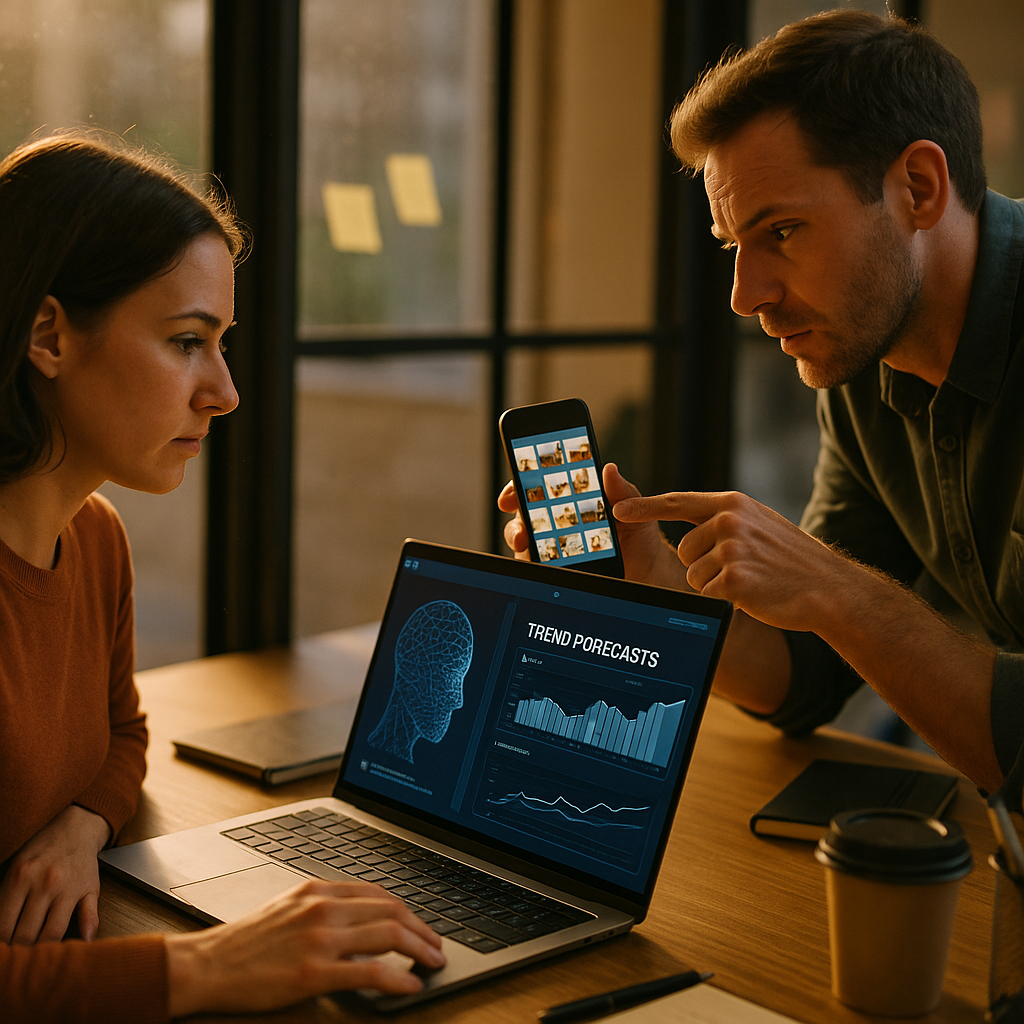
Seventy percent of short-form video formats that trend on TikTok lose half their reach within six weeks, according to internal creator data shared by multiple agencies this year. If your brand still relies on a quarterly trends deck, you’re already behind. An AI trend tracker isn’t a luxury anymore. It’s the only realistic way a three-person social team competes with brands that employ full trend-spotting units.
The Problem Isn’t Spotting Trends, It’s Spotting Them in Time
Every marketer knows what a trend looks like once it’s everywhere. The hard part is catching it in week one, not week six, when the format is already saturated and your version reads as a copycat. Most mid-sized brands don’t have a researcher whose entire job is scrolling, tagging, and forecasting format shifts. They have a social manager juggling content calendars, community replies, and reporting decks, who checks trends between meetings.
That gap used to be acceptable. It isn’t anymore. Content formats now rotate faster than brand approval cycles. A sound, a caption structure, a video length preference, these can peak and decline inside a single sprint. Waiting for a human team to notice, debate, and greenlight a format means you launch into the downslope.
The brands winning on format adoption aren’t the ones with the biggest trends teams. They’re the ones with the shortest gap between detection and production.
What an AI Trend Tracker Actually Does
Strip away the marketing language and an AI trend tracker does three things: it monitors format signals across platforms at a scale no human can match, it scores those signals against your historical performance data, and it flags the ones worth acting on before they peak. Think pattern recognition across millions of posts, not a dashboard that just shows you what’s already viral.
- Signal detection: scanning hashtag velocity, audio usage spikes, caption structure changes, and video length shifts across TikTok, Instagram Reels, and YouTube Shorts.
- Relevance scoring: matching detected formats against your brand’s past content performance to predict fit, not just popularity.
- Lifecycle flagging: estimating where a trend sits on the adoption curve so you know if you’re early, on time, or too late.
Tools like Exolyt, Trendpop, and features built into platforms such as Sprout Social’s listening suite now offer some version of this. The quality varies wildly, and none of them replace judgment entirely. But they compress the detection window from weeks to days, sometimes hours.
Why Small Teams Need This More Than Big Ones
Here’s the uncomfortable truth: enterprise brands with dedicated trends teams don’t actually need AI trackers as badly as lean teams do. They have bodies. A five-person unit scrolling eight hours a day across platforms will catch most emerging formats through sheer volume.
A solo social manager or a two-person content pod cannot replicate that coverage. That’s precisely where automated detection earns its keep. It’s not about replacing human judgment, it’s about giving a stretched team the same visibility that a well-staffed competitor already has. This is the same logic driving adoption across the broader marketing stack, where one creator shoot now yields ten testable ad angles instead of requiring a dozen separate production cycles.
Budget-wise, this math is straightforward. A junior trends analyst costs roughly $55,000 to $70,000 annually depending on market. A trend-tracking tool subscription typically runs a few hundred to a few thousand dollars a month. You’re not getting the same output, but you’re getting enough signal to stop guessing.
Where the Risk Actually Lives
The mistake brands make isn’t skipping AI trend tools, it’s trusting them blindly. A format detection score tells you a trend is rising. It does not tell you whether it fits your brand voice, whether it carries reputational baggage, or whether a competitor already owns the association. That judgment call still belongs to a human.
This mirrors a pattern showing up across AI marketing tooling generally. As covered in our look at how AI copilots still need humans to check the work, automation accelerates research but doesn’t eliminate the review layer. Trend trackers are no different. Treat the output as a shortlist, not a mandate.
There’s also a compliance angle worth flagging. If your trend tracker surfaces a format built around a creator’s unreleased product teaser or an unverified claim, publishing fast without a legal check can backfire. The FTC’s influencer guidance still applies regardless of how quickly a format moves, so speed can’t come at the expense of disclosure accuracy. Brands navigating this tension should review the FTC’s endorsement guidelines before greenlighting any trend-driven creative that touches claims or testimonials.
Building a Lightweight Workflow, Not a New Department
You don’t need to hire anyone to run this well. You need a repeatable weekly rhythm that takes maybe 90 minutes total.
- Monday scan: pull the tracker’s top five flagged formats from the weekend. Filter for anything scoring above your brand’s historical fit threshold.
- Tuesday triage: a 15 minute call (or async thread) where whoever owns content decides yes, no, or “watch another week.”
- Wednesday brief: whatever gets greenlit goes into a one-page brief for whoever shoots or edits, creator or in-house.
- Friday review: check performance against the tracker’s predicted fit score. This is how the system gets smarter over time, and how you catch false positives.
That Friday step matters more than people think. Feeding actual performance data back into your selection criteria is what separates a brand that chases every flagged trend from one that builds a defensible pattern of what actually works for its audience. It’s the same discipline behind AI UGC scoring that predicts which clips survive paid spend, just applied to format selection instead of creative testing.
Picking Tools Without Getting Locked Into the Wrong Stack
Not every trend tracker is built for the same job. Some specialize in audio and sound trend detection (useful if you run a lot of TikTok-first content). Others focus on caption structure and hook pattern analysis, which matters more for brands leaning into long-form or YouTube Shorts. A few, like features inside HubSpot’s social tools, bundle trend signals with broader content calendar functions, which suits teams that want one platform rather than three.
Before committing budget, ask vendors three questions:
- How is the trend lifecycle scored, and what data trains that model?
- Can the tool ingest your own historical performance data, or does it only benchmark against industry averages?
- What’s the actual lag between a format emerging and the tool flagging it?
Vendors who can’t answer the lag question clearly are probably reselling someone else’s listening API with a dashboard on top. That’s not inherently bad, but you should know what you’re paying for. For broader context on how creator and content intelligence tools are consolidating, the shift toward bundling creator marketing into one system is worth watching, since standalone trend trackers may eventually get folded into larger platforms.
A trend tracker that can’t ingest your own performance history is just a louder version of scrolling the For You page yourself.
What Changes When Trend Detection Gets Faster
Speed only helps if your production process can keep pace. There’s no point catching a format on day two if your approval chain still takes nine business days. Brands that get real value from AI trend tracking usually pair it with faster creative turnaround, whether through pre-approved creator pools, modular UGC templates, or generative tools that adapt existing assets. This is also why format tracking increasingly intersects with generative creative variation. If detection speeds up but production doesn’t, you’ve just built a faster way to notice you’re late. Pairing trend intelligence with tools that help scale ads without losing brand voice closes that gap on the execution side.
Platforms are also shifting how they surface format data publicly. Meta’s business tools and TikTok’s ad platform both now expose more granular format performance data than they did two years ago, which is worth checking directly through TikTok’s ad platform and Meta’s business suite if you want a free, if less predictive, starting point before investing in a dedicated tracker.
Next Step
Don’t start by buying a tool. Start by timing your current process: how many days pass between a format trending and your brand publishing something in that format? If it’s longer than seven, that’s the gap an AI trend tracker is built to close, and it’s the number that should justify the budget line.
Frequently Asked Questions
What exactly is an AI trend tracker in marketing?
It’s a tool that monitors content format signals, like audio usage, caption structure, and video length, across platforms at scale, then scores and flags emerging trends before they peak so brands can act early.
Can a small team really replace a full trends department with software?
Not fully. The tool gives you detection speed and scale, but human judgment still needs to decide brand fit, risk, and timing. It narrows the resource gap, it doesn’t eliminate the need for a decision maker.
How much do these tools typically cost?
Pricing ranges widely, from a few hundred dollars a month for basic listening features to several thousand for enterprise-grade detection with custom data ingestion. Compare that against the salary cost of a dedicated analyst to judge ROI.
What’s the biggest mistake brands make when adopting trend tracking tools?
Treating every flagged trend as a must-do. The tools surface statistical signals, not brand fit or compliance risk. Skipping the human review step is how brands end up publishing content that’s fast but off-brand or legally risky.
Do these tools work the same way across TikTok, Instagram, and YouTube Shorts?
No. Detection lag, signal types, and accuracy vary by platform because each has different API access and content structures. Audio-based detection tends to be stronger on TikTok, while caption and hook pattern analysis is more developed for YouTube Shorts.
Top Influencer Marketing Agencies
The leading agencies shaping influencer marketing in 2026
Agencies ranked by campaign performance, client diversity, platform expertise, proven ROI, industry recognition, and client satisfaction. Assessed through verified case studies, reviews, and industry consultations.
Moburst

-
2

The Shelf
Boutique Beauty & Lifestyle Influencer AgencyA data-driven boutique agency specializing exclusively in beauty, wellness, and lifestyle influencer campaigns on Instagram and TikTok. Best for brands already focused on the beauty/personal care space that need curated, aesthetic-driven content.Clients: Pepsi, The Honest Company, Hims, Elf Cosmetics, Pure LeafVisit The Shelf → -
3

Audiencly
Niche Gaming & Esports Influencer AgencyA specialized agency focused exclusively on gaming and esports creators on YouTube, Twitch, and TikTok. Ideal if your campaign is 100% gaming-focused — from game launches to hardware and esports events.Clients: Epic Games, NordVPN, Ubisoft, Wargaming, Tencent GamesVisit Audiencly → -
4

Viral Nation
Global Influencer Marketing & Talent AgencyA dual talent management and marketing agency with proprietary brand safety tools and a global creator network spanning nano-influencers to celebrities across all major platforms.Clients: Meta, Activision Blizzard, Energizer, Aston Martin, WalmartVisit Viral Nation → -
5

The Influencer Marketing Factory
TikTok, Instagram & YouTube CampaignsA full-service agency with strong TikTok expertise, offering end-to-end campaign management from influencer discovery through performance reporting with a focus on platform-native content.Clients: Google, Snapchat, Universal Music, Bumble, YelpVisit TIMF → -
6

NeoReach
Enterprise Analytics & Influencer CampaignsAn enterprise-focused agency combining managed campaigns with a powerful self-service data platform for influencer search, audience analytics, and attribution modeling.Clients: Amazon, Airbnb, Netflix, Honda, The New York TimesVisit NeoReach → -
7

Ubiquitous
Creator-First Marketing PlatformA tech-driven platform combining self-service tools with managed campaign options, emphasizing speed and scalability for brands managing multiple influencer relationships.Clients: Lyft, Disney, Target, American Eagle, NetflixVisit Ubiquitous → -
8

Obviously
Scalable Enterprise Influencer CampaignsA tech-enabled agency built for high-volume campaigns, coordinating hundreds of creators simultaneously with end-to-end logistics, content rights management, and product seeding.Clients: Google, Ulta Beauty, Converse, AmazonVisit Obviously →