


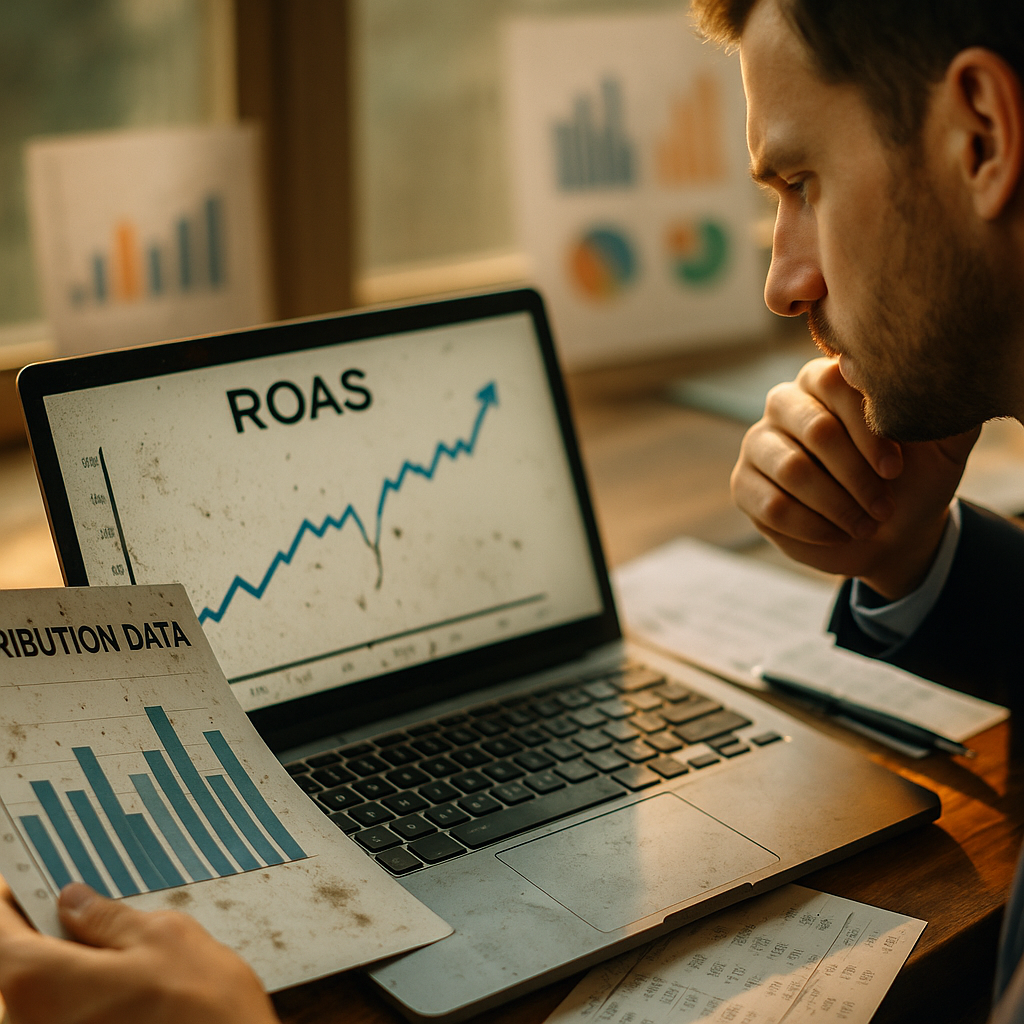
Forty-two percent of marketers now rank ROAS calculation as their single biggest measurement headache, trailing only overall budget justification. That’s not a fringe complaint from small teams without resources. It’s coming from well-funded brands running sophisticated AI-powered martech stacks. So why hasn’t the industry’s massive investment in AI attribution tools solved this? The honest answer: AI can’t calculate its way around dirty data, fragmented platforms, and the simple fact that influencer-driven purchases rarely leave a clean digital trail.
Why ROAS Calculation Still Breaks Marketing Teams
Return on ad spend sounds simple on paper. Revenue divided by spend. But influencer marketing rarely produces revenue numbers that map cleanly to a single campaign, creator, or even platform. A shopper sees a creator’s video on TikTok, searches the brand on Google, asks ChatGPT for a comparison, then buys three days later on desktop. Which channel gets credit? Most attribution models pick one touchpoint and ignore the rest, which means the ROAS number marketing teams report up the chain is frequently wrong, sometimes by a wide margin.
This isn’t a new problem, but it’s gotten more visible as budgets shift toward creator partnerships and brands demand the same rigor they apply to paid search. According to eMarketer, influencer marketing spend continues to climb year over year, yet measurement maturity hasn’t kept pace. Brands are pouring more dollars into a channel they still can’t cleanly measure.
The AI Promise vs. The Attribution Reality
Every martech vendor pitch in the last two years has included some version of “our AI solves attribution.” Multi-touch modeling, predictive ROAS scoring, automated budget reallocation. It sounds great in a sales deck. In practice, these tools are only as good as the data feeding them, and that’s exactly where things fall apart.
Most brands feed AI attribution models incomplete CRM records, inconsistent UTM tagging, and platform-reported metrics that don’t reconcile with actual sales data. One recent analysis found that only 21 percent of CRM data is ready for AI attribution out of the box. That means roughly four out of five brands are asking AI to do precision math with imprecise inputs. The model isn’t broken. The foundation is.
AI attribution tools don’t fail because the algorithms are weak. They fail because they’re asked to reconcile fragmented, inconsistent data that was never designed to be unified in the first place.
Where AI Tools Still Fall Short
Marketers aren’t wrong to be skeptical. Here’s where the gap between promise and performance shows up most consistently:
- Cross-platform stitching: AI models struggle to connect a TikTok view, an Instagram save, and a Shopify purchase into one customer journey without a shared identifier, and most brands don’t have one.
- Dark social and screenshots: A huge share of influencer-driven conversions happen through shared links, screenshots, and word of mouth that never touch a trackable URL.
- Delayed conversion windows: Influencer content often drives purchase intent weeks later, well outside the 7 or 30-day attribution windows most tools default to.
- Creator-level granularity: Platform-wide ROAS is one thing. Knowing which specific creator, hook, or format drove the sale is a much harder problem that most AI tools still approximate rather than measure.
- Payout reconciliation: Even when a sale is correctly attributed, matching it to the right creator payout structure introduces another layer of error, as outlined in unified customer profile compliance risk research.
Put together, these gaps explain why so many teams still default to manual workarounds. It’s not nostalgia for spreadsheets. It’s that spreadsheets, however clunky, let a human sanity-check the output. AI dashboards often don’t offer that same visibility into how a number was derived.
Promo Codes Still Beat Fancy Attribution Models
Here’s an uncomfortable truth for vendors selling six-figure attribution platforms: a lot of performance-minded brands still get their most reliable ROAS data from basic, unglamorous promo codes. Our own reporting found that manual promo codes beat AI attribution on creator payouts in terms of accuracy and dispute resolution, even though they’re far less sophisticated. A unique code tied to a single creator removes ambiguity. No modeling required.
That doesn’t mean promo codes are the future. They undercount influence that doesn’t end in an immediate redemption, and they’re clunky at scale. But their continued popularity says something important: marketers will choose a less elegant method that they trust over a sophisticated one they can’t fully explain to their CFO.
Human Oversight Isn’t Going Away Anytime Soon
If there’s a theme running through most AI attribution failures, it’s this: the tools need more human math-checking than vendors advertise. Recent coverage of enterprise analytics platforms found that agent intelligence still needs human math checks before marketing teams can act on its output with confidence. That’s not a knock on the technology. It’s a reflection of where AI attribution maturity actually sits right now, versus where the marketing is pitching it.
This also explains why influencer AI adoption is lopsided. Discovery and matching tools have gained real traction because the stakes of a wrong answer are low. Pick a slightly wrong creator and you waste a few hundred dollars testing. But attribution errors compound into budget decisions worth six or seven figures, which is why creator discovery AI beats attribution AI on adoption rates across the industry. Teams trust AI more when the downside of a mistake is small.
It’s worth connecting this to the broader AI maturity curve in influencer marketing. Negotiation and discovery tasks are relatively self-contained and easy to validate. Reporting is where things stall, largely because influencer AI stalls between negotiation and reporting, and ROAS sits squarely in that reporting bottleneck.
What Actually Works Right Now
None of this means AI attribution tools are useless. It means brands need to deploy them with realistic expectations and the right scaffolding underneath. A few practical moves that are actually moving the needle for teams we’ve talked to:
- Clean the CRM before you buy the tool. No AI model fixes bad inputs. Audit data hygiene first, or you’re automating confusion at scale.
- Blend methods instead of picking one. Use promo codes or unique links for direct attribution, layer AI modeling on top for incremental lift estimates, and treat the AI number as directional, not gospel.
- Extend attribution windows deliberately. Default 7 or 30-day windows undercount influencer impact. Adjust them based on your actual purchase cycle data.
- Build a human review step into reporting. Someone on the team should spot-check AI-generated ROAS figures against raw sales data monthly, not just trust the dashboard.
- Treat creator-level ROAS as an estimate, not a fact. Report ranges and confidence levels internally rather than a single clean number that implies more precision than the data supports.
This approach mirrors what’s happening elsewhere in marketing AI. Only a small fraction of agentic systems ever reach full production use, as research on why only 10.8 percent of marketing AI agents reach production makes clear. ROAS attribution is no exception. The tools that survive internal scrutiny are the ones paired with strong human governance, not the ones that promise full automation out of the box.
Industry data from HubSpot and Sprout Social consistently shows marketers citing measurement as their top unsolved problem year after year, even as tool spend increases. That gap between spend and confidence is the real story here, not a lack of available software.
FAQs
Frequently Asked Questions
Why is ROAS calculation so hard for influencer marketing specifically?
Influencer-driven purchases rarely happen on a single trackable path. A shopper might see a creator’s content, research the brand elsewhere, and buy days or weeks later through an untracked channel, which makes clean attribution nearly impossible without supplemental tracking like promo codes.
Can AI attribution tools fix inaccurate ROAS reporting on their own?
No. AI models are only as reliable as the data feeding them. If CRM records, UTM tags, and platform metrics are inconsistent or incomplete, AI will produce confident-sounding numbers that are still wrong.
Are promo codes a better alternative to AI-driven attribution?
Promo codes offer more direct, verifiable attribution for a specific creator but undercount influence that doesn’t end in immediate redemption. Most mature programs use them alongside, not instead of, broader modeling.
How should marketing teams verify AI-generated ROAS numbers?
Build a regular human review step that cross-checks AI output against raw sales and CRM data, and treat AI-generated creator-level ROAS as a directional estimate rather than an exact figure.
What attribution window should brands use for influencer campaigns?
There’s no universal answer. Brands should analyze their actual purchase cycle length and adjust default windows (often 7 or 30 days) to match real buying behavior rather than relying on platform defaults.
The fix for broken ROAS reporting isn’t a better algorithm, it’s better data discipline paired with realistic trust in what AI can actually verify. Start by auditing your CRM data quality this quarter, before you sign another contract promising AI-powered attribution clarity.
Top Influencer Marketing Agencies
The leading agencies shaping influencer marketing in 2026
Agencies ranked by campaign performance, client diversity, platform expertise, proven ROI, industry recognition, and client satisfaction. Assessed through verified case studies, reviews, and industry consultations.
Moburst

-
2

The Shelf
Boutique Beauty & Lifestyle Influencer AgencyA data-driven boutique agency specializing exclusively in beauty, wellness, and lifestyle influencer campaigns on Instagram and TikTok. Best for brands already focused on the beauty/personal care space that need curated, aesthetic-driven content.Clients: Pepsi, The Honest Company, Hims, Elf Cosmetics, Pure LeafVisit The Shelf → -
3

Audiencly
Niche Gaming & Esports Influencer AgencyA specialized agency focused exclusively on gaming and esports creators on YouTube, Twitch, and TikTok. Ideal if your campaign is 100% gaming-focused — from game launches to hardware and esports events.Clients: Epic Games, NordVPN, Ubisoft, Wargaming, Tencent GamesVisit Audiencly → -
4

Viral Nation
Global Influencer Marketing & Talent AgencyA dual talent management and marketing agency with proprietary brand safety tools and a global creator network spanning nano-influencers to celebrities across all major platforms.Clients: Meta, Activision Blizzard, Energizer, Aston Martin, WalmartVisit Viral Nation → -
5

The Influencer Marketing Factory
TikTok, Instagram & YouTube CampaignsA full-service agency with strong TikTok expertise, offering end-to-end campaign management from influencer discovery through performance reporting with a focus on platform-native content.Clients: Google, Snapchat, Universal Music, Bumble, YelpVisit TIMF → -
6

NeoReach
Enterprise Analytics & Influencer CampaignsAn enterprise-focused agency combining managed campaigns with a powerful self-service data platform for influencer search, audience analytics, and attribution modeling.Clients: Amazon, Airbnb, Netflix, Honda, The New York TimesVisit NeoReach → -
7

Ubiquitous
Creator-First Marketing PlatformA tech-driven platform combining self-service tools with managed campaign options, emphasizing speed and scalability for brands managing multiple influencer relationships.Clients: Lyft, Disney, Target, American Eagle, NetflixVisit Ubiquitous → -
8

Obviously
Scalable Enterprise Influencer CampaignsA tech-enabled agency built for high-volume campaigns, coordinating hundreds of creators simultaneously with end-to-end logistics, content rights management, and product seeding.Clients: Google, Ulta Beauty, Converse, AmazonVisit Obviously →