


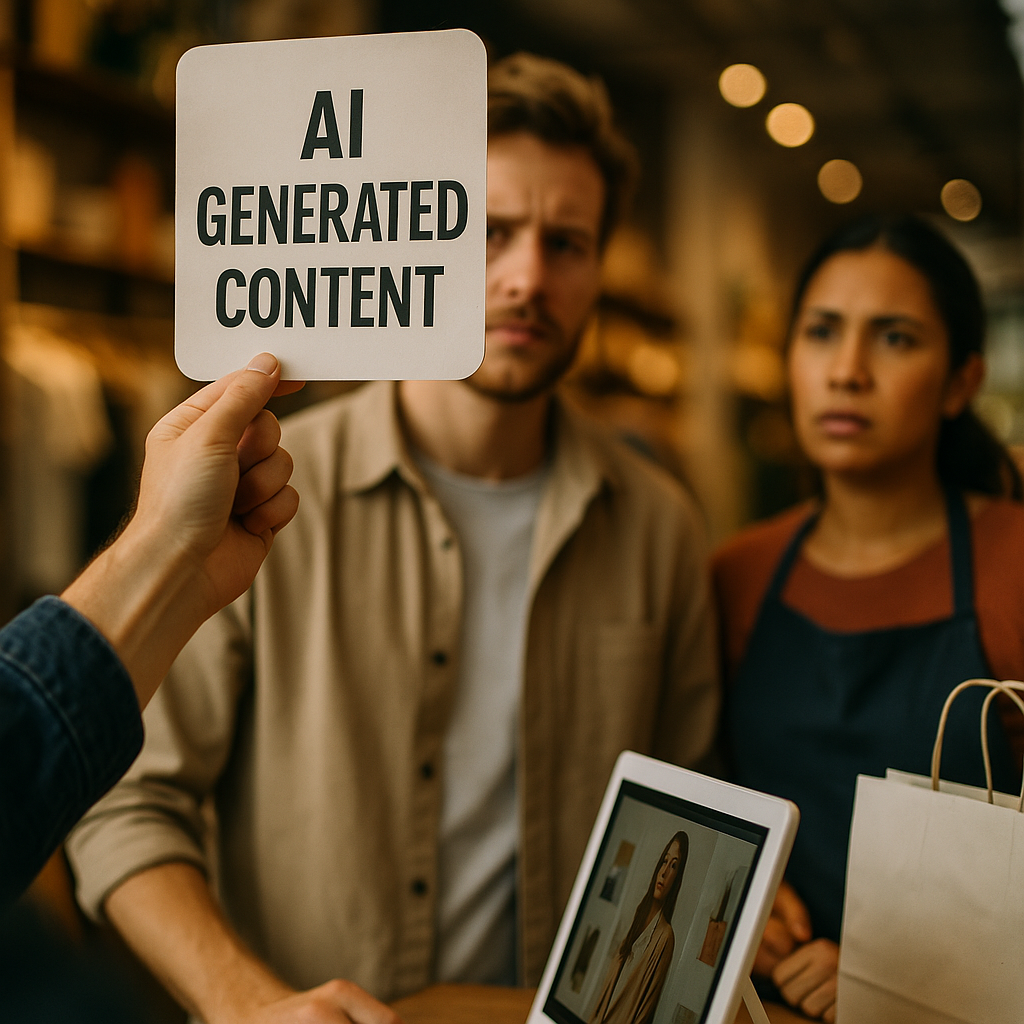
Sixty one percent of consumers now say they want clear disclosure when AI or paid influence shapes what they see online, according to recent industry research. That number was closer to background noise two years ago. Now it’s a warning shot. The AI backlash isn’t a fringe sentiment anymore, it’s showing up in comment sections, boycott threads, and brand safety audits. If your 2026 messaging still treats AI generated content and creator endorsements as interchangeable marketing tools, you’re already behind.
The Trust Collapse Is Measurable
For years, brands assumed audiences couldn’t tell the difference between a human creator and a synthetic one, or didn’t care. That assumption is dead. Audiences have gotten sharper, partly because they’ve been burned. Fake reviews, AI generated testimonials, and deepfaked endorsements have made skepticism the default posture, not the exception.
The data backs this up. Our earlier coverage on disclosure demands showed that unpaid advocacy and quiet AI use are facing the same reckoning that influencer marketing faced a decade ago with #ad labeling. And separate research on trust hierarchies found that frontline staff now outrank CEOs and influencers on credibility. That’s a brutal signal for any brand leaning hard on creator partnerships without transparency baked in.
Audiences aren’t rejecting AI itself. They’re rejecting brands that pretend it isn’t there.
Why the Pushback Is Accelerating Now
Three forces are converging at once. First, AI generated content has gotten good enough to fool a casual scroll, which means the stakes of getting caught are higher, not lower. Second, platforms are under regulatory pressure to flag synthetic media, and that scrutiny trickles down to brands. Third, creators themselves are pushing back publicly when brands use their likeness or style to train AI tools without consent.
Add to that a wave of agentic AI launches hitting marketing stacks faster than teams can vet them. Our report on eight agentic launches in two weeks captured how overwhelmed marketing operations have become. Speed of adoption has outpaced governance. That gap is exactly where backlash grows.
There’s also a simpler explanation: fatigue. People are tired of guessing what’s real. A recent social media trust survey found that authenticity concerns now rank among the top reasons users unfollow brand accounts entirely.
What Recalibration Actually Looks Like
Recalibrating isn’t about abandoning AI. It’s about being honest about where it sits in your workflow, and where it doesn’t belong at all.
- Label synthetic media clearly. Not buried in a caption, visible at first glance. The FTC has already signaled that vague disclosure won’t hold up under scrutiny, per FTC guidance on endorsements and testimonials.
- Separate AI production from AI persona. Using AI to edit a creator’s video is very different from generating a synthetic spokesperson. Audiences treat these as categorically different, even if your internal workflow doesn’t.
- Audit your vendor stack. If a tool casts creators or generates likeness based content, know exactly what consent and compensation model sits underneath it. Our piece on AI casting creators instantly showed how fast this tech moves ahead of contracts and compliance.
- Give creators editorial control. Persona matching tools are improving targeting, as covered in our analysis of persona matching replacing demographics, but matching the right human still beats manufacturing one.
Disclosure Isn’t a Nice to Have Anymore
Here’s the uncomfortable truth: most brands still treat disclosure as a legal checkbox rather than a trust signal. That’s backwards. The UK’s Information Commissioner’s Office and the FTC are both tightening expectations around AI transparency, and the UK’s ICO guidance on AI and data use increasingly overlaps with advertising standards enforcement.
Brands that disclose proactively, before regulators or audiences force the issue, are seeing a reputational dividend. It sounds counterintuitive. Shouldn’t admitting “this was AI assisted” hurt engagement? The data says otherwise. Transparent brands retain more trust over time than brands caught hiding AI involvement after the fact.
Proactive disclosure costs you a little polish today. Getting caught costs you the whole relationship tomorrow.
Creators Are Becoming the Trust Buffer, Use Them That Way
This is the part brands keep missing. Human creators aren’t just content sources anymore, they’re credibility infrastructure. When a known creator vouches for a product, their audience extends them trust that a brand account or synthetic persona simply can’t earn on its own.
That’s why creator content is increasingly doing double duty as paid ad creative rather than sitting in organic feeds alone, a shift we detailed in creator content turning into ad creative. If you’re going to use AI anywhere in the funnel, let it handle production efficiency (editing, localization, captioning) and let human creators handle the trust layer. Don’t flip that division of labor.
It also means budget conversations need to shift. Teams still struggling to benchmark AI ROI despite daily use are exactly the teams most likely to deploy AI messaging carelessly, because nobody’s measuring the downside risk, only the output speed.
A Quick Gut Check Before Your Next Campaign
Ask three questions before any campaign goes live. Does the audience know what’s human and what’s generated? Would the creator be comfortable if this disclosure were public and permanent? Does the AI use save time without replacing the trust a human relationship was providing? If any answer is murky, that’s your recalibration point, not a footnote to fix later.
Marketers chasing efficiency gains sometimes forget that brand trust metrics move slower than production metrics, and recover far more slowly too. A campaign can launch in hours. Rebuilding credibility after a backlash takes quarters.
Frequently Asked Questions
FAQs
What exactly is causing the AI backlash in marketing right now?
It’s driven by a combination of increasingly convincing synthetic content, regulatory scrutiny over disclosure, and audiences who have been repeatedly misled by undisclosed AI use in reviews, testimonials, and influencer content.
Does disclosing AI use actually hurt engagement?
Generally no. Data suggests transparent disclosure preserves trust over time, while brands caught concealing AI involvement see sharper, longer lasting drops in credibility and engagement.
Should brands stop using AI in creator campaigns entirely?
No. The recalibration is about where AI sits in the workflow. Using it for production efficiency is generally accepted. Using it to fabricate personas or endorsements without consent and disclosure is where backlash concentrates.
How should brands handle disclosure for AI assisted creator content?
Make it visible and specific rather than buried in fine print. Clarify whether AI was used for editing, generation, or persona creation, since audiences and regulators increasingly treat these differently.
What role do human creators play in reducing AI backlash risk?
Human creators function as a trust buffer. Their audiences extend credibility based on real relationships, which synthetic personas and brand owned AI content cannot replicate at the same level.
The brands that win this cycle won’t be the ones using the most AI, they’ll be the ones who are clearest about using it. Audit your current creator and AI messaging this quarter, fix the disclosure gaps first, and let human creators carry the trust that no model can fake.
Top Influencer Marketing Agencies
The leading agencies shaping influencer marketing in 2026
Agencies ranked by campaign performance, client diversity, platform expertise, proven ROI, industry recognition, and client satisfaction. Assessed through verified case studies, reviews, and industry consultations.
Moburst

-
2

The Shelf
Boutique Beauty & Lifestyle Influencer AgencyA data-driven boutique agency specializing exclusively in beauty, wellness, and lifestyle influencer campaigns on Instagram and TikTok. Best for brands already focused on the beauty/personal care space that need curated, aesthetic-driven content.Clients: Pepsi, The Honest Company, Hims, Elf Cosmetics, Pure LeafVisit The Shelf → -
3

Audiencly
Niche Gaming & Esports Influencer AgencyA specialized agency focused exclusively on gaming and esports creators on YouTube, Twitch, and TikTok. Ideal if your campaign is 100% gaming-focused — from game launches to hardware and esports events.Clients: Epic Games, NordVPN, Ubisoft, Wargaming, Tencent GamesVisit Audiencly → -
4

Viral Nation
Global Influencer Marketing & Talent AgencyA dual talent management and marketing agency with proprietary brand safety tools and a global creator network spanning nano-influencers to celebrities across all major platforms.Clients: Meta, Activision Blizzard, Energizer, Aston Martin, WalmartVisit Viral Nation → -
5

The Influencer Marketing Factory
TikTok, Instagram & YouTube CampaignsA full-service agency with strong TikTok expertise, offering end-to-end campaign management from influencer discovery through performance reporting with a focus on platform-native content.Clients: Google, Snapchat, Universal Music, Bumble, YelpVisit TIMF → -
6

NeoReach
Enterprise Analytics & Influencer CampaignsAn enterprise-focused agency combining managed campaigns with a powerful self-service data platform for influencer search, audience analytics, and attribution modeling.Clients: Amazon, Airbnb, Netflix, Honda, The New York TimesVisit NeoReach → -
7

Ubiquitous
Creator-First Marketing PlatformA tech-driven platform combining self-service tools with managed campaign options, emphasizing speed and scalability for brands managing multiple influencer relationships.Clients: Lyft, Disney, Target, American Eagle, NetflixVisit Ubiquitous → -
8

Obviously
Scalable Enterprise Influencer CampaignsA tech-enabled agency built for high-volume campaigns, coordinating hundreds of creators simultaneously with end-to-end logistics, content rights management, and product seeding.Clients: Google, Ulta Beauty, Converse, AmazonVisit Obviously →