


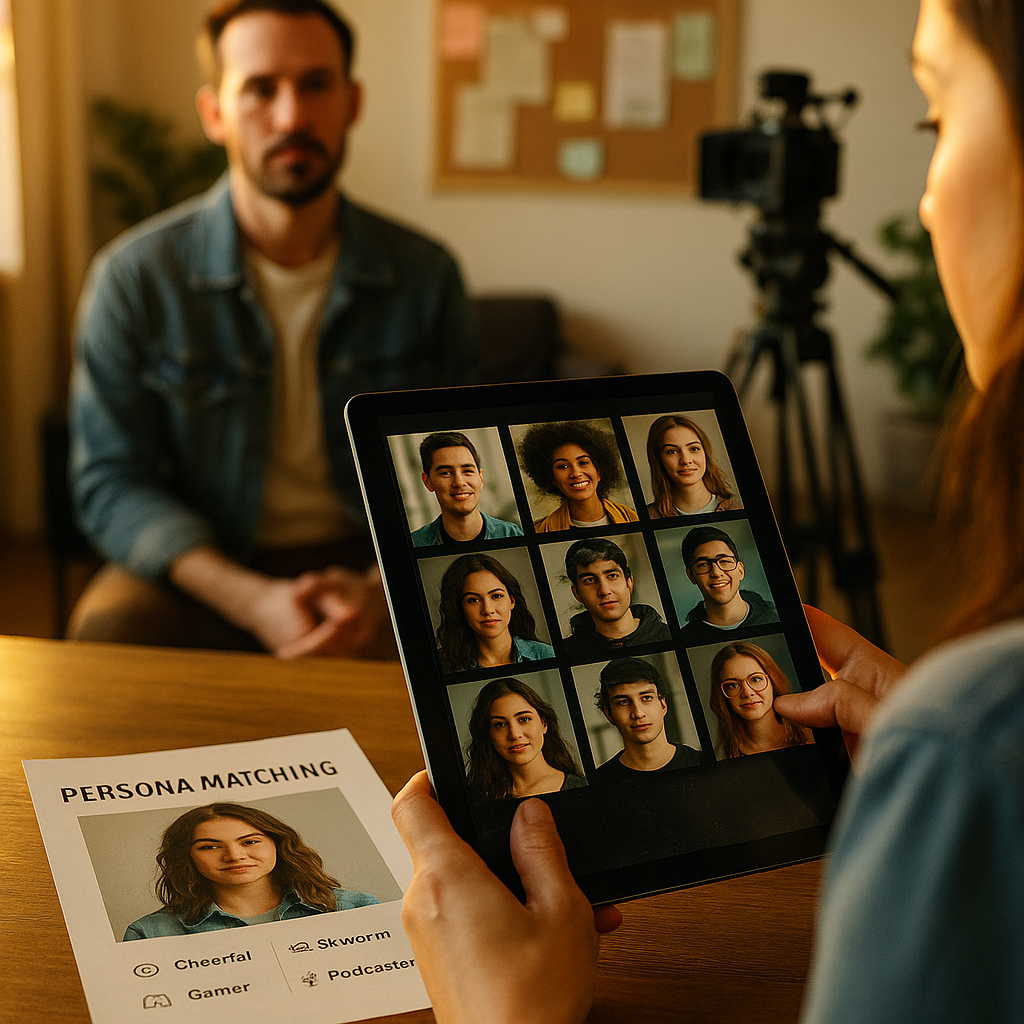
A 24-year-old vegan fitness creator and a 24-year-old meat-and-potatoes dad bod comedian technically match the same demographic cell. They will never move the same customer. That gap is why persona matching is quietly replacing demographics as the default casting method for creator campaigns, and why brands still leaning on age, gender, and location filters are leaving conversion on the table.
The Demographic Model Was Always a Proxy
Demographics were never the actual goal. They were a stand in for something harder to measure: shared values, lifestyle, and purchase intent. Age and gender correlated loosely with behavior back when media planning meant buying a TV slot during a specific show. That correlation has broken down almost completely in social feeds, where a 45-year-old and a 19-year-old can follow the exact same skincare creator for the exact same reason.
Marketers kept the demographic shorthand because it was easy to buy, easy to report, and easy to defend in a budget meeting. Nobody got fired for targeting women 25 to 34. But easy isn’t the same as accurate, and procurement teams scrutinizing creator ad spend are no longer satisfied with a targeting rationale that amounts to a census bracket.
Demographic targeting tells you who someone is on paper. Persona matching tells you why they’d actually buy. Brands optimizing for the second metric are the ones closing the ROI gap.
What Persona Matching Actually Means in Practice
Persona matching casts creators based on the psychographic profile of the audience: values, aspirations, pain points, content consumption habits, and the specific jobs-to-be-done that a product solves for them. Instead of asking “does this creator’s audience skew 25 to 34 female,” brand teams now ask “does this creator’s audience over-index on budget anxiety, time scarcity, or a specific aesthetic identity that maps to our product positioning?”
This isn’t a soft, vibes-based exercise anymore. Platforms built for creator discovery now layer comment sentiment analysis, content theme clustering, and purchase-intent signals on top of raw follower counts. A beauty brand launching a budget-friendly skincare line doesn’t need creators with large audiences of women 18 to 24. It needs creators whose comment sections are full of phrases like “finally something affordable” or “does this work as well as the expensive version.”
That shift mirrors what’s happening across the broader creator sourcing landscape, where the sheer volume of available talent has made manual, demographic-only vetting impractical at scale.
Why the Old Playbook Breaks at Scale
Here’s the uncomfortable math. There are now hundreds of thousands of nano and micro creators actively posting sponsored content, and demographic filters return thousands of “matches” for any reasonably broad targeting criteria. Sorting through that volume using age and gender alone produces a shortlist that’s wide but shallow. Agencies end up picking creators who look right on a spreadsheet but whose actual audience never converts.
Persona matching narrows that funnel dramatically. Instead of a thousand creators who technically fit a demo, a brand gets forty whose audiences demonstrably care about the exact problem the product solves. Smaller list, higher conversion rate, better use of a media buyer’s time.
The Data Behind the Shift
Industry trackers at eMarketer have flagged persona and interest-based targeting as a growing line item in influencer platform RFPs, replacing pure demographic filters as the primary sort criteria. That tracks with what’s happening on the measurement side too. Brands that have shifted to measuring creators like paid media need targeting inputs that actually predict performance, and demographic brackets have a weak track record of doing that.
There’s also a procurement angle that doesn’t get enough attention. When influencer budgets get classified as media spend rather than discretionary marketing, finance teams want to see a targeting methodology that resembles programmatic buying. “We picked creators with the right vibe” doesn’t survive a budget review. “We matched creators to a validated persona segment with documented audience affinity data” does. This is part of why finance teams are pushing agencies toward more rigorous, auditable casting criteria.
How Brands Build Persona Profiles Before Casting
The mechanics vary by team, but the better-run programs follow a similar sequence:
- Start with the customer, not the creator. Build the persona from CRM data, customer interviews, and existing first-party purchase behavior before looking at a single creator profile.
- Map pain points to content themes. A persona defined by “overwhelmed new parent trying to save time” maps to very different creators than “overwhelmed new parent trying to spend quality time,” even though both could sit in the same demographic bucket.
- Audit the creator’s actual audience, not their stated niche. A finance creator’s audience might skew toward anxious first-time investors or toward confident FIRE enthusiasts. Those are different personas requiring different messaging.
- Weight comment and DM sentiment. Tools that parse engagement text for recurring themes and emotional tone are now standard in vetting, not a nice-to-have.
- Validate with a small paid test before scaling the roster. Persona fit is a hypothesis until a creator’s content actually drives the target action.
None of this eliminates demographic data entirely. Age still matters for legal compliance (think alcohol or financial products), and platform ad managers like Meta Business and TikTok Ads Manager still surface demographic breakdowns as a baseline filter. It’s just no longer the primary decision variable. It’s a guardrail, not a target.
Where This Gets Harder: Nano and Micro Creators
Persona matching is comparatively easy with mid-tier and macro creators who have enough audience data to analyze reliably. It gets murkier with nano creators, where sample sizes are small and engagement data is thin. Brands leaning into nano creator strategies for authenticity and cost efficiency need to lean more heavily on qualitative signals, like the specific language a creator uses, the communities they participate in, and the tone of their comment section, because the quantitative audience data simply isn’t dense enough to run the same statistical persona models used for larger accounts.
This is also where AI-assisted discovery tools have become genuinely useful rather than just a sales pitch. Several platforms now auto-cluster creator audiences by inferred psychographic traits pulled from engagement patterns, going well beyond what manual review could ever catch at volume. That capability is accelerating the broader move toward AI-driven creator discovery, even if the contracting and compliance side of the workflow hasn’t caught up yet.
Risk and Compliance Don’t Disappear, They Change Shape
Switching to persona matching doesn’t mean brands can skip brand safety review. If anything, it raises the stakes on suitability checks, because a creator chosen for deep psychographic alignment with a sensitive persona (financial stress, health anxiety, body image) carries more reputational exposure if that creator later posts something off-brand. Legal and compliance teams reviewing campaigns should treat persona-matched creators with at least the same scrutiny applied under brand suitability guidelines, since psychographic targeting can wander into sensitive personal attribute territory if it’s not handled carefully.
That sensitivity matters most in regulated categories. The FTC and the UK’s ICO have both signaled increasing attention to how audience data is collected and used in targeted advertising, and persona-based creator casting that draws on inferred emotional or health-related traits sits close enough to that regulatory line that legal review should be a standing step, not an afterthought.
A persona match that ignores compliance isn’t a better targeting strategy, it’s a liability with a higher conversion rate.
What This Means for Budget Allocation
Persona matching changes how media dollars get distributed across a creator roster, not just who gets picked. Brands that previously spread budget across a wide demographic net are consolidating spend into fewer creators with validated persona fit, then reallocating the savings into testing new persona segments. That’s consistent with the broader trend of conversion-blended creator planning replacing flat, reach-based buys. (Note: link kept to the closest matching conversion-focused resource.)
It also changes agency pricing conversations. A persona-matched roster is smaller and more defensible, which makes it easier to negotiate performance-based terms rather than flat retainers, echoing the shift documented in creator content replacing retainer-based deals.
Tools and Platforms Making This Possible
No single platform owns persona matching yet, but several creator marketplaces and influencer relationship management tools have added psychographic layers to their discovery filters over the past two years. Analytics vendors referenced by Sprout Social and HubSpot have both expanded audience insight reporting to include interest and intent signals alongside standard demographic breakdowns, a direct response to brand demand for richer targeting data. Expect this category to keep consolidating as procurement teams demand standardized reporting across vendors.
Frequently Asked Questions
What is persona matching in influencer marketing?
Persona matching is a creator casting method that selects influencers based on the psychographic profile of their audience, meaning values, interests, pain points, and purchase intent, rather than relying primarily on age, gender, or location demographics.
Why are brands moving away from demographic targeting for creator campaigns?
Demographic brackets no longer reliably predict purchase behavior in social media audiences. Two people in the same age and gender bracket can have completely different values and buying triggers, so brands use persona data to find creators whose audiences actually share relevant motivations.
Does persona matching replace demographic data entirely?
No. Demographic data still serves as a compliance guardrail, particularly for age-restricted products like alcohol or financial services. It’s no longer the primary targeting variable, but it remains part of the vetting process.
Is persona matching harder with nano and micro creators?
Yes. Nano creators typically have smaller audiences with thinner engagement data, which makes statistical persona analysis less reliable. Brands often rely more on qualitative signals, like comment language and community context, when vetting smaller creators.
What compliance risks come with persona-based creator casting?
Psychographic targeting that draws on sensitive inferred traits, such as health anxiety or financial stress, can raise regulatory concerns similar to those flagged by bodies like the FTC and the UK’s ICO. Brands should run persona-matched campaigns through the same brand suitability and legal review as any other targeted campaign.
How do brands build a persona profile before casting creators?
Most start with existing customer data (CRM records, purchase history, customer interviews) to define the persona, then map that persona’s pain points and values to specific creator audiences before reviewing individual creator content and comment sentiment.
Next step: Before your next creator brief goes out, replace the demographic filter line with a one-paragraph persona description pulled from actual customer data, then test it against your current shortlist to see how many creators survive the swap.
Frequently Asked Questions
What is persona matching in influencer marketing?
Persona matching is a creator casting method that selects influencers based on the psychographic profile of their audience, meaning values, interests, pain points, and purchase intent, rather than relying primarily on age, gender, or location demographics.
Why are brands moving away from demographic targeting for creator campaigns?
Demographic brackets no longer reliably predict purchase behavior in social media audiences. Two people in the same age and gender bracket can have completely different values and buying triggers, so brands use persona data to find creators whose audiences actually share relevant motivations.
Does persona matching replace demographic data entirely?
No. Demographic data still serves as a compliance guardrail, particularly for age-restricted products like alcohol or financial services. It’s no longer the primary targeting variable, but it remains part of the vetting process.
Is persona matching harder with nano and micro creators?
Yes. Nano creators typically have smaller audiences with thinner engagement data, which makes statistical persona analysis less reliable. Brands often rely more on qualitative signals, like comment language and community context, when vetting smaller creators.
What compliance risks come with persona-based creator casting?
Psychographic targeting that draws on sensitive inferred traits, such as health anxiety or financial stress, can raise regulatory concerns similar to those flagged by bodies like the FTC and the UK’s ICO. Brands should run persona-matched campaigns through the same brand suitability and legal review as any other targeted campaign.
How do brands build a persona profile before casting creators?
Most start with existing customer data (CRM records, purchase history, customer interviews) to define the persona, then map that persona’s pain points and values to specific creator audiences before reviewing individual creator content and comment sentiment.
Top Influencer Marketing Agencies
The leading agencies shaping influencer marketing in 2026
Agencies ranked by campaign performance, client diversity, platform expertise, proven ROI, industry recognition, and client satisfaction. Assessed through verified case studies, reviews, and industry consultations.
Moburst

-
2

The Shelf
Boutique Beauty & Lifestyle Influencer AgencyA data-driven boutique agency specializing exclusively in beauty, wellness, and lifestyle influencer campaigns on Instagram and TikTok. Best for brands already focused on the beauty/personal care space that need curated, aesthetic-driven content.Clients: Pepsi, The Honest Company, Hims, Elf Cosmetics, Pure LeafVisit The Shelf → -
3

Audiencly
Niche Gaming & Esports Influencer AgencyA specialized agency focused exclusively on gaming and esports creators on YouTube, Twitch, and TikTok. Ideal if your campaign is 100% gaming-focused — from game launches to hardware and esports events.Clients: Epic Games, NordVPN, Ubisoft, Wargaming, Tencent GamesVisit Audiencly → -
4

Viral Nation
Global Influencer Marketing & Talent AgencyA dual talent management and marketing agency with proprietary brand safety tools and a global creator network spanning nano-influencers to celebrities across all major platforms.Clients: Meta, Activision Blizzard, Energizer, Aston Martin, WalmartVisit Viral Nation → -
5

The Influencer Marketing Factory
TikTok, Instagram & YouTube CampaignsA full-service agency with strong TikTok expertise, offering end-to-end campaign management from influencer discovery through performance reporting with a focus on platform-native content.Clients: Google, Snapchat, Universal Music, Bumble, YelpVisit TIMF → -
6

NeoReach
Enterprise Analytics & Influencer CampaignsAn enterprise-focused agency combining managed campaigns with a powerful self-service data platform for influencer search, audience analytics, and attribution modeling.Clients: Amazon, Airbnb, Netflix, Honda, The New York TimesVisit NeoReach → -
7

Ubiquitous
Creator-First Marketing PlatformA tech-driven platform combining self-service tools with managed campaign options, emphasizing speed and scalability for brands managing multiple influencer relationships.Clients: Lyft, Disney, Target, American Eagle, NetflixVisit Ubiquitous → -
8

Obviously
Scalable Enterprise Influencer CampaignsA tech-enabled agency built for high-volume campaigns, coordinating hundreds of creators simultaneously with end-to-end logistics, content rights management, and product seeding.Clients: Google, Ulta Beauty, Converse, AmazonVisit Obviously →