


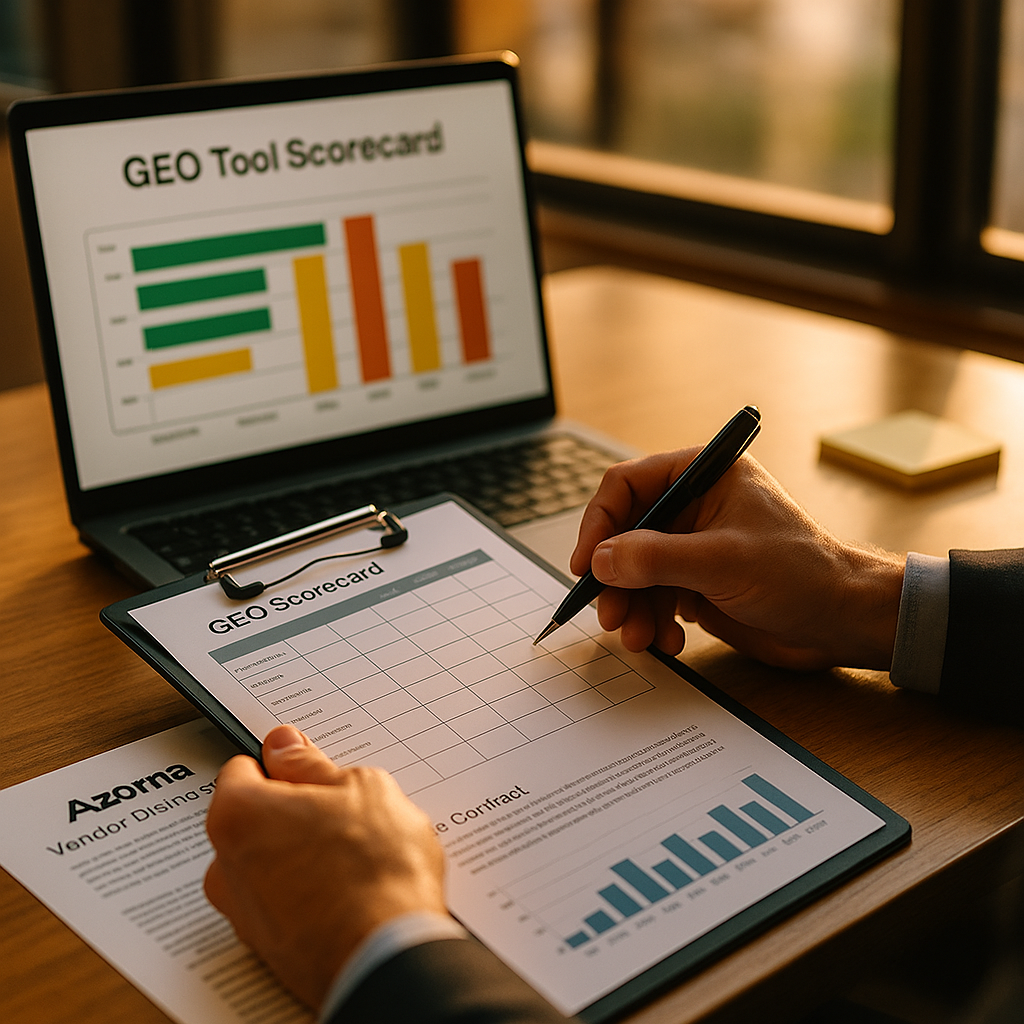
Gartner estimates that search engine volume could drop 25% by the end of the decade as users shift to AI chat interfaces. If that number even gets close to accurate, every brand without a plan for generative engine optimization tools is already behind. The problem is most of these tools are unproven, poorly differentiated, and marketed with claims nobody can verify. Azoma’s evaluation criteria offers a rare, structured way to cut through the noise.
Why GEO Tools Are Suddenly Everywhere
Eighteen months ago, “generative engine optimization” wasn’t a category. Now it’s a land grab. Vendors who used to sell SEO audits, social listening dashboards, or content briefs have rebranded overnight, slapping “GEO” on the same core product and charging a premium. Some of that is legitimate innovation. A lot of it is relabeling.
The appeal is obvious. Brands want to know if ChatGPT, Perplexity, or Google’s AI Overviews are citing them, recommending competitors instead, or ignoring the category entirely. That’s a real and growing concern, and it overlaps heavily with the questions raised in our look at generative search audit tools. But urgency creates bad buying decisions. Marketing teams under pressure to “do something about AI search” are signing annual contracts based on demo screenshots, not defensible methodology.
A tool that can’t explain how it samples AI model responses is giving you a vibe, not a metric.
What Azoma’s Criteria Actually Measures
Azoma, a research and advisory outfit tracking the generative search tooling market, built a scoring rubric specifically because most vendor comparisons were marketing copy dressed up as analysis. Their framework evaluates five dimensions, and it’s worth borrowing even if you never read the original report: methodology transparency, citation accuracy, model coverage, update cadence, and actionability of output.
Each of these maps to a real operational risk. Skip any one of them and you’re buying a reporting tool that looks sophisticated but tells you nothing you can act on.
Methodology Transparency
Can the vendor explain, in plain language, how it queries AI models to check for brand mentions? Some tools run live API calls against GPT, Gemini, and Claude on a defined schedule. Others scrape cached responses or extrapolate from a small sample size and present it as comprehensive coverage. Ask directly: how many queries, how often, against which models, and is the sampling method documented anywhere you can review?
If the answer is vague, that’s your first red flag. This is the same discipline we applied when reviewing answer engine optimization vendor red flags, and it holds here too: opacity in methodology almost always means the underlying data is thinner than the dashboard suggests.
Citation Accuracy
Does the tool correctly identify when and how your brand is cited in an AI-generated answer, versus a false positive triggered by a loose keyword match? Azoma’s testing found meaningful variance here across vendors, with some tools over-reporting brand mentions by conflating category terms with actual citations. If a tool says you were “mentioned” in 40% of relevant AI responses, ask for the raw transcripts. Good vendors will show you exactly what the model said and let you judge for yourself.
Model Coverage
Not all AI engines are created equal, and not all of them matter equally to your audience. A tool that only tracks ChatGPT is incomplete when Perplexity, Google’s AI Overviews, and Microsoft Copilot all pull from different indexes and weight sources differently. Coverage breadth matters, but so does coverage depth. Tracking five models shallowly is less useful than tracking three models with full query logs and historical trend data.
Update Cadence
Generative models change constantly. A vendor that refreshes its data monthly is giving you a snapshot that’s stale by the time you act on it. Weekly or even daily refresh cycles are becoming the baseline expectation among serious buyers, particularly for competitive categories where citation share shifts fast. Ask what happens when a model provider pushes a major update. Does the vendor’s tracking break, or does it adapt within days?
Actionability
This is where most tools fall apart. It’s one thing to tell a brand “you’re cited in 12% of relevant AI responses.” It’s another to tell them which content gaps, structured data issues, or authority signals are driving that number, and what to fix first. Azoma’s rubric weights this heavily, and for good reason: a report without a clear next action is a report nobody reads twice.
Building a Scoring Model Your Team Can Actually Use
You don’t need Azoma’s exact framework to benefit from the logic behind it. Build a simple internal scorecard before you take a single vendor demo. Score each tool from one to five on methodology transparency, citation accuracy, model coverage, update cadence, and actionability. Weight actionability and transparency higher, since those two determine whether the other three even matter.
- Request raw query logs, not summarized dashboards, during the trial period.
- Ask for a reference client in your vertical who will speak candidly about data reliability.
- Test the tool against a known scenario: a competitor you already know is winning AI citations in your category.
- Confirm how pricing scales as query volume and model coverage increase, since many vendors quote entry pricing that doesn’t reflect realistic usage.
This approach mirrors the structured comparison we ran in Contentstack Canoe vs 10Fold MetricsMatter, where fit mattered more than feature count. The same discipline applies to GEO tooling. Feature lists are easy to pad. Defensible data is not.
Where Brands Get This Wrong
The most common mistake is treating GEO tools as a bolt-on to existing SEO stacks without checking whether the data actually reconciles. If your GEO tool says you’re gaining citation share but your traffic and conversion numbers from paid social and organic search don’t move, something’s broken, either in the GEO tool’s measurement or in your attribution model. This is the exact tension we unpacked in reconciling attribution across platforms: more data sources don’t automatically mean more clarity.
The second mistake is ignoring compliance exposure. Several GEO vendors scrape AI model outputs in ways that sit in a legal gray zone, particularly around how they store and reuse third-party model responses. Before signing, ask your legal team to review the vendor’s data handling terms, and cross-check against guidance from the FTC on data practices and disclosure. This isn’t paranoia. It’s the same diligence we recommend for any vendor touching creator or customer data, as outlined in our review of AI infrastructure vendor risk.
Third, teams underestimate how fast this category will consolidate. A tool that looks like a market leader today could be acquired, repriced, or shut down within eighteen months. Favor vendors with clear data portability commitments, so you’re not locked into a sunk cost if the tool disappears.
The Real Cost of Getting This Wrong
A bad GEO tool doesn’t just waste budget. It generates false confidence. A brand team that believes it’s winning AI citation share, based on inflated or poorly sampled data, stops investing in the content and structured data work that actually drives generative visibility. Meanwhile competitors who are doing the unglamorous work of fixing schema markup, building authoritative content, and earning real third-party citations pull ahead quietly. By the time the gap shows up in pipeline numbers, it’s expensive to close.
Industry data from eMarketer and ongoing research from HubSpot both point to the same trend: marketing teams are allocating real budget to AI search visibility, but measurement maturity is lagging adoption. That gap is exactly where overpriced, underperforming GEO tools thrive.
FAQs
Common questions marketing teams ask before committing budget to a generative engine optimization tool.
Frequently Asked Questions
What makes Azoma’s criteria different from other GEO tool evaluation methods?
Azoma’s framework focuses on verifiable methodology rather than vendor-reported metrics. It scores tools on transparency, citation accuracy, model coverage, update cadence, and actionability, forcing buyers to ask vendors for raw data instead of summarized dashboards.
How often should a GEO tool refresh its data?
Weekly refresh cycles are becoming the practical minimum for competitive categories. Monthly updates are too slow given how frequently AI models change their underlying training data and ranking behavior.
Can a GEO tool replace traditional SEO tracking entirely?
No. GEO tools measure visibility inside AI-generated answers, which is a different surface than organic search rankings. Most brands need both, since traffic and conversion still flow heavily through traditional search and paid channels.
What’s the biggest red flag when evaluating a GEO vendor?
Vagueness about how the tool queries AI models. If a vendor can’t explain sample size, query frequency, or which models they test against, treat their reported metrics with heavy skepticism.
Should legal teams be involved in GEO tool procurement?
Yes. Several vendors scrape and store AI model outputs in ways that raise data handling questions. Legal review before signing protects against compliance exposure down the line.
Before you sign a GEO contract, run the vendor through Azoma’s five-point scorecard and demand raw query logs, not polished dashboards. If they can’t produce them, that’s your answer.
Top Influencer Marketing Agencies
The leading agencies shaping influencer marketing in 2026
Agencies ranked by campaign performance, client diversity, platform expertise, proven ROI, industry recognition, and client satisfaction. Assessed through verified case studies, reviews, and industry consultations.
Moburst

-
2

The Shelf
Boutique Beauty & Lifestyle Influencer AgencyA data-driven boutique agency specializing exclusively in beauty, wellness, and lifestyle influencer campaigns on Instagram and TikTok. Best for brands already focused on the beauty/personal care space that need curated, aesthetic-driven content.Clients: Pepsi, The Honest Company, Hims, Elf Cosmetics, Pure LeafVisit The Shelf → -
3

Audiencly
Niche Gaming & Esports Influencer AgencyA specialized agency focused exclusively on gaming and esports creators on YouTube, Twitch, and TikTok. Ideal if your campaign is 100% gaming-focused — from game launches to hardware and esports events.Clients: Epic Games, NordVPN, Ubisoft, Wargaming, Tencent GamesVisit Audiencly → -
4

Viral Nation
Global Influencer Marketing & Talent AgencyA dual talent management and marketing agency with proprietary brand safety tools and a global creator network spanning nano-influencers to celebrities across all major platforms.Clients: Meta, Activision Blizzard, Energizer, Aston Martin, WalmartVisit Viral Nation → -
5

The Influencer Marketing Factory
TikTok, Instagram & YouTube CampaignsA full-service agency with strong TikTok expertise, offering end-to-end campaign management from influencer discovery through performance reporting with a focus on platform-native content.Clients: Google, Snapchat, Universal Music, Bumble, YelpVisit TIMF → -
6

NeoReach
Enterprise Analytics & Influencer CampaignsAn enterprise-focused agency combining managed campaigns with a powerful self-service data platform for influencer search, audience analytics, and attribution modeling.Clients: Amazon, Airbnb, Netflix, Honda, The New York TimesVisit NeoReach → -
7

Ubiquitous
Creator-First Marketing PlatformA tech-driven platform combining self-service tools with managed campaign options, emphasizing speed and scalability for brands managing multiple influencer relationships.Clients: Lyft, Disney, Target, American Eagle, NetflixVisit Ubiquitous → -
8

Obviously
Scalable Enterprise Influencer CampaignsA tech-enabled agency built for high-volume campaigns, coordinating hundreds of creators simultaneously with end-to-end logistics, content rights management, and product seeding.Clients: Google, Ulta Beauty, Converse, AmazonVisit Obviously →