


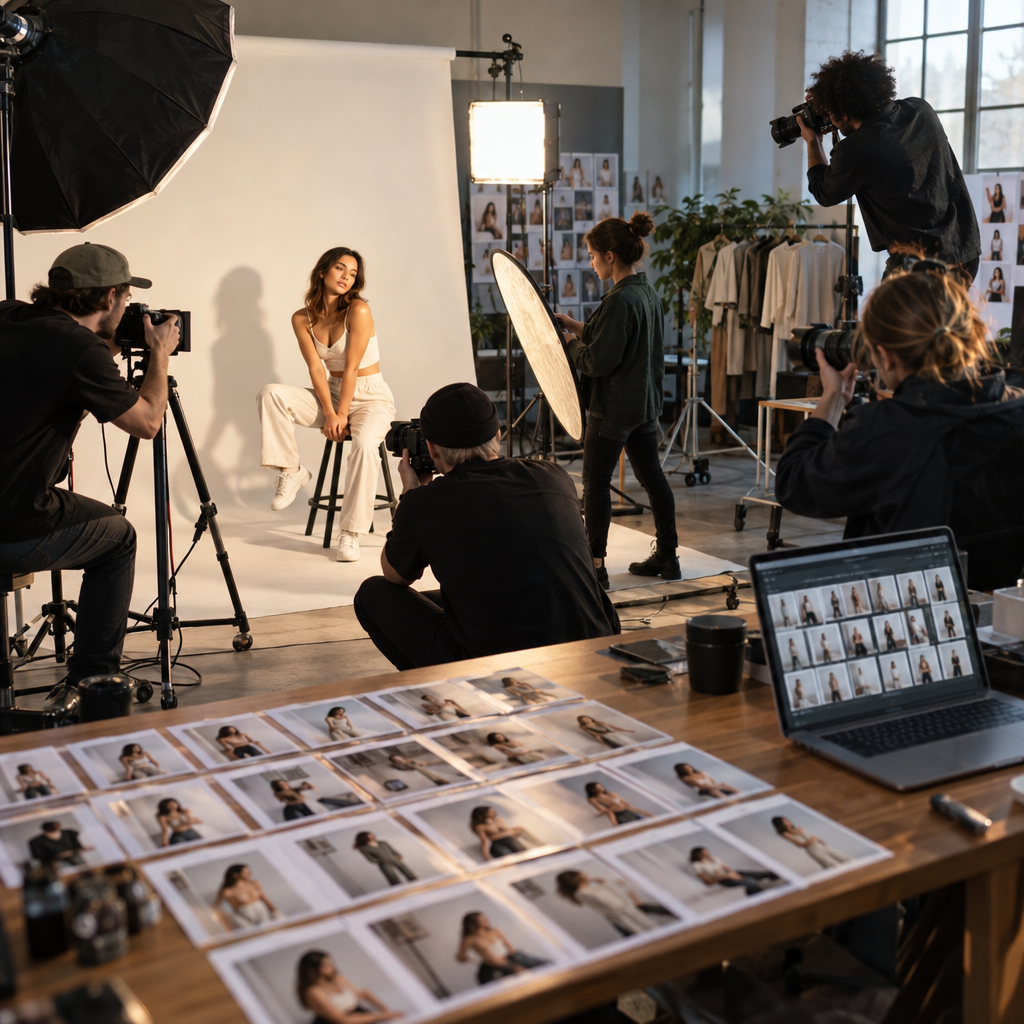
One creator shoot. Twenty ad variations. Zero extra shoot days. Brands running performance creative at scale have figured out that the bottleneck was never the camera, it was the brief. Multi angle creative testing turns a single session with one creator into a full testing matrix, and the teams doing it well are cutting cost per asset by more than half while finding winning hooks faster than teams still shooting one video per concept.
If your paid social team is still commissioning a new shoot for every new hook idea, you’re burning budget on logistics instead of learning. Here’s how to restructure the shoot itself so one session produces a genuine testing library, not just a handful of near-identical cuts.
Why One Hero Video Is a Wasted Opportunity
Most brand teams treat a creator shoot like a film production: one script, one take, one polished output. That mindset made sense when a 30-second TV spot was the deliverable. It makes no sense for performance marketing, where emarketer.com and other industry trackers consistently show that ad fatigue sets in within days on platforms like Meta and TikTok, not weeks.
Platforms reward volume and variety. The algorithm needs fresh signal to keep optimizing, and a single static creative simply can’t generate the testing data required to find a real winner. You need variation in hook, pacing, framing, and message, tested against each other, to know what’s actually working versus what’s just novel this week.
A single 90-minute shoot with one creator, properly planned, can generate enough raw footage and coverage to produce 15 to 20 distinct edits without reshooting a single scene.
That’s not a hypothetical. It’s standard practice now among in-house performance creative teams and agencies running UGC programs for DTC brands. The difference between a shoot that yields two usable clips and one that yields twenty comes down entirely to planning.
The Angle Taxonomy: What Actually Changes Between Versions
“Twenty variations” sounds like twenty completely different ideas. It isn’t. It’s one core message, sliced along a handful of repeatable axes. Build your shoot plan around these variables and the math starts working in your favor fast.
- Hook type: problem-first, curiosity gap, bold claim, direct question, pattern interrupt. Shoot four or five hook variants for the same product moment and you’ve already got your first multiplier.
- Framing and angle: handheld selfie-style POV versus a tripod mid-shot versus an over-the-shoulder demo angle. Same action, three visual textures.
- Pacing and edit rhythm: a fast-cut fifteen-second version for Reels versus a slower thirty-second narrative cut for feed placements.
- Tone: skeptical reviewer, enthusiastic fan, deadpan comedic, matter-of-fact educator. Have the creator run the same key lines with different emotional delivery.
- CTA variant: urgency-driven, discount-led, social proof-led, or benefit-led closers swapped onto the same body footage.
Five hook types times two framing options times two CTA variants already gets you to twenty combinations without touching pacing or tone. The creative lift is in the planning, not in asking your creator to work a twelve-hour day.
Brief for Multiplicity, Not Just a Script
This is where most teams fail before the camera even turns on. A traditional creator brief hands over one script and hopes for the best. A multi angle brief hands over a modular script, a shot list built around variation, and explicit instructions on what needs to be repeated with a twist.
Our earlier breakdown of one page creator briefs applies directly here: the shorter and clearer the direction, the faster the creator can execute multiple takes without confusion on set. Overcomplicating the brief is the single biggest reason shoots run long and still underdeliver on usable footage.
Build the brief in three layers:
- The constant: the product demo, the core claim, the moment that has to appear in every single variation regardless of hook or tone.
- The variables: a checklist of hook lines, CTA lines, and tone directions the creator will run through in sequence, ideally scripted on cue cards just off-camera.
- The coverage list: specific shot types (close-up on product, wide establishing, direct-to-camera, cutaway b-roll) that give editors enough raw material to recombine footage into new sequences after the shoot.
Teams that have adopted vertical first creative briefs already understand this layered approach, since shooting vertical-native from the start avoids the reshoot trap when content needs to move across Stories, Reels, and TikTok without reframing.
The Shot List That Makes Twenty Edits Possible
Here’s a practical structure that works for a one-hour to ninety-minute shoot with a single creator and one product.
Start with three hook reads straight to camera, each using a different opening line from your hook taxonomy. Keep each under five seconds; this is where three second video hooks theory earns its keep, since the opening frames are what you’ll be testing hardest and swapping most often.
Next, capture the demo or usage sequence three separate times: once as confident narration, once as a more skeptical “does this actually work” framing, and once nearly silent with the creator just using the product and reacting naturally. That silent pass is worth its weight in gold. The silent vlog trend has shown that quieter, caption-led edits often outperform narrated versions for save rates, and you can’t produce that cut later if you didn’t capture clean b-roll during the shoot.
Finish with four CTA reads: a discount-led close, a scarcity-led close, a benefit-recap close, and a question-based close that invites comments. Four CTAs times three demo tones times three hooks is already well past twenty raw combinations before your editor even opens the timeline.
Editing at Scale Without Losing Quality
Raw footage isn’t the deliverable. The editing workflow is what actually turns coverage into a tested library, and this is where a lot of teams still bottleneck.
Build a modular editing template rather than editing each variation from scratch. Lock your product demo b-roll as a reusable middle section, then swap in different hook opens and CTA closes around it. This mirrors the logic in our piece on modular UGC assets, where the same core footage gets repackaged across markets and formats without a full re-edit each time. The principle holds for testing variations just as well as it does for localization.
Treat your editing timeline like a template with swappable blocks, not twenty separate projects, and your editor can turn a single shoot into a full testing batch in a day instead of a week.
Batch your exports by platform spec from the start. A 9:16 crop for TikTok and Reels, a 4:5 for feed, a 1:1 for some placements. Getting aspect ratios wrong at the export stage is a sneaky time sink that erodes the efficiency you just built into the shoot.
Running the Actual Test
Twenty variations are only useful if your testing structure can actually isolate what’s working. Don’t launch all twenty into one ad set and hope the algorithm sorts it out organically; that approach burns budget on learning phase churn.
Instead, structure tests around one variable at a time where possible. Run the five hook variants against identical demo footage and CTA first, find your top two or three hooks, then layer in CTA testing against those winners. This sequential approach, rather than a shotgun launch, gets you a clean read on what’s actually driving performance.
Platforms like TikTok Ads Manager and Meta’s ad platform both support structured creative testing tools now, and Sprout Social has published benchmarks on how quickly engagement decays across repeated creative, useful context for deciding how often to refresh your rotation. Budget allocations and benchmark data from Statista can also help you set realistic CPM and CTR expectations before you judge a variation a winner or a loser.
If you’re working with a smaller budget and can’t commission a full creator shoot every cycle, the logic still scales down. Our guide on micro budget UGC hooks shows how to apply the same multiplication principle to a much tighter production budget, proving the framework isn’t just for brands with big production line items.
Where Teams Still Get This Wrong
The most common failure isn’t planning, it’s discipline on set. Creators and production teams default back to “just one more polished take” instead of moving through the variation checklist. Protect the shot list like it’s sacred; every minute spent perfecting one take is a minute not spent capturing a new variable.
The second failure is treating all twenty outputs as equally valuable. They’re not. Some will be near-duplicates that add noise rather than signal. Be ruthless about which combinations actually test a distinct hypothesis before you spend media budget validating them.
Next step: before your next creator shoot, rebuild the brief around three hooks, three tones, and three CTAs instead of one script, and task your editor with a modular timeline from day one. That single planning shift is what turns one session into a genuine testing library instead of one more hero video.
Frequently Asked Questions
How many creators do I need to produce 20 ad variations?
Just one, in most cases. The variation comes from hooks, framing, tone, and CTAs captured during a single structured shoot, not from hiring multiple creators. A well-planned shoot with one creator can generate enough coverage for fifteen to twenty distinct edits.
How long does a multi angle shoot actually take?
Most brands can capture full coverage in 60 to 90 minutes if the shot list is tightly scripted in advance. The time cost shifts from the shoot day to the pre-production planning, which is exactly the trade-off you want.
Do all 20 variations need to go into paid testing at once?
No, and they shouldn’t. Launch a smaller batch to isolate one variable, such as hook type, find the top performers, then test a second variable against those winners. Sequential testing produces cleaner data than launching everything simultaneously.
What’s the biggest mistake brands make with this approach?
Letting the shoot drift back toward perfecting a single “hero” take instead of moving through the planned variation checklist. Discipline on set, not creative talent, is usually the limiting factor.
Can this framework work for smaller budgets or solo marketers?
Yes. The core principle, planning for variation instead of a single polished asset, scales down to micro-budget UGC campaigns just as well as it scales up to larger production budgets.
Top Influencer Marketing Agencies
The leading agencies shaping influencer marketing in 2026
Agencies ranked by campaign performance, client diversity, platform expertise, proven ROI, industry recognition, and client satisfaction. Assessed through verified case studies, reviews, and industry consultations.
Moburst

-
2

The Shelf
Boutique Beauty & Lifestyle Influencer AgencyA data-driven boutique agency specializing exclusively in beauty, wellness, and lifestyle influencer campaigns on Instagram and TikTok. Best for brands already focused on the beauty/personal care space that need curated, aesthetic-driven content.Clients: Pepsi, The Honest Company, Hims, Elf Cosmetics, Pure LeafVisit The Shelf → -
3

Audiencly
Niche Gaming & Esports Influencer AgencyA specialized agency focused exclusively on gaming and esports creators on YouTube, Twitch, and TikTok. Ideal if your campaign is 100% gaming-focused — from game launches to hardware and esports events.Clients: Epic Games, NordVPN, Ubisoft, Wargaming, Tencent GamesVisit Audiencly → -
4

Viral Nation
Global Influencer Marketing & Talent AgencyA dual talent management and marketing agency with proprietary brand safety tools and a global creator network spanning nano-influencers to celebrities across all major platforms.Clients: Meta, Activision Blizzard, Energizer, Aston Martin, WalmartVisit Viral Nation → -
5

The Influencer Marketing Factory
TikTok, Instagram & YouTube CampaignsA full-service agency with strong TikTok expertise, offering end-to-end campaign management from influencer discovery through performance reporting with a focus on platform-native content.Clients: Google, Snapchat, Universal Music, Bumble, YelpVisit TIMF → -
6

NeoReach
Enterprise Analytics & Influencer CampaignsAn enterprise-focused agency combining managed campaigns with a powerful self-service data platform for influencer search, audience analytics, and attribution modeling.Clients: Amazon, Airbnb, Netflix, Honda, The New York TimesVisit NeoReach → -
7

Ubiquitous
Creator-First Marketing PlatformA tech-driven platform combining self-service tools with managed campaign options, emphasizing speed and scalability for brands managing multiple influencer relationships.Clients: Lyft, Disney, Target, American Eagle, NetflixVisit Ubiquitous → -
8

Obviously
Scalable Enterprise Influencer CampaignsA tech-enabled agency built for high-volume campaigns, coordinating hundreds of creators simultaneously with end-to-end logistics, content rights management, and product seeding.Clients: Google, Ulta Beauty, Converse, AmazonVisit Obviously →