


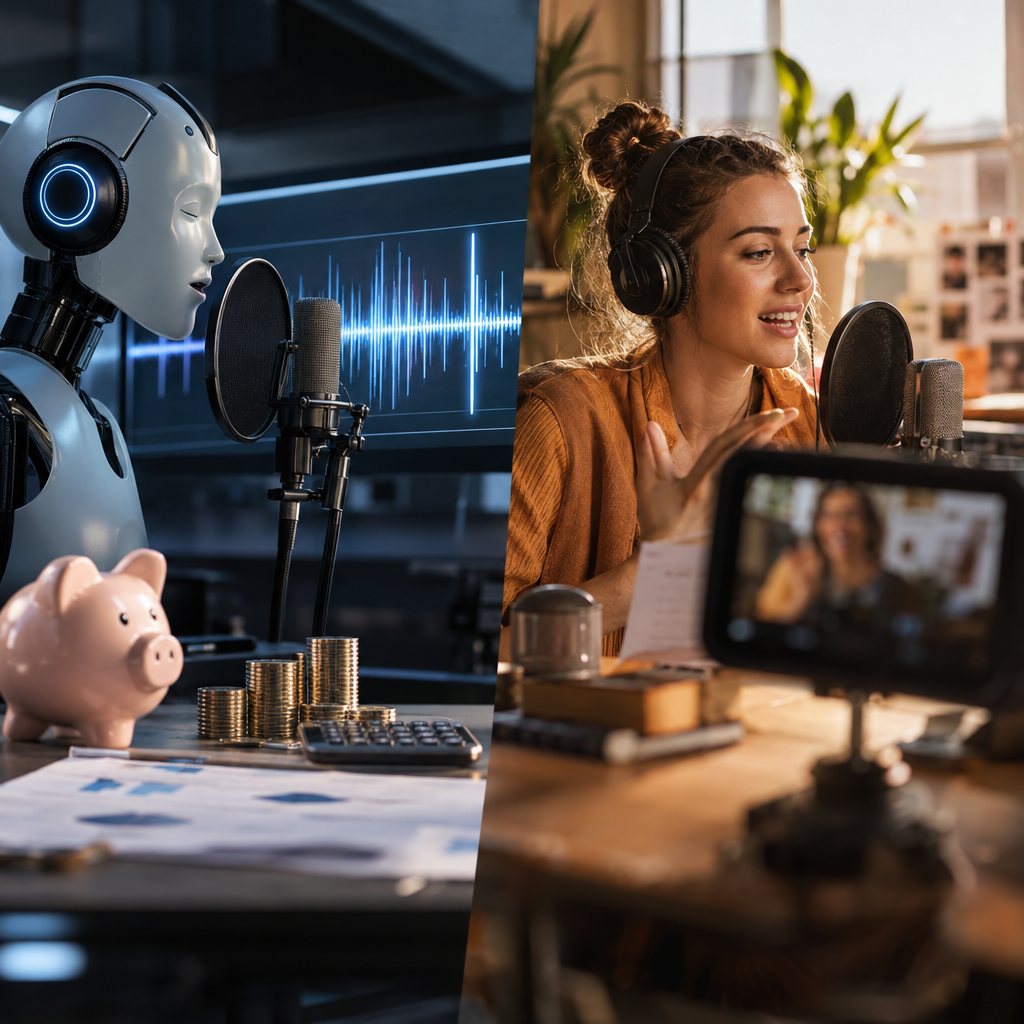
AI-generated voiceover now costs as little as $0.30 per minute to produce, while a single real creator audio placement can run $2,000 to $50,000. So why are sophisticated brands still paying the premium? The AI-generated voiceover ads vs real creator audio question isn’t really about cost at all. It’s about where trust breaks down, and what that costs you downstream in conversion, refunds, and brand equity.
The Cost Math Looks Like a Slam Dunk, Until It Doesn’t
Run the numbers on paper and synthetic voice wins every time. Tools like ElevenLabs, Murf, and Google’s Vertex AI voice models let a brand generate a polished, broadcast-ready voiceover in minutes, with no studio booking, no usage rights negotiation, no reshoot fees when the script changes at 4pm on a Friday. For a performance marketing team running fifty ad variants a week across TikTok, Meta, and YouTube Shorts, that speed is intoxicating.
A mid-tier creator voiceover, by contrast, involves a brief, a fee negotiation, a recording window, revisions, and usually a licensing clause for paid media usage that can double or triple the base rate. Agencies have gotten faster at this (see how AI contract review tools are compressing deal timelines), but it’s still a human-paced process layered on top of a machine-paced media buying system.
Cheaper production doesn’t automatically mean cheaper customer acquisition. If synthetic voice drags conversion rate down even two or three points, the “savings” evaporate fast once you calculate cost per acquired customer.
This is the trap a lot of brands fall into. They measure the wrong line item. Production cost is easy to see. Trust erosion is not, and it shows up three weeks later as a soft conversion dip nobody can quite explain.
Where AI Voice Actually Wins
Let’s be fair to the technology, because it’s genuinely good in specific contexts.
- Localization at scale. Translating a 30-second ad into fourteen languages with consistent tone is something synthetic voice does better and faster than re-casting fourteen creators.
- Low-stakes, high-volume testing. Early-stage hook testing for Performance Max or paid social doesn’t need emotional nuance. It needs volume and speed to find a winning angle, which is exactly the use case explored in performance testing breakdowns on creator-driven variants.
- Internal and B2B content. Training videos, product explainers, and internal comms rarely require the parasocial trust layer that consumer ads depend on.
- Rapid iteration under time pressure. Flash sales, breaking news tie-ins, regulatory disclosure updates. When speed is the deciding factor, AI voice removes the bottleneck entirely.
Production budgets freed up by this efficiency aren’t disappearing, either. As covered in our look at how AI production savings fund rising creator fees, smart brands are reallocating the money saved on volume content into fewer, higher-trust creator partnerships. That’s the real strategic play: use AI voice to clear the low-value work, and spend the savings where trust actually moves revenue.
Where Trust Breaks, Quietly and Expensively
Here’s what the cost spreadsheets miss. Consumers are getting very good at detecting synthetic voice, even when they can’t articulate why something feels “off.” A 2024 Sprout Social consumer survey found that authenticity ranks among the top factors driving purchase decisions on social platforms, and that trust in a recommendation drops sharply once audiences suspect it’s not genuinely human (source: Sprout Social). The uncanny valley isn’t just visual anymore. It’s auditory, and it’s measurable in bounce rates.
Real creator audio carries texture that synthetic voice still struggles to replicate convincingly: the micro-pause before an honest opinion, the slight vocal fry of someone who’s actually tired of filming, the laugh that happens a beat too late because it’s unscripted. Those imperfections are the trust signal. Strip them out and you get something that sounds like an ad reading itself.
There’s also a regulatory dimension brands can’t ignore. The Federal Trade Commission has sharpened its focus on AI-generated endorsements and disclosure requirements, and platforms are following suit with labeling mandates for synthetic media. Fail to disclose AI voice in a testimonial-style ad, and you’re not just risking a trust hit. You’re risking enforcement action.
The Disclosure Gap Nobody’s Pricing In
Most brands running AI voiceover haven’t built disclosure into their creative workflow yet. That’s a gap. Platforms including TikTok and Meta now require labeling for AI-generated or AI-altered content in ads, per their respective TikTok Ads and Meta Business policies. Skip the label, and you’re looking at ad rejection at best, platform penalties at worst. Factor the compliance overhead into your cost comparison, because it’s real and it’s growing.
A Side-by-Side That Actually Matters
Forget the simple per-minute comparison. Here’s what brands should actually be weighing:
- Unit production cost: AI voiceover wins decisively, often by 80 to 95 percent.
- Usage rights complexity: AI voice avoids the licensing negotiations that complicate creator deals, though rights and reuse gaps in AI UGC contracts can introduce their own hidden liabilities.
- Trust and conversion lift: Real creator audio consistently outperforms on engagement and purchase intent in testimonial and recommendation formats.
- Disclosure and compliance risk: AI voice carries a growing regulatory burden that creator audio mostly sidesteps, assuming proper FTC-compliant disclosures are already in place.
- Scalability and localization: AI voice is unmatched for speed and language coverage.
- Brand safety control: Synthetic voice is infinitely controllable. No off-script moments, no PR risk from a creator’s personal controversy.
Notice the pattern. AI voice wins on operational metrics. Creator audio wins on trust metrics. The right answer depends entirely on where in the funnel the ad lives.
Match the Tool to the Funnel Stage
Top-of-funnel awareness content, where the goal is reach and recall rather than deep emotional buy-in, tolerates AI voice well. Bottom-of-funnel content, where a prospect is deciding whether to trust your brand with their money, is where real creator audio earns its premium. This isn’t a philosophical stance, it’s a pattern showing up repeatedly in brand testing.
Think of it the way agencies now think about LLM-driven creator matching: the goal isn’t choosing one approach wholesale, it’s deploying the right asset against the right audience moment. A brand running both synthetic and human voice across the same funnel, segmented by stage, consistently reports better blended CAC than brands committing entirely to one or the other.
There’s also a brand equity argument that doesn’t show up on a quarterly P&L but matters over a longer horizon. Brands that lean too heavily on synthetic voice risk a sameness problem. When every ad in a category sounds like it was generated by the same model (because it often was), differentiation collapses. Real creators, with distinct voices and personalities, remain one of the few durable differentiators left as AI content quality floors rise across the industry.
What This Means for Budget Planning
Practically, here’s how brands should structure spend heading into next year’s planning cycle:
- Audit current voiceover spend by funnel stage and flag anything testimonial-style or recommendation-based running on synthetic voice without disclosure.
- Reallocate low-stakes, high-volume content (hook testing, localization, internal comms) to AI voice tools and measure the time saved.
- Reinvest a portion of that savings into fewer, deeper creator partnerships for trust-critical placements, following the pattern outlined in coverage of creator workflow checkpoints brands are now building in.
- Build disclosure labeling into the creative approval workflow before launch, not after a platform flags it.
- Track conversion lift by voice type over a full quarter before declaring either approach the winner for your category.
One more thing worth saying plainly: this isn’t a static decision. Voice synthesis quality is improving every few months, and consumer tolerance for it may shift as familiarity grows. What’s true about detection and trust today, per current data from eMarketer, may look different within a year or two. Revisit this comparison quarterly, not annually.
Frequently Asked Questions
Is AI-generated voiceover actually cheaper than hiring a creator for ad audio?
Yes, on a per-unit production basis. AI voiceover tools can cost a fraction of a cent per word versus hundreds or thousands of dollars for creator audio with usage rights. The gap narrows or reverses when you factor in conversion rate differences and compliance overhead.
Do consumers trust AI voiceover ads less than real creator audio?
Generally yes, particularly in testimonial or recommendation-style formats where perceived authenticity drives the purchase decision. Trust gaps are smaller in informational or awareness content where emotional buy-in matters less.
Do I need to disclose AI-generated voiceover in my ads?
In most cases, yes. Major platforms including TikTok and Meta require labeling for AI-generated or AI-altered ad content, and regulators like the FTC have increased scrutiny of undisclosed synthetic endorsements.
Can brands blend AI voiceover and real creator audio in the same campaign?
Yes, and this is increasingly the recommended approach. Use AI voice for top-of-funnel, high-volume, or localization needs, and reserve real creator audio for trust-critical, bottom-of-funnel content where conversion depends on perceived authenticity.
Will AI voice quality eventually close the trust gap entirely?
It’s possible but not guaranteed. Voice synthesis is improving rapidly, but consumer detection tools and skepticism are also increasing in parallel, so the gap may persist even as the technology improves.
Next step: Pull your last quarter’s ad performance by voice type (AI versus creator) and segment it by funnel stage before your next budget cycle locks. That single audit will tell you more about your actual cost-per-trust-dollar than any industry benchmark report.
Top Influencer Marketing Agencies
The leading agencies shaping influencer marketing in 2026
Agencies ranked by campaign performance, client diversity, platform expertise, proven ROI, industry recognition, and client satisfaction. Assessed through verified case studies, reviews, and industry consultations.
Moburst

-
2

The Shelf
Boutique Beauty & Lifestyle Influencer AgencyA data-driven boutique agency specializing exclusively in beauty, wellness, and lifestyle influencer campaigns on Instagram and TikTok. Best for brands already focused on the beauty/personal care space that need curated, aesthetic-driven content.Clients: Pepsi, The Honest Company, Hims, Elf Cosmetics, Pure LeafVisit The Shelf → -
3

Audiencly
Niche Gaming & Esports Influencer AgencyA specialized agency focused exclusively on gaming and esports creators on YouTube, Twitch, and TikTok. Ideal if your campaign is 100% gaming-focused — from game launches to hardware and esports events.Clients: Epic Games, NordVPN, Ubisoft, Wargaming, Tencent GamesVisit Audiencly → -
4

Viral Nation
Global Influencer Marketing & Talent AgencyA dual talent management and marketing agency with proprietary brand safety tools and a global creator network spanning nano-influencers to celebrities across all major platforms.Clients: Meta, Activision Blizzard, Energizer, Aston Martin, WalmartVisit Viral Nation → -
5

The Influencer Marketing Factory
TikTok, Instagram & YouTube CampaignsA full-service agency with strong TikTok expertise, offering end-to-end campaign management from influencer discovery through performance reporting with a focus on platform-native content.Clients: Google, Snapchat, Universal Music, Bumble, YelpVisit TIMF → -
6

NeoReach
Enterprise Analytics & Influencer CampaignsAn enterprise-focused agency combining managed campaigns with a powerful self-service data platform for influencer search, audience analytics, and attribution modeling.Clients: Amazon, Airbnb, Netflix, Honda, The New York TimesVisit NeoReach → -
7

Ubiquitous
Creator-First Marketing PlatformA tech-driven platform combining self-service tools with managed campaign options, emphasizing speed and scalability for brands managing multiple influencer relationships.Clients: Lyft, Disney, Target, American Eagle, NetflixVisit Ubiquitous → -
8

Obviously
Scalable Enterprise Influencer CampaignsA tech-enabled agency built for high-volume campaigns, coordinating hundreds of creators simultaneously with end-to-end logistics, content rights management, and product seeding.Clients: Google, Ulta Beauty, Converse, AmazonVisit Obviously →