


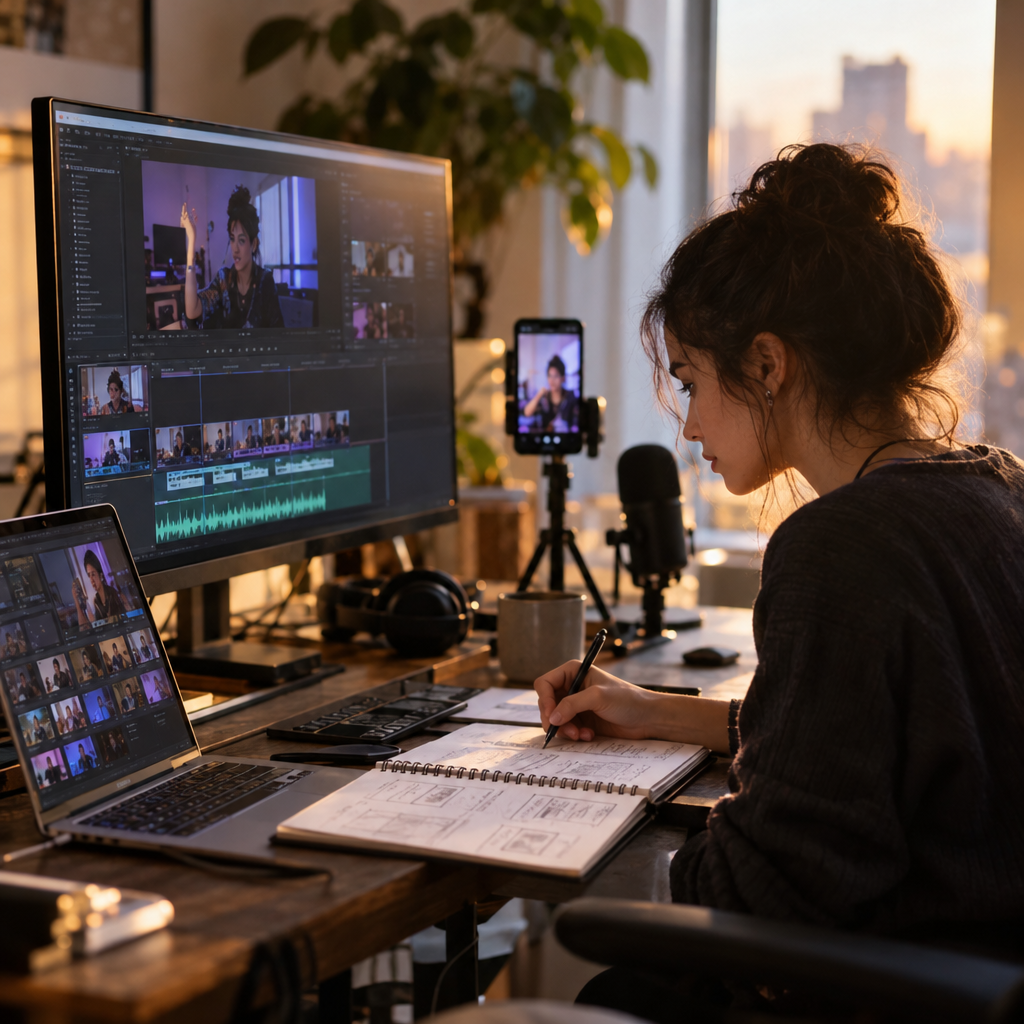
Twitch and YouTube Live generated more than 24 billion hours of watch time combined last year, and almost none of it was scripted for repurposing. That’s the gap. Brands sitting on hours of raw livestream footage are leaving short-form gold on the table because they assume clipping requires an editing bay and a production calendar. It doesn’t. Scripting stream clip content for short-form platforms is now a solo-operator job, if you build the right system first.
The Crew-Free Reality Brands Are Betting On
Five years ago, turning a livestream into TikTok or Reels content meant hiring an editor, briefing them on brand tone, and waiting two days for a rough cut. That workflow is dead for most mid-market brands. Budgets tightened, in-house teams shrank, and platforms rewarded speed over polish.
What replaced it is a lean, repeatable scripting process: one person, a laptop, and a clip-first mindset baked into the stream itself before it even airs. This isn’t about lowering quality. It’s about front-loading the editorial thinking so the actual cutting takes minutes, not hours.
The brands winning short-form right now aren’t the ones with the biggest production budgets. They’re the ones who scripted for the clip before they hit record on the stream.
Why Scripting Before the Stream Changes Everything
Here’s the mistake most marketing teams make: they stream first, then hope something clippable happened. That’s backwards. A better approach treats the live broadcast as raw material for a predetermined short-form output, the same way a podcast host might plan a question specifically because it’ll make a good 40-second pull.
This means building a lightweight run-of-show that flags three or four moments designed to stand alone. A product reveal. A reaction beat. A direct-to-camera CTA. A moment of unscripted humor you can nudge into happening. Each one gets a mental (or literal) timestamp marker during the stream, so post-production is a search-and-extract job, not a forty-minute scrub through raw footage.
This is the same philosophy behind turning one livestream into dozens of assets, except here the focus is narrower: building the script muscle so a single streamer or host can self-produce clip-ready content without waiting on an editor.
What Actually Makes a Moment “Clippable”?
Not every entertaining minute of livestream translates to short-form. The moments that travel well share a few traits:
- They resolve in under 60 seconds, ideally 15 to 30.
- They contain a visible emotional shift (surprise, frustration, delight).
- They make sense without the preceding context.
- They end on a line or visual that works as a loop or a cliffhanger.
If you’re scripting in advance, build moments that hit these criteria on purpose. Ask a guest a pointed question you know will get a strong reaction. Stage a reveal at a specific point in the stream. You’re not faking authenticity, you’re giving authenticity a container it can live in after the broadcast ends.
A Scripting Framework That Survives a Solo Operator
You don’t need a writers’ room. You need a template you reuse every stream. Here’s a four-part structure that works whether you’re running a gaming stream, a founder Q&A, or a product demo livestream:
- The hook moment: something said or shown in the first 90 seconds that can open a standalone clip.
- The tension beat: a disagreement, a problem, or a question that creates a reason to keep watching.
- The payoff: the resolution, reveal, or punchline that gives the clip a satisfying ending.
- The CTA tag: a few seconds where the host says a direct action line (follow, shop, download) that editors can splice onto the end of any clip.
That last one is underrated. Recording a modular CTA line separately means you can attach it to any clip in post, which is how a single livestream becomes six or seven distinct short-form pieces without re-shooting anything. This is the same logic covered in clipping long-form video into paid ad assets, where modular endings let one asset feed multiple campaign angles.
Tools That Replace the Crew
A crew of one doesn’t mean working harder, it means picking software that automates the boring parts. A few categories worth knowing:
- AI clip detection tools that flag high-engagement moments based on chat spikes, audio peaks, or facial expression changes.
- Auto-caption generators that burn in subtitles instantly, since most short-form viewing happens muted.
- Vertical reframing software that converts 16:9 stream footage to 9:16 without manual cropping.
- Scheduling dashboards that queue clips across TikTok, Reels, and Shorts from a single upload.
These tools won’t write your script for you, but they remove the technical bottleneck that used to require a dedicated editor. According to HubSpot’s marketing research, short-form video continues to deliver the highest ROI of any content format marketers track, which is exactly why removing the production bottleneck matters so much right now.
Structure Isn’t Just for Single Clips
If you’re streaming regularly, think in series, not one-offs. A format that repeats (same opening line, same visual cue, same ending tag) trains your audience to recognize your clips in a crowded feed. This is the same reasoning behind scripting episodes that retain viewers across a vertical video series: predictability isn’t boring, it’s a retention tool.
It also makes scripting faster over time. Once you’ve built a reusable four-beat skeleton, each new stream just needs fresh content poured into the same mold. That’s how solo operators keep up a near-daily clip cadence without burning out.
A repeatable format isn’t a creative limitation. It’s what lets one person do the job that used to require three.
Where Niche Verticals Apply This Differently
Not every industry clips the same way. Gaming and iGaming streams, for example, often script around big win reveals or bonus reactions, a pattern explored in stream clip compilations built around four beats for sign-up conversion. Podcast-style livestreams lean harder on quotable soundbites, which is why scripting hooks that drive acquisition from podcast clips focuses more on verbal hooks than visual ones.
The underlying principle holds across verticals: decide what the clip needs to do (drive a click, build trust, generate a laugh) before the stream starts, and build the moment to deliver it.
Compliance Doesn’t Disappear Because There’s No Crew
Solo production doesn’t mean solo accountability. If a stream includes a sponsored segment, that disclosure needs to survive the clipping process, not just exist in the original broadcast. The FTC’s endorsement guidance applies to every repurposed cut of sponsored content, meaning a 20-second clip pulled from a two-hour stream still needs a visible disclosure if the underlying moment was paid.
Build the disclosure into your script template the same way you build in the CTA tag. A simple on-screen text overlay or verbal mention during the tension beat keeps every downstream clip compliant without requiring legal review on each individual cut. Platforms like Meta Business and TikTok Ads Manager also have their own branded content disclosure tools worth layering on top of FTC requirements.
Data tracking matters too. According to Statista’s platform usage research, short-form video consumption keeps climbing year over year, which means the compliance exposure from repurposed clips is only growing alongside the opportunity. If you’re measuring clip performance to prove ROI to leadership, pair it with the framework in tracking weekly content cadence against actual revenue signals, not just views.
The takeaway is simple: stop treating stream clips as an afterthought and start scripting for them before the camera rolls. One person with a four-beat template and the right software can now produce what used to take a full production team, and the brands doing this consistently are the ones building short-form libraries their competitors can’t match on volume alone.
FAQs
Do I need video editing experience to script stream clip content?
No. The scripting work happens before and during the stream, not in post-production. Basic familiarity with auto-caption and clip detection tools covers most of the technical skill required.
How long should a repurposed stream clip be?
Most high-performing clips run between 15 and 60 seconds. Shorter clips (under 30 seconds) tend to perform best on TikTok and Reels, while slightly longer cuts work on YouTube Shorts.
Can I script moments without making the stream feel fake?
Yes, if you script for structure rather than dialogue. Plan when a reveal happens or when a question gets asked, but let the actual reaction stay unscripted. Audiences can tell the difference between a staged moment and a guided one.
What’s the minimum tech setup for crew-free clipping?
A laptop, an AI clip detection or highlight tool, an auto-caption generator, and a scheduling dashboard. Most of these are available as monthly subscriptions and require no technical onboarding.
Does FTC disclosure still apply to short clips pulled from a longer stream?
Yes. Each repurposed clip is treated as its own piece of content under FTC guidance. If the original segment was sponsored, the disclosure needs to appear in every derivative clip, not just the full broadcast.
Top Influencer Marketing Agencies
The leading agencies shaping influencer marketing in 2026
Agencies ranked by campaign performance, client diversity, platform expertise, proven ROI, industry recognition, and client satisfaction. Assessed through verified case studies, reviews, and industry consultations.
Moburst

-
2

The Shelf
Boutique Beauty & Lifestyle Influencer AgencyA data-driven boutique agency specializing exclusively in beauty, wellness, and lifestyle influencer campaigns on Instagram and TikTok. Best for brands already focused on the beauty/personal care space that need curated, aesthetic-driven content.Clients: Pepsi, The Honest Company, Hims, Elf Cosmetics, Pure LeafVisit The Shelf → -
3

Audiencly
Niche Gaming & Esports Influencer AgencyA specialized agency focused exclusively on gaming and esports creators on YouTube, Twitch, and TikTok. Ideal if your campaign is 100% gaming-focused — from game launches to hardware and esports events.Clients: Epic Games, NordVPN, Ubisoft, Wargaming, Tencent GamesVisit Audiencly → -
4

Viral Nation
Global Influencer Marketing & Talent AgencyA dual talent management and marketing agency with proprietary brand safety tools and a global creator network spanning nano-influencers to celebrities across all major platforms.Clients: Meta, Activision Blizzard, Energizer, Aston Martin, WalmartVisit Viral Nation → -
5

The Influencer Marketing Factory
TikTok, Instagram & YouTube CampaignsA full-service agency with strong TikTok expertise, offering end-to-end campaign management from influencer discovery through performance reporting with a focus on platform-native content.Clients: Google, Snapchat, Universal Music, Bumble, YelpVisit TIMF → -
6

NeoReach
Enterprise Analytics & Influencer CampaignsAn enterprise-focused agency combining managed campaigns with a powerful self-service data platform for influencer search, audience analytics, and attribution modeling.Clients: Amazon, Airbnb, Netflix, Honda, The New York TimesVisit NeoReach → -
7

Ubiquitous
Creator-First Marketing PlatformA tech-driven platform combining self-service tools with managed campaign options, emphasizing speed and scalability for brands managing multiple influencer relationships.Clients: Lyft, Disney, Target, American Eagle, NetflixVisit Ubiquitous → -
8

Obviously
Scalable Enterprise Influencer CampaignsA tech-enabled agency built for high-volume campaigns, coordinating hundreds of creators simultaneously with end-to-end logistics, content rights management, and product seeding.Clients: Google, Ulta Beauty, Converse, AmazonVisit Obviously →