


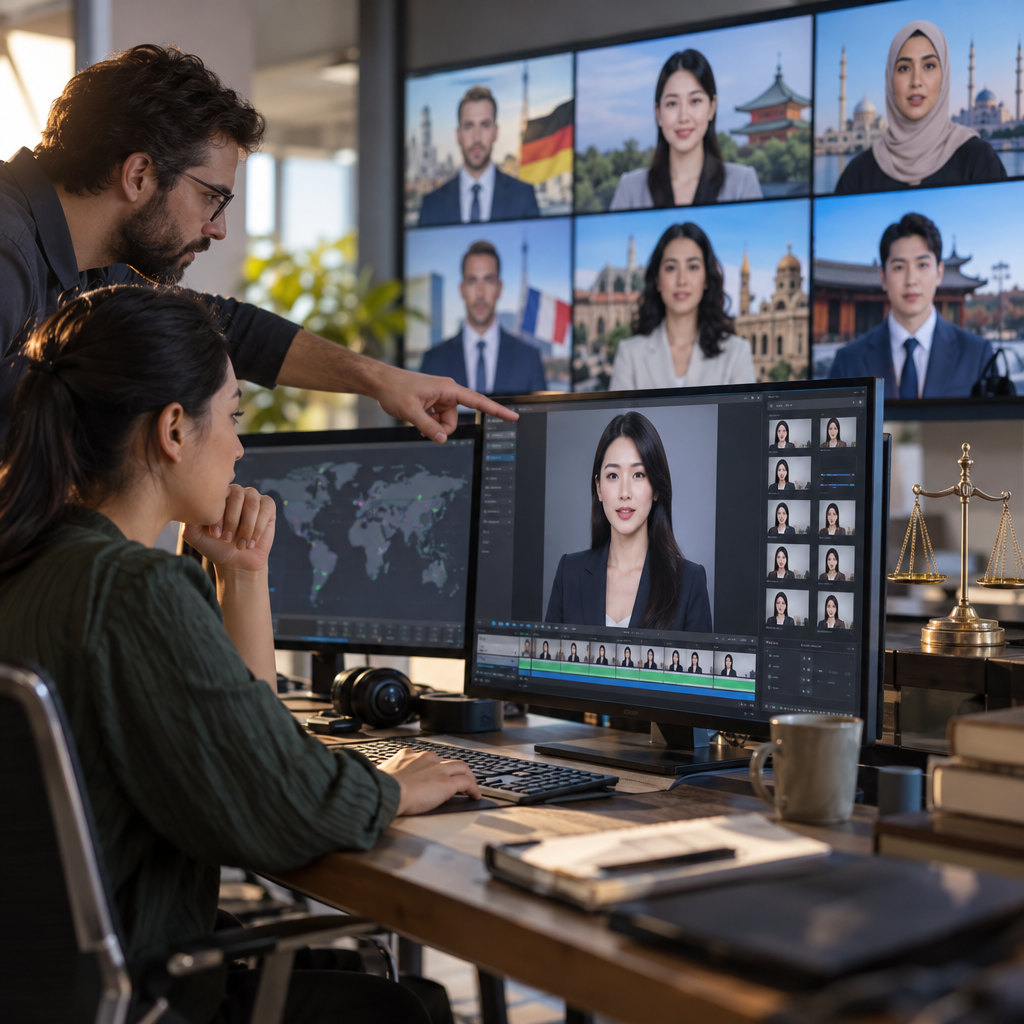
Shoppers want product information in their own language. Most brands still serve them one English video. AI avatar presenters promise to close that gap at a fraction of the shoot cost. They also introduce a new risk: content that looks like a creator but isn’t one.
Why localization is the real prize
The business case isn’t “cheaper video.” It’s reach. Audiences tend to favor brands that speak to them in their own language, and that preference shapes conversion.
Now picture your current influencer program. You pay a creator in Austin, get one hero video, and run it in twelve markets with subtitles. Subtitles are a half measure. A presenter who speaks the viewer’s language, with local references and a local rhythm, is a different asset.
That’s where avatar presenters earn their keep. One approved script becomes a dozen market versions without twelve casting calls, twelve shoots and twelve rounds of approvals.
Avatar, creator or both?
Here’s the distinction most briefs skip. An avatar presenter is a synthetic on-screen host. A human creator is a person with an audience that trusts them. Treating the two as interchangeable is the fastest way to waste budget.
Use avatars where the audience wants information fast and doesn’t need a relationship:
- Product explainers and feature walkthroughs
- Onboarding and how-to content
- Regional offer announcements and price changes
- Retargeting variations of a proven creator message
Keep human creators where trust is the product: reviews, first-person testimonials, founder moments and anything that depends on lived experience. An avatar can’t honestly say “I’ve used this for six months.” If your script has it say so, you’ve created a deceptive endorsement, not efficient content.
The smartest use of AI avatars is as a distribution layer for creator-proven messages, not as a replacement for the creator who proved them.
Scripting for a presenter that isn’t a person
Creator-style doesn’t mean copy-pasting a creator’s voice. It means borrowing the structure that makes creator content work: a fast hook, a single idea, a specific proof point, a clear next step. Then you write it so a synthetic host can deliver it believably.
Write for the ear, not the page
Avatars stumble on long clauses, stacked numbers and idioms. Keep sentences short. Spell out numbers the way they’re spoken. Put one idea in each line so the lip-sync and pacing stay natural. Read every script aloud before it goes into the tool.
Transcreate, don’t translate
Literal translation kills tone. Humor, urgency and formality shift across markets. A casual “you guys” hook that works in the US can read as disrespectful in markets where formal address is expected. Brief a native reviewer on intent, not just words. Our guide to auto-dubbed video tone covers how to protect voice through translation.
Cut the first-person claims
Remove any line that implies the avatar has personal experience. Replace “I tested this” with “Here’s what testing showed,” and attach the evidence on screen. It’s less sexy. It’s also defensible.
Build for sound-off
Many viewers will watch on mute, and avatar lip-sync glitches are less noticeable with strong captions and on-screen text. Script the captions as a deliberate layer in each language. The principles in sound-off viewing apply directly here.
A workflow that scales without breaking
Speed is the selling point, so the process has to be lean. But lean doesn’t mean unchecked. A workable pipeline looks like this:
- Start from a proven master. Pick a creator asset or script with real performance data. Don’t localize an untested idea twelve times.
- Lock the claims. Legal approves the claims once, in the master. Every localized version can only use approved claims.
- Transcreate with native reviewers. Machine translation drafts, humans finalize. Budget for this. It’s the cheapest insurance you’ll buy.
- Generate and QA the avatar output. Check lip-sync, pronunciation of brand and product names, and cultural details like gestures, clothing and backgrounds.
- Apply disclosure by market. Label rules differ. Build the label into the template, not as an afterthought.
- Test small, then scale. Run a limited spend per market before rolling out widely.
If you already run creator shoots, plan the avatar versions at the brief stage. Our piece on adapting one creator shoot shows how to capture assets once and reuse them without flattening the creator’s voice.
Disclosure is no longer optional
Brands used to treat AI labeling as a platform courtesy. That’s changing, and quickly.
In the EU, the European Commission’s Article 50 transparency FAQ says Article 50 applies as from 2 August 2026. Deployers must disclose deepfake content to a person upon first exposure at the latest. According to the same Commission FAQ, fines can reach up to 15 million euros or 3% of total worldwide turnover for the preceding financial year, though proportionality can be taken into account for SMEs.
Does your avatar count as a deepfake? The FAQ sets three cumulative criteria, including a high level of resemblance to the simulated subject and an appearance of being authentic or truthful. A clearly stylized brand mascot may not qualify. An avatar modeled on a real creator’s face and voice very likely does. Have counsel make that call per asset, not per campaign.
Platforms are moving too. YouTube’s own announcement says creators must disclose altered or synthetic content. For most videos, the label appears in the expanded description. For sensitive topics such as health, news, elections or finance, YouTube shows a more prominent label on the video itself. It may also add a label even when the creator hasn’t.
If a platform can label your avatar video for you, you’ve already lost control of the message. Disclose first, in your own words, in your own template.
Write the disclosure into the script and the on-screen design. A short spoken line plus a persistent visual tag covers both audio and sound-off viewers. For wording ideas that don’t kill performance, see our breakdown of AI disclosure scripting.
What to measure
Don’t judge avatar content by view counts alone. Track what tells you whether the localization works:
- Completion rate by market, compared with the subtitled original
- Comment sentiment, especially mentions of “AI” or “fake”
- Conversion rate and cost per acquisition against the human-creator baseline
- Cost per localized version, including review and QA, not just generation fees
That last one matters. Teams often compare tool fees against a full shoot and declare victory. Add native review, legal checks and revisions, then compare. The savings are usually still real, just smaller than the pitch deck said.
Watch for audience pushback too. In markets where creator authenticity carries heavy weight, an unlabeled or poorly disclosed avatar can damage the brand more than a subtitled video ever would.
Next step: pick your best-performing creator script, adapt it for two priority markets with native reviewers and a built-in disclosure line, and test it against your subtitled version before you commit budget to a wider rollout.
FAQs
What are AI avatar presenters?
They are synthetic on-screen hosts generated by AI tools that deliver a scripted message in a chosen language. Brands use them for explainers, product updates and localized ads where a human shoot would be slow or costly.
Do AI avatar videos need to be labeled?
Increasingly, yes. YouTube asks creators to disclose altered or synthetic content, and the EU’s Article 50 transparency obligations apply from 2 August 2026. Whether a specific avatar counts as a deepfake depends on factors like resemblance to a real person and whether it appears authentic, so get legal review.
Can an avatar give a product testimonial?
It shouldn’t claim personal experience it doesn’t have. A first-person “I used this” line from a synthetic host risks being a deceptive endorsement. Use avatars for factual information and keep testimonials with real customers or creators.
Is translation enough for localized creator-style content?
No. Tone, humor, formality and cultural references vary by market. Transcreation by a native reviewer protects the message. Machine output should be treated as a draft.
Why bother localizing at all?
Language preference drives buying behavior. Content in the viewer’s language removes a real conversion barrier, which is why localization is worth the added review cost.
How should brands measure avatar content performance?
Compare completion rate, comment sentiment, conversion rate and fully loaded cost per version against your subtitled or human-creator baseline in each market. Include review and QA costs, not just tool fees.
Should avatars replace human creators?
No. Use avatars to extend creator-proven messages into more markets and formats. Keep human creators for content that depends on trust, experience and audience relationships.
Top Influencer Marketing Agencies
The leading agencies shaping influencer marketing in 2026
Agencies ranked by campaign performance, client diversity, platform expertise, proven ROI, industry recognition, and client satisfaction. Assessed through verified case studies, reviews, and industry consultations.
Moburst

-
2

The Shelf
Boutique Beauty & Lifestyle Influencer AgencyA data-driven boutique agency specializing exclusively in beauty, wellness, and lifestyle influencer campaigns on Instagram and TikTok. Best for brands already focused on the beauty/personal care space that need curated, aesthetic-driven content.Clients: Pepsi, The Honest Company, Hims, Elf Cosmetics, Pure LeafVisit The Shelf → -
3

Audiencly
Niche Gaming & Esports Influencer AgencyA specialized agency focused exclusively on gaming and esports creators on YouTube, Twitch, and TikTok. Ideal if your campaign is 100% gaming-focused — from game launches to hardware and esports events.Clients: Epic Games, NordVPN, Ubisoft, Wargaming, Tencent GamesVisit Audiencly → -
4

Viral Nation
Global Influencer Marketing & Talent AgencyA dual talent management and marketing agency with proprietary brand safety tools and a global creator network spanning nano-influencers to celebrities across all major platforms.Clients: Meta, Activision Blizzard, Energizer, Aston Martin, WalmartVisit Viral Nation → -
5

The Influencer Marketing Factory
TikTok, Instagram & YouTube CampaignsA full-service agency with strong TikTok expertise, offering end-to-end campaign management from influencer discovery through performance reporting with a focus on platform-native content.Clients: Google, Snapchat, Universal Music, Bumble, YelpVisit TIMF → -
6

NeoReach
Enterprise Analytics & Influencer CampaignsAn enterprise-focused agency combining managed campaigns with a powerful self-service data platform for influencer search, audience analytics, and attribution modeling.Clients: Amazon, Airbnb, Netflix, Honda, The New York TimesVisit NeoReach → -
7

Ubiquitous
Creator-First Marketing PlatformA tech-driven platform combining self-service tools with managed campaign options, emphasizing speed and scalability for brands managing multiple influencer relationships.Clients: Lyft, Disney, Target, American Eagle, NetflixVisit Ubiquitous → -
8

Obviously
Scalable Enterprise Influencer CampaignsA tech-enabled agency built for high-volume campaigns, coordinating hundreds of creators simultaneously with end-to-end logistics, content rights management, and product seeding.Clients: Google, Ulta Beauty, Converse, AmazonVisit Obviously →