


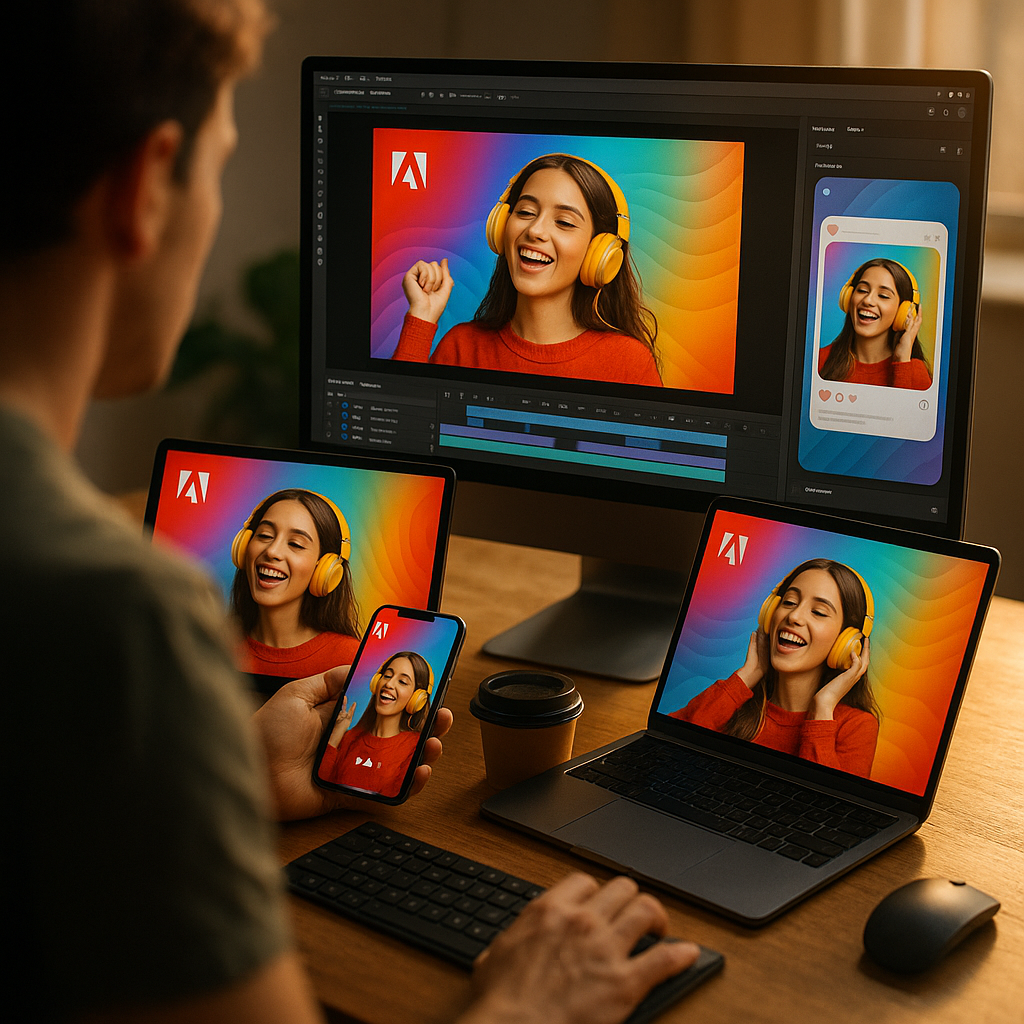
One Brief. Two Screens. Most Brands Are Still Running Separate Playbooks.
Connected TV ad spend crossed $30 billion in the U.S. this year, yet most brand creative teams still treat CTV and social as separate productions with separate briefs, separate timelines, and separate budgets. Adobe GenStudio’s cross-channel AI production tools make that operational split unnecessary — and for creative directors managing creator programs, the implications are significant.
The question is whether your briefing process has caught up with the technology.
Why the CTV-Social Gap Exists (and Who It’s Costing)
The gap isn’t strategic. Nobody chose to run two parallel creative operations because it made business sense. It happened incrementally: social content got fast and scrappy, CTV stayed slow and expensive, and nobody ever built the bridge. Agencies developed social-native production workflows. TV buyers operated in a completely different cadence. Creator briefs defaulted to short-form vertical video because that’s where the activation happened.
The result: brands running coordinated CTV and social campaigns routinely see brand consistency issues, compressed timelines that force asset compromise, and creative teams burning budget on redundant production. According to eMarketer research, cross-channel campaigns significantly outperform single-channel executions on brand recall and purchase intent — yet operational friction keeps most brand teams from executing true cross-channel creative at scale.
For creative directors, the cost isn’t just financial. It’s the creative coherence cost: your CTV spot looks like a broadcast piece, your TikTok looks like a different brand entirely, and your creator content lives in a third aesthetic universe. Consumers notice, even when they can’t articulate what feels off.
What Adobe GenStudio Actually Does in a Cross-Channel Context
Adobe GenStudio for Performance Marketing isn’t a content scheduler or a lightweight design tool. It’s an enterprise-grade AI production environment built on Adobe Firefly’s generative models, integrated with Adobe Experience Manager, and connected to performance data through Adobe Analytics. The cross-channel production capability specifically addresses the CTV-social problem by allowing teams to generate, resize, reformat, and brand-govern assets from a single campaign session.
The workflow looks like this in practice: a creative director uploads or defines a campaign concept with brand voice parameters, visual guidelines, and messaging hierarchy. GenStudio’s AI produces asset variants simultaneously across formats — 16:9 for CTV pre-roll, 9:16 for TikTok and Instagram Reels, 1:1 for feed placements, and 4:5 for mixed-feed environments. The brand governance layer (which you can read more about in our coverage of Adobe GenStudio brand voice governance) enforces typography, color, logo placement, and tone of voice across every variant automatically.
This is not just resizing. The system applies format-specific creative logic: CTV assets get proper safe zones for overscan, longer brand impression windows at the open, and audio-dependent storytelling structures. Social assets get motion-first hooks, caption-readable framing, and platform-native pacing. The same campaign brief produces genuinely different executions that feel native to each environment — not stretched or cropped afterthoughts.
The breakthrough isn’t that AI can resize a video. It’s that GenStudio can brief itself on the creative logic specific to CTV versus social, and produce assets that behave correctly in both environments without a second human production pass.
How This Should Change the Creator Brief
This is where most creative directors are leaving value on the table. Current creator briefing practices were built for social-only outputs. Creators get a brief, shoot vertical content, deliver 9:16 footage, and the brand adapts it. For social, that works. For CTV-connected campaigns, it fails immediately.
The structural change GenStudio enables is the single-session production model: one creator engagement, one shoot direction, one day of footage that feeds an AI production pipeline capable of generating both CTV-ready assets and social-native assets simultaneously. But this only works if the brief is written with that bifurcation in mind from the start.
Practically, this means briefing creators differently on four dimensions:
- Shooting ratios: Request footage in multiple aspect ratios within the same shoot, specifically horizontal 16:9 coverage of key moments alongside vertical capture. Most smartphone setups handle this natively; the brief just has to ask for it.
- Audio independence: CTV content can rely on audio; social often can’t. Brief creators to deliver both audio-dependent and visually-complete (no-audio) versions of key messaging moments.
- Brand impression windows: CTV safe brand windows run 3-5 seconds at open; social hooks need to earn attention in under 2 seconds. Brief creators to capture product or brand moments that work in both time windows.
- B-roll density: GenStudio’s AI works better with richer source footage. Brief creators to deliver 3-5x more B-roll than they’d normally capture for a social-only deliverable. The AI uses that material to construct CTV-appropriate cutaways and scene transitions.
The payoff is compounding. The same creator session that produces your Instagram Reels campaign also feeds your CTV pre-roll library, your YouTube in-stream assets, and your connected retail media placements. For a detailed look at how AI-powered CTV and social production flows from a single brief, the operational model is worth studying before restructuring your briefing templates.
The Governance Question Creative Directors Have to Solve First
CTV carries brand weight that social doesn’t. A 30-second spot on a connected TV platform reaches a lean-back audience in a high-attention, brand-safe environment. If that asset has a compliance issue, a licensing gap, or a brand inconsistency, the exposure risk is qualitatively different from a social post that can be deleted in 60 seconds.
This means the governance layer inside GenStudio can’t be configured as an afterthought. Before your team runs a single cross-channel production session, the brand governance parameters — approved music libraries, licensed talent releases, legal-reviewed claim language, platform-specific disclosure requirements — need to be baked into the system’s production rules.
Adobe’s integration with Adobe Experience Manager handles asset rights metadata at the library level. But the FTC’s disclosure requirements for paid creator content, particularly around endorsement guidelines, apply differently across CTV and social formats. Your governance configuration needs to account for that delta, not assume one disclosure approach covers both channels. For teams already using agentic systems for campaign oversight, the discussion on agentic AI campaign governance covers how Adobe, Google, and Zoho are approaching this at the platform level.
Performance Signals Close the Loop
The production efficiency argument for GenStudio’s cross-channel capability is compelling on its own. But the real operational advantage for brand teams appears in the performance feedback cycle. When your CTV and social assets are produced from the same session and governed through the same system, performance data from both channels feeds back into a unified creative intelligence layer.
Which creator framing drove higher brand recall on CTV? Which product moment drove the highest swipe-up rate on social? GenStudio surfaces those signals and uses them to inform the next production session’s AI parameters. This is the feedback loop that separates AI-assisted production from genuinely intelligent creative operations.
Teams already exploring AI micro-assets routed by performance signals will recognize this architecture: the system learns what works, adjusts the creative parameters, and the next brief is smarter than the last one. For platforms like TikTok for Business and Meta Business, where algorithmic performance signals update hourly, a creative production system that responds to that cadence has a structural advantage over teams still running quarterly creative refreshes.
Creative directors who instrument their GenStudio sessions with performance feedback from both CTV and social channels are effectively running a continuous creative optimization program — not just a production pipeline.
For teams managing creator budgets against paid media spend, the compounding efficiency of cross-channel production from one session also changes the AI ad spend vs creator budget equation. When one creator session generates six to eight channel-ready assets instead of two, the cost-per-asset math shifts dramatically in favor of creator-led production.
What to Actually Do Next
Start by auditing your last three major campaigns: how many unique production sessions did it take to generate CTV and social assets? If the answer is more than one per campaign, that’s your baseline inefficiency number. Then run a single pilot using GenStudio’s cross-channel tools with one creator, one campaign brief written to the four-dimension framework above, and measure asset output volume and brand consistency scores against your historical baseline. The results of that pilot will make the operational case faster than any vendor demo.
Get your governance configuration right before you scale, brief creators for multi-format footage from day one, and connect performance data from both channels back into the production system. That three-step sequence is the difference between using GenStudio as an expensive resizing tool and using it as a genuine cross-channel creative engine.
Frequently Asked Questions
What is Adobe GenStudio’s cross-channel AI production capability?
Adobe GenStudio for Performance Marketing includes AI-powered tools that generate brand-governed creative assets across multiple formats and aspect ratios from a single campaign brief. The system applies format-specific creative logic — including CTV-appropriate safe zones and pacing versus social-native hooks and vertical framing — simultaneously, without requiring separate production sessions for each channel.
How should creative directors brief creators differently for cross-channel CTV and social production?
Briefs for cross-channel production should request footage in multiple aspect ratios (16:9 and 9:16), audio-dependent and audio-independent versions of key messaging moments, brand impression windows that work in both 2-second social hooks and 3-5 second CTV opens, and significantly more B-roll than a social-only brief would require. Richer source footage gives the AI production system more material to construct genuinely native assets for each channel.
Does GenStudio handle FTC disclosure compliance for paid creator content across CTV and social?
GenStudio’s brand governance layer can be configured to enforce disclosure requirements, but platform-specific compliance rules — including FTC endorsement guidelines that apply differently to CTV formats versus social posts — must be built into the system’s production rules before cross-channel sessions begin. The platform does not automatically differentiate CTV and social disclosure requirements without that configuration work upfront.
What performance data does GenStudio use to improve cross-channel creative over time?
GenStudio integrates with Adobe Analytics to surface performance signals from both CTV and social placements. Brand recall data from CTV and engagement signals from social channels feed back into the creative intelligence layer, which informs AI parameters for subsequent production sessions. This creates a feedback loop where each campaign brief benefits from the performance history of previous cross-channel executions.
Is one creator session realistically enough to produce both CTV and social assets?
With a properly structured brief and sufficient source footage, yes. The key requirement is that creators capture footage in multiple ratios and produce enough B-roll for the AI to construct format-specific variations. Brands that restructure their briefing templates to support multi-format capture consistently report generating six to eight channel-ready assets from a single creator session, compared to two or three from a traditional social-only brief.
Top Influencer Marketing Agencies
The leading agencies shaping influencer marketing in 2026
Agencies ranked by campaign performance, client diversity, platform expertise, proven ROI, industry recognition, and client satisfaction. Assessed through verified case studies, reviews, and industry consultations.
Moburst

-
2

The Shelf
Boutique Beauty & Lifestyle Influencer AgencyA data-driven boutique agency specializing exclusively in beauty, wellness, and lifestyle influencer campaigns on Instagram and TikTok. Best for brands already focused on the beauty/personal care space that need curated, aesthetic-driven content.Clients: Pepsi, The Honest Company, Hims, Elf Cosmetics, Pure LeafVisit The Shelf → -
3

Audiencly
Niche Gaming & Esports Influencer AgencyA specialized agency focused exclusively on gaming and esports creators on YouTube, Twitch, and TikTok. Ideal if your campaign is 100% gaming-focused — from game launches to hardware and esports events.Clients: Epic Games, NordVPN, Ubisoft, Wargaming, Tencent GamesVisit Audiencly → -
4

Viral Nation
Global Influencer Marketing & Talent AgencyA dual talent management and marketing agency with proprietary brand safety tools and a global creator network spanning nano-influencers to celebrities across all major platforms.Clients: Meta, Activision Blizzard, Energizer, Aston Martin, WalmartVisit Viral Nation → -
5

The Influencer Marketing Factory
TikTok, Instagram & YouTube CampaignsA full-service agency with strong TikTok expertise, offering end-to-end campaign management from influencer discovery through performance reporting with a focus on platform-native content.Clients: Google, Snapchat, Universal Music, Bumble, YelpVisit TIMF → -
6

NeoReach
Enterprise Analytics & Influencer CampaignsAn enterprise-focused agency combining managed campaigns with a powerful self-service data platform for influencer search, audience analytics, and attribution modeling.Clients: Amazon, Airbnb, Netflix, Honda, The New York TimesVisit NeoReach → -
7

Ubiquitous
Creator-First Marketing PlatformA tech-driven platform combining self-service tools with managed campaign options, emphasizing speed and scalability for brands managing multiple influencer relationships.Clients: Lyft, Disney, Target, American Eagle, NetflixVisit Ubiquitous → -
8

Obviously
Scalable Enterprise Influencer CampaignsA tech-enabled agency built for high-volume campaigns, coordinating hundreds of creators simultaneously with end-to-end logistics, content rights management, and product seeding.Clients: Google, Ulta Beauty, Converse, AmazonVisit Obviously →