


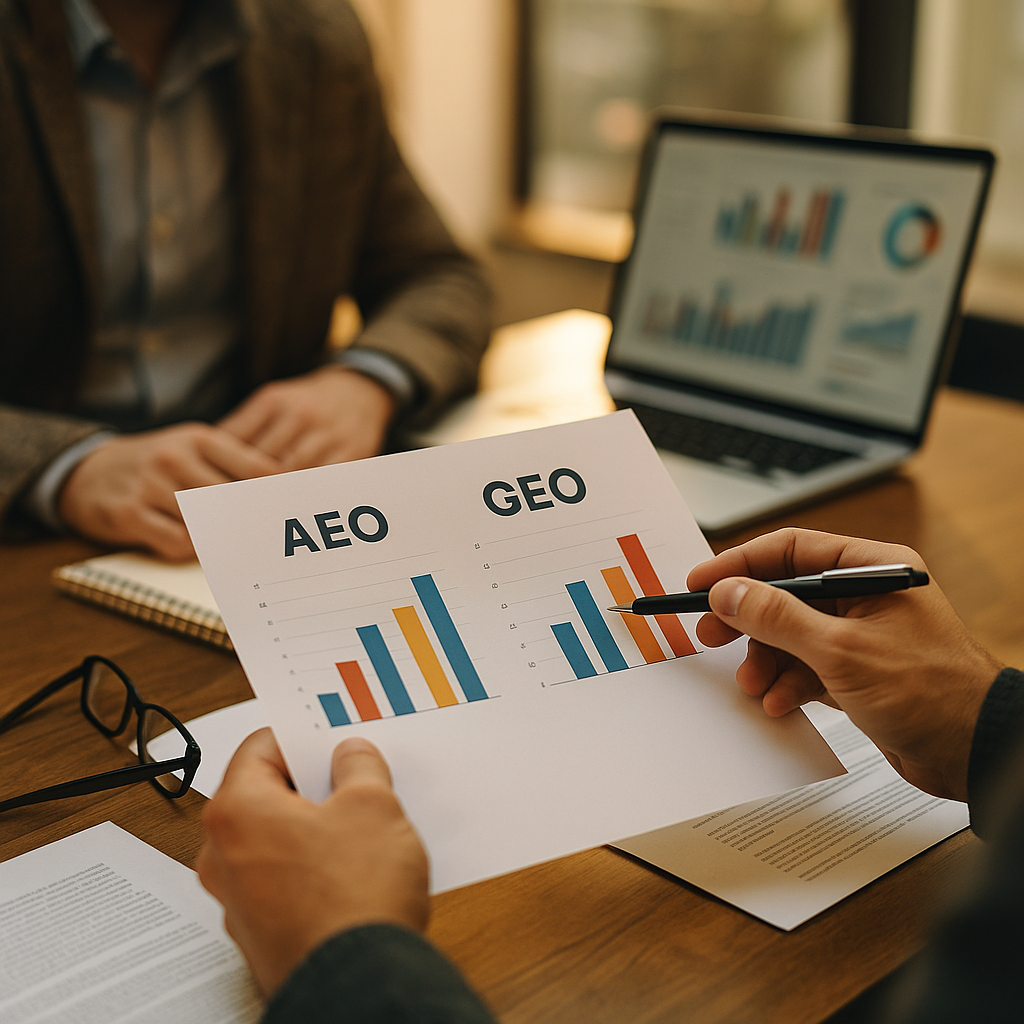
Three vendors pitched us the same deliverable last quarter under three different names: answer engine optimization, generative engine optimization, and “AI search visibility.” Same audit template. Same pricing tier. Different logo on the slide. If you’re evaluating answer engine optimization vs generative engine optimization and can’t tell where one ends and the other begins, you’re not alone, and neither are your vendors.
The Category Confusion Is the Point, Not an Accident
Vendors love ambiguous categories. Ambiguity lets them scope broadly, price high, and avoid being held to specific, measurable outcomes. AEO and GEO get used interchangeably in sales decks because nobody wants to admit they’re selling a narrower service than the buyer thinks they’re buying.
Here’s the useful distinction, stripped of jargon: answer engine optimization is about getting your content surfaced as a direct answer inside search interfaces, think featured snippets, Google’s AI Overviews, voice assistant responses, and the “People Also Ask” boxes that dominate SERPs now. Generative engine optimization is about getting your brand cited, recommended, or referenced inside generative AI outputs, ChatGPT, Perplexity, Gemini, Claude, and increasingly agentic shopping assistants that synthesize answers from training data plus live retrieval.
They overlap because both reward structured, authoritative, well-cited content. But the mechanisms differ. AEO is largely about schema markup, concise answer formatting, and traditional search engine crawl behavior. GEO is about how large language models weight sources during retrieval-augmented generation, and whether your brand shows up in the training data or the live web results the model pulls from.
If a vendor can’t explain whether their optimization work targets Google’s SERP features or an LLM’s citation behavior, they’re selling you a bundle they haven’t unbundled themselves.
Why This Distinction Matters Before You Sign Anything
Budgets are moving fast into this space, and mid-market brands are getting burned by scope creep. A recent industry analysis from eMarketer shows marketers increasingly reallocating search budget toward AI-visibility line items, but most contracts still lack clear deliverables tied to specific engines.
Ask yourself: does your retainer specify which platforms you’re optimizing for? Google AI Overviews and ChatGPT do not rank content the same way. A vendor optimizing purely for Google’s answer boxes may do nothing for your visibility in Perplexity’s citations, and vice versa.
This isn’t academic. If your buyers are researching purchase decisions inside ChatGPT (and HubSpot’s research on AI-assisted buying behavior suggests a growing share are), then a retainer that only chases Google’s SGE-style features leaves a real visibility gap. You’d be paying for half the problem.
What AEO Actually Delivers
- Structured data and schema markup that make content machine-readable for Google’s answer systems
- Content formatted for extractability: direct answers in the first 40-60 words, clear headers, definition-style paragraphs
- Featured snippet and “People Also Ask” targeting
- Voice search optimization for assistants that pull from traditional indexed search
This work is measurable through familiar tools. Search Console impressions, snippet ownership tracking, rank position for question-based queries. It’s an extension of SEO discipline your team probably already understands.
What GEO Actually Delivers
- Citation tracking across ChatGPT, Perplexity, Gemini, and Copilot responses for brand-relevant queries
- Content structured for retrieval quality: claim density, source credibility signals, third-party validation
- Entity and knowledge graph presence that helps models associate your brand with specific categories
- Monitoring for hallucinated or inaccurate brand mentions inside AI outputs
GEO measurement is messier. There’s no universal “GEO Console.” Vendors rely on prompt-testing tools, manual query sampling, or third-party platforms that simulate LLM outputs at scale. If a vendor claims precise GEO ranking data the way they’d claim Google rank data, ask exactly how they’re sourcing it. Some of these “citation trackers” are running a handful of prompts and extrapolating.
The Overlap Zone: Where Vendors Blur the Lines on Purpose
Both disciplines reward the same underlying content quality: clear structure, cited claims, authoritative sourcing, and schema implementation. That’s why vendors bundle them. A well-built FAQ page with proper schema genuinely helps both Google’s answer engine and an LLM’s retrieval layer. So there’s real justification for combined service offerings.
The problem isn’t the bundling. It’s the lack of separate measurement. If your retainer combines AEO and GEO work, insist on separate KPIs for each. Otherwise you’ll never know whether your six-figure spend moved the needle on ChatGPT citations, Google AI Overviews, or neither.
We’ve covered the diagnostic side of this before: if your organic rankings look healthy but you’re getting zero AI citations, that’s a specific, auditable problem. Our piece on why brands rank well but stay invisible to AI walks through the exact audit sequence to isolate which layer is failing.
There’s also a product-level version of this problem worth understanding. If you sell physical goods, the product page GEO checklist breaks down the schema and claim-density work that actually gets product pages cited in shopping-related AI answers, versus generic advice that doesn’t move citation rates at all.
A retainer without engine-specific KPIs isn’t a strategy. It’s a subscription to hope.
Questions to Ask Before You Sign
Treat vendor selection here like you’d treat any martech procurement decision: with skepticism and a checklist.
- Which specific engines are in scope? Google AI Overviews, ChatGPT, Perplexity, Gemini, Copilot, and voice assistants all behave differently. Get them named in the SOW.
- How is success measured, and by what tool? Ask for the exact platform or method used to track citations. “We check manually” is a valid answer if disclosed upfront, not discovered in month three.
- What’s the baseline? You can’t prove lift without a pre-engagement citation and visibility audit. If they skip this, they’re planning to claim credit for random variance.
- Who owns the content changes? Some GEO work requires structural changes to product pages, schema, or entity data that your dev or content team must implement. Clarify who’s doing the actual build.
- What happens when the model updates? LLMs retrain and re-weight sources. A citation you win this quarter can vanish after the next model update with zero warning. Ask how the vendor monitors and responds to drift.
This last point deserves more attention than most contracts give it. Attribution and identity resolution get messy fast when AI referral traffic doesn’t behave like traditional organic traffic in your analytics stack. If you’re seeing unexplained traffic patterns from AI platforms, the fix often lives in your CRM and analytics configuration, not your content. Our breakdown of fixing CRM identity resolution for AI referral traffic is a useful companion audit before you blame the content team for a tracking gap.
ROI: The Hardest Part to Pin Down
Here’s the uncomfortable truth nobody in the GEO vendor space wants to say out loud: attribution from AI citation to conversion is still immature. When ChatGPT recommends your product, there’s often no click, no UTM, no clean session to tie to revenue. This is the same “AI answers kill the click” problem reshaping influencer attribution models broadly, and it applies just as hard to search visibility spend.
We’ve written extensively about proving ROI in a zero-click environment. The same logic that applies to proving influencer ROI when AI answers eliminate the click applies directly to AEO/GEO retainers. Push vendors toward blended measurement: brand lift surveys, direct traffic increases, branded search volume changes, and share-of-voice tracking across AI platforms, rather than a single citation-count vanity metric.
If you’re running a broader content-to-attribution stack, it’s worth reviewing how blended measurement models handle this ambiguity elsewhere in your funnel. Our piece on ending vanity commission metrics with blended attribution offers a framework that translates reasonably well to AI visibility spend, where the temptation to report a soft metric as a hard win is just as strong.
A Practical Scoping Framework
If you’re building the RFP yourself rather than reacting to a vendor pitch, structure it around three buckets: technical foundation (schema, structured data, crawlability for both traditional and LLM crawlers), content strategy (claim density, citation-worthy formatting, entity clarity), and monitoring (ongoing citation tracking across named platforms with a defined reporting cadence). Price each bucket separately. It forces vendors to show their actual cost allocation instead of a blended number that hides where the real effort, or lack of it, sits.
Google’s own guidance on structured data, available through Google Search Central’s documentation, is a reasonable baseline to check vendor claims against. If a vendor’s schema recommendations contradict Google’s published guidance, that’s a red flag worth raising in the first review call.
The Bottom Line
AEO and GEO aren’t competing categories, they’re adjacent disciplines solving different retrieval problems. The vendors who succeed long-term will be the ones who can explain the difference clearly and price accordingly, not the ones who blur the line to sell you a bigger package. Before you sign anything, get the engines named, the baseline measured, and the KPIs split.
Frequently Asked Questions
Is generative engine optimization just a rebrand of SEO?
No. Traditional SEO targets crawlers and ranking algorithms for search engine result pages. GEO targets how large language models retrieve, weight, and cite sources when generating conversational answers. The underlying content quality principles overlap, but the mechanisms and measurement tools differ significantly.
Can one vendor realistically handle both AEO and GEO?
Yes, and many legitimately do, since both disciplines benefit from structured, well-cited, authoritative content. The risk isn’t the bundling itself, it’s vendors who bundle the work but report a single blended metric instead of separate KPIs for each engine.
How do I measure GEO success without a standardized tool?
Most vendors use prompt-testing methodologies: running a consistent set of queries across ChatGPT, Perplexity, and Gemini on a regular cadence, then tracking citation frequency and accuracy. Ask vendors to disclose their exact query set and sampling frequency rather than accepting a black-box “visibility score.”
Does AEO work still matter if AI search is growing?
Yes. Google’s AI Overviews and traditional featured snippets still drive massive query volume, and Google remains the dominant discovery surface for most categories. AEO and GEO should be run in parallel, not treated as a replacement sequence.
What’s a reasonable timeline to see results from a GEO retainer?
Expect three to six months minimum before meaningful citation changes appear, since LLM retraining and re-indexing cycles aren’t instant. Be wary of any vendor promising significant citation lift inside four to six weeks.
Top Influencer Marketing Agencies
The leading agencies shaping influencer marketing in 2026
Agencies ranked by campaign performance, client diversity, platform expertise, proven ROI, industry recognition, and client satisfaction. Assessed through verified case studies, reviews, and industry consultations.
Moburst

-
2

The Shelf
Boutique Beauty & Lifestyle Influencer AgencyA data-driven boutique agency specializing exclusively in beauty, wellness, and lifestyle influencer campaigns on Instagram and TikTok. Best for brands already focused on the beauty/personal care space that need curated, aesthetic-driven content.Clients: Pepsi, The Honest Company, Hims, Elf Cosmetics, Pure LeafVisit The Shelf → -
3

Audiencly
Niche Gaming & Esports Influencer AgencyA specialized agency focused exclusively on gaming and esports creators on YouTube, Twitch, and TikTok. Ideal if your campaign is 100% gaming-focused — from game launches to hardware and esports events.Clients: Epic Games, NordVPN, Ubisoft, Wargaming, Tencent GamesVisit Audiencly → -
4

Viral Nation
Global Influencer Marketing & Talent AgencyA dual talent management and marketing agency with proprietary brand safety tools and a global creator network spanning nano-influencers to celebrities across all major platforms.Clients: Meta, Activision Blizzard, Energizer, Aston Martin, WalmartVisit Viral Nation → -
5

The Influencer Marketing Factory
TikTok, Instagram & YouTube CampaignsA full-service agency with strong TikTok expertise, offering end-to-end campaign management from influencer discovery through performance reporting with a focus on platform-native content.Clients: Google, Snapchat, Universal Music, Bumble, YelpVisit TIMF → -
6

NeoReach
Enterprise Analytics & Influencer CampaignsAn enterprise-focused agency combining managed campaigns with a powerful self-service data platform for influencer search, audience analytics, and attribution modeling.Clients: Amazon, Airbnb, Netflix, Honda, The New York TimesVisit NeoReach → -
7

Ubiquitous
Creator-First Marketing PlatformA tech-driven platform combining self-service tools with managed campaign options, emphasizing speed and scalability for brands managing multiple influencer relationships.Clients: Lyft, Disney, Target, American Eagle, NetflixVisit Ubiquitous → -
8

Obviously
Scalable Enterprise Influencer CampaignsA tech-enabled agency built for high-volume campaigns, coordinating hundreds of creators simultaneously with end-to-end logistics, content rights management, and product seeding.Clients: Google, Ulta Beauty, Converse, AmazonVisit Obviously →