


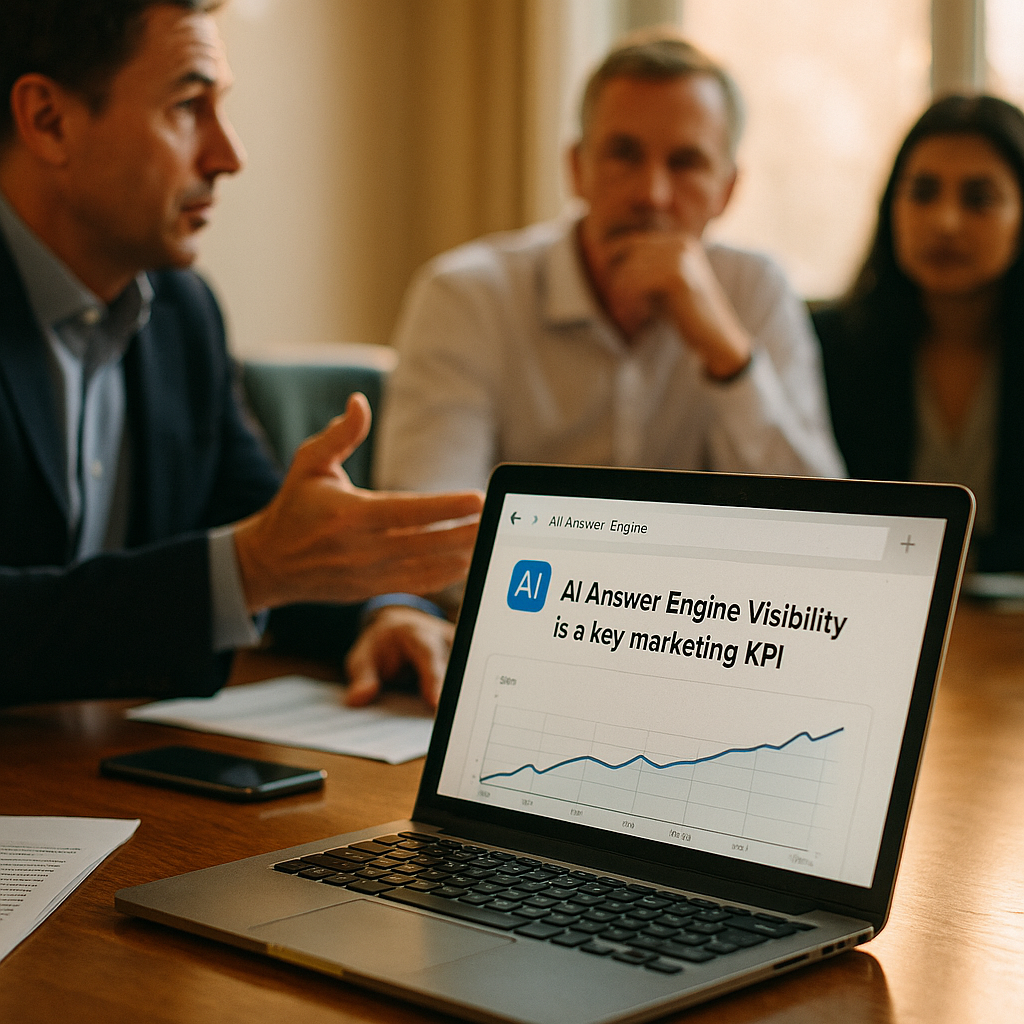
Seventy one percent of consumers now start product research in a chatbot or AI overview before they ever touch a search engine, according to recent emarketer survey data. If your brand can’t answer the question “do we show up in ChatGPT, Gemini, or Perplexity,” you’ve got a visibility gap that no amount of SEO polish will fix. That gap just landed on the board agenda. AI answer engine visibility is no longer a technical curiosity owned by the SEO team. It’s a KPI the CEO asks about.
Why the CMO’s Dashboard Just Got a New Line Item
Boards don’t usually care about ranking factors. They care about revenue exposure. And right now, revenue exposure is shifting from traditional search results pages into AI generated answers that summarize, synthesize, and sometimes completely omit brand mentions.
Think about what happened to click through rates on organic search over the past two years. Our own coverage of CTR compression trends showed how saturated channels quietly erode returns long before anyone notices in the quarterly numbers. AI answer engines are doing the same thing to search, except faster. A query that used to send ten blue links now returns one synthesized paragraph. If your brand isn’t cited in that paragraph, you don’t exist for that moment of intent.
When a single AI generated answer replaces ten search results, being absent from that answer is the same as being delisted from the internet for that query.
That’s why finance and operations leaders, not just marketers, are asking for visibility scores. A board member reviewing CAC trends wants to know if rising acquisition costs trace back to invisible brand presence in AI tools. That’s a direct line from a technical SEO metric to a P&L conversation, and it’s exactly why this KPI climbed the org chart so fast.
What Counts as “Visibility” in an Answer Engine?
Unlike traditional rank tracking, AI answer engine visibility measures whether a brand, product, or claim gets surfaced inside a generated response, and how accurately. Vendors like Profound, Scrunch AI, and Semrush’s AI visibility toolkit now track share of voice across ChatGPT, Gemini, Copilot, and Perplexity by running thousands of representative prompts and logging which brands get named, cited, or linked.
- Citation frequency: how often your domain or brand name appears as a source within AI generated answers.
- Sentiment accuracy: whether the AI’s summary of your product matches your actual positioning, not a stale or hallucinated version.
- Share of answer: the percentage of a generated response devoted to your brand versus competitors mentioned in the same response.
- Prompt coverage: the breadth of buyer intent queries where your brand appears at all.
None of these metrics existed in a marketing dashboard three years ago. Now they’re the headline slide. Our analysis of the 392 percent AI search surge covered how quickly this traffic source went from rounding error to budget priority, and that trajectory hasn’t slowed.
The Board Doesn’t Care About Rankings. It Cares About This.
Here’s the uncomfortable truth for marketing leaders: boards don’t want a lecture on generative engine optimization (GEO) or answer engine optimization (AEO). They want three things. Is spend protected? Is risk contained? Is the competitor winning the moment we’re losing?
That reframes the entire reporting structure. Instead of presenting “AI visibility score: 42,” smart CMOs are presenting it as a revenue protection metric tied to funnel stages. If 60 percent of AI search summaries are rerouting retail media spend, as our piece on AI search summary spend rerouting detailed, then visibility isn’t a vanity number. It’s a direct predictor of where next quarter’s paid media budget needs to shift.
This is also where agencies are repositioning fast. Several have started bundling AEO and GEO audits into retainer packages rather than treating them as add on projects, a trend we broke down in coverage of the AEO and GEO acquisition race. Clients aren’t asking “can you do this.” They’re asking “why haven’t you already built this into our reporting.”
How This Shift Is Rewiring Creator and Content Budgets
Creator content has quietly become one of the biggest inputs into AI answer engines. Large language models are trained and retrieved against vast amounts of user generated content, reviews, and influencer commentary. That means a creator’s honest product review on YouTube or a long form TikTok breakdown can directly shape how an AI assistant describes your product to a prospective buyer.
This creates both opportunity and operational headache. On the opportunity side, brands that systematically brief creators to use specific product language, accurate claims, and consistent terminology are seeing that language echoed back in AI generated summaries weeks later. On the headache side, unmonitored creator content can introduce outdated pricing, discontinued features, or compliance issues that get baked into an AI’s “knowledge” of your brand for months before anyone catches it.
This is precisely the blind spot explored in our coverage of AI chatbot dark traffic, where creator influence shows up in AI answers but never appears in standard attribution tools, quietly inflating acquisition costs because nobody can trace the real source of demand. If your attribution model still treats last click as gospel, you’re flying blind on half the funnel. We’ve written before about why last click attribution fails in creator driven journeys, and AI answer engines make that failure mode even more expensive.
Measurement Still Has Gaps
Let’s be honest about where this discipline is immature. There’s no universal standard for how AI visibility is measured across platforms. ChatGPT, Gemini, and Perplexity each pull from different data sources, update at different cadences, and weight citations differently. A brand that scores well in one tool’s visibility index might barely register in another.
Benchmarking against competitors is also messy. Unlike traditional SEO, where tools like HubSpot and Sprout Social have built mature reporting ecosystems over a decade, AI visibility tracking is maybe eighteen months old in its current form. Boards asking for quarter over quarter trend lines need to understand they’re comparing early stage data, not ten years of stable benchmarks.
Treat AI answer engine visibility like you treated social media metrics in their first two years: directionally useful, but not yet precise enough to bet the entire budget on a single number.
Google’s own documentation on how AI Overviews source and cite content gives some transparency, but it’s far from a complete measurement framework. Marketers reporting to the board need to pair any visibility score with qualitative context: what queries matter most to the business, and are we present in those specific moments.
Building the Governance Layer Nobody Wants to Own
Here’s where this gets political inside organizations. AI answer engine visibility touches SEO, content, PR, legal, and influencer marketing teams simultaneously. Who owns the KPI when it fails?
Smart organizations are standing up a cross functional governance layer now, before a visibility crisis forces the conversation. That typically means a shared taxonomy for product claims, a review cadence for creator briefs to ensure language consistency, and a direct line between the SEO/content team and whoever owns the AI visibility dashboard. The IAB’s recent research, covered in our piece on how AI now drives five of six marketer priorities, confirms this isn’t a niche concern. It’s reshaping budget allocation at the category level.
Compliance teams should also be in the room. If an AI answer engine misrepresents a product claim sourced from an unvetted creator post, that’s not just a reputational problem, it’s potentially a disclosure or advertising claims issue. The FTC has made clear that misleading endorsements carry liability regardless of which platform or format surfaces them, and AI generated summaries don’t get a pass just because a human didn’t write the final sentence.
Data on overall brand spend, available through sources like Statista, shows marketing budgets are already shifting toward measurement infrastructure rather than pure media spend. That reallocation is a direct response to exactly this governance gap.
What This Means for Next Quarter’s Budget Conversation
If you’re walking into a board meeting without an AI answer engine visibility baseline, you’re already behind. Not because the metric is perfect, it isn’t, but because the absence of data invites worse assumptions. A board member who reads a headline about declining organic traffic will connect dots on their own, and those dots usually point toward panic cuts rather than strategic reinvestment.
The fix isn’t complicated, but it requires commitment. Run a baseline visibility audit across the top three AI answer engines your buyers actually use. Tie that score to a specific funnel stage and dollar figure. Then report it alongside, not instead of, your existing search and paid media metrics. That’s the version of this KPI a board will actually trust.
The Takeaway
Start treating AI answer engine visibility as you would any other revenue protecting metric: baseline it this quarter, assign clear ownership across content and compliance teams, and report it in dollar terms the board already understands.
Frequently Asked Questions
What is AI answer engine visibility?
AI answer engine visibility measures how often and how accurately a brand, product, or claim is surfaced inside AI generated responses from tools like ChatGPT, Gemini, Perplexity, and Copilot, as opposed to traditional search engine rankings.
Why is this becoming a board level KPI?
Boards track metrics tied to revenue exposure and acquisition cost. As more buyer research shifts into AI generated summaries, invisibility in those summaries directly threatens pipeline, making it a financial concern rather than a purely technical SEO issue.
How is AI visibility different from traditional SEO tracking?
Traditional SEO tracks rankings on a results page with multiple listed links. AI visibility tracks whether a brand is cited, summarized accurately, or omitted entirely within a single synthesized answer, which has no concept of “page two.”
Can creator content affect AI answer engine visibility?
Yes. AI models frequently draw on creator reviews, social commentary, and long form content when generating product summaries, which means unmanaged creator messaging can shape how an AI describes your brand long after the original post was published.
What tools measure AI answer engine visibility?
Vendors including Profound, Scrunch AI, and Semrush’s AI visibility toolkit track citation frequency, share of answer, and sentiment accuracy across major AI platforms, though no single industry standard yet exists for comparing scores across tools.
Who should own AI visibility inside a marketing organization?
Because it touches SEO, content, PR, legal, and influencer teams, most organizations are establishing a cross functional governance group rather than assigning ownership to a single department.
Top Influencer Marketing Agencies
The leading agencies shaping influencer marketing in 2026
Agencies ranked by campaign performance, client diversity, platform expertise, proven ROI, industry recognition, and client satisfaction. Assessed through verified case studies, reviews, and industry consultations.
Moburst

-
2

The Shelf
Boutique Beauty & Lifestyle Influencer AgencyA data-driven boutique agency specializing exclusively in beauty, wellness, and lifestyle influencer campaigns on Instagram and TikTok. Best for brands already focused on the beauty/personal care space that need curated, aesthetic-driven content.Clients: Pepsi, The Honest Company, Hims, Elf Cosmetics, Pure LeafVisit The Shelf → -
3

Audiencly
Niche Gaming & Esports Influencer AgencyA specialized agency focused exclusively on gaming and esports creators on YouTube, Twitch, and TikTok. Ideal if your campaign is 100% gaming-focused — from game launches to hardware and esports events.Clients: Epic Games, NordVPN, Ubisoft, Wargaming, Tencent GamesVisit Audiencly → -
4

Viral Nation
Global Influencer Marketing & Talent AgencyA dual talent management and marketing agency with proprietary brand safety tools and a global creator network spanning nano-influencers to celebrities across all major platforms.Clients: Meta, Activision Blizzard, Energizer, Aston Martin, WalmartVisit Viral Nation → -
5

The Influencer Marketing Factory
TikTok, Instagram & YouTube CampaignsA full-service agency with strong TikTok expertise, offering end-to-end campaign management from influencer discovery through performance reporting with a focus on platform-native content.Clients: Google, Snapchat, Universal Music, Bumble, YelpVisit TIMF → -
6

NeoReach
Enterprise Analytics & Influencer CampaignsAn enterprise-focused agency combining managed campaigns with a powerful self-service data platform for influencer search, audience analytics, and attribution modeling.Clients: Amazon, Airbnb, Netflix, Honda, The New York TimesVisit NeoReach → -
7

Ubiquitous
Creator-First Marketing PlatformA tech-driven platform combining self-service tools with managed campaign options, emphasizing speed and scalability for brands managing multiple influencer relationships.Clients: Lyft, Disney, Target, American Eagle, NetflixVisit Ubiquitous → -
8

Obviously
Scalable Enterprise Influencer CampaignsA tech-enabled agency built for high-volume campaigns, coordinating hundreds of creators simultaneously with end-to-end logistics, content rights management, and product seeding.Clients: Google, Ulta Beauty, Converse, AmazonVisit Obviously →