


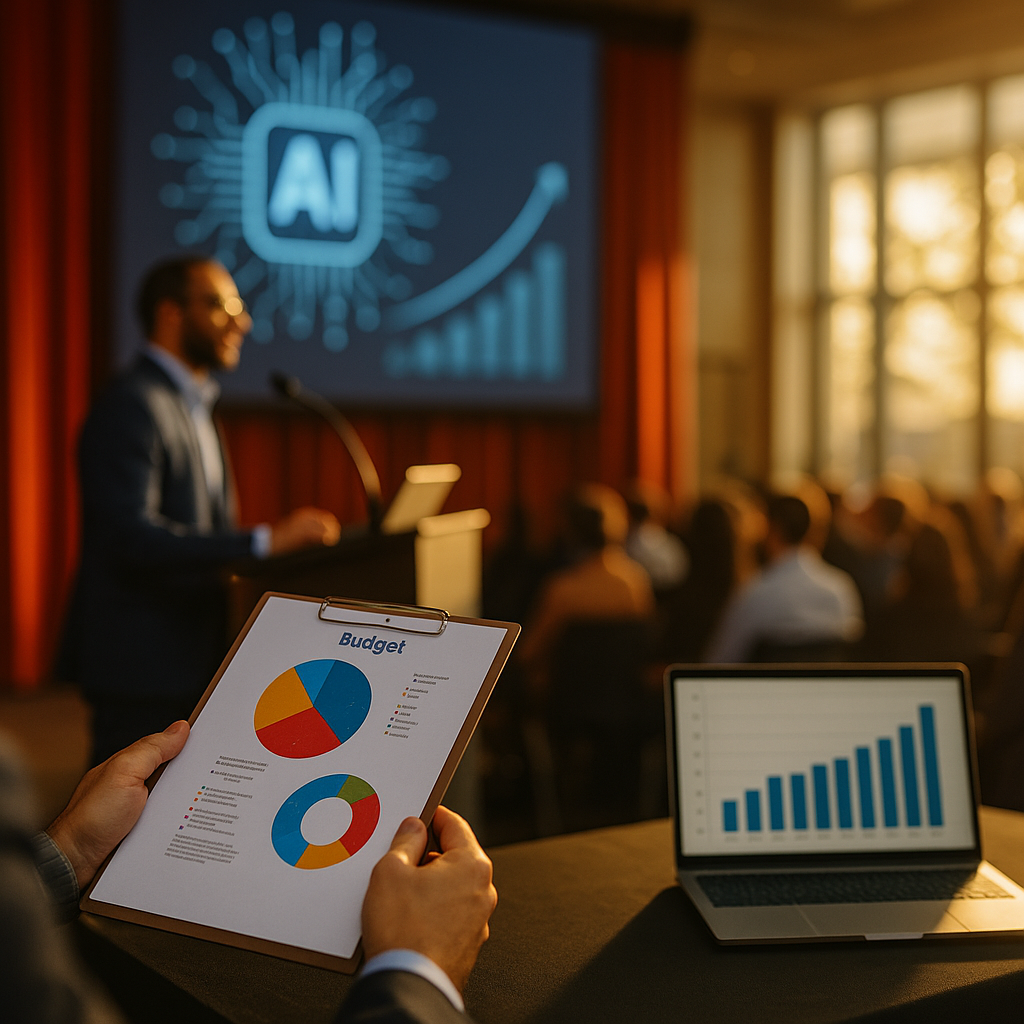
Three-quarters of marketing leaders say they’re increasing AI spend this year, yet most can’t name a single conference session that shaped that decision. That’s the gap AI conference season 2026 is meant to close. Ai4, IJCAI-ECAI, and AIMST just wrapped their sessions, and the signal underneath the hype is clear: budgets are shifting away from generic generative tools and toward agentic, auditable, and industry-specific systems.
If you’re a brand strategist or agency lead still benchmarking your AI stack against last year’s playbook, this is your reset.
Why Conference Agendas Matter More Than Product Launches
Vendor keynotes tell you what a company wants to sell. Conference session tracks tell you what buyers are actually asking about. That distinction matters more than usual this cycle, because the gap between AI marketing hype and AI marketing spend has widened. According to Statista market tracking, martech AI investment continues to grow, but procurement cycles have lengthened as legal and finance teams demand more proof before signing.
Ai4, held every year as one of the largest cross-industry AI events, drew heavy marketing and retail attendance this cycle, with entire tracks dedicated to agentic workflows and AI governance. IJCAI-ECAI, the joint International Joint Conference on Artificial Intelligence and European Conference on AI, is normally academic territory. But its applied-AI and industry tracks have become a bellwether for what’s about to move from research paper to production tool. AIMST, the AI in Marketing, Sales, and Technology summit, is the most commercially blunt of the three: vendors pitch, brands push back, and the friction in those Q&A sessions is where you learn what’s actually enterprise-ready.
Put those three together and you get a triangulated view: academic frontier, applied industry pressure, and commercial packaging. That’s rare. Most conferences give you one lens.
Signal One: Agentic AI Moved From Panel Topic to Procurement Line Item
Last cycle, “agentic AI” was a buzzword panel filler. This cycle, it was a budget conversation. Multiple Ai4 sessions focused on multi-step marketing agents that plan a campaign, draft assets, route them for approval, and adjust spend based on live performance data, with a human checkpoint at each stage rather than full autonomy.
That’s a meaningful shift from the chatbot-for-copywriting era. It also explains why agencies are quietly restructuring teams. The rise of forward-deployed engineers inside ad agencies isn’t a coincidence. Agentic systems need people who can configure, monitor, and debug them in production, not just prompt them.
The most requested AIMST session topic, according to organizers, wasn’t “generative AI use cases.” It was “agentic AI governance and audit trails” — proof that brands now want control mechanisms as much as capability.
For marketing leaders, the operational question isn’t whether to adopt agentic workflows. It’s how to structure approval gates so an autonomous agent doesn’t greenlight a six-figure media buy without sign-off. That’s a governance problem, not a technology problem, and it’s exactly why procurement teams are slowing down deals until vendors can answer it.
IJCAI-ECAI: The Research Signals Nobody in Marketing Is Watching Closely Enough
IJCAI-ECAI sessions skew academic, which is precisely why marketers underweight them. That’s a mistake. The applied-AI and industry track this cycle featured multiple papers on multimodal grounding, essentially, techniques to make AI outputs more traceable back to source data. That’s the underlying research behind the “hallucination reduction” claims every martech vendor will make at next year’s AIMST.
Watching IJCAI-ECAI gives you an 12-to-18-month lead on what vendors will package and sell. Attribution transparency, for instance, showed up as a research theme well before it became a boardroom demand. That’s directly relevant to the ongoing conversation around why attribution must go transparent as AI usage climbs and audience trust in AI-generated content and recommendations continues to erode.
There’s also a quieter thread worth watching: retrieval-augmented generation applied specifically to brand safety filtering. Instead of a generic content moderation layer, several papers described domain-tuned filters trained on brand guideline documents. That’s a direct answer to the compliance headaches agencies have been managing manually. Expect this to surface as a commercial product within two conference cycles.
AIMST’s Commercial Reality Check
AIMST is where vendor claims meet brand skepticism, and this cycle’s Q&A sessions got pointed. Attendees pushed back hard on ROI claims for generative creative tools, specifically asking vendors to show attribution data, not just output volume metrics.
That skepticism tracks with broader survey data. Marketers increasingly trust community signals over AI output, and that same distrust showed up in session hallways as pointed questions about training data provenance and brand safety guarantees. Vendors who couldn’t answer clearly lost credibility fast.
The commercial takeaway: platforms with clean attribution and audit logging are winning deals. Platforms that only talk about content volume are losing them, even when the volume genuinely helps with the content volume crisis many teams face on flat budgets.
Pricing came up constantly, too. Several sessions dissected the premium agencies now charge for AI-augmented services, echoing the pattern detailed in AI-augmented agency pricing analysis. Buyers at AIMST wanted to know exactly what that premium buys. The honest answer, from several panelists, was governance and speed, not raw creative quality. That’s a useful line to remember next time a vendor pitches you.
Where the Money Is Actually Moving
Strip away the keynote theater and three investment patterns emerge across all three events.
First: governance and compliance tooling. Budget that used to go entirely toward generation tools is splitting, with a growing share earmarked for monitoring, audit trails, and brand safety layers. This tracks with the regulatory pressure building from rulings like the EU DSA ruling on Meta, which put algorithmic accountability squarely on brand radars.
Second: vertical-specific AI over horizontal platforms. Sessions on retail-specific and finance-specific marketing AI drew bigger crowds than general-purpose generative tool demos. Buyers are tired of retrofitting generic tools to fit compliance-heavy industries.
Third: vendor consolidation risk. Multiple AIMST panelists raised concerns about smaller AI vendors folding or getting acquired mid-contract. That worry lines up with the broader funding shakeout covered in how AI funding shifts put vendor stacks at risk. If you’re signing a multi-year contract with a Series B AI startup right now, ask about data portability. You’ll want it if they get acquired.
This consolidation anxiety is also driving renewed interest in foundational model selection. Brands don’t just want a marketing tool anymore, they want to know which underlying model powers it, and whether they can switch. That’s precisely the decision framework laid out in OpenAI vs Anthropic vendor selection, and it’s becoming a standard due-diligence question in procurement conversations, not just a technical curiosity.
What This Means for Your Budget Planning
None of this is abstract. The HubSpot state-of-marketing benchmarks and the broader martech budget reshuffle already underway both point the same direction: less spend on flashy generation, more spend on infrastructure that proves the generation is safe, accurate, and attributable.
Practically, that means budget conversations this planning cycle should include line items for:
- Governance and audit tooling layered on top of existing generative tools, not replacing them
- Vendor contract clauses covering data portability and model-switching rights
- Attribution infrastructure that can withstand a skeptical CFO’s questions, not just a marketing dashboard
- Vertical-specific AI tools if you operate in a regulated or compliance-heavy category
Don’t skip the human side either. Every conference track this cycle mentioned talent gaps: brands need people who understand both marketing strategy and AI system configuration. That’s a hiring and training line item, not just a software one, and it echoes the same skills shift behind the forward-deployed engineer trend inside agencies.
One more thing worth flagging: session attendance data itself is a signal. When governance and audit sessions outdraw flashy generative demo sessions, that’s the market telling you where confidence actually sits. Bet your next budget cycle accordingly.
Frequently Asked Questions
FAQs
What is the biggest marketing AI trend coming out of this year’s conference season?
Agentic AI governance is the clearest trend. Brands are less focused on generation capability and more focused on audit trails, approval checkpoints, and control mechanisms for AI systems that take autonomous action.
Should brands attend Ai4, IJCAI-ECAI, and AIMST, or just follow the recaps?
Attending in person helps most for AIMST, where vendor Q&A reveals real objections and gaps. IJCAI-ECAI recaps are usually sufficient for marketing teams since the content is research-forward and takes time to become commercially relevant anyway.
How does IJCAI-ECAI relate to practical marketing AI decisions?
IJCAI-ECAI research often previews what vendors will commercialize 12 to 18 months later. Tracking its applied-AI sessions gives marketing leaders early visibility into features that will eventually show up in martech products.
What should marketers ask AI vendors after this conference cycle?
Ask about data portability, model-switching rights, audit logging, and whether claims about output quality are backed by attribution data rather than volume metrics alone.
Is agentic AI ready for full autonomy in marketing campaigns?
Not yet, according to most sessions across all three events. The current standard is human-in-the-loop agentic workflows, where AI handles multi-step execution but a person approves key decisions like budget allocation or public-facing content.
Next step: Before your next budget cycle, pull the session agendas from all three events and map them against your current vendor contracts. If your stack has no governance or audit-trail component, that’s the gap this year’s conference signals say to close first.
Top Influencer Marketing Agencies
The leading agencies shaping influencer marketing in 2026
Agencies ranked by campaign performance, client diversity, platform expertise, proven ROI, industry recognition, and client satisfaction. Assessed through verified case studies, reviews, and industry consultations.
Moburst

-
2

The Shelf
Boutique Beauty & Lifestyle Influencer AgencyA data-driven boutique agency specializing exclusively in beauty, wellness, and lifestyle influencer campaigns on Instagram and TikTok. Best for brands already focused on the beauty/personal care space that need curated, aesthetic-driven content.Clients: Pepsi, The Honest Company, Hims, Elf Cosmetics, Pure LeafVisit The Shelf → -
3

Audiencly
Niche Gaming & Esports Influencer AgencyA specialized agency focused exclusively on gaming and esports creators on YouTube, Twitch, and TikTok. Ideal if your campaign is 100% gaming-focused — from game launches to hardware and esports events.Clients: Epic Games, NordVPN, Ubisoft, Wargaming, Tencent GamesVisit Audiencly → -
4

Viral Nation
Global Influencer Marketing & Talent AgencyA dual talent management and marketing agency with proprietary brand safety tools and a global creator network spanning nano-influencers to celebrities across all major platforms.Clients: Meta, Activision Blizzard, Energizer, Aston Martin, WalmartVisit Viral Nation → -
5

The Influencer Marketing Factory
TikTok, Instagram & YouTube CampaignsA full-service agency with strong TikTok expertise, offering end-to-end campaign management from influencer discovery through performance reporting with a focus on platform-native content.Clients: Google, Snapchat, Universal Music, Bumble, YelpVisit TIMF → -
6

NeoReach
Enterprise Analytics & Influencer CampaignsAn enterprise-focused agency combining managed campaigns with a powerful self-service data platform for influencer search, audience analytics, and attribution modeling.Clients: Amazon, Airbnb, Netflix, Honda, The New York TimesVisit NeoReach → -
7

Ubiquitous
Creator-First Marketing PlatformA tech-driven platform combining self-service tools with managed campaign options, emphasizing speed and scalability for brands managing multiple influencer relationships.Clients: Lyft, Disney, Target, American Eagle, NetflixVisit Ubiquitous → -
8

Obviously
Scalable Enterprise Influencer CampaignsA tech-enabled agency built for high-volume campaigns, coordinating hundreds of creators simultaneously with end-to-end logistics, content rights management, and product seeding.Clients: Google, Ulta Beauty, Converse, AmazonVisit Obviously →