


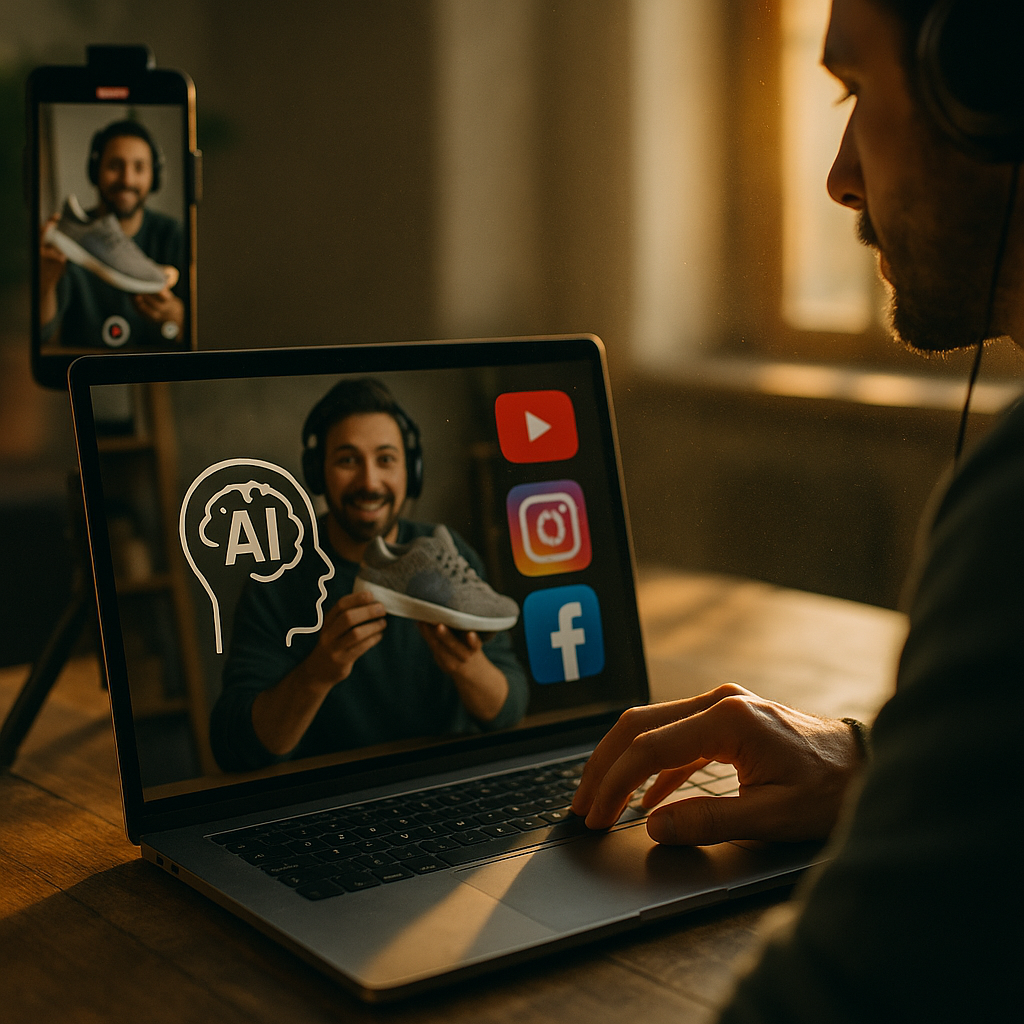
One creator video. Nine platforms. Zero manual re-edits. That’s the promise of AI-driven channel optimization, and most brands are still nowhere close to it. A recent eMarketer survey found that marketers spend up to 30% of campaign budgets on redundant content variations for different placements. That’s not a creative problem. It’s a workflow problem.
If your team is still manually cropping, recaptioning, and reformatting creator content for every channel, you’re paying a creativity tax that AI has already made obsolete.
The Core Problem: One Asset, Infinite Destinations
A single piece of creator content today needs to live in at least three distinct environments: social feeds, streaming ad breaks, and retail media placements. Each has its own aspect ratio, pacing expectations, compliance rules, and performance logic. TikTok wants native, fast-cut vertical video. Connected TV wants polished 15- or 30-second spots with clear brand framing. Retail media networks like Amazon DSP or Walmart Connect want product-forward creative that survives a cluttered, low-attention shopping environment.
The old way handled this with separate shoots, separate briefs, and separate agencies. The new way starts with one creator asset and a workflow that intelligently transforms it for each destination, without losing the authenticity that made it work in the first place.
The brands winning right now aren’t producing more content. They’re extracting more value from the content they already have, at a fraction of the production cost.
Why This Matters More in the Retail Media Era
Retail media ad spend is projected to exceed $175 billion globally, according to eMarketer’s retail media forecasts. That’s real budget competing with social and streaming for the same creator content. Yet most brands still treat retail media creative as an afterthought, bolted on late in the process with a generic product shot and a discount badge.
That’s a missed opportunity. Retail media placements convert on intent, and creator content, when adapted correctly, converts better than static banner ads because it carries social proof into the shopping moment.
The brands treating this seriously are building what amounts to a content supply chain: one hero asset, multiple AI-assisted derivatives, each tuned to the psychology of its destination.
What an AI-Driven Optimization Workflow Actually Looks Like
Strip away the buzzwords and the workflow breaks into five stages. None of them require reinventing your creative process, but they do require rethinking who (or what) touches the asset after the creator delivers it.
- Ingest and tag. The raw creator asset gets ingested into a DAM or AI content pipeline, where computer vision and NLP models tag scenes, product placements, spoken claims, and emotional beats. This metadata layer is what makes everything downstream possible.
- Generate channel-specific cuts. Tools like Adobe Firefly, Vidyo.ai, and Munch use scene-tagging to auto-generate vertical, square, and horizontal cuts, trimming for platform-specific attention spans without a human re-editing from scratch.
- Apply compliance and disclosure logic. Each channel has different disclosure and labeling rules. Streaming ads may need broadcast-standard supers; social needs FTC-compliant tags; retail media has its own review gates. Automating this step prevents the kind of compliance gaps outlined in our ad transparency compliance guide.
- Localize and personalize creative variants. This is where SKU-level and audience-level personalization comes in, especially for retail media, where the same creator moment might need ten product-specific variants. This overlaps heavily with the logic covered in our SKU-level dynamic creative guide.
- Route, tag, and measure. Every derivative gets pushed to its destination with consistent UTM and identity tagging so performance data flows back into one attribution model instead of three disconnected dashboards.
Skip any of these steps and you end up with what one media director I spoke with called “creative spaghetti”: dozens of asset versions, no consistent naming convention, and no way to know which variant actually drove the sale.
Social: Speed and Authenticity Win, Not Polish
Social platforms punish anything that smells like a repurposed TV ad. The AI layer here needs to preserve the rough, native feel of the original creator content while adjusting for format. That means smart cropping that keeps the creator’s face and hands in frame, auto-captioning that matches the platform’s native style, and pacing edits that respect each app’s average watch-through curve.
TikTok and Instagram Reels reward the first three seconds above almost everything else. An AI workflow that can auto-detect the strongest hook moment in a longer piece of creator content, and lead with it, is doing more for performance than any amount of manual editing discipline.
Platforms themselves are pushing this. Meta’s ad tools already offer automated aspect-ratio and pacing adjustments through Meta Business Suite, and TikTok’s ad manager includes similar auto-optimization features via TikTok Ads Manager. If you’re not using these natively, you’re leaving free optimization on the table.
One caveat: authenticity checks still need a human. AI can generate ten cuts in minutes, but only a strategist familiar with the creator’s voice can tell you which cut still feels real.
Streaming: Where Polish and Pacing Actually Matter
Streaming and connected TV are the opposite end of the spectrum. Viewers expect production value here, and creative that looks obviously repurposed from a TikTok will underperform, sometimes badly. The AI workflow needs to do more heavy lifting: upscaling resolution, adding proper lower-thirds and legal supers, adjusting pacing for a less skippable, more captive viewing context.
This is also where synthetic tools are quietly changing production economics. Enterprise teams are increasingly using AI dubbing and voice-matching to adapt a single creator’s spot for multiple regional CTV buys without reshooting. If you’re evaluating vendors for this, our synthetic presenter vetting guide is a useful starting point before signing any contracts.
Streaming ad inventory is also getting smarter about targeting. Platforms increasingly support dynamic creative insertion, meaning your AI workflow should be producing modular assets (swappable end cards, alternate CTAs) rather than one monolithic 30-second file.
Retail Media: The Channel Most Brands Still Get Wrong
Retail media creative has a job that neither social nor streaming does: it has to convert in a shopping context, often in a shrunken ad unit next to a search results grid. Creator content works well here because it injects trust into a transactional moment, but only if it’s adapted correctly.
The winning pattern: extract the product demonstration moment from the original creator asset, pair it with a clean product shot and price/promo overlay, and keep total runtime under six seconds for on-site placements. Longer formats work for off-site retail media (Amazon DSP, Instacart Ads, Walmart Connect display network) but need clearer branding since there’s no algorithmic feed context to carry it.
Dynamic creative optimization at the SKU level is where this gets genuinely powerful, and genuinely complex. A single creator video showcasing a skincare routine might need twelve retail-ready variants, one per SKU, each with accurate pricing and stock-status logic pulled live from a product feed.
Retail media isn’t a distribution channel for leftover creative. It’s a conversion surface that deserves its own creative logic, built from the start, not patched on at the end.
Governance: The Part Everyone Skips
Here’s the uncomfortable truth: most AI-driven content workflows fail not because the technology can’t generate variants, but because nobody owns the governance layer. Who approves the auto-generated cuts? Who checks that the FTC disclosure survived the reformatting? Who catches brand voice drift when an AI model has been generating captions for six months unsupervised?
This is where a lot of the operational risk lives. If you’re scaling this across a multi-agent content system, the governance framework matters as much as the generation tools. Our agentic AI governance framework and multi-agent marketing blueprint both cover this in more depth, but the short version is: build approval checkpoints into the workflow, not around it.
Voice drift is a real, measurable risk too. If your AI captioning tool has quietly shifted your brand’s tone over dozens of automated iterations, you need version control, not vibes. That’s exactly the problem addressed in our prompt version control piece.
Measurement: Closing the Loop Across Channels
None of this matters if you can’t tie performance back to one identity graph. A creator asset that crushes it on TikTok but underperforms on retail media isn’t necessarily a failure, it might just mean the derivative was wrong, not the source content. Without unified tagging and attribution, you’ll never know the difference.
Set up consistent naming conventions and UTM structures before you generate a single derivative. Feed performance data back into one dashboard, ideally tied to a broader identity resolution system like the one described in our identity graph attribution piece. For deeper platform benchmarking guidance, HubSpot’s marketing analytics resources and Sprout Social’s social media benchmark reports are solid starting points for building comparative KPIs across channels.
Next step: Audit one existing piece of creator content this week. Map every channel it currently lives on, identify where the derivative creative was manually built versus AI-assisted, and calculate the hours spent. That number is your baseline. Everything the AI workflow saves from here is measurable ROI, not a hypothetical.
FAQs
What is AI-driven channel optimization in influencer marketing?
It’s the practice of using AI tools to automatically adapt one piece of creator content into multiple channel-specific formats, such as social cuts, streaming ads, and retail media creative, without manually re-editing each version from scratch.
Which platforms benefit most from repurposed creator content?
Social platforms like TikTok and Instagram benefit from fast, authentic cuts; streaming and CTV need polished, modular creative with dynamic end cards; retail media networks like Amazon DSP and Walmart Connect need short, product-forward variants tied to live pricing and stock data.
Do AI-generated content variants need separate compliance checks per channel?
Yes. Disclosure requirements differ across social, streaming, and retail media, and automated workflows should include a compliance logic layer rather than relying on manual review after the fact, particularly given evolving FTC guidance available at ftc.gov.
How do brands measure ROI across an AI-driven content workflow?
By using consistent UTM tagging and a unified identity graph that ties performance from every channel-specific derivative back to one source asset, allowing direct comparison of cost-per-variant against revenue attributed to each channel.
What’s the biggest risk in automating creative repurposing?
Brand voice drift and compliance gaps. Without governance checkpoints and version control, automated systems can quietly shift tone or drop required disclosures across dozens of iterations before anyone notices.
Frequently Asked Questions
What is AI-driven channel optimization in influencer marketing?
It’s the practice of using AI tools to automatically adapt one piece of creator content into multiple channel-specific formats, such as social cuts, streaming ads, and retail media creative, without manually re-editing each version from scratch.
Which platforms benefit most from repurposed creator content?
Social platforms like TikTok and Instagram benefit from fast, authentic cuts; streaming and CTV need polished, modular creative with dynamic end cards; retail media networks like Amazon DSP and Walmart Connect need short, product-forward variants tied to live pricing and stock data.
Do AI-generated content variants need separate compliance checks per channel?
Yes. Disclosure requirements differ across social, streaming, and retail media, and automated workflows should include a compliance logic layer rather than relying on manual review after the fact, particularly given evolving FTC guidance available at ftc.gov.
How do brands measure ROI across an AI-driven content workflow?
By using consistent UTM tagging and a unified identity graph that ties performance from every channel-specific derivative back to one source asset, allowing direct comparison of cost-per-variant against revenue attributed to each channel.
What’s the biggest risk in automating creative repurposing?
Brand voice drift and compliance gaps. Without governance checkpoints and version control, automated systems can quietly shift tone or drop required disclosures across dozens of iterations before anyone notices.
Top Influencer Marketing Agencies
The leading agencies shaping influencer marketing in 2026
Agencies ranked by campaign performance, client diversity, platform expertise, proven ROI, industry recognition, and client satisfaction. Assessed through verified case studies, reviews, and industry consultations.
Moburst

-
2

The Shelf
Boutique Beauty & Lifestyle Influencer AgencyA data-driven boutique agency specializing exclusively in beauty, wellness, and lifestyle influencer campaigns on Instagram and TikTok. Best for brands already focused on the beauty/personal care space that need curated, aesthetic-driven content.Clients: Pepsi, The Honest Company, Hims, Elf Cosmetics, Pure LeafVisit The Shelf → -
3

Audiencly
Niche Gaming & Esports Influencer AgencyA specialized agency focused exclusively on gaming and esports creators on YouTube, Twitch, and TikTok. Ideal if your campaign is 100% gaming-focused — from game launches to hardware and esports events.Clients: Epic Games, NordVPN, Ubisoft, Wargaming, Tencent GamesVisit Audiencly → -
4

Viral Nation
Global Influencer Marketing & Talent AgencyA dual talent management and marketing agency with proprietary brand safety tools and a global creator network spanning nano-influencers to celebrities across all major platforms.Clients: Meta, Activision Blizzard, Energizer, Aston Martin, WalmartVisit Viral Nation → -
5

The Influencer Marketing Factory
TikTok, Instagram & YouTube CampaignsA full-service agency with strong TikTok expertise, offering end-to-end campaign management from influencer discovery through performance reporting with a focus on platform-native content.Clients: Google, Snapchat, Universal Music, Bumble, YelpVisit TIMF → -
6

NeoReach
Enterprise Analytics & Influencer CampaignsAn enterprise-focused agency combining managed campaigns with a powerful self-service data platform for influencer search, audience analytics, and attribution modeling.Clients: Amazon, Airbnb, Netflix, Honda, The New York TimesVisit NeoReach → -
7

Ubiquitous
Creator-First Marketing PlatformA tech-driven platform combining self-service tools with managed campaign options, emphasizing speed and scalability for brands managing multiple influencer relationships.Clients: Lyft, Disney, Target, American Eagle, NetflixVisit Ubiquitous → -
8

Obviously
Scalable Enterprise Influencer CampaignsA tech-enabled agency built for high-volume campaigns, coordinating hundreds of creators simultaneously with end-to-end logistics, content rights management, and product seeding.Clients: Google, Ulta Beauty, Converse, AmazonVisit Obviously →