


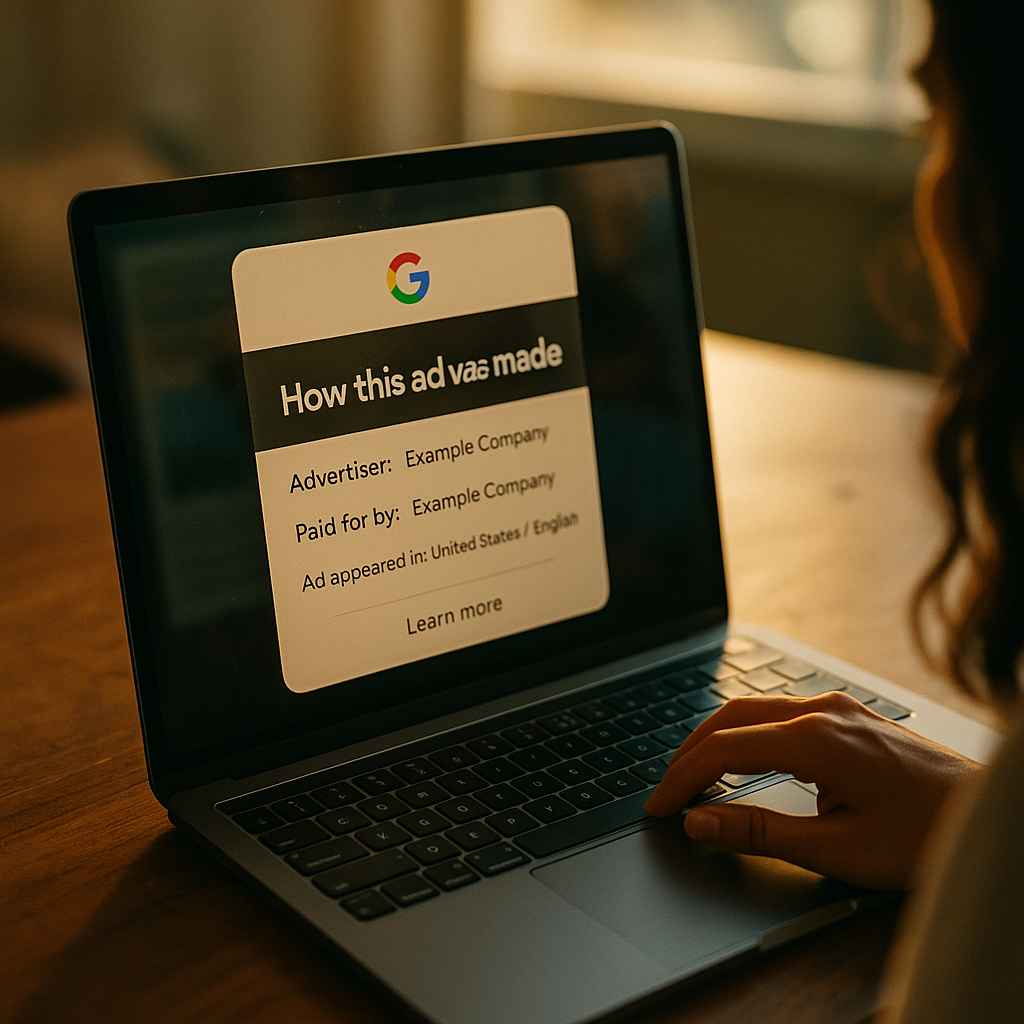
Google now tells searchers exactly which parts of an ad were touched by AI. That single interface change, a small panel labeled “How This Ad Was Made”, is quietly rewriting the compliance playbook for every brand running AI-assisted search and discovery campaigns. If your legal team hasn’t seen it yet, they will soon. And they’ll have questions.
What the Panel Actually Shows
Google rolled out the “How This Ad Was Made” disclosure panel as part of its broader push toward transparency in AI-generated advertising. Click the three-dot menu on a Search or Discovery ad, and you get a breakdown: was the headline AI-written? Was the image generated or edited with Gemini-powered tools? Was the asset produced entirely by the advertiser, or assembled by Google’s own generative features inside Performance Max and Demand Gen campaigns?
It’s not a giant red “AI-MADE” stamp. It’s more like a nutrition label, tucked away but accessible to anyone who looks. That distinction matters for how brands should think about risk. Regulators and watchdogs increasingly expect this kind of layered disclosure, similar to what the FTC has signaled around AI-generated content and endorsement transparency.
The panel doesn’t just disclose AI involvement, it creates a permanent, queryable record of how an ad was assembled. That’s an audit trail brands didn’t ask for but now have to manage.
Why This Isn’t Just a UX Tweak
Here’s the thing marketers keep missing: this panel isn’t cosmetic. It’s a compliance surface. Every asset generated through Google’s AI Max, automatically created assets in Performance Max, or Gemini-assisted creative tools now carries metadata that surfaces to the end user. That means your creative supply chain, however messy it already is, just got a public-facing window.
Think about how many hands touch a single search ad today. A freelance copywriter drafts the headline. An in-house designer edits a stock photo. Google’s automatically created assets feature swaps in a generated variant during serving. Layer on a GEO or AEO vendor optimizing copy for AI Overviews citations, and suddenly nobody on your team can say with certainty who or what made the final ad a user sees.
That ambiguity used to be invisible. Now it’s one click away from public view.
The Compliance Gaps Brands Are Ignoring
Most brand compliance frameworks were built for a pre-generative world: disclosure rules for influencer posts, FTC endorsement guidelines, maybe some platform-specific ad policy checks. Almost none of them account for AI-assisted ad assembly at the platform level, where Google itself is generating or modifying creative after you hit submit.
- No ownership mapping. Few teams can trace which vendor, tool, or internal process touched a given asset.
- No AI-disclosure review step. Legal and compliance sign-off processes rarely include a check on what the “How This Ad Was Made” panel will actually show.
- No version control for auto-generated assets. Performance Max can swap creative dynamically, meaning the disclosed “recipe” for an ad can change week to week without a human re-approving it.
- No cross-market consistency. A panel showing “AI-generated image” might trigger different obligations under EU AI Act guidance versus U.S. state-level AI disclosure laws.
This is the same governance gap we flagged in our look at AI social posting agents: the tools moved faster than the sign-off process. Search ads just caught up to where social already was.
A Practical Walkthrough: What to Check Before You Launch
Forget waiting for legal to build a 40-page policy doc. Here’s a working checklist you can run this week on any active Search, Performance Max, or Demand Gen campaign.
- Audit your automatically created assets settings. In Google Ads, check whether ACA is opted in by default for each campaign. If you haven’t reviewed this since launch, assume it’s on.
- Pull the panel view yourself. Search your own brand terms, find your live ads, and click through the disclosure panel. See what it actually says. Most marketers have never done this once.
- Map creative provenance. For every asset type (headline, description, image, video), document whether it was human-written, AI-drafted-then-edited, or fully AI-generated. This becomes your internal source of truth when the panel and your records need to match.
- Loop in legal before scaling, not after. If your industry is regulated (finance, health, pharma), a mismatch between what the panel discloses and what your compliance filings say could be a real problem, not a theoretical one.
- Set a re-check cadence. Dynamic creative changes. Build a monthly audit into your workflow, similar to how teams already run AI Overviews citation audits for organic visibility.
None of this is exotic. It’s the same discipline brands already apply to influencer disclosure compliance, just pointed at a new surface.
Where This Intersects With Discovery and Shopping Campaigns
Discovery ads and Demand Gen campaigns lean heavily on generative creative, since they’re built for feed-based, visually dense placements across YouTube, Gmail, and Discover. That means the “How This Ad Was Made” panel is going to surface far more frequently here than on a plain-text search ad.
If you’re running Shopping or product-led campaigns, the stakes climb higher. Buyers increasingly research products through AI-assisted discovery, and the line between “ad” and “AI-generated answer” is blurring fast. Our breakdown of the Google Universal Cart rebuild covers a related shift: product feed data is now being consumed by AI agents directly, not just rendered as static ads. The disclosure panel is a parallel thread in the same story: transparency requirements are creeping into every layer of AI-assisted commerce.
Brands running influencer-fed shopping content should also revisit TikTok Shop’s IP verification rules for comparison. Different platform, same underlying trend: provenance verification is becoming table stakes, not a nice-to-have.
The Agency Accountability Question
If you work with an agency or an AEO/GEO vendor, ask them directly: do they know what the disclosure panel shows for your campaigns? Many won’t. That’s not necessarily a red flag on its own, this is genuinely new territory, but their answer tells you a lot about how seriously they’re tracking platform-level AI governance.
This is exactly the kind of question that belongs in vendor vetting. Our AEO agency vendor scorecard is a useful starting template, add a line item specifically for “AI disclosure compliance across ad platforms” and make vendors answer it before signing.
If your agency can’t tell you what percentage of your live creative is flagged as AI-assisted, they can’t tell you your actual compliance exposure either.
What Google’s Move Signals for the Rest of Search
Google rarely builds a disclosure feature in isolation. Expect Microsoft Advertising and Meta’s ad libraries to follow with comparable transparency panels, especially as regulatory pressure mounts globally. The EU’s AI Act already pushes toward mandatory labeling of AI-generated content, and platforms that build voluntary disclosure now are positioning themselves ahead of forced compliance later.
For brand strategists, that means the “How This Ad Was Made” panel isn’t a one-off Google quirk to patch around. It’s the first visible layer of a compliance infrastructure that’s going to expand across every AI-assisted marketing channel you touch, from search ads to autonomous media-buying agents making real-time bidding decisions on your behalf.
Data from eMarketer continues to show AI-assisted ad creative adoption accelerating across Performance Max advertisers, which means the exposure surface here isn’t shrinking. It’s compounding. Brands that build the audit habit now save themselves a scramble later, the same lesson we’ve seen play out with GDPR, CCPA, and every other compliance wave that started as “just check a settings panel” and became a full governance function within eighteen months.
Next Step
Don’t wait for a regulator or a journalist to click the panel on your ads before you do. Pull it yourself this week, map what it shows against your actual creative provenance records, and flag any mismatch to legal before your next campaign refresh goes live.
FAQs
What is Google’s “How This Ad Was Made” panel?
It’s a disclosure feature in Google Ads that shows users which parts of a Search, Discovery, or Demand Gen ad were created or modified using AI tools, including automatically created assets and Gemini-powered creative features.
Does this panel apply to all Google ad formats?
It applies most visibly to formats that use generative or automatically created assets, particularly Performance Max, Demand Gen, and Discovery campaigns. Standard text search ads can also trigger it if AI-assisted copy tools were used.
How can brands audit their exposure to this disclosure?
Check your automatically created assets settings in Google Ads, click through the panel on your own live ads, and document the actual provenance of each creative asset (human-written, AI-drafted, or fully generated) to compare against what the panel discloses.
Is this related to FTC or EU AI Act disclosure rules?
It’s a related but separate mechanism. Google’s panel is a platform-level transparency feature, while FTC guidance and the EU AI Act impose legal disclosure obligations. Brands should treat the panel as one data point in a broader compliance strategy, not a substitute for it.
Should agencies be held accountable for this compliance layer?
Yes. Any agency or AEO/GEO vendor managing your Google Ads accounts should be able to explain what percentage of your live creative is flagged as AI-assisted and how that maps to your compliance obligations.
Top Influencer Marketing Agencies
The leading agencies shaping influencer marketing in 2026
Agencies ranked by campaign performance, client diversity, platform expertise, proven ROI, industry recognition, and client satisfaction. Assessed through verified case studies, reviews, and industry consultations.
Moburst

-
2

The Shelf
Boutique Beauty & Lifestyle Influencer AgencyA data-driven boutique agency specializing exclusively in beauty, wellness, and lifestyle influencer campaigns on Instagram and TikTok. Best for brands already focused on the beauty/personal care space that need curated, aesthetic-driven content.Clients: Pepsi, The Honest Company, Hims, Elf Cosmetics, Pure LeafVisit The Shelf → -
3

Audiencly
Niche Gaming & Esports Influencer AgencyA specialized agency focused exclusively on gaming and esports creators on YouTube, Twitch, and TikTok. Ideal if your campaign is 100% gaming-focused — from game launches to hardware and esports events.Clients: Epic Games, NordVPN, Ubisoft, Wargaming, Tencent GamesVisit Audiencly → -
4

Viral Nation
Global Influencer Marketing & Talent AgencyA dual talent management and marketing agency with proprietary brand safety tools and a global creator network spanning nano-influencers to celebrities across all major platforms.Clients: Meta, Activision Blizzard, Energizer, Aston Martin, WalmartVisit Viral Nation → -
5

The Influencer Marketing Factory
TikTok, Instagram & YouTube CampaignsA full-service agency with strong TikTok expertise, offering end-to-end campaign management from influencer discovery through performance reporting with a focus on platform-native content.Clients: Google, Snapchat, Universal Music, Bumble, YelpVisit TIMF → -
6

NeoReach
Enterprise Analytics & Influencer CampaignsAn enterprise-focused agency combining managed campaigns with a powerful self-service data platform for influencer search, audience analytics, and attribution modeling.Clients: Amazon, Airbnb, Netflix, Honda, The New York TimesVisit NeoReach → -
7

Ubiquitous
Creator-First Marketing PlatformA tech-driven platform combining self-service tools with managed campaign options, emphasizing speed and scalability for brands managing multiple influencer relationships.Clients: Lyft, Disney, Target, American Eagle, NetflixVisit Ubiquitous → -
8

Obviously
Scalable Enterprise Influencer CampaignsA tech-enabled agency built for high-volume campaigns, coordinating hundreds of creators simultaneously with end-to-end logistics, content rights management, and product seeding.Clients: Google, Ulta Beauty, Converse, AmazonVisit Obviously →