


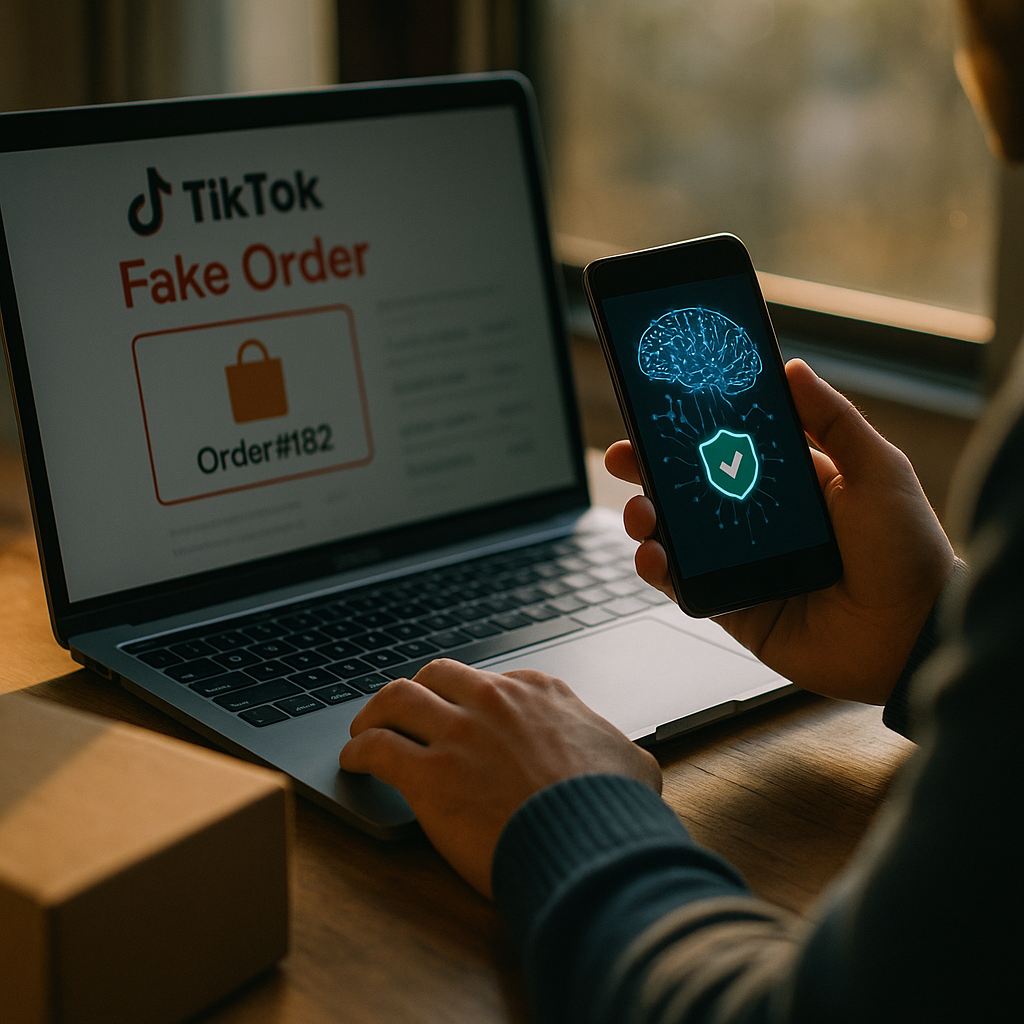
Roughly one in five TikTok Shop affiliate orders flagged for commission payout never survives a return or chargeback review, according to fraud analysts tracking the platform’s creator commerce boom. That is not a rounding error. It is a budget leak, and it is why AI fraud detection for TikTok Shop affiliate sales has moved from “nice to have” to a line item finance teams now demand before they approve creator spend.
The Fake Order Problem Nobody Wants to Admit
TikTok Shop’s affiliate model pays creators on completed sales, which sounds airtight until you realize “completed” is a moving target. Orders get placed, commissions accrue, and then the order gets returned, canceled, or reversed after the payout window closes. Brands eat the cost twice: once on the product and once on the commission that never should have cleared.
This isn’t a fringe issue affecting a handful of bad actors. Affiliate fraud across e-commerce platforms costs advertisers billions annually, and TikTok Shop’s rapid scale-up, paired with looser vetting for new affiliates, has made it an attractive target. Self-purchase schemes, where a creator or their network buys through their own link to trigger commission, are especially common in categories with thin margins and generous payout tiers.
If your fraud review happens after commissions are paid, you are not preventing fraud, you are just documenting it.
What Fake Orders Actually Look Like
Fraud on affiliate commerce rarely looks like a smoking gun. It looks like patterns that only become obvious at scale:
- Clusters of orders from the same device fingerprint or IP range, spread across “different” customer accounts
- Return rates on a specific creator’s link that run 3x to 5x the category average
- Orders placed within seconds of a livestream ending, with no corresponding view-to-cart behavior
- New affiliate accounts generating outsized order volume in their first 48 hours, then going dormant
- Bulk orders shipped to freight forwarders or resale addresses rather than typical residential patterns
Any single signal above could be innocent. A creator’s audience really might convert fast during a live drop. The problem is volume: when a brand runs hundreds of affiliate partnerships, manually cross-referencing these signals is not realistic. That is the gap AI is built to close.
How AI Fraud Detection Actually Works Here
Good fraud detection models for affiliate commerce don’t rely on one red flag. They score orders across dozens of behavioral and transactional signals simultaneously, then assign a risk probability before the commission ever gets approved for payout. Think of it as underwriting, not policing.
The strongest systems combine:
- Device and network fingerprinting to catch repeat purchasing from the same source disguised as unique customers
- Behavioral sequencing that checks whether a purchase path (view, click, cart, checkout) actually matches how real shoppers move, or whether it skipped steps in a way only bots do
- Historical creator baselines that flag sudden volume spikes inconsistent with a creator’s normal engagement or follower growth
- Return and chargeback correlation that holds commission payout until a reasonable return window has passed, weighted by category risk
This is the same underlying logic covered in our piece on how AI fraud detection exposes fabricated content at scale: the model isn’t looking for one lie, it’s looking for statistical inconsistency across many small signals.
Why Manual Review Alone Can’t Keep Up
TikTok Shop’s affiliate program can onboard thousands of new creators in a category within weeks during a trending push. A fraud team of five people reviewing spreadsheets cannot audit that volume before commissions hit net-30 payout terms. By the time a human catches the pattern, the money is often already gone, and the affiliate has moved to a new account.
That’s not a knock on fraud analysts. It’s a math problem. AI models don’t replace the analyst, they triage the volume so the analyst spends time on the 2% of cases that actually need a human judgment call, not the 98% that are clearly clean or clearly fraudulent. This mirrors the argument we made about human verification layers closing gaps that automated identity checks alone tend to miss.
Building the Business Case: ROI Beyond Fraud Prevention
Fraud prevention is the obvious win, but it’s not the only one. Brands running AI-scored affiliate programs report cleaner attribution data overall, because the same signals used to catch fraud also clean up legitimate performance measurement. If you strip fraudulent orders out of your creator leaderboard, you get a much more honest picture of who is actually driving sales versus who is gaming the payout structure.
That has downstream effects on budget allocation too. Teams using real-time budget engines to shift creator spend need clean signal to make those calls fast. Feed a budget engine fraud-inflated performance data and it will happily pour more money into a creator who is essentially laundering their own commission.
Fraud detection isn’t just a cost center. It’s the data hygiene layer that makes every other performance decision downstream more trustworthy.
There’s also a compliance angle finance and legal teams care about. The Federal Trade Commission has increasingly scrutinized influencer commerce disclosures and deceptive practices, and platforms are under pressure to demonstrate they’re policing their own marketplaces. Brands that can show a documented fraud detection process are in a stronger position if regulators or platform partners come asking questions.
What to Look For in a Fraud Detection Vendor or Build
Not every “AI fraud detection” pitch holds up under scrutiny. Before signing a vendor contract or greenlighting an internal build, push on these points:
- Latency: does the system flag risk before or after commission payout triggers? After is too late.
- False positive rate: ask for real numbers. A model that blocks 40% of legitimate creators to catch 5% more fraud is not a win.
- Explainability: can the tool tell you *why* an order was flagged, or is it a black box score? You need the reasoning for dispute resolution with creators.
- Integration depth: does it connect natively to TikTok Shop’s affiliate API and your commission management system, or does it require manual exports?
- Audit trail: can you produce a clean record of flagged transactions if a creator disputes a withheld payout?
This is the same due diligence rigor we outlined in vendor audits at AI handoffs, and it applies directly here. A fraud tool that can’t explain its own flags will create as many operational headaches as the fraud it’s supposed to stop, because you’ll be fielding angry creator emails with no evidence to back your decision.
Brands serious about defensible spend are also building this into broader frameworks. Our four layer verification framework treats fraud detection as one layer among several, alongside identity verification, content authenticity checks, and performance validation. Fraud detection in isolation catches fake orders. Stacked with other verification layers, it catches the creators running multiple schemes at once.
Operational Reality: Who Owns This Inside the Org?
Here’s where a lot of programs stall. Fraud detection tools generate flags, but someone has to own the decision to withhold payout, respond to disputes, and update creator standing. If that ownership sits nowhere specific, flags pile up and commissions get paid anyway by default, because nobody wants to be the one holding up a creator’s paycheck without absolute certainty.
The teams that get this right typically route flagged transactions through a shared queue visible to both the affiliate operations team and finance, with clear SLAs on review time. Confidence scoring helps here too. Systems that assign a numeric risk score rather than a binary flag let teams triage by severity instead of treating every alert as equally urgent, an approach similar to what we described in confidence scoring dashboards for creator matching.
Finance teams tracking this at scale also benefit from tighter CRM integration, so flagged and reversed commissions actually reconcile with reporting rather than living in a spreadsheet nobody updates. The attribution challenges we covered around CRM rewrites for creator attribution apply just as much to fraud-adjusted commission data as they do to standard performance tracking.
What This Means for the Next Quarter
TikTok Shop isn’t going to solve this for you at the platform level, at least not fast enough to protect your specific commission budget. Platform-wide fraud tools catch the obvious bot networks; they’re not tuned to your category’s return patterns or your brand’s margin sensitivity. That’s the case for a brand-side or agency-side layer, whether bought or built.
According to industry estimates tracked by eMarketer, social commerce spend continues climbing double digits year over year, and affiliate-driven models like TikTok Shop’s are capturing an outsized share of that growth. More volume means more surface area for fraud, not less. Waiting until the fake order gap shows up as a line item in your Q3 finance review is the expensive way to learn this lesson.
Start small: audit your last two payout cycles for the red flags above, then pressure-test any fraud vendor against the false positive and latency questions before you sign. The brands closing the fake order gap now will be the ones setting affiliate program terms industry-wide within the year.
Frequently Asked Questions
What counts as a fake order in TikTok Shop’s affiliate program?
A fake order typically involves a purchase generated to trigger affiliate commission rather than genuine consumer intent. This includes self-purchases by the creator or their network, bot-generated checkouts, and orders placed specifically to be returned after commission is credited.
How does AI fraud detection differ from manual fraud review?
AI fraud detection scores every transaction against behavioral, device, and historical signals in real time, flagging risk before payout. Manual review can’t scale to the transaction volume TikTok Shop affiliate programs generate, so it typically catches fraud only after commissions have already been paid out.
Can fraud detection tools reduce legitimate creator earnings?
Poorly tuned tools can, which is why false positive rate matters as much as detection accuracy. Ask vendors for documented false positive benchmarks and require explainable flags so disputes with legitimate creators can be resolved quickly and fairly.
Does TikTok Shop offer its own fraud protection?
TikTok Shop has platform-level fraud monitoring, detailed on its TikTok for Business resources, but these tools are tuned for platform-wide abuse patterns, not brand-specific category risk or margin sensitivity. Most brands still need a dedicated layer for their own affiliate program.
What’s a realistic timeframe to implement AI fraud detection for an affiliate program?
Vendor-based integrations can typically go live within four to eight weeks, depending on API access and commission system integration. Internal builds take considerably longer and require ongoing model tuning as fraud patterns shift.
Top Influencer Marketing Agencies
The leading agencies shaping influencer marketing in 2026
Agencies ranked by campaign performance, client diversity, platform expertise, proven ROI, industry recognition, and client satisfaction. Assessed through verified case studies, reviews, and industry consultations.
Moburst

-
2

The Shelf
Boutique Beauty & Lifestyle Influencer AgencyA data-driven boutique agency specializing exclusively in beauty, wellness, and lifestyle influencer campaigns on Instagram and TikTok. Best for brands already focused on the beauty/personal care space that need curated, aesthetic-driven content.Clients: Pepsi, The Honest Company, Hims, Elf Cosmetics, Pure LeafVisit The Shelf → -
3

Audiencly
Niche Gaming & Esports Influencer AgencyA specialized agency focused exclusively on gaming and esports creators on YouTube, Twitch, and TikTok. Ideal if your campaign is 100% gaming-focused — from game launches to hardware and esports events.Clients: Epic Games, NordVPN, Ubisoft, Wargaming, Tencent GamesVisit Audiencly → -
4

Viral Nation
Global Influencer Marketing & Talent AgencyA dual talent management and marketing agency with proprietary brand safety tools and a global creator network spanning nano-influencers to celebrities across all major platforms.Clients: Meta, Activision Blizzard, Energizer, Aston Martin, WalmartVisit Viral Nation → -
5

The Influencer Marketing Factory
TikTok, Instagram & YouTube CampaignsA full-service agency with strong TikTok expertise, offering end-to-end campaign management from influencer discovery through performance reporting with a focus on platform-native content.Clients: Google, Snapchat, Universal Music, Bumble, YelpVisit TIMF → -
6

NeoReach
Enterprise Analytics & Influencer CampaignsAn enterprise-focused agency combining managed campaigns with a powerful self-service data platform for influencer search, audience analytics, and attribution modeling.Clients: Amazon, Airbnb, Netflix, Honda, The New York TimesVisit NeoReach → -
7

Ubiquitous
Creator-First Marketing PlatformA tech-driven platform combining self-service tools with managed campaign options, emphasizing speed and scalability for brands managing multiple influencer relationships.Clients: Lyft, Disney, Target, American Eagle, NetflixVisit Ubiquitous → -
8

Obviously
Scalable Enterprise Influencer CampaignsA tech-enabled agency built for high-volume campaigns, coordinating hundreds of creators simultaneously with end-to-end logistics, content rights management, and product seeding.Clients: Google, Ulta Beauty, Converse, AmazonVisit Obviously →