


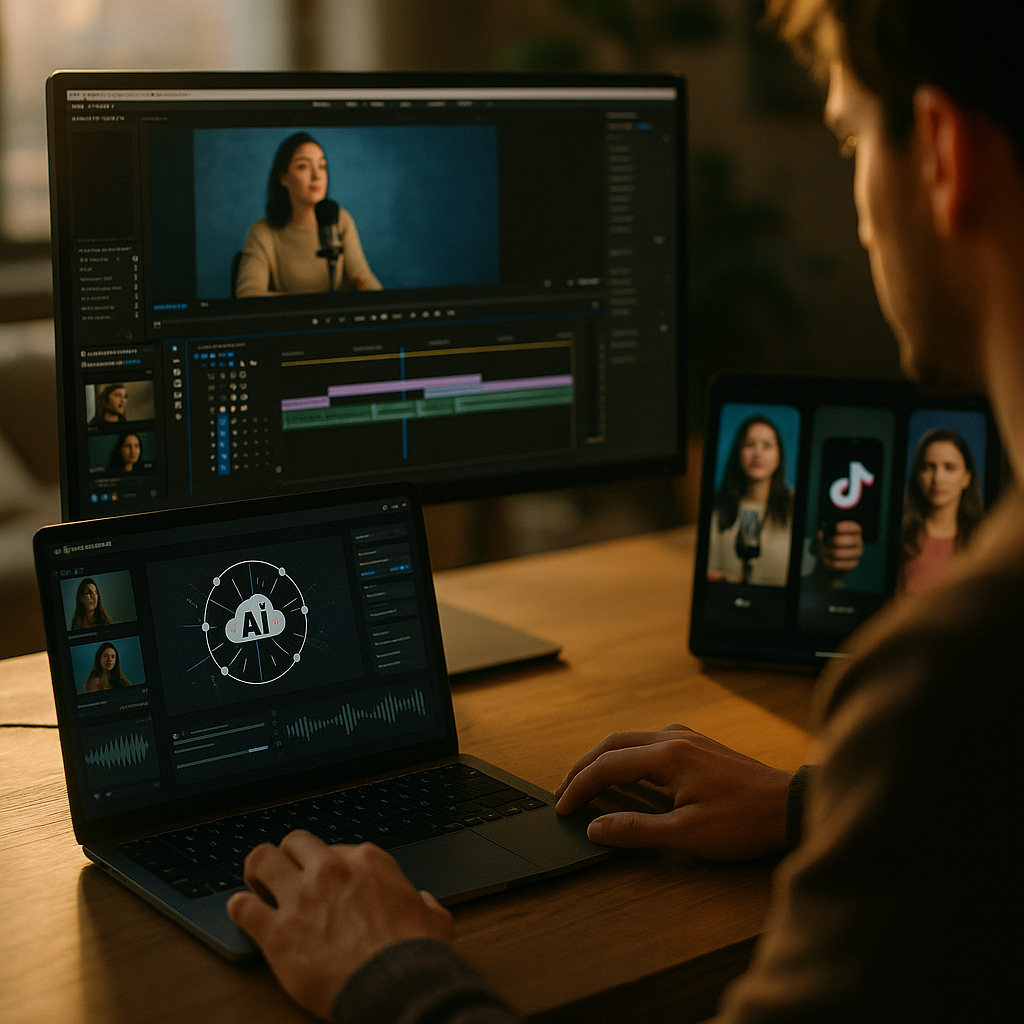
One Asset. Three Formats. Zero Wasted Budget.
Brands running video across TikTok, Meta, and YouTube are producing the same campaign three times over. That redundancy costs real money. The AI-enabled single-workflow multi-platform video pipeline promises to collapse that production overhead into one automated pass, and the tools delivering on that promise are worth serious evaluation.
Why the Old Production Model Is Breaking Down
The traditional approach goes like this: shoot creative, send to post-production, wait two weeks, receive a 16:9 cut, then brief your editor again for 9:16 TikTok and 1:1 Meta placements. By the time all three formats are approved and trafficked, the cultural moment has passed and your CPMs have climbed.
According to Statista, short-form video ad spend continues to outpace every other format. But the ops infrastructure behind most mid-market brand teams has not kept up. Creative teams are still running manual reformatting jobs, burning agency hours on work that is fundamentally mechanical.
The workflow problem compounds at scale. A DTC brand running 10 SKUs across three paid channels needs 30 distinct video assets per campaign. At even $800 per edited cut, that is $24,000 in production before a single dollar hits the ad auction.
The reformatting tax is not a creative problem. It is an operational one. Brands that solve it at the workflow layer, not the creative layer, will outspend competitors on distribution, not production.
What “Single-Workflow” Actually Means in Practice
The term gets used loosely, so let’s be precise. A genuine single-workflow multi-platform pipeline does three things without human intervention between steps: it ingests a raw asset or product URL, it applies platform-specific formatting logic (aspect ratio, safe zones, caption placement, hook timing), and it outputs publish-ready files for each destination. If any of those steps requires a human handoff, it is not a single workflow. It is just a faster version of the old one.
Tools like NemoVideo have built specifically around this use case, generating TikTok, Meta, and YouTube cuts from a product link with AI-driven scene selection and copy adaptation. Platforms like Waymark and Pilothouse approach it differently, prioritizing template-based reformatting over generative output. Neither approach is universally better. The right fit depends on how much creative variance your brand requires per platform.
For a deeper comparison of production cost and CPA tradeoffs across these tools, the AI video platforms vs agency retainer analysis is a useful benchmark before you enter vendor negotiations.
The Evaluation Framework Brands Are Actually Using
When procurement and marketing ops teams sit down to assess these tools, the conversation usually drifts toward feature lists. That is the wrong starting point. Start with four operational questions:
- Ingestion flexibility: Can the tool accept a product URL, a raw video file, a static image, and a UGC clip equally? Tools with narrow ingestion requirements create bottlenecks immediately.
- Platform logic depth: Does the tool understand that TikTok hooks must land in the first 1.5 seconds, that Meta feed placements penalize text-heavy lower thirds, and that YouTube pre-roll needs a different pacing structure? Surface-level reformatting is not the same as platform-native adaptation.
- Brand governance controls: Can you lock fonts, colors, logo placement, and tone-of-voice parameters at the brand account level so every auto-generated cut stays compliant without manual review? This is the feature most buyers underweight and most regret.
- Output approval workflow: Who approves before publish, and how many clicks does that take? A tool that saves three days in production but adds two days in approval routing has not actually improved your time-to-air.
A fifth question worth asking: does the vendor’s pricing model penalize volume? Some platforms charge per render, which means your cost structure scales directly with your campaign cadence. Others charge flat SaaS fees. For high-volume e-commerce brands running always-on creative testing, the per-render model can get expensive fast. The TCO and CPA breakdown for AI video tools covers this math in detail.
Platform-Specific Formatting Is the Differentiator
Aspect ratio is the easy part. Every tool in this category handles 9:16, 1:1, and 16:9 resizing. The real differentiation is in what happens to the content inside that frame.
TikTok’s ad guidelines are explicit: key messaging needs to appear within the first three seconds, and bottom-of-frame placements compete with the native UI. A tool that simply crops a landscape video to vertical and calls it TikTok-ready is not solving the problem. It is creating a new one.
Meta’s creative best practices similarly recommend that the value proposition appear on-screen within the first four seconds for Reels placements, and that call-to-action elements avoid the bottom 20% of the frame where navigation overlays. These are not suggestions. Ignoring them degrades performance.
YouTube pre-roll operates on a completely different psychological contract with the viewer. The skip button appears at five seconds, so the creative logic needs to front-load brand recognition, not product features. A pipeline that applies the same hook structure across all three platforms is optimizing for none of them.
This is why platform logic depth, not render speed, should be the primary evaluation criterion. Fast output of poorly adapted creative is a cost center, not a capability.
Where AI Agents Are Changing the Stack
The more sophisticated tools in this space have moved beyond templated reformatting into agentic workflows. The distinction matters operationally. A template-based tool requires a human to define the output rules. An agentic tool ingests performance data from previous campaigns and adjusts formatting and hook structure autonomously based on what has worked for your brand on each platform.
This creates a compounding advantage. Each campaign cycle, the pipeline gets more calibrated to your audience’s behavior on each channel. Brands that adopt these systems early accumulate performance data that competitors cannot easily replicate.
The tradeoff is data dependency and vendor lock-in risk. If your pipeline’s optimization logic lives entirely inside one vendor’s model, switching costs escalate quickly. Before committing, review the consolidation risk at contract renewal and ensure you retain portability of your performance data in any contract you sign.
Agentic video pipelines learn from your campaign history. That accumulated intelligence is a competitive asset. Read your contract to confirm it belongs to you, not the vendor.
Connecting the Pipeline to Measurement
A video pipeline that cannot connect its outputs to attribution data is operationally incomplete. You need to know not just that a TikTok cut performed better than its Meta counterpart, but which creative element, which platform-specific adaptation, or which product angle drove the delta.
This is where pipeline selection intersects with your broader measurement stack. Tools that integrate directly with Google’s analytics infrastructure or pass structured metadata through to your attribution layer give you the closed-loop visibility to actually improve creative decisions over time. Tools that output clean video files and nothing else leave you doing manual attribution work that defeats much of the efficiency gain.
For brands building out this closed-loop architecture, the unified attribution model for paid and organic is a useful starting framework. And if you are also running creator content through the same pipeline, the social commerce attribution guide covers the integration points worth mapping before you finalize your stack.
One more check before vendor sign-off: confirm that the platform’s output metadata is structured in a way that your CRM and paid media teams can actually use. Beautifully formatted video with no trackable parameters attached is just expensive content.
Run a paid pilot with defined CPA benchmarks before committing to an annual contract. Require the vendor to demonstrate platform-specific logic on your actual creative assets, not their demo library, before you sign anything.
Frequently Asked Questions
What is a single-workflow multi-platform video pipeline?
It is an automated system that takes a single input, such as a product URL or raw video file, and outputs platform-ready video cuts for TikTok (9:16), Meta (1:1), and YouTube (16:9) without requiring manual handoffs between steps. The key is that formatting, platform logic, and asset adaptation all happen inside one continuous workflow.
How do these tools handle platform-specific creative requirements beyond aspect ratio?
The best tools apply platform-specific logic to hook timing, caption placement, safe zones, and call-to-action positioning based on each platform’s native behavior and ad policies. Weaker tools simply reframe the video without adapting the content structure, which typically underperforms natively produced creative.
What should brands look for in brand governance controls within these platforms?
Look for the ability to lock brand parameters at the account level, including fonts, color palettes, logo placement rules, and approved copy libraries. This ensures every auto-generated output is on-brand without requiring a manual review cycle for each asset, which is the primary operational bottleneck in most brand approval workflows.
How does vendor lock-in become a risk with agentic video platforms?
Agentic tools build optimization intelligence from your campaign performance data over time. If that data is stored exclusively within the vendor’s system and is not exportable, your ability to switch tools diminishes with each campaign cycle. Always negotiate data portability and export rights before signing an annual contract.
What is the difference between template-based reformatting and AI-driven platform adaptation?
Template-based tools apply predefined layout rules to reformat existing creative. AI-driven tools analyze the content itself, select the strongest hook moments, adapt copy for each platform’s audience behavior, and can adjust outputs based on historical performance data. The practical difference shows up in platform-specific conversion rates, particularly on TikTok where hook timing is critical.
How should brands connect their video pipeline to attribution?
Choose tools that pass structured metadata through to your analytics and attribution systems, whether that is GA4, a CRM, or a paid media dashboard. Without this integration, you can see that one platform outperformed another, but you cannot identify which creative element or platform adaptation drove the difference, which limits your ability to improve future campaigns.
Top Influencer Marketing Agencies
The leading agencies shaping influencer marketing in 2026
Agencies ranked by campaign performance, client diversity, platform expertise, proven ROI, industry recognition, and client satisfaction. Assessed through verified case studies, reviews, and industry consultations.
Moburst

-
2

The Shelf
Boutique Beauty & Lifestyle Influencer AgencyA data-driven boutique agency specializing exclusively in beauty, wellness, and lifestyle influencer campaigns on Instagram and TikTok. Best for brands already focused on the beauty/personal care space that need curated, aesthetic-driven content.Clients: Pepsi, The Honest Company, Hims, Elf Cosmetics, Pure LeafVisit The Shelf → -
3

Audiencly
Niche Gaming & Esports Influencer AgencyA specialized agency focused exclusively on gaming and esports creators on YouTube, Twitch, and TikTok. Ideal if your campaign is 100% gaming-focused — from game launches to hardware and esports events.Clients: Epic Games, NordVPN, Ubisoft, Wargaming, Tencent GamesVisit Audiencly → -
4

Viral Nation
Global Influencer Marketing & Talent AgencyA dual talent management and marketing agency with proprietary brand safety tools and a global creator network spanning nano-influencers to celebrities across all major platforms.Clients: Meta, Activision Blizzard, Energizer, Aston Martin, WalmartVisit Viral Nation → -
5

The Influencer Marketing Factory
TikTok, Instagram & YouTube CampaignsA full-service agency with strong TikTok expertise, offering end-to-end campaign management from influencer discovery through performance reporting with a focus on platform-native content.Clients: Google, Snapchat, Universal Music, Bumble, YelpVisit TIMF → -
6

NeoReach
Enterprise Analytics & Influencer CampaignsAn enterprise-focused agency combining managed campaigns with a powerful self-service data platform for influencer search, audience analytics, and attribution modeling.Clients: Amazon, Airbnb, Netflix, Honda, The New York TimesVisit NeoReach → -
7

Ubiquitous
Creator-First Marketing PlatformA tech-driven platform combining self-service tools with managed campaign options, emphasizing speed and scalability for brands managing multiple influencer relationships.Clients: Lyft, Disney, Target, American Eagle, NetflixVisit Ubiquitous → -
8

Obviously
Scalable Enterprise Influencer CampaignsA tech-enabled agency built for high-volume campaigns, coordinating hundreds of creators simultaneously with end-to-end logistics, content rights management, and product seeding.Clients: Google, Ulta Beauty, Converse, AmazonVisit Obviously →