


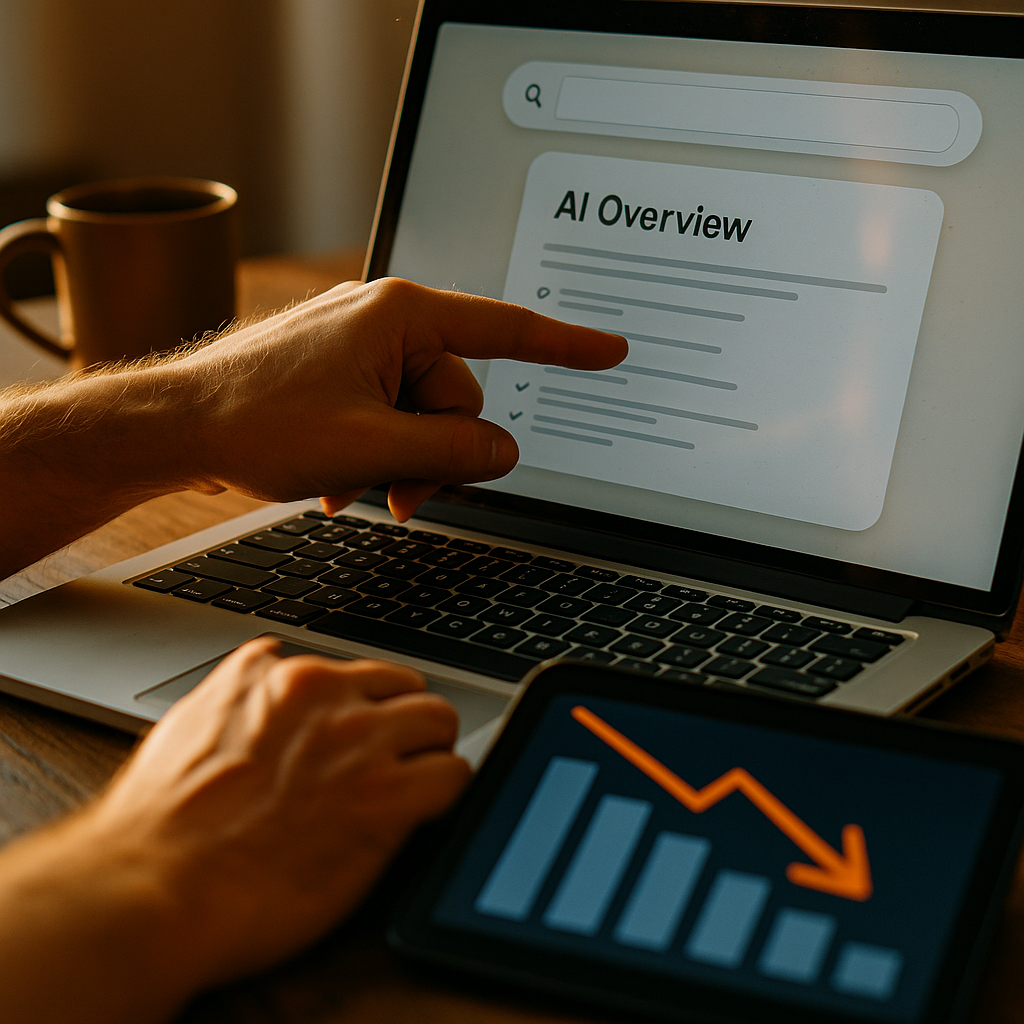
Click-through rates on informational queries have dropped 18% since Google widened AI Overviews. Read that again. Zero-click discovery isn’t a future risk marketers should plan for someday — it’s already eating the top of your funnel, and most brand teams are still measuring success with metrics built for a search era that’s quietly ending.
If your funnel still assumes a searcher lands on a blog post, scrolls, clicks a CTA, and converts on your site, you’re optimizing for a journey fewer and fewer people take. The question isn’t whether this shift is real. It’s what you build to replace the traffic you’re losing.
The 18% Isn’t the Whole Story
That CTR figure gets cited constantly, but it undersells the problem. It’s an average across query types, and the decline is far steeper for informational and comparison searches — exactly the queries brands rely on to introduce products to new audiences. Navigational searches (someone typing your brand name) still click through fine. Nobody needs an AI summary to find your homepage.
The damage concentrates in the messy middle: “best skincare for sensitive skin,” “how does a HELOC work,” “top project management tools for small teams.” These used to be goldmines for content marketing and organic acquisition. Now Google (and increasingly Bing’s Copilot integration, and Perplexity, and ChatGPT search) answers the question directly, synthesizing from multiple sources including yours, and the user never clicks through to see who said it.
Brands are still getting cited as sources inside AI Overviews. They’re just not getting the traffic that citation used to guarantee. Visibility and traffic have decoupled — and most attribution models haven’t caught up.
This matters more for B2B and considered-purchase brands than for impulse categories, because the research phase is longer and more search-dependent. If your funnel has five or six touchpoints before a lead form fill, and two or three of those used to happen via organic search, you’ve got a real gap to fill — not a vanity metric to shrug off.
Zero-Click Discovery Isn’t New. The Scale Is.
Featured snippets, knowledge panels, and “People Also Ask” boxes have been eating clicks for a decade. What’s different now is the sophistication and coverage. AI Overviews don’t just pull a definition — they synthesize comparisons, pros and cons, pricing ranges, and recommendations across dozens of sources in a single block. Generative search now drives half of product research according to recent data, which means the discovery phase of your funnel is increasingly happening entirely off your properties.
Practitioners who’ve been tracking this closely already know the pattern from a related piece we ran: AI Overviews are eating paid search budgets, not just organic. Paid search CPCs are climbing as advertisers compete for shrinking click inventory on queries that AI now answers for free. If your media buyer hasn’t flagged this yet, ask them to pull query-level impression share data. The story will be uncomfortable.
What Actually Breaks in a Traditional Funnel
Most funnel models assume a linear-ish path: awareness (search, social) → consideration (site visit, content) → conversion (form, purchase) → retention. Zero-click discovery breaks the first two stages in a specific way.
- Attribution blind spots. Someone reads your product mentioned favorably in an AI Overview, then later searches your brand name directly and converts. Your analytics show a “direct” or “branded search” conversion with zero visibility into what actually triggered the decision.
- Content ROI gets murkier. You wrote the definitive guide that AI Overviews cite. Great for authority, terrible for the CTR-based case you used to justify the content budget internally.
- Retargeting pools shrink. Pixel-based remarketing depends on site visits. Fewer visits means smaller retargeting audiences, which means your paid social and display retargeting gets less efficient over time.
- Brand consideration happens invisibly. The comparison shopping that used to generate five site visits across your category now happens in one AI-generated summary the user never leaves.
None of this means demand disappeared. It means the funnel’s shape changed, and measurement hasn’t kept pace. Marketers who keep reporting organic sessions as the health metric for top-of-funnel are, frankly, measuring the wrong thing now.
So What Do You Actually Rebuild?
Start with the assumption that your job is no longer “get the click.” It’s “get cited, get remembered, get searched by name later.” That reframes almost every tactical decision.
Shift budget toward brand-search generation, not just brand-search capture
If branded search is the one query type still converting reliably, the priority becomes generating more branded search volume upstream. That’s an awareness and trust problem, not an SEO problem. This is exactly where creator partnerships earn their keep: a creator mentioning your product by name, on video, drives a viewer to search your brand directly, sidestepping the AI Overview layer entirely because branded queries behave differently than generic ones.
This is also why most brands still underspend on influencer marketing relative to what the funnel now requires. If organic search discovery is shrinking, creator-driven discovery has to expand to fill the gap, and budget allocation should follow.
Structure content to get cited, not just ranked
AI Overviews pull from content that’s structured, specific, and confidently sourced. Vague, keyword-stuffed blog posts don’t get cited — they get ignored. Content with clear data points, named studies, direct answers in the first two sentences, and original research performs better in generative summaries. If your content team is still writing for a 2018 SEO checklist, that’s the first thing to fix.
Getting cited in an AI Overview without getting a click is still a win for brand memory and trust — but only if you can prove it. Start tracking citation appearances manually or through emerging tools, because your CMS analytics won’t show you this on their own.
Invest in the platforms where discovery still converts
TikTok Shop, Instagram Shopping, and YouTube Shopping aren’t just sales channels — they’re discovery-to-conversion funnels that don’t route through a search engine at all. TikTok Shop live-selling converts at roughly 30% versus 2-3% for static ecommerce, which tells you something important: when discovery and purchase happen in the same closed environment, conversion rates climb because there’s no drop-off between “learning about it” and “buying it.”
That’s the structural advantage social commerce has over search-driven funnels right now. Search sends someone away to research; social commerce keeps them in the moment of interest. Brands rebuilding funnels for a zero-click world should be shifting spend toward these closed-loop environments, not just defending organic search rankings that matter less each quarter.
Treat creators as your new distributed SEO
Here’s an underused idea: creator content, especially long-form YouTube reviews and TikTok explainer videos, increasingly gets pulled into AI Overview citations and appears directly in generative search results. A creator’s honest comparison video showing up in an AI-generated answer is a distribution channel most brands haven’t mapped yet. AI adoption, not spend, signals creator program maturity — and that maturity increasingly includes briefing creators to produce content that AI models want to cite: structured comparisons, clear pros/cons, specific use cases.
Repeat creator partnerships matter more here too. A one-off post doesn’t build the kind of consistent brand association that shows up across multiple AI-summarized queries over time. Turning one-off creator deals into repeat partnerships compounds your presence across the exact long-tail queries AI Overviews are now answering.
Measurement Has to Change Before Strategy Can
You can’t rebuild a funnel while still reporting on it with the old dashboard. A few concrete moves:
- Track branded search volume as a leading indicator, not an afterthought. If awareness campaigns (creator, video, social) are working, branded search should climb even as generic organic traffic flattens.
- Separate “citation visibility” from “click traffic” in reporting. They’re different metrics measuring different value now, and conflating them will get your content budget cut for the wrong reasons.
- Model multi-touch attribution that includes off-platform influence. A view on a creator’s video, an AI Overview citation, and a branded search a week later are one journey, not three unrelated events.
- Push for platform-level conversion data from TikTok Shop, Instagram, and YouTube directly, since these environments increasingly hold the conversion event your web analytics will never see.
None of this is exotic. It’s the same rigor brands already apply to solving creator ROI measurement, just extended to cover the search layer too. The tools and the discipline already exist inside most marketing orgs. What’s missing is the willingness to stop defending metrics that no longer reflect how people actually discover brands.
Worth checking your own analytics for a reality check: pull organic landing page sessions for your top ten informational queries over the last twelve months against eMarketer’s search advertising data and see if the CTR compression shows up in your numbers the way it does in the aggregate stats. It usually does.
The Compliance Angle Nobody’s Talking About
One more wrinkle for brand and legal teams: when creator content gets pulled into AI-generated summaries, disclosure and sponsorship transparency get murkier. If a sponsored review shows up paraphrased inside an AI Overview with no #ad disclosure attached, does that create regulatory exposure? The FTC’s endorsement guidance was written for a world where the sponsored content itself was the thing a consumer saw. It wasn’t written for a world where an AI model summarizes that content and strips the disclosure in the process.
This isn’t hypothetical for long. Brands running creator programs at scale should be raising this with legal now, not after a summary strips a disclosure and a regulator notices. It’s also another reason platform diversification matters: platform risk and creator strategy diversification now needs to account for how generative search engines repackage creator content, not just how individual platforms change their algorithms.
Where This Leaves Budget Planning
If you’re building next year’s plan right now, the practical shift looks like this: hold or slightly trim pure organic content spend focused on generic informational queries, and reallocate toward creator partnerships, branded search generation, and social commerce environments where conversion still happens in one motion. Track citation visibility as a new KPI even if it’s imperfect. And stop treating a CTR drop as a content team failure — it’s a market shift, and the response has to be structural, not cosmetic.
The brands that treat this as a search engine optimization problem will keep losing ground. The ones treating it as a full-funnel rebuild, with creators and social commerce absorbing the discovery role search used to play, are already pulling ahead.
Frequently Asked Questions
What is zero-click discovery in search marketing?
Zero-click discovery describes searches where the user gets their answer directly from the search results page, often via an AI Overview, featured snippet, or knowledge panel, without clicking through to any website. The searcher’s information need is met, but no site receives the traffic or attribution.
Why did CTR drop 18% with AI Overviews?
AI Overviews synthesize answers from multiple sources directly on the search results page, so users often get sufficient information without needing to visit a website. This effect is strongest on informational and comparison queries, while branded and navigational searches are largely unaffected.
How should brands measure funnel performance if organic clicks are declining?
Shift toward tracking branded search volume as a leading indicator of awareness, monitor AI Overview citation appearances separately from click-through metrics, and build multi-touch attribution models that account for creator content and social platform influence outside your owned web analytics.
Do creators still matter if search traffic is declining?
Creators matter more, not less. Creator content drives branded search behavior that bypasses generic AI Overviews, and creator videos are increasingly cited directly within AI-generated search summaries, making creator partnerships a distribution channel for the generative search era.
Is paid search still worth the investment given this shift?
Paid search remains valuable for high-intent, transactional queries where AI Overviews have less impact, but CPCs are rising as advertisers compete for a shrinking pool of clickable inventory on informational queries. Budget should shift toward channels where discovery and conversion happen in one motion, like social commerce.
What does this mean for content marketing strategy?
Content needs to be structured for citation, not just ranking: clear answers, specific data, and original research perform better in AI-generated summaries. Success metrics should include citation visibility alongside traditional traffic and conversion metrics.
Next step: Pull your organic CTR data for your top twenty informational queries this quarter, compare it against last year, and if the drop mirrors the 18% average, redirect that budget line toward creator partnerships and branded search generation before your next planning cycle locks in the old assumptions.
Frequently Asked Questions
What is zero-click discovery in search marketing?
Zero-click discovery describes searches where the user gets their answer directly from the search results page, often via an AI Overview, featured snippet, or knowledge panel, without clicking through to any website. The searcher’s information need is met, but no site receives the traffic or attribution.
Why did CTR drop 18% with AI Overviews?
AI Overviews synthesize answers from multiple sources directly on the search results page, so users often get sufficient information without needing to visit a website. This effect is strongest on informational and comparison queries, while branded and navigational searches are largely unaffected.
How should brands measure funnel performance if organic clicks are declining?
Shift toward tracking branded search volume as a leading indicator of awareness, monitor AI Overview citation appearances separately from click-through metrics, and build multi-touch attribution models that account for creator content and social platform influence outside your owned web analytics.
Do creators still matter if search traffic is declining?
Creators matter more, not less. Creator content drives branded search behavior that bypasses generic AI Overviews, and creator videos are increasingly cited directly within AI-generated search summaries, making creator partnerships a distribution channel for the generative search era.
Is paid search still worth the investment given this shift?
Paid search remains valuable for high-intent, transactional queries where AI Overviews have less impact, but CPCs are rising as advertisers compete for a shrinking pool of clickable inventory on informational queries. Budget should shift toward channels where discovery and conversion happen in one motion, like social commerce.
What does this mean for content marketing strategy?
Content needs to be structured for citation, not just ranking: clear answers, specific data, and original research perform better in AI-generated summaries. Success metrics should include citation visibility alongside traditional traffic and conversion metrics.
Top Influencer Marketing Agencies
The leading agencies shaping influencer marketing in 2026
Agencies ranked by campaign performance, client diversity, platform expertise, proven ROI, industry recognition, and client satisfaction. Assessed through verified case studies, reviews, and industry consultations.
Moburst

-
2

The Shelf
Boutique Beauty & Lifestyle Influencer AgencyA data-driven boutique agency specializing exclusively in beauty, wellness, and lifestyle influencer campaigns on Instagram and TikTok. Best for brands already focused on the beauty/personal care space that need curated, aesthetic-driven content.Clients: Pepsi, The Honest Company, Hims, Elf Cosmetics, Pure LeafVisit The Shelf → -
3

Audiencly
Niche Gaming & Esports Influencer AgencyA specialized agency focused exclusively on gaming and esports creators on YouTube, Twitch, and TikTok. Ideal if your campaign is 100% gaming-focused — from game launches to hardware and esports events.Clients: Epic Games, NordVPN, Ubisoft, Wargaming, Tencent GamesVisit Audiencly → -
4

Viral Nation
Global Influencer Marketing & Talent AgencyA dual talent management and marketing agency with proprietary brand safety tools and a global creator network spanning nano-influencers to celebrities across all major platforms.Clients: Meta, Activision Blizzard, Energizer, Aston Martin, WalmartVisit Viral Nation → -
5

The Influencer Marketing Factory
TikTok, Instagram & YouTube CampaignsA full-service agency with strong TikTok expertise, offering end-to-end campaign management from influencer discovery through performance reporting with a focus on platform-native content.Clients: Google, Snapchat, Universal Music, Bumble, YelpVisit TIMF → -
6

NeoReach
Enterprise Analytics & Influencer CampaignsAn enterprise-focused agency combining managed campaigns with a powerful self-service data platform for influencer search, audience analytics, and attribution modeling.Clients: Amazon, Airbnb, Netflix, Honda, The New York TimesVisit NeoReach → -
7

Ubiquitous
Creator-First Marketing PlatformA tech-driven platform combining self-service tools with managed campaign options, emphasizing speed and scalability for brands managing multiple influencer relationships.Clients: Lyft, Disney, Target, American Eagle, NetflixVisit Ubiquitous → -
8

Obviously
Scalable Enterprise Influencer CampaignsA tech-enabled agency built for high-volume campaigns, coordinating hundreds of creators simultaneously with end-to-end logistics, content rights management, and product seeding.Clients: Google, Ulta Beauty, Converse, AmazonVisit Obviously →