


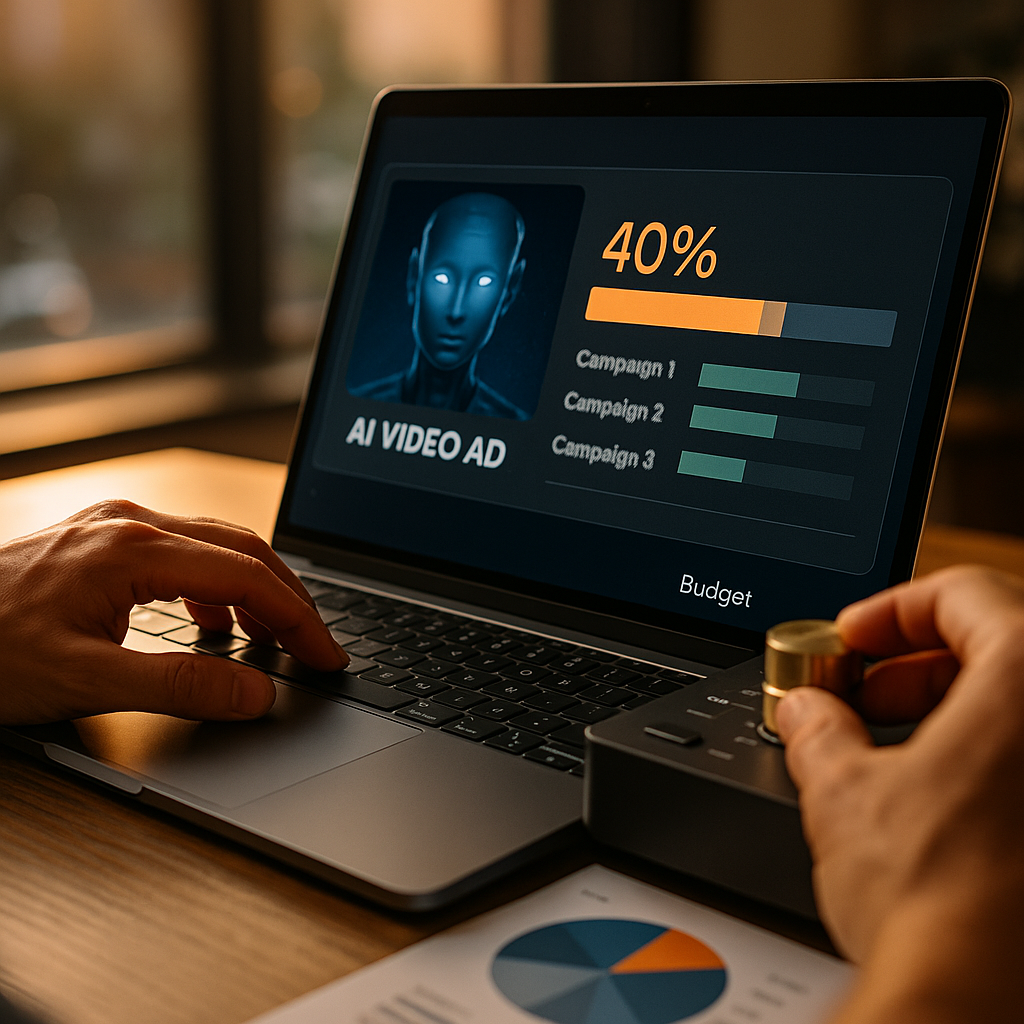
AI video ad inventory just crossed 40 percent of available programmatic video supply, and most media buyers are still budgeting like it’s 5 percent. That gap is where the money is. Either you reweight production spend now, or you pay retail prices for generative capacity next quarter.
This isn’t a hype cycle anymore. It’s a supply-side shift with real financial consequences for anyone running a production budget line.
What “40 Percent” Actually Means
Ad exchanges and DSPs have quietly reclassified a huge chunk of their video inventory as “generative-eligible” or “AI-produced,” meaning creative built fully or partially through tools like Google’s Veo, OpenAI’s Sora, Runway, or Meta’s Movie Gen family. Some of that inventory is brand-supplied. A growing share is publisher- or platform-generated, dynamically assembled per impression.
Forty percent doesn’t mean 40 percent of impressions are watching AI content today. It means 40 percent of the inventory pool is now technically capable of serving generative creative at scale, often at a lower CPM because production marginal cost approaches zero. That’s the number media buyers should care about, not vanity adoption stats.
When nearly half of available video inventory can absorb generative creative at near-zero marginal production cost, the constraint shifts from “can we make enough content” to “can we make the right content fast enough to compete for that inventory.”
Compare this to where digital ad spend growth has been heading generally. As covered in our piece on how AI efficiency eats budgets, the macro trend is fewer dollars doing more work. Generative video inventory is the sharpest expression of that trend yet.
Why Media Buyers Are Slow to Reweight
Three reasons, mostly organizational.
- Production budgets are sticky. Agencies and in-house teams built annual plans around live-action shoots, editing retainers, and talent fees months before this inventory shift hit. Reallocating mid-cycle means uncomfortable conversations with finance.
- Quality anxiety persists. Marketers remember early generative video, the uncanny valley faces, the physics errors. Current-generation tools have largely fixed this, but perception lags reality by a year or more.
- Attribution is murky. Nobody has a clean model yet for whether AI-generated creative performs better, worse, or the same as traditionally produced assets against identical audiences. Early data suggests parity or better on click-through for short-form, but sample sizes are still thin outside a few large advertisers.
None of these are good reasons to sit still. They’re reasons to move deliberately, not reasons to wait another two quarters.
The Reweighting Framework: Four Buckets
Here’s the practical framework we’re recommending to media buying teams working through production budget overruns and looking for a structured way to shift spend without blowing up existing commitments.
Bucket one: Hero content stays human
Brand campaigns, flagship launches, anything requiring emotional nuance or celebrity talent, keep this in traditional production. Generative tools still struggle with subtle performance direction and true brand-safe likeness control. This is maybe 15-20 percent of total video spend for most mid-size brands.
Bucket two: Variant and localization work goes generative first
This is the easiest win and the one most teams under-exploit. If you’re producing 12 regional cuts of the same ad, or 30 audience-segment variants for a paid social test, generative tools should be the default, not the backup. The cost delta is enormous, and quality parity is high enough that most audiences won’t notice or care.
Bucket three: Always-on and reactive content
Trend-jacking content, seasonal refreshes, rapid A/B creative tests, anything with a shelf life under 30 days. Generative production turns a two-week lead time into a two-day one. That speed alone often outweighs marginal quality differences, especially in fast-moving feeds where attention windows keep shrinking.
Bucket four: Experimental and long-tail formats
Vertical-specific, platform-native formats you wouldn’t have justified budget for otherwise, interactive video ads, hyper-personalized DCO variants, shoppable video overlays. Treat this bucket as R&D. Cap it at 5-10 percent of total spend but don’t skip it. This is where you’ll learn what generative video can do that traditional production structurally can’t.
A useful rule of thumb: if an asset’s value comes from precision and craft, keep it human. If its value comes from volume and speed, shift it to generative.
Building the Reallocation Math
Start with your current production spend broken into the four buckets above, even roughly. Most teams find bucket two (variants and localization) eating 35-45 percent of their current budget while delivering the lowest marginal ROI per dollar. That’s your primary reallocation target.
A realistic model for a mid-market brand spending $2M annually on video production might look like this: shift 60 percent of the variant/localization bucket to generative workflows, freeing roughly $250K-$400K. Redirect half of that freed budget into the experimental bucket, and the other half into buying more of that 40 percent AI-eligible inventory at the lower CPMs it commands.
This isn’t just a production cost play. It’s a media buying arbitrage. Cheaper-to-produce creative paired with cheaper-to-serve inventory compounds the savings on both sides of the ledger.
Compare notes with how brands are approaching other structural reallocations, like the Netflix ad inventory reallocation framework or the shift toward CFO-friendly deal structures. The pattern repeats: rigid annual budgets are losing to teams that treat spend as a quarterly, data-responsive allocation exercise.
What About Vendor Selection?
Choosing between generative video vendors is starting to resemble choosing between LLM providers, and the criteria overlap more than you’d think: licensing terms on training data, output rights, brand safety controls, and API reliability at scale. Our vendor selection framework piece on OpenAI versus Anthropic maps closely onto how you should be evaluating Runway versus Sora versus Veo for ad production. Don’t pick a tool because it’s trending. Pick it because its licensing indemnification and output consistency match your risk tolerance.
Also worth checking: does your DSP or ad exchange disclose which inventory is generative-eligible before you bid? Not all do yet, and that’s a real due-diligence gap. Ask your programmatic partners directly. If they can’t answer, that’s information too.
Risk Mitigation Isn’t Optional Here
Generative video ad inventory carries compliance exposure that traditional production doesn’t. Disclosure requirements around AI-generated content are tightening globally, and the FTC has already signaled scrutiny on synthetic media in advertising contexts. The EU’s regulatory posture is similarly active, following the same enforcement energy behind the DSA ruling on Meta.
Build disclosure language into your creative brief templates now, before a regulator or a platform policy update forces it on you mid-campaign. It’s cheaper to bake in than to retrofit.
There’s also a brand trust dimension. Our research on the AI trust paradox found that heavier AI usage in visible brand touchpoints can erode trust if consumers feel misled, even when the content itself performs well on engagement metrics. Reweighting production spend toward generative formats has to happen alongside a disclosure and authenticity strategy, not after one.
For broader context on where the industry consensus is forming, eMarketer’s ad spend forecasting and Statista’s programmatic inventory data are both tracking this shift closely, and both are useful benchmarks when you’re building the business case internally for finance stakeholders who need more than a vendor’s own numbers.
The Next Move
Pull your last twelve months of production invoices, sort them into the four buckets above, and identify which 30 percent of spend is doing variant or localization work that generative tools could handle today. Reallocate that slice first, measure performance against a control group for one full quarter, then scale what works. Don’t wait for the inventory number to hit 60 percent before you start; by then the pricing advantage will be gone.
FAQs
What does “AI video ad inventory” actually refer to?
It refers to programmatic video ad placements that ad exchanges classify as capable of serving AI-generated or AI-assisted creative, whether the content is brand-supplied, publisher-generated, or dynamically assembled per impression.
Is generative video creative actually cheaper to produce than traditional video?
Yes, typically significantly cheaper for variant, localization, and short-form work, since marginal production cost approaches zero once a base asset or model is set up. Hero content with complex talent direction still favors traditional production economics in most cases.
How should media buyers reallocate production budgets right now?
Start by sorting spend into four categories, hero content, variants and localization, always-on/reactive content, and experimental formats, then shift variant and localization budgets toward generative workflows first since that’s typically the largest and lowest-ROI spend bucket.
Does generative video ad creative require special disclosure?
Increasingly, yes. Regulators including the FTC and EU authorities are tightening synthetic media disclosure expectations, so brands should build disclosure language into creative briefs proactively rather than reactively.
Will AI-generated video hurt brand trust?
It can, if used without transparency or if quality feels inconsistent with brand standards. Performance metrics like click-through can stay strong even as underlying trust erodes, so pairing generative production with clear disclosure and quality control is essential.
Top Influencer Marketing Agencies
The leading agencies shaping influencer marketing in 2026
Agencies ranked by campaign performance, client diversity, platform expertise, proven ROI, industry recognition, and client satisfaction. Assessed through verified case studies, reviews, and industry consultations.
Moburst

-
2

The Shelf
Boutique Beauty & Lifestyle Influencer AgencyA data-driven boutique agency specializing exclusively in beauty, wellness, and lifestyle influencer campaigns on Instagram and TikTok. Best for brands already focused on the beauty/personal care space that need curated, aesthetic-driven content.Clients: Pepsi, The Honest Company, Hims, Elf Cosmetics, Pure LeafVisit The Shelf → -
3

Audiencly
Niche Gaming & Esports Influencer AgencyA specialized agency focused exclusively on gaming and esports creators on YouTube, Twitch, and TikTok. Ideal if your campaign is 100% gaming-focused — from game launches to hardware and esports events.Clients: Epic Games, NordVPN, Ubisoft, Wargaming, Tencent GamesVisit Audiencly → -
4

Viral Nation
Global Influencer Marketing & Talent AgencyA dual talent management and marketing agency with proprietary brand safety tools and a global creator network spanning nano-influencers to celebrities across all major platforms.Clients: Meta, Activision Blizzard, Energizer, Aston Martin, WalmartVisit Viral Nation → -
5

The Influencer Marketing Factory
TikTok, Instagram & YouTube CampaignsA full-service agency with strong TikTok expertise, offering end-to-end campaign management from influencer discovery through performance reporting with a focus on platform-native content.Clients: Google, Snapchat, Universal Music, Bumble, YelpVisit TIMF → -
6

NeoReach
Enterprise Analytics & Influencer CampaignsAn enterprise-focused agency combining managed campaigns with a powerful self-service data platform for influencer search, audience analytics, and attribution modeling.Clients: Amazon, Airbnb, Netflix, Honda, The New York TimesVisit NeoReach → -
7

Ubiquitous
Creator-First Marketing PlatformA tech-driven platform combining self-service tools with managed campaign options, emphasizing speed and scalability for brands managing multiple influencer relationships.Clients: Lyft, Disney, Target, American Eagle, NetflixVisit Ubiquitous → -
8

Obviously
Scalable Enterprise Influencer CampaignsA tech-enabled agency built for high-volume campaigns, coordinating hundreds of creators simultaneously with end-to-end logistics, content rights management, and product seeding.Clients: Google, Ulta Beauty, Converse, AmazonVisit Obviously →