


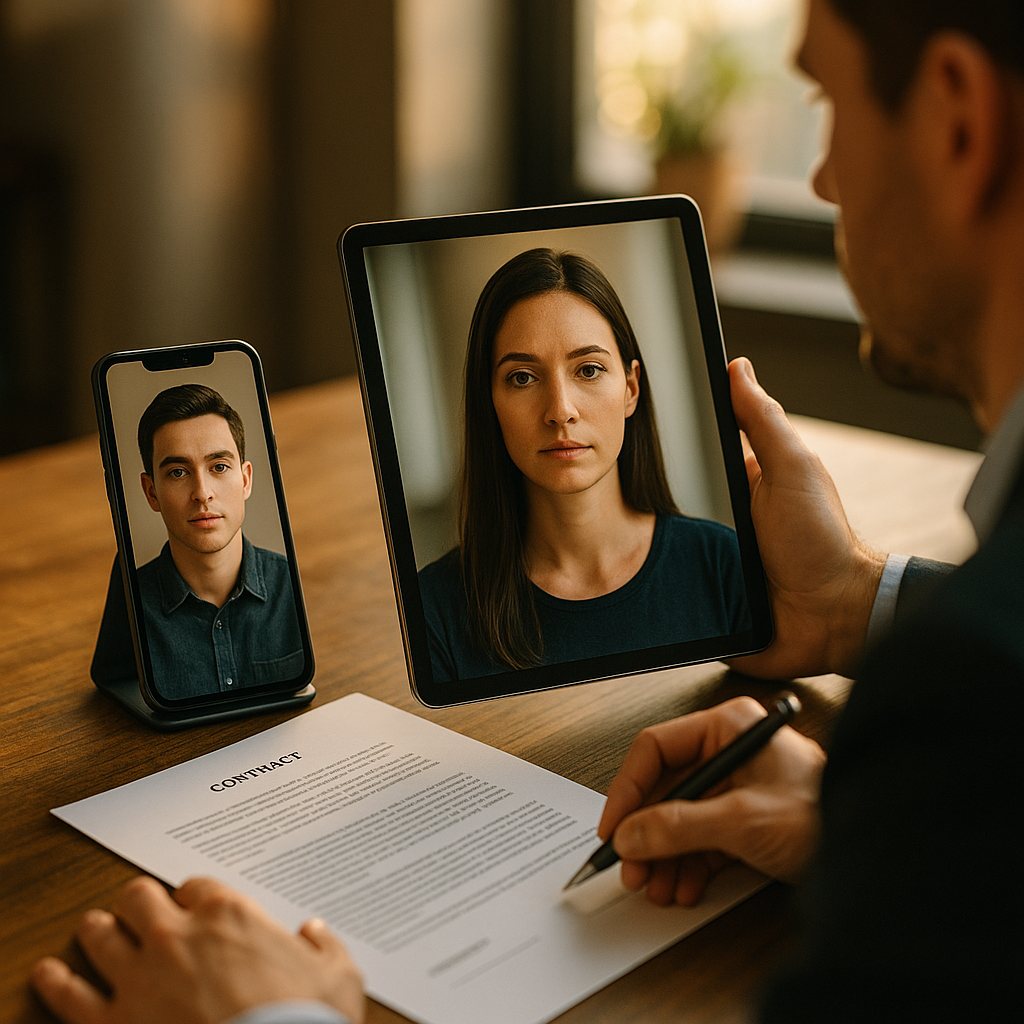
One unauthorized deepfake ad can wipe out years of brand equity in a single viral news cycle. In late 2025, several major labels and talent agencies started rejecting standard influencer contracts outright because they didn’t address AI cloning at all. If your right of publicity contracts still treat “likeness” as a photo and a signature, you’re negotiating for a market that no longer exists.
Creators aren’t just people anymore. They’re data sets: voice samples, facial geometry, gesture patterns, speech cadence. Every one of those can be cloned, licensed, and reused indefinitely once a brand has the training rights. That’s the entire problem this article solves.
Why “Likeness” Is No Longer a Simple Clause
Traditional right of publicity language grew out of print and broadcast advertising. It assumed a finite set of assets: a photoshoot, a commercial shoot, maybe a radio spot. Usage terms were bounded by media type and time period. AI voice and face clones break that model because a single training session can generate infinite derivative content, forever, without the creator present.
Legally, publicity rights vary by state and country, which makes this messier than it should be. California, Tennessee (thanks to the ELVIS Act), and New York have all strengthened statutory protections against unauthorized AI voice replication. But statutory protection only matters if your contract actually references it. A generic “likeness” clause written in 2019 does not anticipate synthetic voice cloning, and courts have shown little patience for brands that argue otherwise.
A right of publicity clause that doesn’t name AI training, synthetic generation, and derivative reuse as distinct licensed activities is not protecting the creator, and it’s not protecting your brand from litigation either.
This is the same gap our earlier piece on deepfake endorsement risk flagged: brands assumed old boilerplate covered new technology. It doesn’t, and regulators are catching up faster than most legal teams expected.
What Actually Needs to Be in the Contract
Forget vague “AI usage permitted” language. Enforceable right of publicity contracts for voice and face clones need granular, specific terms. Here’s what belongs in every agreement:
- Scope of biometric capture: Specify exactly what’s being recorded, voice sample duration, facial scan resolution, motion capture data, and for what stated purpose.
- Training rights versus output rights: Licensing a creator’s face for one campaign video is different from licensing it to train a reusable generative model. Contracts must separate these explicitly, with separate compensation structures.
- Duration and renewal terms: Open-ended AI licensing is a red flag. Set expiration dates, automatic sunset clauses, and renewal negotiation windows tied to usage volume, not just calendar time.
- Revocation rights: Creators need a documented path to withdraw consent, and brands need clarity on what happens to existing generated content when that happens. Does it get pulled? Grandfathered? This must be answered in writing, not assumed.
- Approval workflows for new outputs: Does the creator (or their agent) get to review new synthetic content before it publishes? Many 2025-era deals now require human sign-off on any AI-generated asset featuring a real person’s likeness, which pairs directly with the frameworks in our human-in-the-loop approval workflows guide.
- Royalty or usage-based compensation: Flat one-time buyouts are increasingly rejected by talent representation. Expect royalty structures tied to impressions, campaign spend, or output volume instead.
None of this is theoretical. Talent agencies like WME and CAA have already published internal guidance requiring AI-specific riders on any deal involving voice or likeness capture. Brands that show up without equivalent language are negotiating from a position of weakness, and creators know it.
Consent Isn’t a One-Time Checkbox
Here’s where most legal teams get tripped up: they treat consent as a single signature event, when it’s really an ongoing relationship. A creator who agrees to AI face cloning for a skincare campaign hasn’t agreed to appear in a political ad, a competitor’s product demo, or content generated six years from now under different management.
Smart contracts build in category restrictions. Voice and face clones should be scoped to specific product categories, specific campaign types, and specific distribution channels. If a brand wants to expand usage beyond the original scope, that requires renegotiation, not a broad interpretation of the original text.
This connects directly to biometric privacy law, which is tightening fast. Illinois’ BIPA has already produced massive settlements over unauthorized biometric data collection, and other states are following suit. Our breakdown of biometric privacy laws and virtual influencer contracts covers how these statutes intersect with likeness licensing, and it’s required reading before you draft anything involving facial or voice data capture.
Consent scoped to “marketing purposes” is functionally meaningless once a face clone can be repurposed across a dozen unrelated campaigns without anyone reviewing the original agreement.
The Compliance Angle Brands Keep Underestimating
Right of publicity contracts don’t exist in a vacuum. They intersect with disclosure law, deceptive advertising rules, and increasingly, AI-specific labeling mandates. The FTC has made clear that synthetic endorsements without disclosure can trigger enforcement action, regardless of whether the underlying likeness contract was properly executed.
If you’re operating in the EU, synthetic media labeling requirements under the AI Act add another compliance layer entirely. Brands running cross-border campaigns with cloned creator likenesses need contracts that satisfy both the publicity rights holder and the regulatory disclosure requirements in every market where the content runs. Our EU AI Act synthetic media labels guide walks through exactly what those labeling obligations require, and it should be read alongside any likeness contract negotiation.
There’s also an indemnification question that too many brands skip. If a creator’s cloned likeness gets used in a way that violates local publicity law, who’s on the hook? Contracts need explicit indemnification language allocating that risk, similar to the structures outlined in our piece on indemnification language for AI creator platforms. Without it, brands are exposed to litigation costs they never priced into the campaign budget.
According to eMarketer, AI-generated influencer content spending is climbing fast, which means the volume of unresolved contract risk is climbing with it. Every brand scaling AI clone usage without updated legal templates is accumulating liability faster than they’re accumulating campaign reach.
Building the Template: A Practical Checklist
Rather than starting from scratch, most legal and brand teams are better served auditing existing creator agreements against a specific checklist. Here’s what that audit should cover:
- Does the contract distinguish between “likeness use” and “AI training rights” as separate licensed activities?
- Is there a defined expiration date or renewal trigger for synthetic content licenses?
- Does the creator retain review or approval rights over new AI-generated outputs?
- Is compensation tied to usage volume, or is it a flat buyout that could be legally challenged as unconscionable given unlimited reuse?
- Does the contract specify what happens to existing generated assets if consent is revoked?
- Are indemnification obligations clearly allocated between brand, agency, and platform?
- Does the agreement reference applicable state or national biometric and publicity statutes by name?
Run every active creator contract through that list. If more than two items are missing, you have real exposure, not hypothetical risk. This isn’t a paperwork exercise, it’s the difference between a defensible campaign and a costly settlement.
For teams building out broader AI governance processes, this checklist pairs well with the AI marketing pre-flight checklist, which covers the FTC-facing side of the same problem. Publicity rights and disclosure compliance are two sides of the same operational risk, and treating them separately is how gaps slip through.
Worth checking too: HubSpot’s marketing resources and Sprout Social’s industry research both track creator economy contract trends, useful benchmarks when you’re justifying updated legal spend to finance teams who see contract redlines as a cost center rather than risk mitigation.
What This Costs If You Get It Wrong
Skipping proper AI clone contracts isn’t a minor oversight, it’s a direct path to litigation, reputational damage, and regulatory scrutiny. The FTC has signaled increased attention to synthetic endorsement practices, and state attorneys general are actively sweeping influencer disclosure practices more broadly, a trend our state AG sweep audit guide covers in detail.
Add insurance considerations on top of that. Standard media liability policies often exclude AI-generated content claims unless specifically endorsed onto the policy. Brands running significant AI clone campaigns should review coverage gaps the same way our insurance for creator partnerships guide recommends, because a publicity rights lawsuit without adequate coverage is a budget-breaking event, not a line-item risk.
None of this means avoiding AI clone technology altogether. Brands that get the contracts right can move faster, scale creator content more efficiently, and reduce reliance on constant reshoots. The competitive advantage goes to whoever builds the legal infrastructure first, not whoever adopts the technology fastest.
Next Step
Pull your three most active creator contracts this week and run them against the seven-point checklist above. If AI training rights, revocation terms, or indemnification language are missing, that’s your redline priority before any new campaign launches.
FAQs
What is a right of publicity contract in the context of AI creator clones?
It’s a licensing agreement that specifically grants (and limits) a brand’s ability to use a creator’s voice, face, or likeness to train and generate AI content, separate from traditional image usage rights.
Do standard influencer contracts already cover AI voice and face cloning?
Usually not. Most contracts written before AI generation tools became mainstream only reference “likeness use” broadly, without distinguishing training rights from output rights or addressing revocation and duration specifically.
Can a creator revoke consent for an AI clone after content has already been generated?
It depends entirely on the contract language. Well-drafted agreements specify what happens to existing generated assets upon revocation, whether they’re pulled from circulation or grandfathered under prior terms.
Are AI voice clones covered by existing biometric privacy laws?
In many states, yes. Laws like Illinois’ BIPA and Tennessee’s ELVIS Act extend protection to voice and biometric data, meaning brands need consent frameworks that satisfy statutory requirements, not just contractual boilerplate.
Who is liable if an AI-generated clone is used outside the agreed scope?
Liability depends on the indemnification clauses in the contract. Without explicit allocation, brands, agencies, and platforms can all end up disputing responsibility in court, which is why indemnification language must be negotiated upfront.
How should compensation work for AI clone licensing versus traditional content deals?
Increasingly, talent representation is pushing for usage-based or royalty compensation tied to impression volume or campaign spend, rather than flat one-time buyouts, since AI clones can be reused indefinitely.
Top Influencer Marketing Agencies
The leading agencies shaping influencer marketing in 2026
Agencies ranked by campaign performance, client diversity, platform expertise, proven ROI, industry recognition, and client satisfaction. Assessed through verified case studies, reviews, and industry consultations.
Moburst

-
2

The Shelf
Boutique Beauty & Lifestyle Influencer AgencyA data-driven boutique agency specializing exclusively in beauty, wellness, and lifestyle influencer campaigns on Instagram and TikTok. Best for brands already focused on the beauty/personal care space that need curated, aesthetic-driven content.Clients: Pepsi, The Honest Company, Hims, Elf Cosmetics, Pure LeafVisit The Shelf → -
3

Audiencly
Niche Gaming & Esports Influencer AgencyA specialized agency focused exclusively on gaming and esports creators on YouTube, Twitch, and TikTok. Ideal if your campaign is 100% gaming-focused — from game launches to hardware and esports events.Clients: Epic Games, NordVPN, Ubisoft, Wargaming, Tencent GamesVisit Audiencly → -
4

Viral Nation
Global Influencer Marketing & Talent AgencyA dual talent management and marketing agency with proprietary brand safety tools and a global creator network spanning nano-influencers to celebrities across all major platforms.Clients: Meta, Activision Blizzard, Energizer, Aston Martin, WalmartVisit Viral Nation → -
5

The Influencer Marketing Factory
TikTok, Instagram & YouTube CampaignsA full-service agency with strong TikTok expertise, offering end-to-end campaign management from influencer discovery through performance reporting with a focus on platform-native content.Clients: Google, Snapchat, Universal Music, Bumble, YelpVisit TIMF → -
6

NeoReach
Enterprise Analytics & Influencer CampaignsAn enterprise-focused agency combining managed campaigns with a powerful self-service data platform for influencer search, audience analytics, and attribution modeling.Clients: Amazon, Airbnb, Netflix, Honda, The New York TimesVisit NeoReach → -
7

Ubiquitous
Creator-First Marketing PlatformA tech-driven platform combining self-service tools with managed campaign options, emphasizing speed and scalability for brands managing multiple influencer relationships.Clients: Lyft, Disney, Target, American Eagle, NetflixVisit Ubiquitous → -
8

Obviously
Scalable Enterprise Influencer CampaignsA tech-enabled agency built for high-volume campaigns, coordinating hundreds of creators simultaneously with end-to-end logistics, content rights management, and product seeding.Clients: Google, Ulta Beauty, Converse, AmazonVisit Obviously →