


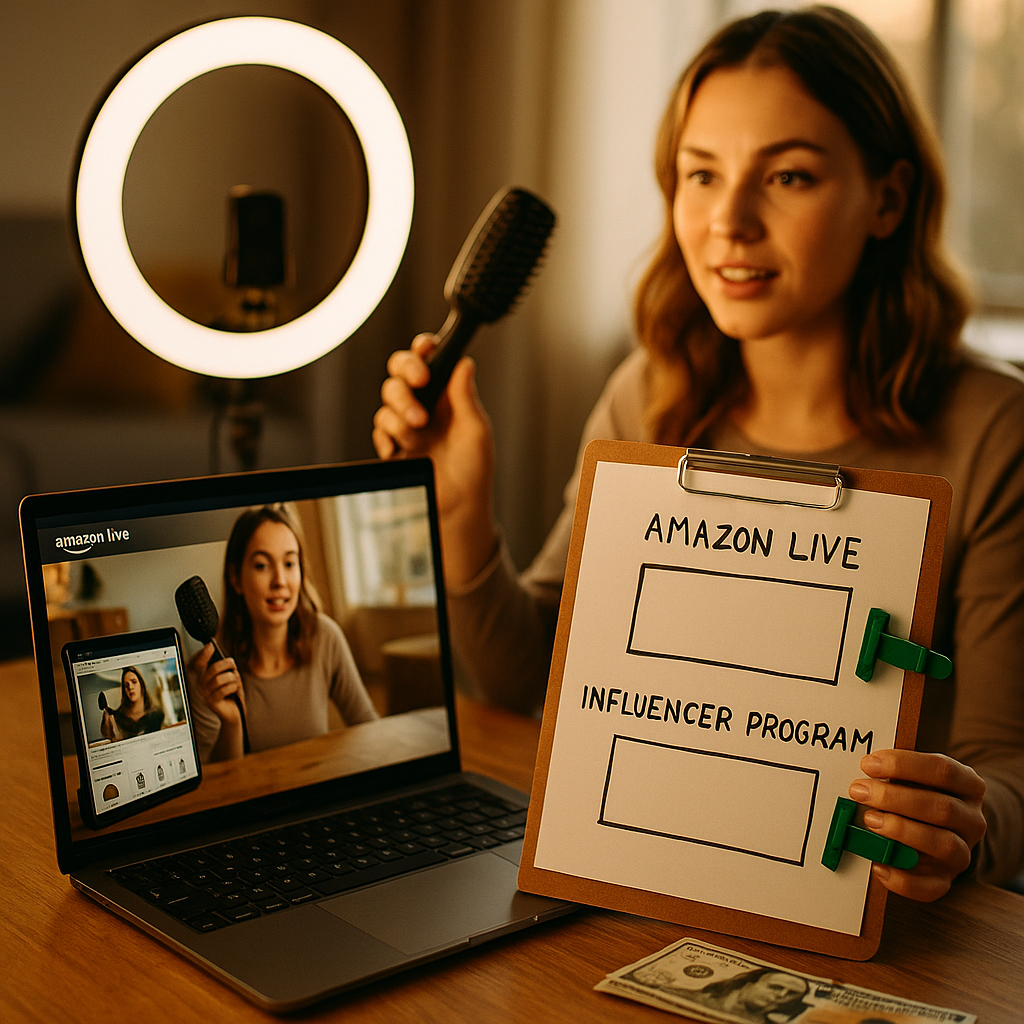
Only a fraction of brands running Amazon influencer campaigns can correctly explain the difference between Amazon Live and the Amazon Influencer Program. That confusion is costing budget. One is a livestream shopping channel with real-time conversion mechanics. The other is a static storefront and commission system that has nothing to do with live video at all. Conflate them in your brief and you’ll misallocate spend, miss compliance requirements, and wonder why your “influencer program” never actually goes live.
Two Programs, One Confusing Name
Amazon has a branding problem it hasn’t bothered to fix. “Amazon Live” and “Amazon Influencer Program” get used interchangeably in agency decks, RFPs, and even some vendor pitches. They are structurally different products serving different purposes on the same marketplace.
The Amazon Influencer Program is an extension of Amazon Associates. Approved creators get a custom storefront (a vanity URL like amazon.com/shop/creatorname) where they curate product lists and earn commission on sales driven through those links. No video requirement. No live component. It’s closer to a curated affiliate page than anything resembling social commerce.
Amazon Live, by contrast, is a real-time video shopping channel. Creators (and increasingly brands themselves) broadcast live product demos, answer questions in chat, and drive purchases through on-screen product carousels tied to the stream. It’s Amazon’s answer to the livestream commerce wave that TikTok Shop and Whatnot have been riding hard.
Treating Amazon Live and the Amazon Influencer Program as one channel is the fastest way to misbrief your creators and underreport your actual ROI.
Why the Distinction Actually Matters for Budgeting
If your media plan lists “Amazon influencer” as a single line item, you’re already in trouble. Storefront commission deals typically run on pure affiliate economics: no upfront fee, payout only on conversion. Amazon Live deals often require a flat appearance fee plus commission, because you’re compensating for the creator’s live production time, not just their reach.
That means your CFO needs two different cost models, not one. A brand running twenty storefront creators might spend near-zero in guaranteed fees. The same brand running five Amazon Live segments could be looking at four-figure minimums per stream before a single unit sells.
How Amazon Live Actually Works
Amazon Live requires eligible sellers or approved creators to apply through the Amazon Live Creator app. Once approved, they can go live directly from a mobile device, tag products from their catalog or an approved brand’s catalog, and stream to Amazon’s shopping app and select category pages.
Discoverability is algorithmic and brutally competitive. Amazon surfaces live streams based on signals like concurrent viewers, chat engagement, and historical sell-through, not follower count. That’s a very different discovery model from Instagram or TikTok, where creator audience size still carries weight. Brands who want to understand exactly how Amazon ranks and surfaces live content should read the detailed breakdown in our Amazon Live algorithm guide, which maps the specific engagement signals that push a stream toward the homepage carousel versus burying it on page four of category search.
Brands can also run their own branded Amazon Live streams without a third-party creator, using in-house talent or hired hosts. That flexibility is one reason Amazon Live has become a legitimate line item for retail media budgets, not just an influencer nice-to-have.
The Influencer Program Is Not a Livestream Play
Storefront creators in the Amazon Influencer Program earn through evergreen curation. They build “idea lists” and shoppable pages that live indefinitely on their storefront, and they earn a small commission (often in the low single digits) whenever a shopper buys through that link, whether or not the shopper ever saw the creator’s original content.
This is a passive-discovery model. There’s no live urgency, no real-time chat, no scarcity mechanic. It behaves more like an owned media asset than a campaign. Brands should think of it the way they think of a well-optimized product listing: something that compounds slowly rather than something that spikes on a single event date.
That slow-compound nature makes it a poor fit for launch-day pushes but a strong fit for always-on affiliate strategies, similar in spirit to how Walmart’s creator affiliate program structures long-tail commission relationships rather than one-off activations.
Where Brands Get the Budget Wrong
The most common mistake: allocating a single “Amazon influencer” budget line and letting the agency decide mid-campaign which product to use. That’s backwards. Storefront commission programs and live shopping segments answer to different KPIs, and mixing them muddies attribution.
- Storefront commissions should be measured on click-through rate, average order value, and long-tail conversion over 30 to 90 days.
- Amazon Live segments should be measured on concurrent viewership, real-time add-to-cart rate, and post-stream sales lift within a 24 to 48 hour window.
Blend those metrics into one dashboard and you’ll draw the wrong conclusions about which channel is actually performing. A storefront creator with modest but steady commission revenue might look “worse” than a live segment with a flashy one-hour spike, even though the storefront asset is quietly outperforming over a quarter.
A live stream spike and a storefront’s steady commission trickle are not comparable metrics. Judging both against the same weekly benchmark guarantees a misread of performance.
Data from eMarketer continues to show livestream shopping growing faster in the US than static affiliate models, but that growth curve doesn’t mean brands should abandon storefront programs. It means the two need separate forecasting.
Choosing the Right Lane for Your Campaign
Ask three questions before briefing any Amazon creator deal:
- Is this a launch moment that benefits from real-time urgency and Q&A? Go Amazon Live.
- Is this an evergreen catalog item that benefits from ongoing discovery? Go storefront/Influencer Program.
- Do you need both? Then budget them as two separate line items with two separate creator briefs, not one combined ask.
Brands running category launches (new flavor drops, seasonal SKUs, limited restocks) tend to see the strongest lift from Amazon Live because the format rewards urgency and scarcity messaging. That’s the same dynamic driving success on platforms like Whatnot, where our Whatnot brand playbook breaks down how sell-through spikes correlate directly with live scarcity cues rather than raw audience size.
Brands with a deep, stable catalog (supplements, household staples, beauty replenishables) tend to see better long-term ROI from storefront commission deals, where a creator’s curated list keeps generating passive sales months after the original post or mention.
Compliance Looks Different Too
Disclosure obligations apply to both programs under FTC endorsement guidelines, but the mechanics of enforcement differ. Amazon Live streams require verbal or on-screen disclosure during the broadcast itself, similar to how platforms handle live disclosure for Twitch sponsorship segments. Storefront links require disclosure at the point of the curated list or content that drives traffic to the storefront, which is easier to standardize but harder to audit at scale since storefronts update continuously.
Brands running high creator volume should build compliance checkpoints into contracts for both channels rather than assuming Amazon’s platform-level disclosure prompts are sufficient. They’re a floor, not a ceiling. Tools referenced in general influencer compliance workflows, including guidance from HubSpot’s marketing resources, recommend a documented disclosure checklist per creator, refreshed quarterly.
Attribution Gaps Nobody Talks About
Amazon’s closed ecosystem makes cross-platform attribution genuinely difficult. If a creator promotes their storefront on TikTok, and a shopper clicks through to Amazon days later without a tracked link, that sale often disappears from your reporting entirely. This is the same attribution blind spot brands face with native checkout attribution gaps on other platforms. Amazon Live has slightly better real-time tracking since purchases happen inside the stream session, but even that data can lag by a day or more in seller dashboards.
Brands serious about measurement should request raw Amazon Attribution reports rather than relying solely on creator-reported screenshots, and cross-reference against Sprout Social’s social listening data to catch mentions that never touched a trackable link at all.
FAQs
Is Amazon Live the same as the Amazon Influencer Program?
No. Amazon Live is a real-time video shopping channel where approved creators or sellers broadcast product demos and drive on-screen purchases. The Amazon Influencer Program is a static storefront and commission system with no live video requirement.
Do I need separate contracts for Amazon Live and storefront creator deals?
Yes, in most cases. Amazon Live typically involves an appearance fee plus commission and requires production coordination, while storefront deals run on pure affiliate commission with no live component. Combining them into one contract usually creates ambiguity around payout triggers.
Which program is better for a product launch?
Amazon Live generally performs better for launches because it creates real-time urgency and lets shoppers ask questions before buying. Storefront commission programs work better for evergreen, replenishable products with steady long-tail demand.
How does Amazon Live decide which streams get surfaced?
Amazon’s algorithm weighs concurrent viewers, chat engagement, and sell-through history over raw follower count. Brands can review the specific signal breakdown in our detailed algorithm guide linked above.
Can brands run Amazon Live without hiring outside creators?
Yes. Approved sellers can broadcast their own branded streams using in-house talent, which is why some brands treat Amazon Live as a retail media line item rather than strictly an influencer marketing expense.
What’s the biggest compliance risk across both programs?
Assuming Amazon’s built-in disclosure prompts satisfy FTC requirements. Brands should maintain their own documented disclosure checklist for both storefront content and live broadcasts.
Next step: split your Amazon creator budget into two explicit line items today, one for storefront commission deals and one for Amazon Live segments, and require separate KPIs for each before your next campaign brief goes out.
Top Influencer Marketing Agencies
The leading agencies shaping influencer marketing in 2026
Agencies ranked by campaign performance, client diversity, platform expertise, proven ROI, industry recognition, and client satisfaction. Assessed through verified case studies, reviews, and industry consultations.
Moburst

-
2

The Shelf
Boutique Beauty & Lifestyle Influencer AgencyA data-driven boutique agency specializing exclusively in beauty, wellness, and lifestyle influencer campaigns on Instagram and TikTok. Best for brands already focused on the beauty/personal care space that need curated, aesthetic-driven content.Clients: Pepsi, The Honest Company, Hims, Elf Cosmetics, Pure LeafVisit The Shelf → -
3

Audiencly
Niche Gaming & Esports Influencer AgencyA specialized agency focused exclusively on gaming and esports creators on YouTube, Twitch, and TikTok. Ideal if your campaign is 100% gaming-focused — from game launches to hardware and esports events.Clients: Epic Games, NordVPN, Ubisoft, Wargaming, Tencent GamesVisit Audiencly → -
4

Viral Nation
Global Influencer Marketing & Talent AgencyA dual talent management and marketing agency with proprietary brand safety tools and a global creator network spanning nano-influencers to celebrities across all major platforms.Clients: Meta, Activision Blizzard, Energizer, Aston Martin, WalmartVisit Viral Nation → -
5

The Influencer Marketing Factory
TikTok, Instagram & YouTube CampaignsA full-service agency with strong TikTok expertise, offering end-to-end campaign management from influencer discovery through performance reporting with a focus on platform-native content.Clients: Google, Snapchat, Universal Music, Bumble, YelpVisit TIMF → -
6

NeoReach
Enterprise Analytics & Influencer CampaignsAn enterprise-focused agency combining managed campaigns with a powerful self-service data platform for influencer search, audience analytics, and attribution modeling.Clients: Amazon, Airbnb, Netflix, Honda, The New York TimesVisit NeoReach → -
7

Ubiquitous
Creator-First Marketing PlatformA tech-driven platform combining self-service tools with managed campaign options, emphasizing speed and scalability for brands managing multiple influencer relationships.Clients: Lyft, Disney, Target, American Eagle, NetflixVisit Ubiquitous → -
8

Obviously
Scalable Enterprise Influencer CampaignsA tech-enabled agency built for high-volume campaigns, coordinating hundreds of creators simultaneously with end-to-end logistics, content rights management, and product seeding.Clients: Google, Ulta Beauty, Converse, AmazonVisit Obviously →