


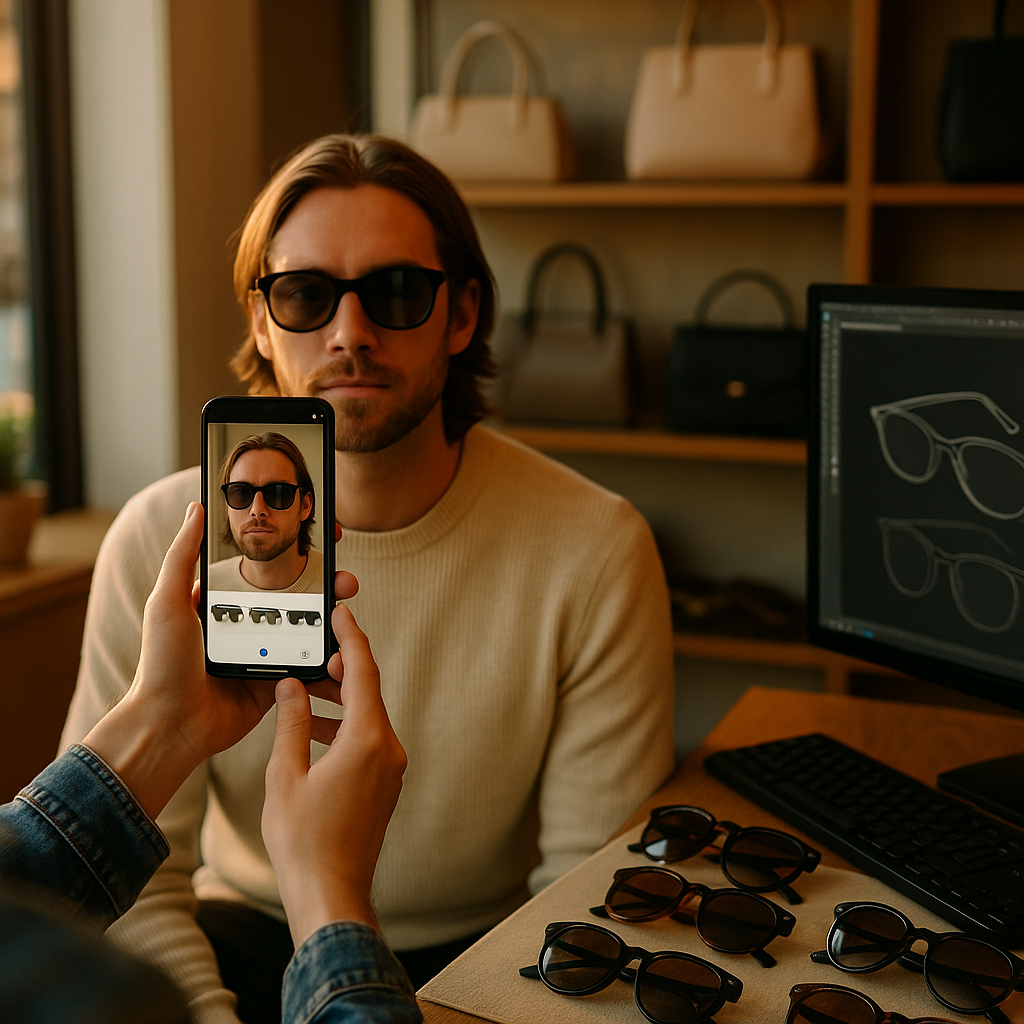
Meta says shoppers who use AR try-on tools are up to 2x more likely to convert. Yet fewer than 15% of mid-market brands have shipped a working AR try-before-you-buy Instagram Shopping experience. That gap won’t last. As Meta pushes deeper into AI-assisted commerce, AR try-on is becoming table stakes for any brand selling apparel, beauty, or home goods on Instagram. Here’s how to build one without blowing your production budget.
Why AR Try-On Is Suddenly a Line Item, Not a Nice-to-Have
Return rates are the quiet budget killer nobody wants to talk about in the boardroom. Apparel returns average 24-30% industry-wide, and “didn’t fit as expected” or “didn’t look like the photos” account for the majority of those. AR try-on directly attacks that problem at the point of decision, inside the scroll, before the cart.
Instagram Shopping has spent the last two years quietly building the infrastructure for this. Product tags now support richer media attachments, Spark AR’s successor tools integrate more tightly with the Shopping catalog, and Meta’s own commerce data shows shoppability features driving measurably higher add-to-cart rates. Brands that treat AR as a gimmick are missing the point: this is a conversion and returns-reduction tool wearing a fun hat.
Every AR try-on unit you ship should be judged the same way you judge a paid ad: by its impact on conversion rate and return rate, not by how impressive the demo looks in a deck.
What “Try-Before-You-Buy” Actually Means on Instagram in 2026
Let’s be precise about the mechanics, because “AR filter” and “AR try-on commerce experience” are not the same thing. A try-before-you-buy build needs three components working together:
- A face, hand, or body-tracking AR effect built to reflect the actual SKU (shade, size, pattern, finish) accurately enough that it informs a purchase decision.
- A direct link between the AR effect and the Instagram Shopping product tag, so a user can move from “trying it on” to “adding to cart” in two taps or fewer.
- A data feedback loop that tells you which AR sessions convert, which ones bounce, and where in the try-on flow people drop off.
Miss any one of those three and you’ve built a filter, not a commerce tool. Filters are fun. They don’t move revenue the same way.
Scoping the Build: What This Actually Costs
Budget expectations vary wildly depending on category, but here’s a realistic range for 2026 production costs:
- Beauty (lip, eye, skin-tone matching): $8,000-$25,000 for a polished, catalog-linked effect, depending on how many SKUs and shade-matching precision you need.
- Apparel and accessories (glasses, hats, jewelry): $12,000-$40,000, with body-tracking and fit-accuracy work driving the higher end.
- Home goods (furniture placement, wall art): $15,000-$50,000, since this usually requires world-tracking rather than face/body tracking, a more complex build.
Agencies that specialize in Spark AR-style development (many now operate under Meta’s broader AR partner ecosystem) can move faster than in-house teams building this for the first time. If you’re testing the waters, start with one hero SKU rather than a full catalog rollout. Prove the conversion lift, then scale.
The Production Workflow, Step by Step
Here’s the sequence that actually works, based on how brands are structuring these builds heading into next year’s shopping seasons.
- Pick the SKU with the highest return rate, not the highest margin. AR try-on delivers the fastest ROI when it’s solving a real pre-purchase uncertainty problem. A best-selling foundation shade with a 35% return rate is a better first candidate than your flagship product if that flagship already converts well.
- Source high-fidelity 3D or texture assets early. This is the step teams underestimate. You need accurate color profiles, material textures, and (for apparel) draping simulations. Budget 3-4 weeks just for asset capture if you don’t already have 3D product models.
- Build and test the tracking logic. Face tracking for beauty, hand tracking for jewelry, body tracking for apparel, world tracking for furniture. Each has different accuracy thresholds and different failure modes (bad lighting, skin tone variance, camera angle).
- Wire the effect to the product tag. This is the commerce layer. The AR experience needs a clear, low-friction “shop this” call-to-action baked into the UI, not a link buried in a caption.
- QA across devices obsessively. AR performance on a five-year-old Android phone looks nothing like it does on the latest iPhone. If your top markets skew toward older devices, budget extra QA time or build a lighter-weight fallback experience.
- Instrument everything before launch. Session starts, completion rate, tap-through to product page, add-to-cart, and purchase, all need to be tracked separately. Without this, you can’t prove the ROI case for your next budget cycle.
Briefing Creators to Drive Discovery of the AR Experience
An AR try-on tool that nobody knows exists is a sunk cost. This is where creator partnerships earn their keep, not by explaining the tech, but by demonstrating the decision-making moment it solves. A creator filming themselves genuinely uncertain about a shade or fit, then using the AR try-on to resolve that uncertainty on camera, is far more persuasive than a polished demo reel.
This pairs naturally with formats built around authentic product uncertainty. If you’ve used a skeptic-to-convert arc before, the AR try-on moment slots in as the resolution beat: skepticism, AR try-on, purchase confidence. Briefs built around real product use also translate well here, since the entire value proposition of AR try-on is reducing the gap between digital preview and physical reality.
Don’t over-script this. Creators fumbling slightly with a new AR tool on camera, then landing on genuine surprise (“oh, that actually looks like what I expected”) reads as authentic. A perfectly smooth demo reads as an ad, and audiences tune ads out.
Compliance: Where AR Try-On Gets Brands in Trouble
Two risk areas deserve explicit attention before you launch, because AR sits at an uncomfortable intersection of advertising claims and product representation.
Accuracy claims. If your AR try-on shows a lipstick shade that renders noticeably lighter or more saturated than the physical product, you’re exposed to false advertising complaints, not just bad reviews. The FTC has increasingly scrutinized digital representations of physical products, particularly in beauty and apparel. Build shade-matching QA into your process with the same rigor you’d apply to packaging color accuracy.
Creator disclosure. If you’re paying or gifting creators to demo the AR experience, standard FTC endorsement guidelines still apply in full. The novelty of the format doesn’t exempt anyone from disclosure requirements. If you need a refresher on structuring compliant creator briefs around new-format content, the framework in this FTC briefing guide transfers directly.
The biggest compliance risk in AR try-on isn’t the technology, it’s the gap between how vivid your AR rendering looks and how accurate it actually is. Close that gap before a regulator or a viral complaint does it for you.
Measuring Whether It’s Actually Working
Track these four metrics from day one, and report on them the same way you’d report on a paid media campaign:
- Try-on completion rate: what percentage of people who open the AR experience actually complete the interaction (versus abandoning mid-session).
- Try-on-to-cart rate: the percentage who move from the AR experience directly into the shopping flow.
- Return rate delta: compare return rates for orders that involved an AR try-on session against orders that didn’t. This is your clearest ROI signal.
- Device and market drop-off: where performance issues are costing you completions, broken down by device type and region.
For deeper analysis benchmarks and industry conversion data, eMarketer and Statista both publish regularly updated commerce and AR adoption figures worth citing in your internal business case. Meta’s own Meta for Business resources also detail current Shopping tag capabilities and AR partner requirements, which change frequently enough to warrant a quarterly check.
If you’re already running diversified content formats across your creator program, this data plugs neatly into a broader test-and-learn structure. The budgeting logic in this format diversification framework applies well to AR, treat it as one test format among several, not a standalone bet-the-quarter initiative.
Next Step
Pick one high-return SKU, scope a single AR try-on build for it this quarter, and measure the return-rate delta against a control group before committing to a full catalog rollout. The data will make your next budget conversation a lot easier.
FAQs
How much does an AR try-on experience for Instagram Shopping typically cost?
Costs range from roughly $8,000 for a simple beauty shade-matching effect to $50,000 for complex furniture placement or apparel try-on with body tracking. Most mid-market brands should start with a single hero SKU before scaling to a full catalog.
Does AR try-on actually reduce product returns?
Early adopter data and Meta’s own commerce reporting suggest measurable reductions in returns tied to fit and appearance mismatches, particularly in beauty and apparel. Brands should track a return-rate delta between AR-assisted and non-AR orders to confirm the effect for their specific catalog.
Do creators need to disclose when demoing an AR try-on feature?
Yes. Standard FTC endorsement and disclosure rules apply regardless of format novelty. Any paid or gifted partnership demoing the AR experience needs clear, unambiguous disclosure per current FTC guidelines.
What’s the biggest technical risk in building AR try-on for Instagram Shopping?
Color and fit accuracy across devices. An AR rendering that looks noticeably different from the physical product creates both a trust problem with shoppers and a potential false advertising exposure.
Should every brand build AR try-on, or only certain categories?
It delivers the clearest ROI for categories with high pre-purchase uncertainty: beauty (shade matching), apparel (fit and drape), eyewear, jewelry, and furniture. Categories with low return rates or low visual-fit uncertainty will see a weaker payoff relative to build cost.
Top Influencer Marketing Agencies
The leading agencies shaping influencer marketing in 2026
Agencies ranked by campaign performance, client diversity, platform expertise, proven ROI, industry recognition, and client satisfaction. Assessed through verified case studies, reviews, and industry consultations.
Moburst

-
2

The Shelf
Boutique Beauty & Lifestyle Influencer AgencyA data-driven boutique agency specializing exclusively in beauty, wellness, and lifestyle influencer campaigns on Instagram and TikTok. Best for brands already focused on the beauty/personal care space that need curated, aesthetic-driven content.Clients: Pepsi, The Honest Company, Hims, Elf Cosmetics, Pure LeafVisit The Shelf → -
3

Audiencly
Niche Gaming & Esports Influencer AgencyA specialized agency focused exclusively on gaming and esports creators on YouTube, Twitch, and TikTok. Ideal if your campaign is 100% gaming-focused — from game launches to hardware and esports events.Clients: Epic Games, NordVPN, Ubisoft, Wargaming, Tencent GamesVisit Audiencly → -
4

Viral Nation
Global Influencer Marketing & Talent AgencyA dual talent management and marketing agency with proprietary brand safety tools and a global creator network spanning nano-influencers to celebrities across all major platforms.Clients: Meta, Activision Blizzard, Energizer, Aston Martin, WalmartVisit Viral Nation → -
5

The Influencer Marketing Factory
TikTok, Instagram & YouTube CampaignsA full-service agency with strong TikTok expertise, offering end-to-end campaign management from influencer discovery through performance reporting with a focus on platform-native content.Clients: Google, Snapchat, Universal Music, Bumble, YelpVisit TIMF → -
6

NeoReach
Enterprise Analytics & Influencer CampaignsAn enterprise-focused agency combining managed campaigns with a powerful self-service data platform for influencer search, audience analytics, and attribution modeling.Clients: Amazon, Airbnb, Netflix, Honda, The New York TimesVisit NeoReach → -
7

Ubiquitous
Creator-First Marketing PlatformA tech-driven platform combining self-service tools with managed campaign options, emphasizing speed and scalability for brands managing multiple influencer relationships.Clients: Lyft, Disney, Target, American Eagle, NetflixVisit Ubiquitous → -
8

Obviously
Scalable Enterprise Influencer CampaignsA tech-enabled agency built for high-volume campaigns, coordinating hundreds of creators simultaneously with end-to-end logistics, content rights management, and product seeding.Clients: Google, Ulta Beauty, Converse, AmazonVisit Obviously →