


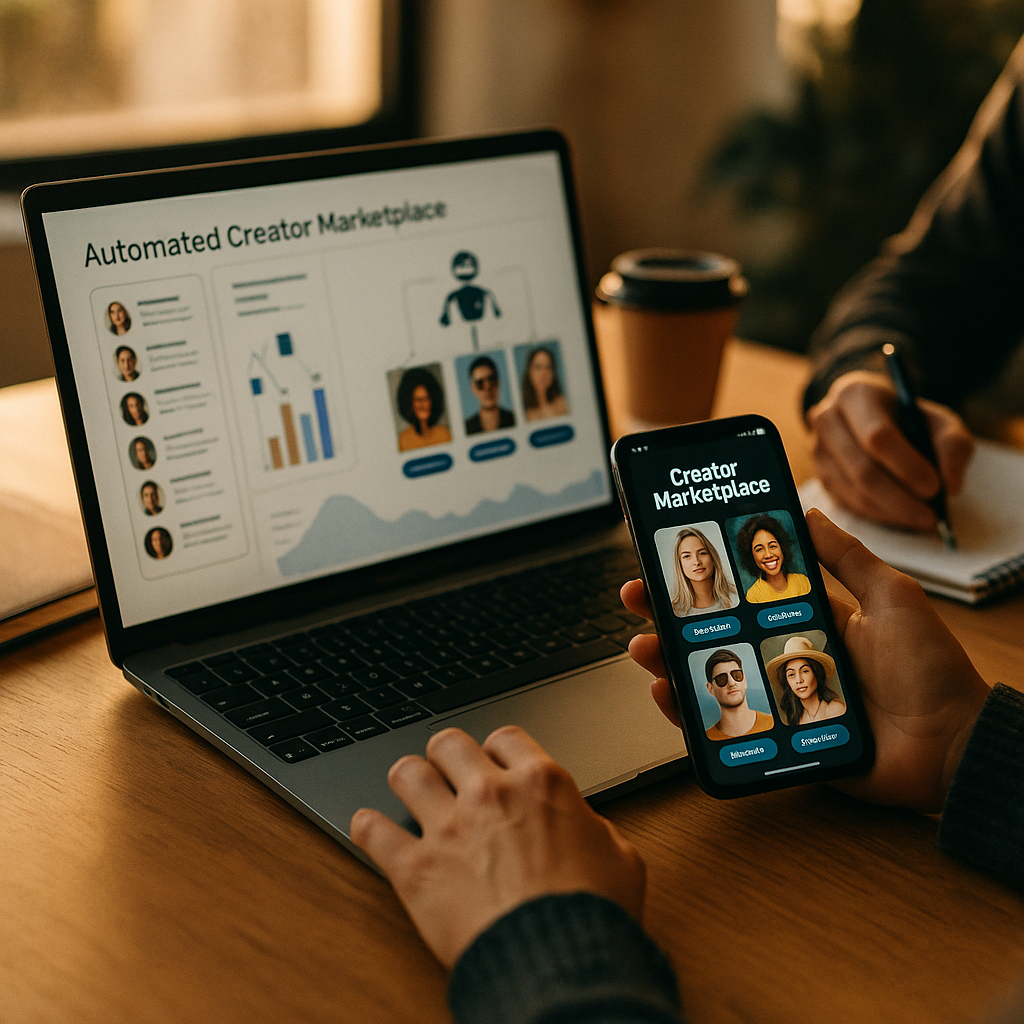
Roughly 63% of marketers still manage creator outreach in spreadsheets, per eMarketer estimates on influencer workflow maturity. So when a vendor claims to run sourcing, negotiation, and payment without a human in the loop, brand leads should pay attention. The automated creator marketplace model that 1stCollab has built isn’t just another SaaS dashboard bolted onto influencer marketing. It’s a structural bet that the entire creator transaction — not just discovery — can be machine-run.
Why This Isn’t Just Another Discovery Tool
Most influencer platforms sell you a database and call it innovation. You get filters for follower count, engagement rate, audience geography. Then a human still has to DM fifty creators, chase contracts, and reconcile invoices. That’s the part nobody automated — until now.
1stCollab’s pitch is different: an end-to-end system that identifies creators matching campaign goals, negotiates rates algorithmically, drafts and executes contracts, and handles payment logistics with minimal human intervention. Think of it less as a marketplace and more as an operating layer that sits between a brand’s budget and thousands of creator relationships, making decisions at a speed no procurement team could match.
The shift isn’t from manual to digital. It’s from human-negotiated to machine-negotiated — and that changes who brands need on staff to run influencer programs.
That distinction matters for anyone building a martech stack. A discovery tool saves you research time. A fully automated marketplace changes your operating model, your headcount allocation, and arguably your risk exposure.
The Category Nobody Named Yet
Marketing technology loves inventing categories after the fact. CDPs existed as a practice before anyone coined the term. Something similar is happening with automated creator marketplaces right now. They sit at the intersection of three existing categories — influencer platforms, programmatic ad buying, and AI-driven procurement — but they don’t fit cleanly into any of them.
Call it what you want: agentic creator ops, autonomous influencer procurement, whatever sticks. The functional test is simple. Does the platform make transactional decisions (who to hire, what to pay, when to renew) without a human approving each step? If yes, you’re looking at the new category. If a human still greenlights every deal, you’re looking at a faster version of the old one.
This lines up with a broader trend covered in agentic marketing architecture discussions — static rule-based tools are giving way to systems that act, not just recommend. Influencer marketing was arguably the last major budget line to get this treatment, mostly because creator relationships felt too “human” to hand to an algorithm. That assumption is now being tested at scale.
What Changes for Brand Teams, Practically
If you run influencer programs today, here’s the operational shift worth war-gaming:
- Negotiation shifts from art to input variable. Rate benchmarking becomes a data feed the system optimizes against, not a conversation your team has with a creator’s manager.
- Speed-to-launch compresses dramatically. Campaigns that took weeks to staff can theoretically go live in days, echoing the pattern already seen in AI-powered campaign setup for paid media.
- Headcount needs shrink on execution, grow on oversight. You need fewer people sending DMs and more people auditing algorithmic decisions.
- Vendor lock-in risk rises. Once your creator relationships live inside someone else’s automated pipeline, switching costs aren’t just financial — they’re relational.
None of this is hypothetical anymore. Brands piloting automated marketplaces are already reporting cycle-time reductions that mirror what agencies achieved through AI adoption elsewhere — see the case study on a brand that cut agency costs 82% by shifting execution to AI tooling. Influencer ops is following the same trajectory paid media took five years ago.
The ROI Case, and Where It Gets Shaky
The pitch is compelling on paper. Automated negotiation theoretically removes inflated rate-card padding. Algorithmic matching reduces mismatched brand-creator pairings that waste budget on low-converting partnerships. Faster contracting means campaigns launch closer to cultural moments instead of missing them by three weeks of legal review.
But ROI claims from any vendor promising full automation deserve scrutiny, not applause. A few questions brand teams should be asking before signing:
- What’s the actual conversion lift versus a well-run manual program, not versus a bad one?
- How does the system handle edge cases — creators with unusual contract terms, brand safety flags, or regional compliance quirks?
- Who’s liable if an automated negotiation locks in a deal that violates FTC disclosure rules or a platform’s branded content policy?
That last question isn’t rhetorical. The FTC’s endorsement guidelines put disclosure compliance squarely on the brand, regardless of who negotiated the deal. If a fully automated system fails to flag a creator’s disclosure history or contract irregularity, the brand still eats the regulatory risk. Automation doesn’t transfer liability. It just moves the point of failure upstream, where fewer humans are watching.
This is where the parallel to fraud detection gaps becomes relevant. Influencers Time reported that only 13.9% of brands use AI fraud detection in creator vetting today. If automated marketplaces are moving faster than fraud and compliance tooling can keep pace with, brands are essentially trading manual slowness for automated blind spots. Speed without verification isn’t efficiency — it’s just risk wearing a nicer interface.
Brief Quality Still Matters — Maybe More
Automated systems are only as good as the inputs they optimize against. If your campaign brief is vague, an algorithm will happily execute a vague strategy at scale, fast. That’s arguably worse than a slow, sloppy manual process because the mistakes compound across hundreds of creator relationships instead of a handful.
Influencers Time’s research on brief generation is instructive here: AI brief generation stalls at 21% adoption industry-wide, largely because marketers don’t trust automated briefs to capture nuance. Automated marketplaces inherit that same trust gap, just one step further down the funnel. Garbage in, scaled garbage out.
An automated marketplace doesn’t fix a weak briefing process. It just executes that weakness a thousand times faster.
Who Should Actually Pilot This Model
Not every brand needs this yet, and that’s fine to admit. Automated creator marketplaces make the most sense for organizations running high-volume, lower-complexity influencer programs — think consumer apps doing hundreds of micro-influencer deals a quarter, or DTC brands with repeatable UGC needs. The math works when transaction volume is high enough that automation’s speed gains outweigh the loss of relationship nuance.
Where it makes less sense: luxury brands managing a small roster of high-profile ambassador relationships, or regulated categories (pharma, finance, alcohol) where every creator partnership needs bespoke legal review. In those cases, the “efficiency” of automation is a liability, not a feature.
Agencies in fast-moving markets are already testing hybrid models. Coverage of Dubai agencies using AI dashboards to reallocate creator budgets shows a middle path: automation for budget-shifting decisions, humans for relationship management. That hybrid approach might end up being the more durable model than 1stCollab’s fully automated end-to-end version, at least for the next few years.
What Vendors in This Space Need to Prove
Before this category matures past early adopters, vendors need to show, with third-party data, not just case studies, three things: measurable reduction in cost-per-acquisition versus manual programs, a compliance track record clean enough to survive an FTC audit, and creator satisfaction scores that prove the algorithm isn’t quietly underpaying talent to hit margin targets. That last one matters more than most brand teams realize — creator backlash over automated lowball offers could become a PR problem faster than any campaign underperformance.
Platforms like Meta Business Suite and TikTok Ads Manager already show what happens when platform-side automation outpaces brand-side oversight capacity: complaints about opaque decisioning follow closely behind adoption. Automated creator marketplaces risk the same reputation lag if transparency isn’t built in from day one.
Where This Leaves Budget Planning
If you’re building next year’s influencer budget, don’t allocate spend to full automation as a category yet. Allocate a pilot line — 10 to 15% of total influencer spend, tested against a control group running your existing manual or hybrid process. Measure cost-per-engagement, disclosure compliance rate, and creator retention over two quarters before scaling further. That’s the disciplined way to evaluate a genuinely new vendor category without betting the whole program on an unproven model.
Frequently Asked Questions
What is an automated creator marketplace?
An automated creator marketplace is a platform that handles the full influencer transaction lifecycle — sourcing, negotiation, contracting, and payment — using algorithmic decisioning rather than manual, human-led processes at each step.
How is this different from existing influencer platforms?
Most influencer platforms provide discovery and campaign management tools that still require humans to negotiate rates, draft contracts, and manage payments. Fully automated marketplaces remove human approval from most or all of these transactional steps.
Is 1stCollab’s model compliant with FTC disclosure rules?
Compliance depends on how the platform is configured and monitored by the brand, since liability for FTC endorsement guideline violations typically rests with the advertiser regardless of which system negotiated the deal.
Which brands benefit most from automated creator marketplaces?
High-volume programs with repeatable, lower-complexity creator partnerships — such as DTC brands or consumer apps running frequent micro-influencer campaigns — tend to see the strongest ROI from automation.
What are the biggest risks of full automation in influencer marketing?
Key risks include compliance blind spots, weak handling of contract edge cases, creator dissatisfaction with algorithmic rate negotiation, and over-reliance on brief quality that the system can’t independently improve.
Should brands pilot this model now or wait?
A limited pilot — roughly 10-15% of influencer budget tested against a manual control group over one to two quarters — is a reasonable way to evaluate the model without overcommitting before the category matures.
Next step: run a two-quarter pilot with a capped budget, a manual control group, and hard compliance checkpoints before deciding whether automated creator marketplaces earn a permanent line in your martech stack.
Frequently Asked Questions
What is an automated creator marketplace?
An automated creator marketplace is a platform that handles the full influencer transaction lifecycle — sourcing, negotiation, contracting, and payment — using algorithmic decisioning rather than manual, human-led processes at each step.
How is this different from existing influencer platforms?
Most influencer platforms provide discovery and campaign management tools that still require humans to negotiate rates, draft contracts, and manage payments. Fully automated marketplaces remove human approval from most or all of these transactional steps.
Is 1stCollab’s model compliant with FTC disclosure rules?
Compliance depends on how the platform is configured and monitored by the brand, since liability for FTC endorsement guideline violations typically rests with the advertiser regardless of which system negotiated the deal.
Which brands benefit most from automated creator marketplaces?
High-volume programs with repeatable, lower-complexity creator partnerships — such as DTC brands or consumer apps running frequent micro-influencer campaigns — tend to see the strongest ROI from automation.
What are the biggest risks of full automation in influencer marketing?
Key risks include compliance blind spots, weak handling of contract edge cases, creator dissatisfaction with algorithmic rate negotiation, and over-reliance on brief quality that the system can’t independently improve.
Should brands pilot this model now or wait?
A limited pilot — roughly 10-15% of influencer budget tested against a manual control group over one to two quarters — is a reasonable way to evaluate the model without overcommitting before the category matures.
Top Influencer Marketing Agencies
The leading agencies shaping influencer marketing in 2026
Agencies ranked by campaign performance, client diversity, platform expertise, proven ROI, industry recognition, and client satisfaction. Assessed through verified case studies, reviews, and industry consultations.
Moburst

-
2

The Shelf
Boutique Beauty & Lifestyle Influencer AgencyA data-driven boutique agency specializing exclusively in beauty, wellness, and lifestyle influencer campaigns on Instagram and TikTok. Best for brands already focused on the beauty/personal care space that need curated, aesthetic-driven content.Clients: Pepsi, The Honest Company, Hims, Elf Cosmetics, Pure LeafVisit The Shelf → -
3

Audiencly
Niche Gaming & Esports Influencer AgencyA specialized agency focused exclusively on gaming and esports creators on YouTube, Twitch, and TikTok. Ideal if your campaign is 100% gaming-focused — from game launches to hardware and esports events.Clients: Epic Games, NordVPN, Ubisoft, Wargaming, Tencent GamesVisit Audiencly → -
4

Viral Nation
Global Influencer Marketing & Talent AgencyA dual talent management and marketing agency with proprietary brand safety tools and a global creator network spanning nano-influencers to celebrities across all major platforms.Clients: Meta, Activision Blizzard, Energizer, Aston Martin, WalmartVisit Viral Nation → -
5

The Influencer Marketing Factory
TikTok, Instagram & YouTube CampaignsA full-service agency with strong TikTok expertise, offering end-to-end campaign management from influencer discovery through performance reporting with a focus on platform-native content.Clients: Google, Snapchat, Universal Music, Bumble, YelpVisit TIMF → -
6

NeoReach
Enterprise Analytics & Influencer CampaignsAn enterprise-focused agency combining managed campaigns with a powerful self-service data platform for influencer search, audience analytics, and attribution modeling.Clients: Amazon, Airbnb, Netflix, Honda, The New York TimesVisit NeoReach → -
7

Ubiquitous
Creator-First Marketing PlatformA tech-driven platform combining self-service tools with managed campaign options, emphasizing speed and scalability for brands managing multiple influencer relationships.Clients: Lyft, Disney, Target, American Eagle, NetflixVisit Ubiquitous → -
8

Obviously
Scalable Enterprise Influencer CampaignsA tech-enabled agency built for high-volume campaigns, coordinating hundreds of creators simultaneously with end-to-end logistics, content rights management, and product seeding.Clients: Google, Ulta Beauty, Converse, AmazonVisit Obviously →