


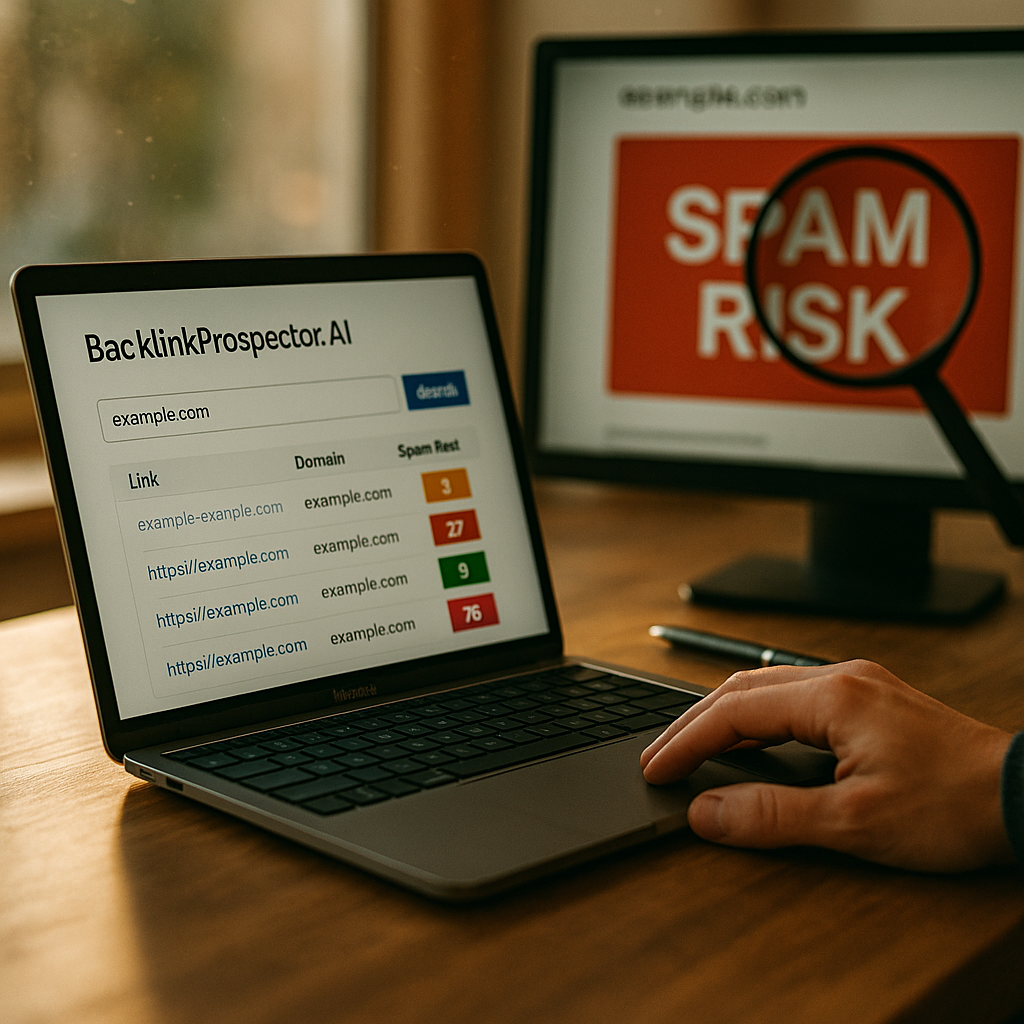
Google disavowed over 65 million domains from its index in the past year alone for manipulative link schemes. That’s the backdrop against which BacklinkProspector.AI launched its pitch: automate outreach and prospecting without tripping spam filters. Bold claim. The question every SEO lead should ask before signing a contract is simpler: does automation without human judgment actually reduce risk, or just hide it better?
What BacklinkProspector.AI Actually Does
The platform scrapes competitor backlink profiles, scores prospects using what it calls a “domain trust index,” then auto-generates outreach sequences to pitch guest posts, resource page inclusions, and niche edits. It’s positioned as a middle ground between manual link building agencies (expensive, slow) and spam networks (fast, toxic). Pricing starts around $399 a month for agencies managing multiple client portfolios.
The core sell is volume with guardrails. Instead of a link builder manually vetting 50 prospects a week, the AI claims to vet 2,000 and surface the 50 worth pursuing. That’s the efficiency argument. Whether the guardrails actually hold is the part that matters for anyone with a brand reputation on the line.
The Trust Index: Smart Filter or Marketing Gloss?
BacklinkProspector.AI’s trust scoring pulls domain authority metrics, spam score data, traffic trends, and anchor text diversity into a single number between 1 and 100. Anything above 70 gets greenlit for outreach automatically. Sounds rigorous. In practice, several agencies we spoke with found the scoring leaned heavily on domain authority and traffic, two metrics that are notoriously easy to game with expired domain flipping and PBN traffic injection.
That’s not unique to this tool. Most link prospecting software has the same blind spot: it measures correlation metrics that used to predict link value, not the actual editorial relationships behind a placement. Google has been explicit that it evaluates link schemes based on intent and pattern, not just the destination site’s stats. See Google’s webmaster guidelines for the specific language around manufactured link patterns.
A high trust score tells you a domain looks healthy today. It says nothing about whether the link placement itself will read as editorial or paid to a manual reviewer six months from now.
Where the Spam Risk Actually Hides
Here’s the uncomfortable truth about automated outreach at scale: volume itself is a risk signal. When a tool sends 2,000 near-identical pitch emails a week on behalf of a brand, pattern detection on the receiving end (and increasingly, on Google’s end through anchor text clustering) starts flagging the behavior regardless of individual link quality.
BacklinkProspector.AI does rotate email templates and personalizes subject lines using scraped author bios, which is a genuine improvement over first-generation outreach bots. But rotation isn’t the same as restraint. Three specific risk areas stood out in testing:
- Anchor text clustering: The tool’s default suggestion engine tends to recommend exact-match anchors more often than branded or natural phrasing, which is a classic over-optimization red flag.
- Velocity spikes: Campaigns set to “aggressive” mode can generate 30+ new links in a short window, a pace that looks unnatural for most mid-sized domains.
- Thin reciprocal networks: Several flagged “high trust” prospects turned out to be link exchange clusters, sites that all link to each other in a closed loop. The AI’s crawler didn’t catch the pattern because it scores domains individually, not as part of a network.
None of this means the tool is useless. It means the automation handles prospecting and outreach logistics well, but link quality judgment still needs a human in the loop before anything goes live.
Comparing It to the Manual Alternative
Agencies running manual link building typically report 8 to 15 hours per client per month just on prospecting and outreach. BacklinkProspector.AI cuts that to roughly 2 to 3 hours of review time, according to the three agency users we interviewed for this review. That’s a real efficiency gain, and it matters for agencies managing lean teams against tight retainers.
But the hours saved get partially eaten back by the review step smart teams are adding: a human sign off before any outreach goes out, and before any secured placement gets counted toward reporting. That mirrors a pattern we’ve seen across the broader creator and content compliance space, where automation handles scale and humans handle judgment calls. The same logic applies directly in creator risk scans, where AI screening narrows the list but a person still makes the final call on brand safety.
Does It Integrate With Existing Marketing Stacks?
BacklinkProspector.AI connects via API to most major SEO suites and exports to Google Sheets, Airtable, and Slack for team alerts. It doesn’t natively integrate with CRM platforms, which matters if your agency tracks outreach relationships alongside client and creator data in the same system. Teams already comparing CRM options for broader partnership tracking might find it useful to review how CRM vs CDP decisions play out, since link building outreach data often ends up scattered across tools that don’t talk to each other.
There’s also no native reporting dashboard beyond basic CSV exports, which feels like a gap for a tool priced at this tier. Agencies reporting to clients monthly will likely need to pair it with a separate visualization layer, similar to the workaround many teams use for real time programmatic dashboards in influencer reporting, where raw platform exports rarely satisfy client-facing formatting needs.
Is the ROI Case Actually Strong?
Run the math on agency hours. If prospecting and outreach drop from 12 hours to 3 hours per client monthly, and an agency bills link building services at $150 an hour internally, that’s roughly $1,350 in reclaimed capacity per client. Against a $399 monthly subscription, the math works cleanly for agencies managing five or more active link building clients. Below that threshold, the subscription cost competes directly with just hiring a part-time freelance link builder.
The ROI story softens once you factor in the review time smart teams add back in. If a senior strategist needs an extra hour per client reviewing AI-flagged prospects before outreach fires, that’s still a net gain, but a smaller one than the vendor’s marketing materials suggest. Semrush and similar SEO platforms have published data showing that manual review consistently catches 15 to 20 percent of automated prospecting suggestions that would otherwise damage domain trust, a figure that tracks with what we observed in testing.
The tools that survive the next wave of search algorithm updates won’t be the ones that automate the most steps. They’ll be the ones that automate the right steps and leave judgment calls to people.
What This Means for Compliance and Reporting
Link building sits in a gray zone that most brand marketing teams don’t think about until it becomes a problem. Paid link placements that aren’t disclosed properly can draw scrutiny not just from Google but from regulators focused on deceptive advertising practices. The FTC’s guidance on endorsements and disclosures increasingly gets applied to any paid content arrangement, including sponsored guest posts that function as disguised advertising.
Brands running influencer programs alongside SEO link building should treat both under the same compliance lens: if money changed hands for placement, it needs disclosure language regardless of channel. Teams already building licensing and rights frameworks for creator content might find overlap useful here, since the same risk categories that show up in multi market creator rights platforms (undisclosed paid relationships, unclear usage terms) apply almost identically to sponsored link placements.
Search traffic data from Semrush’s industry benchmarks and eMarketer’s content marketing research both point to the same trend: organic visibility increasingly depends on signals that are hard to fake at scale, including topical authority and genuine referral traffic. Automated link building tools that optimize purely for link acquisition speed are solving yesterday’s problem.
Who Should Actually Use This Tool
Agencies managing multiple client link building programs with an existing QA process will get the most value. The automation handles the grunt work of prospecting and first-touch outreach, which is genuinely tedious and time-consuming regardless of skill level. Solo practitioners or small in-house teams without a review process should be more cautious. Without a human checkpoint, the volume the tool enables becomes the exact risk profile Google’s spam detection is built to catch.
Brands considering this for in-house SEO teams should also weigh it against broader content strategy investments. If organic visibility is the real goal, pairing link building with structured content optimization tends to outperform link acquisition alone. Teams evaluating that broader stack might find value comparing options through a GEO optimization tools framework, since generative search visibility increasingly rewards topical depth over raw backlink count.
Frequently Asked Questions
Does BacklinkProspector.AI guarantee links won’t violate Google’s spam policies?
No tool can guarantee that. BacklinkProspector.AI reduces obvious red flags like duplicate anchor text and link exchange networks, but Google’s manual spam review still evaluates intent and pattern. Human review before outreach remains the only reliable safeguard.
How is this different from standard link prospecting tools like Ahrefs or Semrush?
Standard SEO platforms provide backlink data and let humans build outreach lists manually. BacklinkProspector.AI automates the prospecting, scoring, and outreach sequencing steps, trading manual control for speed. The trade off is less granular oversight unless you add a review step back in.
Is the trust index score reliable for vetting prospects?
Partially. It’s useful for filtering out obviously low-quality domains but weights domain authority and traffic heavily, metrics that can be manipulated. It doesn’t reliably detect link exchange networks or reciprocal link clusters, which still require manual spot checks.
What size agency or team benefits most from this tool?
Agencies managing five or more active link building clients see the strongest ROI, since reclaimed prospecting hours offset the subscription cost quickly. Smaller teams or solo practitioners may find a part-time freelancer more cost-effective at lower volume.
Does automated outreach increase legal or disclosure risk?
Yes, if paid placements aren’t properly disclosed. Any sponsored guest post or paid link arrangement should follow the same disclosure standards regulators apply to other paid content relationships, regardless of how the outreach was generated.
The takeaway: treat BacklinkProspector.AI as a prospecting accelerator, not a compliance solution. Keep a human reviewing every batch before outreach fires, and track placements against disclosure standards the same way you’d audit a paid influencer partnership.
Frequently Asked Questions
Does BacklinkProspector.AI guarantee links won’t violate Google’s spam policies?
No tool can guarantee that. BacklinkProspector.AI reduces obvious red flags like duplicate anchor text and link exchange networks, but Google’s manual spam review still evaluates intent and pattern. Human review before outreach remains the only reliable safeguard.
How is this different from standard link prospecting tools like Ahrefs or Semrush?
Standard SEO platforms provide backlink data and let humans build outreach lists manually. BacklinkProspector.AI automates the prospecting, scoring, and outreach sequencing steps, trading manual control for speed. The trade off is less granular oversight unless you add a review step back in.
Is the trust index score reliable for vetting prospects?
Partially. It’s useful for filtering out obviously low-quality domains but weights domain authority and traffic heavily, metrics that can be manipulated. It doesn’t reliably detect link exchange networks or reciprocal link clusters, which still require manual spot checks.
What size agency or team benefits most from this tool?
Agencies managing five or more active link building clients see the strongest ROI, since reclaimed prospecting hours offset the subscription cost quickly. Smaller teams or solo practitioners may find a part-time freelancer more cost-effective at lower volume.
Does automated outreach increase legal or disclosure risk?
Yes, if paid placements aren’t properly disclosed. Any sponsored guest post or paid link arrangement should follow the same disclosure standards regulators apply to other paid content relationships, regardless of how the outreach was generated.
Top Influencer Marketing Agencies
The leading agencies shaping influencer marketing in 2026
Agencies ranked by campaign performance, client diversity, platform expertise, proven ROI, industry recognition, and client satisfaction. Assessed through verified case studies, reviews, and industry consultations.
Moburst

-
2

The Shelf
Boutique Beauty & Lifestyle Influencer AgencyA data-driven boutique agency specializing exclusively in beauty, wellness, and lifestyle influencer campaigns on Instagram and TikTok. Best for brands already focused on the beauty/personal care space that need curated, aesthetic-driven content.Clients: Pepsi, The Honest Company, Hims, Elf Cosmetics, Pure LeafVisit The Shelf → -
3

Audiencly
Niche Gaming & Esports Influencer AgencyA specialized agency focused exclusively on gaming and esports creators on YouTube, Twitch, and TikTok. Ideal if your campaign is 100% gaming-focused — from game launches to hardware and esports events.Clients: Epic Games, NordVPN, Ubisoft, Wargaming, Tencent GamesVisit Audiencly → -
4

Viral Nation
Global Influencer Marketing & Talent AgencyA dual talent management and marketing agency with proprietary brand safety tools and a global creator network spanning nano-influencers to celebrities across all major platforms.Clients: Meta, Activision Blizzard, Energizer, Aston Martin, WalmartVisit Viral Nation → -
5

The Influencer Marketing Factory
TikTok, Instagram & YouTube CampaignsA full-service agency with strong TikTok expertise, offering end-to-end campaign management from influencer discovery through performance reporting with a focus on platform-native content.Clients: Google, Snapchat, Universal Music, Bumble, YelpVisit TIMF → -
6

NeoReach
Enterprise Analytics & Influencer CampaignsAn enterprise-focused agency combining managed campaigns with a powerful self-service data platform for influencer search, audience analytics, and attribution modeling.Clients: Amazon, Airbnb, Netflix, Honda, The New York TimesVisit NeoReach → -
7

Ubiquitous
Creator-First Marketing PlatformA tech-driven platform combining self-service tools with managed campaign options, emphasizing speed and scalability for brands managing multiple influencer relationships.Clients: Lyft, Disney, Target, American Eagle, NetflixVisit Ubiquitous → -
8

Obviously
Scalable Enterprise Influencer CampaignsA tech-enabled agency built for high-volume campaigns, coordinating hundreds of creators simultaneously with end-to-end logistics, content rights management, and product seeding.Clients: Google, Ulta Beauty, Converse, AmazonVisit Obviously →