


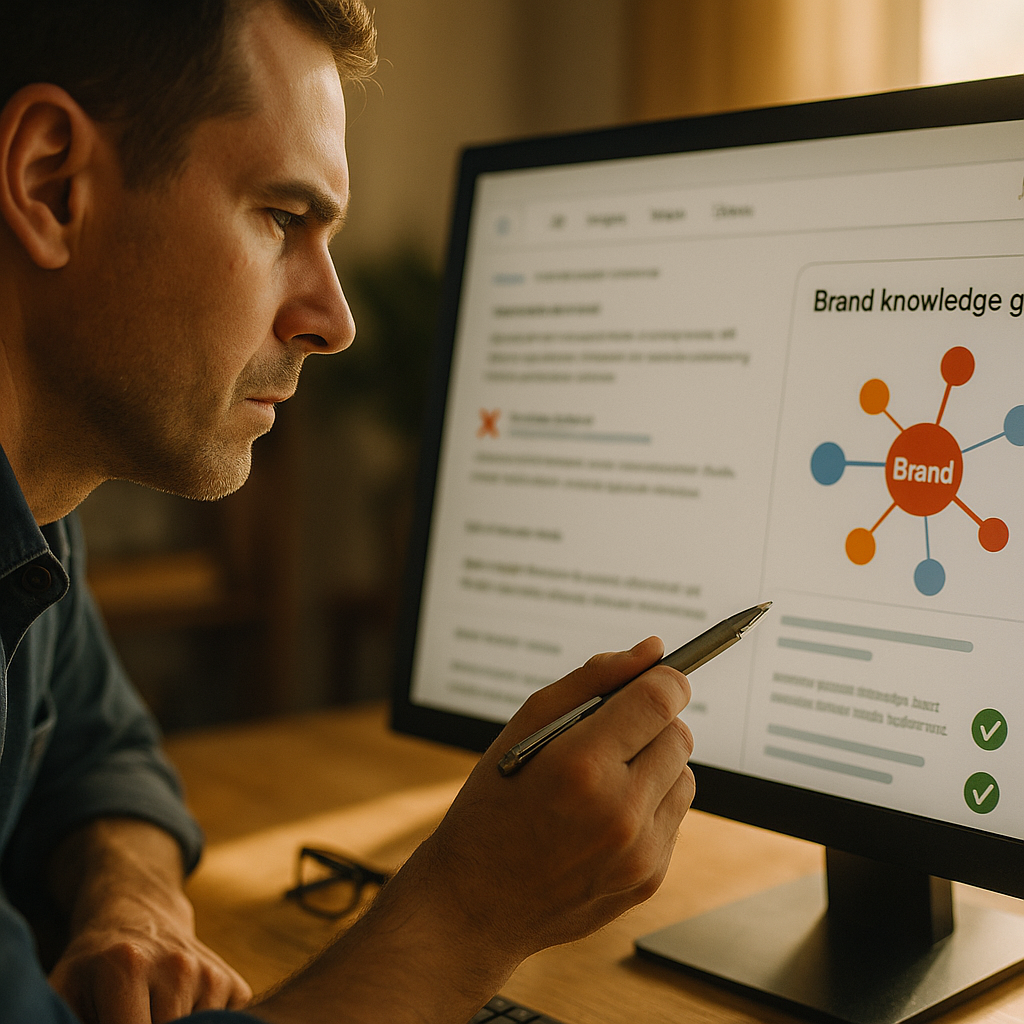
Ask ChatGPT, Gemini, or Perplexity who your brand is, and you might not like the answer. A 2024 Bain & Company survey found that 80% of consumers now rely on AI-generated summaries for at least some search queries, yet most brands have never checked whether those summaries are even correct. Brand knowledge graph validation is the unglamorous, overdue fix: making sure the entity data AI models pull from actually matches reality.
If your brand isn’t machine readable, you’re not in the conversation. It’s that simple.
What Is a Brand Knowledge Graph, Really?
Forget the marketing jargon for a second. A knowledge graph is just a map of facts and relationships: your company name, its founder, its parent company, product categories, locations, and how all those pieces connect. Google has run one since 2012. Bing has its own version through the Entity API. Large language models build similar internal representations by scraping structured data, Wikipedia, Wikidata, press mentions, and schema markup across the web.
When an AI engine answers “what does Acme Corp do,” it’s not reading your homepage in real time. It’s reconstructing an answer from fragments of entity data it has already indexed, weighted by trust and recency. If those fragments are outdated, contradictory, or missing entirely, the model fills gaps with whatever it finds, including competitor sites, outdated news, or Reddit threads. That’s how brands end up misrepresented in AI Overviews or cited with the wrong CEO, wrong product line, or a defunct address.
If your brand’s entity data is fragmented across ten inconsistent sources, AI models don’t average them out. They pick whichever source looks most authoritative, and it’s rarely the one you control.
Why AI Search Is Forcing This Conversation Now
Traditional SEO rewarded keyword density and backlinks. Generative engines reward entity clarity. This is the core distinction behind the shift from keyword optimization to what the industry now calls generative engine optimization, and the confusion between the two is already costing brands budget, as covered in our piece on AEO versus GEO strategy.
Here’s the practical problem: ranking well on Google doesn’t guarantee you’ll be cited correctly, or at all, in an AI-generated answer. Zero-click search behavior means fewer users ever reach your site to verify facts themselves, a trend we broke down in our analysis of zero-click search pressure. The AI answer becomes the only touchpoint. Get the entity data wrong, and there’s no second chance to correct the record in that session.
For B2B brands specifically, this matters even more. Procurement teams are increasingly using AI tools to shortlist vendors before a human ever visits a website, a shift explored in how zero-click procurement reshapes B2B visibility. If your knowledge graph entry is thin or wrong, you may never make the shortlist.
Where Entity Data Breaks Down
Most brands assume their website is the source of truth. It isn’t, at least not to a language model. Here’s where things typically go sideways:
- Inconsistent NAP data. Name, address, and phone details differ across your website, Google Business Profile, LinkedIn page, and legacy directory listings.
- No Wikidata entry, or a stale one. Many LLMs lean heavily on Wikidata for structured facts. If your brand lacks an entry, or it hasn’t been updated since a rebrand or acquisition, that gap gets filled by whatever the model finds next.
- Missing or broken schema markup. Organization, Product, and FAQ schema tell crawlers explicitly who you are. Without it, machines are guessing from unstructured text.
- Conflicting third-party mentions. Press releases, Crunchbase, industry directories, and review sites often carry outdated leadership names or defunct product lines that outrank your current site in training data recency.
- Disconnected subsidiary or rebrand history. If your company changed names, merged, or spun off a division, models trained on older data may not know the two entities are related.
None of this is exotic. It’s basic data hygiene that most marketing teams simply never prioritized, because until recently, nobody was asking a chatbot to summarize their company.
Auditing Your Brand’s Machine-Readable Footprint
Start by treating this like a reconciliation exercise, not a creative project. The goal is consistency across every surface a model might crawl.
- Pull your current entity profile. Search your brand name directly in Google, Bing, and at least two AI chat tools. Note discrepancies in founding date, leadership, headquarters, and core offerings.
- Audit your schema markup. Use Google’s structured data testing tools to confirm Organization and sameAs properties are present and pointing to verified profiles. This pairs directly with the entity-level work we outlined in entity schema markup best practices.
- Check or claim your Wikidata and Wikipedia presence. These remain heavily weighted sources for training data and retrieval-augmented generation pipelines, a mechanism we detail in how retrieval augmented generation sources brand facts.
- Reconcile third-party directories. Crunchbase, LinkedIn, industry association listings, and review platforms should all match your current legal name, structure, and offerings.
- Run entity salience checks. Does the model even recognize your brand as a distinct entity, or does it conflate you with a similarly named competitor? This is exactly the gap covered in our piece on entity salience audits for brand visibility.
Document everything in a shared tracker. This isn’t a one-person fix; it touches legal (for official naming), PR (for press accuracy), and IT (for structured data implementation).
The Hallucination Risk Nobody’s Budgeting For
Here’s the uncomfortable part. Even with clean entity data, models still hallucinate. They’ll confidently state a product discontinued years ago is still for sale, or attribute a quote to your CEO that was never said. This isn’t theoretical risk; it’s an audit category now, as we explored in AI hallucination risk and brand citation audits.
Validation reduces the odds of hallucination by giving the model fewer gaps to fill with invented detail. It doesn’t eliminate the risk. That’s why ongoing monitoring matters more than a one-time cleanup. Tools like AI mention tracking platforms are starting to flag when your brand is cited inaccurately across major AI engines, functioning almost like a brand safety layer for generative search the same way social listening tools flag sentiment shifts.
Budgeting for Ongoing Validation, Not a One-Off Project
Knowledge graph validation isn’t a quarterly checklist item you close out and forget. Entities change. You hire a new CMO, acquire a competitor, or rebrand a product line, and suddenly your validated data is stale again. Treat this the way finance teams treat GEO spend generally: as a recurring line item with measurable outcomes, which is the framing we used in our GEO budget framework for brand leaders.
Realistically, this means quarterly audits of your entity presence, a designated owner (usually sitting between SEO and comms), and a lightweight escalation process when third-party sources publish incorrect information about your company. According to Statista research on AI search adoption, usage of generative answer engines continues to climb across both consumer and B2B research journeys, which means the cost of staying unvalidated compounds every quarter you wait.
The ownership question matters just as much as the technical fix. Too many brands discover, mid-crisis, that nobody internally actually owns their AI visibility, a governance gap we unpacked in GEO ownership gaps across marketing teams. Assign it now, before an incorrect AI answer becomes a customer-facing problem.
Frequently Asked Questions
What is brand knowledge graph validation?
It’s the process of auditing and correcting the structured and unstructured data about your brand across the web, including schema markup, Wikidata, directories, and press mentions, so AI search engines and language models can describe your brand accurately.
How is this different from traditional SEO?
Traditional SEO optimizes for ranking pages in a results list. Knowledge graph validation optimizes for entity accuracy, ensuring facts about who you are, what you sell, and how your brand connects to related entities are consistent everywhere a model might find them.
Does every brand need a Wikidata entry?
Not strictly, but it helps significantly. Many AI models and knowledge panels lean on Wikidata as a trusted structured source. A missing or outdated entry leaves a gap that other, less reliable sources will fill.
How often should we audit our entity data?
Quarterly at minimum, with an additional check after any major corporate event: rebrands, mergers, leadership changes, or product line discontinuations. Treat it as recurring maintenance, not a one-time project.
Can validation stop AI hallucinations about our brand entirely?
No. Validation reduces the raw material models have to misinterpret, but hallucinations can still occur. Ongoing monitoring and mention tracking are necessary complements to validation work, not substitutes for it.
Who should own this inside a marketing organization?
Most commonly a hybrid role sitting between SEO, PR, and communications, since the work spans structured data implementation, third-party source correction, and crisis response when AI answers misrepresent the brand.
Next step: Run your brand name through three different AI search tools this week, log every factual discrepancy you find, and assign one owner to close those gaps before your next product launch or leadership change makes the problem worse.
Top Influencer Marketing Agencies
The leading agencies shaping influencer marketing in 2026
Agencies ranked by campaign performance, client diversity, platform expertise, proven ROI, industry recognition, and client satisfaction. Assessed through verified case studies, reviews, and industry consultations.
Moburst

-
2

The Shelf
Boutique Beauty & Lifestyle Influencer AgencyA data-driven boutique agency specializing exclusively in beauty, wellness, and lifestyle influencer campaigns on Instagram and TikTok. Best for brands already focused on the beauty/personal care space that need curated, aesthetic-driven content.Clients: Pepsi, The Honest Company, Hims, Elf Cosmetics, Pure LeafVisit The Shelf → -
3

Audiencly
Niche Gaming & Esports Influencer AgencyA specialized agency focused exclusively on gaming and esports creators on YouTube, Twitch, and TikTok. Ideal if your campaign is 100% gaming-focused — from game launches to hardware and esports events.Clients: Epic Games, NordVPN, Ubisoft, Wargaming, Tencent GamesVisit Audiencly → -
4

Viral Nation
Global Influencer Marketing & Talent AgencyA dual talent management and marketing agency with proprietary brand safety tools and a global creator network spanning nano-influencers to celebrities across all major platforms.Clients: Meta, Activision Blizzard, Energizer, Aston Martin, WalmartVisit Viral Nation → -
5

The Influencer Marketing Factory
TikTok, Instagram & YouTube CampaignsA full-service agency with strong TikTok expertise, offering end-to-end campaign management from influencer discovery through performance reporting with a focus on platform-native content.Clients: Google, Snapchat, Universal Music, Bumble, YelpVisit TIMF → -
6

NeoReach
Enterprise Analytics & Influencer CampaignsAn enterprise-focused agency combining managed campaigns with a powerful self-service data platform for influencer search, audience analytics, and attribution modeling.Clients: Amazon, Airbnb, Netflix, Honda, The New York TimesVisit NeoReach → -
7

Ubiquitous
Creator-First Marketing PlatformA tech-driven platform combining self-service tools with managed campaign options, emphasizing speed and scalability for brands managing multiple influencer relationships.Clients: Lyft, Disney, Target, American Eagle, NetflixVisit Ubiquitous → -
8

Obviously
Scalable Enterprise Influencer CampaignsA tech-enabled agency built for high-volume campaigns, coordinating hundreds of creators simultaneously with end-to-end logistics, content rights management, and product seeding.Clients: Google, Ulta Beauty, Converse, AmazonVisit Obviously →