


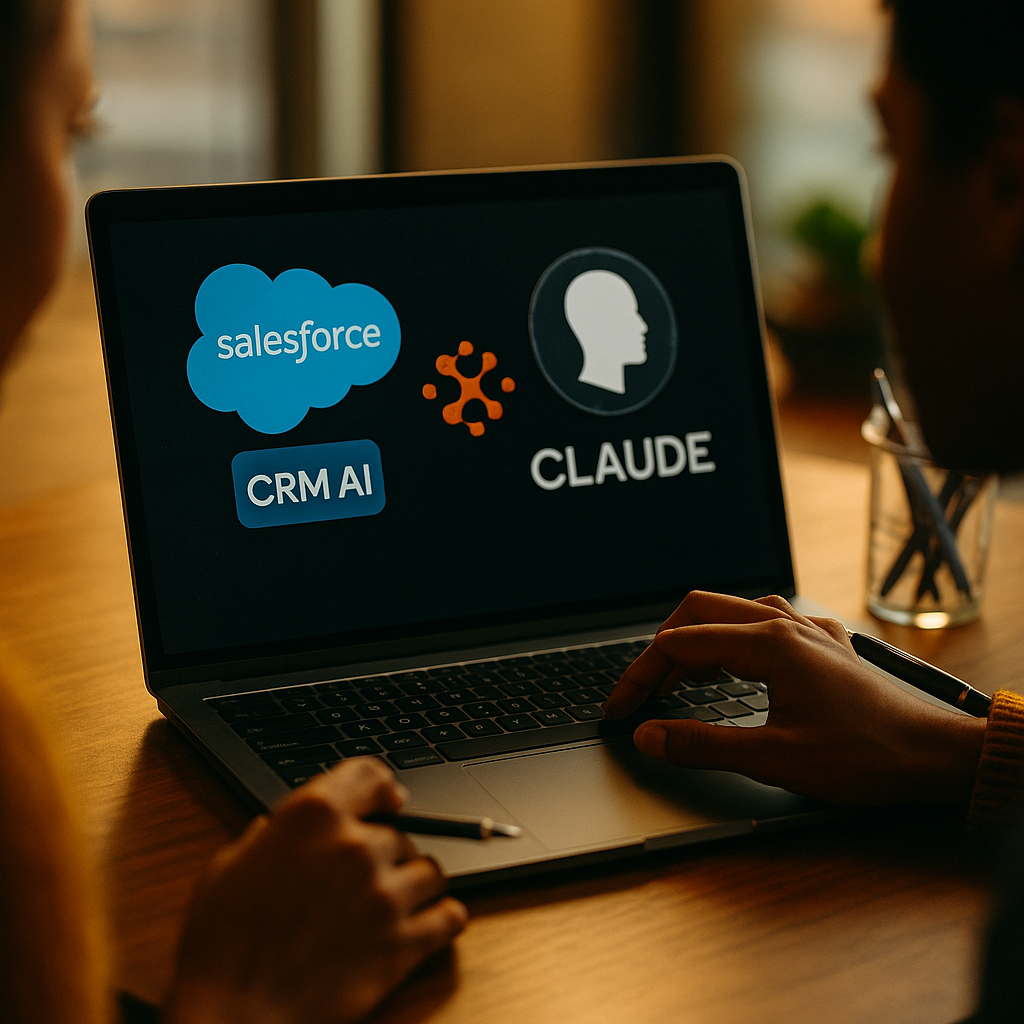
Only 21% of marketers trust their CRM data enough to let AI act on it. Salesforce just made a $30 billion bet that Anthropic’s Claude, wired directly into Dun & Bradstreet’s Commercial Graph, can fix that. Call it Claudeforce: a CRM-native AI agent layer that leans on third-party firmographic data to validate what your sales and marketing teams already have in Salesforce. For brand teams tired of chasing bad account data, this is the first serious attempt to close the gap between “data we have” and “data we can act on.”
The question isn’t whether AI agents are coming to your CRM. They’re already there. The question is whether the data underneath them is good enough to trust with autonomous decisions — lead routing, account scoring, budget allocation, even outreach personalization. That’s where the D&B Commercial Graph integration gets interesting.
What Claudeforce Actually Is
Claudeforce is Salesforce’s branding for the deep integration of Anthropic’s Claude models across Agentforce, its agentic AI platform. Instead of Claude acting as a bolt-on chatbot, it’s embedded into workflows: reading CRM records, cross-referencing external data sources, and taking action inside Sales Cloud, Service Cloud, and Marketing Cloud. Salesforce has pushed hard into agentic AI over the past two years, and this partnership signals it wants a foundation model partner with a stronger reasoning track record than what it had leaning solely on its own Einstein stack.
The Dun & Bradstreet piece matters more than the headline suggests. D&B’s Commercial Graph covers hundreds of millions of business records globally, mapping corporate hierarchies, ownership structures, and firmographic signals that most CRMs simply don’t capture on their own. When Claude agents inside Salesforce need to verify whether “Acme Corp” in your pipeline is the same entity as the “Acme Corporation LLC” a rep entered manually six months ago, that’s a Commercial Graph lookup, not a guess.
Brand and marketing teams have spent a decade treating CRM data as a given. Agentic AI treats it as a liability if it’s wrong — because now the data doesn’t just sit there, it drives autonomous decisions at machine speed.
Why Data Accuracy Suddenly Has Teeth
Bad CRM data used to be an annoyance. A rep would notice a duplicate account, roll their eyes, and move on. Marketing would send a campaign to a stale contact list and shrug off the bounce rate. Nobody died. Nothing broke.
Autonomous AI agents change that calculus entirely. If a Claudeforce agent scores an account as high-intent based on a bad firmographic match — wrong industry code, outdated employee count, a subsidiary mistaken for a parent company — it can trigger real actions: reallocating ad spend, prioritizing outreach, adjusting a lead score that feeds directly into your marketing automation. Multiply that by thousands of accounts running through agentic workflows daily, and small data errors compound into meaningfully bad decisions before a human ever notices.
This is the exact problem Influencers Time covered in our root-cause analysis of CRM trust gaps: most brands haven’t fixed their underlying data hygiene, they’ve just added AI on top of it. Layering agentic decision-making onto unverified records doesn’t fix the rot. It just makes the rot move faster.
The Commercial Graph as a Trust Layer
D&B’s pitch has always been entity resolution at scale: knowing that a company’s legal name, DBA, subsidiary structure, and trade name all point to one real-world business. For brand teams running account-based marketing, this solves a headache that’s existed since the CRM was invented. Sales enters one version of a company name. Marketing’s list vendor has another. The events team has a third from a badge scan. None of them match cleanly, and every attempt at unified reporting turns into a manual reconciliation project.
By having Claude agents query the Commercial Graph in real time, Salesforce is effectively outsourcing entity resolution to a third party with decades of firmographic data and a global compliance function tracking corporate changes, mergers, and bankruptcies. That’s not a small thing. It’s the difference between an AI agent guessing at company hierarchy and an AI agent checking a maintained, audited source of record.
Does that mean your CRM data problems disappear? No. Garbage inputs from your own sales team, unstructured notes, mismatched custom fields, still need internal governance. But it does mean the external validation layer, the part brands have historically had to buy from separate vendors like ZoomInfo or Clearbit, is now native to the agent’s decision loop.
What This Means for Marketing Ops, Not Just Sales
Most of the initial coverage on Claudeforce has focused on sales use cases: lead scoring, opportunity management, forecast accuracy. But the marketing implications are arguably bigger, especially for B2B brands running account-based programs.
- Segmentation accuracy improves at the source. If firmographic data is verified against D&B before it hits your ABM segments, you stop wasting spend targeting misclassified accounts.
- Attribution gets less noisy. Duplicate or mismatched account records have always muddied multi-touch attribution models. Cleaner entity resolution means fewer phantom accounts skewing pipeline reporting.
- Personalization at scale becomes less risky. Claude agents drafting outreach or dynamic content based on firmographic context are only as good as that context. A verified company size and industry code beats a stale CRM field every time.
This connects directly to the CRM monitoring conversation we covered in our piece on real-time CRM monitoring and AI readiness. Real-time validation against an external graph is one way to operationalize that fix, rather than just recommending it.
The Risk Side Nobody’s Talking About Enough
Here’s the part that should give brand and legal teams pause. When you plug a third-party data graph into an agentic AI system, you’re inheriting D&B’s data accuracy and update cadence as your own operational risk. If D&B’s records lag on a recent acquisition, your Claude agent inherits that lag. If there’s a licensing dispute or API rate limit issue between Salesforce and D&B down the line, workflows built on that dependency could degrade without much warning.
There’s also the question of data provenance and compliance. Marketers operating under GDPR or similar frameworks need to understand where firmographic enrichment data comes from and how it’s processed when an AI agent uses it to make a decision about a real contact or account. This isn’t hypothetical: regulators have already signaled scrutiny of automated decision-making in marketing and sales contexts. The FTC and the UK’s ICO have both flagged automated profiling as an area of growing enforcement interest, and B2B firmographic enrichment isn’t automatically exempt just because it’s not consumer data.
Brands should be asking their Salesforce reps pointed questions right now: What’s the audit trail when a Claude agent makes a decision based on Commercial Graph data? Can that decision be reconstructed and explained if a client or regulator asks? If the answer is “we’re still figuring that out,” that’s useful information too.
How This Compares to Other Agentic AI Moves in Martech
Salesforce isn’t alone in racing toward agentic AI with better grounding. Adobe has been pushing its own autonomous agents into marketing workflows, which we broke down in our analysis of Adobe’s virtual workers and what they mean for org design. Anthropic itself has been expanding enterprise retrieval capabilities well beyond the Salesforce deal, a trend we compared directly in Claude for Enterprise versus OpenAI’s retrieval tools.
The pattern across all of these moves is consistent: foundation model providers are realizing that raw reasoning power means nothing without clean, contextual, verifiable data to reason over. Zig.ai’s forward deployment model and knowledge graph approach, which we’ve compared against traditional CDPs, reflects the same underlying shift. Vendors are competing less on model quality alone and more on how well they can ground that model in trustworthy enterprise data.
That’s a good thing for brands, generally. It means data accuracy is finally being treated as a product feature rather than an IT afterthought. But it also means procurement and marketing ops teams need new evaluation criteria. It’s no longer enough to ask “how good is the AI.” You have to ask “how good, current, and auditable is the data the AI is reasoning over,” and “what happens when that data source has a bad day.”
A Practical Checklist Before You Lean In
- Audit how many of your active accounts currently have mismatched or duplicate firmographic records in Salesforce.
- Ask your Salesforce or D&B rep for documentation on data refresh cadence and error correction SLAs.
- Pilot Claude-driven scoring or segmentation on a limited account set before rolling it into always-on campaigns.
- Build a human review checkpoint for any AI-driven decision above a defined spend or pipeline-value threshold.
- Document your data lineage now, before a compliance question forces you to reconstruct it under pressure.
None of this is groundbreaking governance advice. It’s the same discipline brands should already apply to any AI system making autonomous decisions with real budget attached, a theme we’ve explored in our human override framework for AI media buying. Claudeforce just raises the stakes because the decisions now touch account-level data that feeds nearly every downstream marketing and sales motion.
Industry analysts tracking enterprise AI spend, including recent commentary from eMarketer, have noted that data quality investment is increasingly outpacing model spend as enterprises get burned by AI systems built on shaky foundations. Salesforce betting on D&B is a tacit admission of the same lesson: the model was never the bottleneck. The data was.
Don’t roll out Claudeforce-driven segmentation or scoring to your full account base on day one. Run it against a 90-day pilot cohort, compare AI-verified firmographic matches against your existing CRM records by hand, and only scale once the error rate is low enough that a human wouldn’t catch something the AI missed.
FAQs
What is Claudeforce?
Claudeforce refers to Salesforce’s deep integration of Anthropic’s Claude models into its Agentforce platform, embedding AI agents directly into CRM workflows across Sales Cloud, Service Cloud, and Marketing Cloud rather than treating AI as a separate chatbot layer.
How does the D&B Commercial Graph improve CRM data accuracy?
The Commercial Graph provides verified firmographic and entity-resolution data covering corporate hierarchies, subsidiaries, and business identifiers. When Claude agents query it in real time, they can validate or correct CRM records instead of acting on unverified, manually entered data.
Does this fix all CRM data quality problems?
No. It addresses external validation, like confirming a company’s legal structure or industry classification, but internal data hygiene issues such as duplicate entries, inconsistent custom fields, or unstructured notes still require dedicated governance from the brand’s own teams.
What risks should marketing teams consider before adopting agentic CRM tools?
Key risks include dependency on third-party data refresh cycles, lack of audit trails for AI-driven decisions, and compliance exposure if automated profiling touches contact-level data under frameworks like GDPR. Teams should pilot on a limited account set and document data lineage before scaling.
How is this different from existing data enrichment tools like ZoomInfo or Clearbit?
Those tools typically function as separate enrichment layers marketers query manually or through integrations. Claudeforce embeds Commercial Graph validation directly into the AI agent’s decision-making loop inside the CRM, so the verification happens automatically as part of autonomous actions, not as a manual lookup step.
FAQs
What is Claudeforce?
Claudeforce refers to Salesforce’s deep integration of Anthropic’s Claude models into its Agentforce platform, embedding AI agents directly into CRM workflows across Sales Cloud, Service Cloud, and Marketing Cloud rather than treating AI as a separate chatbot layer.
How does the D&B Commercial Graph improve CRM data accuracy?
The Commercial Graph provides verified firmographic and entity-resolution data covering corporate hierarchies, subsidiaries, and business identifiers. When Claude agents query it in real time, they can validate or correct CRM records instead of acting on unverified, manually entered data.
Does this fix all CRM data quality problems?
No. It addresses external validation, like confirming a company’s legal structure or industry classification, but internal data hygiene issues such as duplicate entries, inconsistent custom fields, or unstructured notes still require dedicated governance from the brand’s own teams.
What risks should marketing teams consider before adopting agentic CRM tools?
Key risks include dependency on third-party data refresh cycles, lack of audit trails for AI-driven decisions, and compliance exposure if automated profiling touches contact-level data under frameworks like GDPR. Teams should pilot on a limited account set and document data lineage before scaling.
How is this different from existing data enrichment tools like ZoomInfo or Clearbit?
Those tools typically function as separate enrichment layers marketers query manually or through integrations. Claudeforce embeds Commercial Graph validation directly into the AI agent’s decision-making loop inside the CRM, so the verification happens automatically as part of autonomous actions, not as a manual lookup step.
Top Influencer Marketing Agencies
The leading agencies shaping influencer marketing in 2026
Agencies ranked by campaign performance, client diversity, platform expertise, proven ROI, industry recognition, and client satisfaction. Assessed through verified case studies, reviews, and industry consultations.
Moburst

-
2

The Shelf
Boutique Beauty & Lifestyle Influencer AgencyA data-driven boutique agency specializing exclusively in beauty, wellness, and lifestyle influencer campaigns on Instagram and TikTok. Best for brands already focused on the beauty/personal care space that need curated, aesthetic-driven content.Clients: Pepsi, The Honest Company, Hims, Elf Cosmetics, Pure LeafVisit The Shelf → -
3

Audiencly
Niche Gaming & Esports Influencer AgencyA specialized agency focused exclusively on gaming and esports creators on YouTube, Twitch, and TikTok. Ideal if your campaign is 100% gaming-focused — from game launches to hardware and esports events.Clients: Epic Games, NordVPN, Ubisoft, Wargaming, Tencent GamesVisit Audiencly → -
4

Viral Nation
Global Influencer Marketing & Talent AgencyA dual talent management and marketing agency with proprietary brand safety tools and a global creator network spanning nano-influencers to celebrities across all major platforms.Clients: Meta, Activision Blizzard, Energizer, Aston Martin, WalmartVisit Viral Nation → -
5

The Influencer Marketing Factory
TikTok, Instagram & YouTube CampaignsA full-service agency with strong TikTok expertise, offering end-to-end campaign management from influencer discovery through performance reporting with a focus on platform-native content.Clients: Google, Snapchat, Universal Music, Bumble, YelpVisit TIMF → -
6

NeoReach
Enterprise Analytics & Influencer CampaignsAn enterprise-focused agency combining managed campaigns with a powerful self-service data platform for influencer search, audience analytics, and attribution modeling.Clients: Amazon, Airbnb, Netflix, Honda, The New York TimesVisit NeoReach → -
7

Ubiquitous
Creator-First Marketing PlatformA tech-driven platform combining self-service tools with managed campaign options, emphasizing speed and scalability for brands managing multiple influencer relationships.Clients: Lyft, Disney, Target, American Eagle, NetflixVisit Ubiquitous → -
8

Obviously
Scalable Enterprise Influencer CampaignsA tech-enabled agency built for high-volume campaigns, coordinating hundreds of creators simultaneously with end-to-end logistics, content rights management, and product seeding.Clients: Google, Ulta Beauty, Converse, AmazonVisit Obviously →