


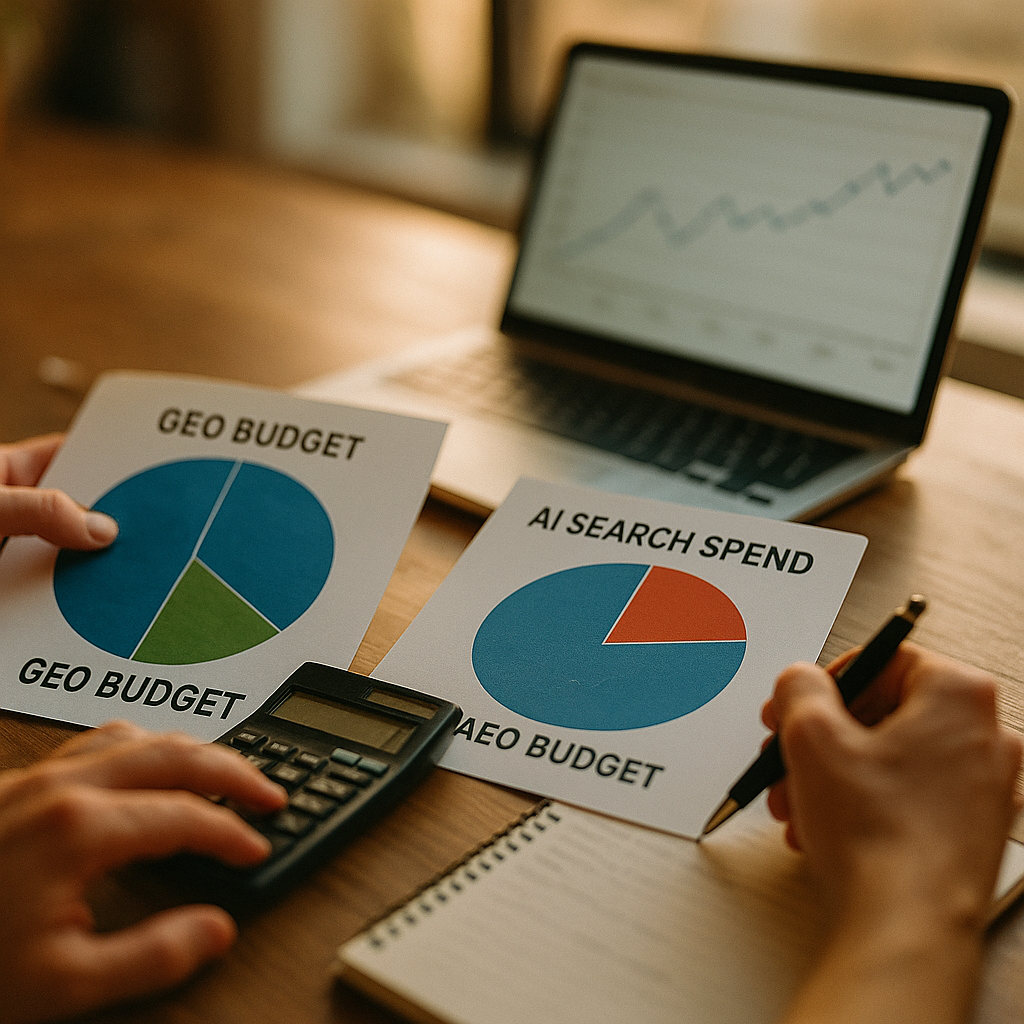
Only 12% of marketers can confidently say they’ve allocated a dedicated budget line for AI search visibility, yet ChatGPT, Perplexity, and Google’s AI Overviews now shape purchase decisions before a single organic link gets clicked. Generative Engine Optimization and Answer Engine Optimization keep getting lumped together in planning decks. They shouldn’t be. Here’s how to split the money.
Two Disciplines Wearing One Trench Coat
Generative Engine Optimization (GEO) is about getting your brand cited, quoted, or recommended inside AI-generated responses — think ChatGPT’s synthesized answers, Google’s AI Overviews, or Perplexity’s sourced summaries. Answer Engine Optimization (AEO) is narrower and older in spirit: structuring content so it directly answers a specific question, often surfacing in featured snippets, voice assistants, or the direct-answer boxes that predate the generative AI boom.
They overlap. A well-structured FAQ page can win both a featured snippet and a citation in an AI Overview. But the mechanics diverge more than most budget owners realize. AEO rewards precision and schema discipline. GEO rewards authority signals, entity consistency, and being the kind of source a language model has learned to trust across millions of training examples.
Treating GEO and AEO as one line item is like budgeting “social media” in 2012 and expecting it to cover both organic community management and paid Facebook ads. The tactics, timelines, and success metrics are fundamentally different.
Why the Distinction Matters for Budget Owners
Marketing leaders are under pressure to prove AI search ROI without a clean attribution model. Zero-click search is already breaking traditional GA4 attribution, and finance teams still want a defensible number attached to every dollar. If you can’t separate GEO spend from AEO spend, you can’t tell your CFO which one is working.
The two also have wildly different time horizons. AEO tactics — schema markup, direct-answer formatting, structured data — can show measurable snippet wins within weeks. GEO is slower. It depends on how frequently large language models retrain or refresh their retrieval indexes, and on whether your brand has enough third-party mentions to be treated as a credible entity. Budgeting them identically sets false expectations on both sides.
The Practical Split: A 60/40 Starting Point
For most mid-to-senior marketing teams building an AI search budget from scratch, a 60/40 split favoring GEO makes sense — but the ratio should shift based on your industry and current search visibility.
- GEO (55-65% of budget): Digital PR and earned mentions, structured entity data (Wikipedia, Wikidata, Crunchbase profiles), original research and data studies that get cited, and technical work ensuring your content is crawlable by AI retrieval bots (llms.txt, clean semantic HTML, API access where relevant).
- AEO (35-45% of budget): FAQ schema implementation, direct-answer content blocks, conversational query mapping, and voice-search-friendly formatting on existing high-traffic pages.
If you’re in a heavily regulated or B2B category — fintech, healthcare, enterprise SaaS — lean further into GEO. LLMs weight authority and citation density heavily in these spaces, and tracking brand visibility in AI answers becomes the leading indicator that predicts downstream conversion, not the lagging one.
What Actually Moves the Needle in GEO
Forget keyword density. GEO responds to a different signal set entirely. Language models build a probabilistic sense of which brands are authoritative based on co-occurrence: how often your brand name appears near relevant topics, across how many independent domains, and how consistently.
That’s why digital PR has quietly become the backbone of GEO strategy. A single well-placed data study, cited by ten industry publications, does more for your AI Overview presence than a hundred blog posts optimized for a single keyword. Original research works because LLMs favor primary sources when synthesizing answers — it’s the same instinct that made journalists chase exclusive data a decade ago.
Consider how generative search tools are already restructuring how marketing data gets unified for exactly this purpose: consistent entity signals across every touchpoint. If your company name, product descriptions, and executive bios don’t match across your website, LinkedIn, Crunchbase, and press mentions, you’re actively confusing the retrieval layer.
Structured Data Still Does Heavy Lifting
Don’t sleep on the technical layer. Schema.org markup, clean JSON-LD implementation, and an accessible llms.txt file all make it easier for AI crawlers to parse and trust your content. This is unglamorous work. It also happens to be some of the highest-ROI spend in the entire GEO budget because it’s a one-time technical investment rather than an ongoing content commitment.
AEO: Smaller Budget, Faster Feedback Loop
AEO is where marketing teams can show quick wins to skeptical stakeholders. Structuring a support page as a clear Q&A, adding FAQPage schema, and matching content format to actual query intent can lift featured snippet capture within a single reporting cycle.
The discipline required here is intent-mapping. Pull your actual customer service queries, your sales team’s most common objections, and your site search logs. Those are your AEO content briefs, not your keyword tool’s “questions” tab, which is often stale or generic. A tested content framework for AI answer engines starts with real customer language, not assumed search behavior.
One thing that trips up teams: AEO success on Google’s traditional SERP features doesn’t automatically transfer to AI chat interfaces. A snippet win on Google doesn’t guarantee a citation in ChatGPT’s response to the same question, because the retrieval and ranking logic differ. Budget for testing both surfaces separately, even if the content asset is shared.
Measurement: The Part Everyone Gets Wrong
You cannot measure GEO and AEO with the same dashboard. AEO has relatively mature tracking — Google Search Console shows featured snippet performance, and third-party rank trackers now flag “position zero” wins reliably.
GEO measurement is messier and still maturing. Most teams are stitching together manual prompt testing (running a consistent set of queries across ChatGPT, Perplexity, and Gemini on a weekly cadence), citation tracking tools, and referral traffic analysis. Separating ChatGPT-driven traffic from standard organic search in GA4 is a prerequisite, not a nice-to-have, if you want to report GEO impact with any credibility.
Set expectations early: GEO metrics will be directional for the next several quarters, not precise. Report share-of-voice in AI answers alongside traditional KPIs, but don’t promise the CFO a clean CPA on citation-building work. That’s not how the discipline works yet, and pretending otherwise erodes trust when Q3 numbers come in fuzzy.
Governance Can’t Be an Afterthought
As AI search budgets grow, so does the compliance surface area. Who approves the data studies your GEO strategy depends on? Who vets AI content tools before they touch brand messaging? A governance checklist built specifically for AI search marketing should sit alongside your budget split, not get bolted on after launch.
This matters more than it sounds. Regulators are paying attention to AI-generated marketing claims, and the FTC has already signaled scrutiny around AI-assisted endorsements and unsubstantiated claims. If your GEO strategy involves AI-generated content designed to game citation frequency, you’re building risk into the same system meant to build trust.
How to Actually Allocate the Budget Line by Line
Here’s a workable structure for a mid-size brand with a $150K-$300K annual AI search budget:
- Digital PR and data studies (25-30%): The highest-leverage GEO investment. Fund at least two original research reports per year.
- Entity and structured data cleanup (10-15%): One-time technical spend covering schema, llms.txt, and cross-platform consistency audits.
- Content production for both GEO and AEO surfaces (25-30%): Writers and strategists who understand conversational query structure, not just traditional SEO copy.
- Monitoring and measurement tools (15-20%): Prompt-tracking software, citation monitoring, and GA4 configuration work.
- Governance and compliance review (5-10%): Legal and brand-safety review cycles for AI-facing content claims.
According to eMarketer research on shifting search behavior, a meaningful share of product research now starts inside AI chat interfaces rather than traditional search engines — which is exactly why this budget split can’t wait for a “someday” planning cycle. Teams still running AI search as a side project of their existing SEO retainer are already behind.
A Note on Agency Selection
If you’re evaluating outside help, ask candidates to show separate case studies for GEO and AEO work. Anyone who presents them as interchangeable hasn’t done the work recently. The tooling landscape is evolving fast too — platforms handling AI distribution agent architecture are becoming part of the vetting conversation, not just content vendors.
Start next quarter by auditing where you currently show up in AI answers versus traditional snippets, then assign real budget lines to each discipline instead of one vague “AI SEO” bucket. The brands treating GEO and AEO as separate disciplines now will own the citation share that latecomers spend the next two years trying to claw back.
Frequently Asked Questions
What’s the core difference between GEO and AEO?
Generative Engine Optimization focuses on earning citations and mentions inside AI-generated responses from tools like ChatGPT and Google AI Overviews. Answer Engine Optimization focuses on structuring content to directly answer specific questions, typically surfacing in featured snippets, voice search results, and direct-answer boxes.
How should brands split their budget between GEO and AEO?
A common starting point is a 60/40 split favoring GEO, adjusted based on industry. Regulated or high-authority-dependent sectors like fintech and healthcare should lean further into GEO, since large language models weight citation density and entity authority heavily in those categories.
Can one piece of content serve both GEO and AEO goals?
Yes, well-structured FAQ content with proper schema markup can win both a featured snippet and an AI Overview citation. But ranking well in one surface doesn’t guarantee performance in the other, since retrieval logic differs between traditional search and generative AI interfaces.
How do you measure GEO performance if there’s no clean attribution model?
Most teams combine manual prompt testing across multiple AI platforms, citation tracking tools, and GA4 configurations that separate AI-referral traffic from standard organic search. Treat these metrics as directional indicators rather than precise conversion data for now.
Is AEO becoming obsolete because of generative AI search?
No. AEO remains relevant because voice assistants, featured snippets, and structured direct-answer formats are still active ranking surfaces. It’s simply a narrower, faster-moving discipline that now needs to coexist with GEO rather than stand in as the entire AI search strategy.
Top Influencer Marketing Agencies
The leading agencies shaping influencer marketing in 2026
Agencies ranked by campaign performance, client diversity, platform expertise, proven ROI, industry recognition, and client satisfaction. Assessed through verified case studies, reviews, and industry consultations.
Moburst

-
2

The Shelf
Boutique Beauty & Lifestyle Influencer AgencyA data-driven boutique agency specializing exclusively in beauty, wellness, and lifestyle influencer campaigns on Instagram and TikTok. Best for brands already focused on the beauty/personal care space that need curated, aesthetic-driven content.Clients: Pepsi, The Honest Company, Hims, Elf Cosmetics, Pure LeafVisit The Shelf → -
3

Audiencly
Niche Gaming & Esports Influencer AgencyA specialized agency focused exclusively on gaming and esports creators on YouTube, Twitch, and TikTok. Ideal if your campaign is 100% gaming-focused — from game launches to hardware and esports events.Clients: Epic Games, NordVPN, Ubisoft, Wargaming, Tencent GamesVisit Audiencly → -
4

Viral Nation
Global Influencer Marketing & Talent AgencyA dual talent management and marketing agency with proprietary brand safety tools and a global creator network spanning nano-influencers to celebrities across all major platforms.Clients: Meta, Activision Blizzard, Energizer, Aston Martin, WalmartVisit Viral Nation → -
5

The Influencer Marketing Factory
TikTok, Instagram & YouTube CampaignsA full-service agency with strong TikTok expertise, offering end-to-end campaign management from influencer discovery through performance reporting with a focus on platform-native content.Clients: Google, Snapchat, Universal Music, Bumble, YelpVisit TIMF → -
6

NeoReach
Enterprise Analytics & Influencer CampaignsAn enterprise-focused agency combining managed campaigns with a powerful self-service data platform for influencer search, audience analytics, and attribution modeling.Clients: Amazon, Airbnb, Netflix, Honda, The New York TimesVisit NeoReach → -
7

Ubiquitous
Creator-First Marketing PlatformA tech-driven platform combining self-service tools with managed campaign options, emphasizing speed and scalability for brands managing multiple influencer relationships.Clients: Lyft, Disney, Target, American Eagle, NetflixVisit Ubiquitous → -
8

Obviously
Scalable Enterprise Influencer CampaignsA tech-enabled agency built for high-volume campaigns, coordinating hundreds of creators simultaneously with end-to-end logistics, content rights management, and product seeding.Clients: Google, Ulta Beauty, Converse, AmazonVisit Obviously →