


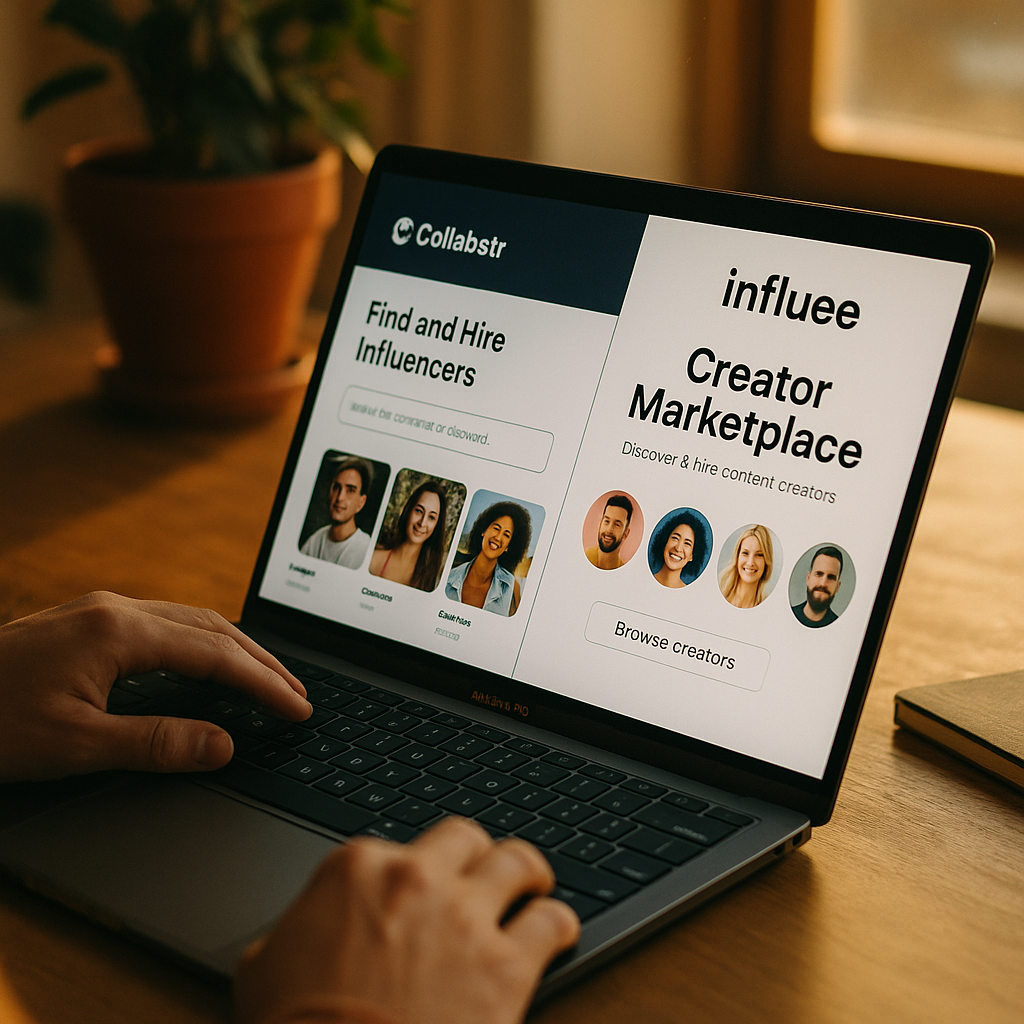
Seventy-one percent of marketers say finding the right creator still takes longer than producing the actual content, according to industry surveys tracked by eMarketer. If sourcing is your bottleneck, the Collabstr vs Influee decision matters more than another platform demo deck suggests. Both promise browse-and-book simplicity. Neither delivers it the same way.
The Core Difference: Browse-and-Book vs Managed Discovery
Collabstr is a straight-up marketplace. You search a catalog of creator profiles, see fixed package prices upfront, and book directly, similar to hiring a freelancer on Fiverr. No intermediary negotiates on your behalf. What you see is what you pay, and the creator either accepts the brief or doesn’t.
Influee leans more managed. It still lets you browse creator profiles and filter by niche, platform, and audience size, but it layers in campaign workflow tools: brief templates, approval stages, and in-platform messaging designed to mimic an agency relationship without the agency retainer. Think of it as self-serve with guardrails.
The real differentiator isn’t the catalog size. It’s how much operational scaffolding sits between your brief and a creator’s deliverable.
That scaffolding is the whole ballgame. A five-person brand team running fifteen campaigns a quarter needs different rails than a solo marketer booking three TikTok creators for a product drop.
Speed: How Fast Can You Actually Launch a Campaign?
Collabstr’s selling point is velocity. Fixed pricing means no back-and-forth negotiation. You filter by budget, niche, and platform, message a shortlist, and lock in bookings within a day or two if creators respond quickly. For brands running reactive campaigns, say, riding a trend before it cools, that speed is genuinely valuable. Our own look at trend detection tools found that the window between spotting a moment and shipping content is shrinking fast, and sourcing delays kill more trend-jack campaigns than production delays do.
Influee is slightly slower out of the gate because its structured brief process asks for more upfront detail: goals, brand guidelines, usage rights preferences. That extra step costs you an hour or two on day one. But it often saves time downstream because creators receive clearer direction and revision requests drop.
So which wins on speed? Collabstr wins the sprint. Influee wins the marathon, especially on multi-deliverable campaigns where unclear briefs compound into weeks of back-and-forth.
Control: Who Owns the Brief, the Content, and the Timeline?
This is where the comparison gets interesting for brand and legal teams. Collabstr’s direct-booking model puts control almost entirely in your hands, for better and worse. You write the brief, you chase revisions, you manage usage rights negotiations creator by creator. That’s fine if you have a producer or community manager dedicated to influencer ops. It’s a liability if you’re running this as a side task.
Influee’s structured workflow centralizes more of that control inside the platform itself. Usage rights, revision limits, and payment milestones are built into the booking flow rather than negotiated in DMs. That matters more than it sounds. A surprising number of disputes between brands and creators stem from vague usage terms, not bad content, a problem we’ve flagged before in our piece on creator rights licensing risk.
- Collabstr: Flexible, minimal friction, but you own every follow-up and edge case.
- Influee: Structured, slower to start, but disputes and scope creep get absorbed by the platform’s workflow.
Neither approach is objectively better. It depends on whether your team treats influencer sourcing as a core competency or a task bolted onto someone’s existing job.
Pricing and Vetting: Where the Real Risk Lives
Collabstr’s fixed-price packages are transparent, which brands love for budget forecasting. But transparency on price doesn’t mean transparency on quality. Vetting still falls largely on you: checking engagement authenticity, reviewing past work samples, confirming the creator’s audience actually matches your target demo. Fake followers and inflated engagement remain a persistent headache industry-wide, something the FTC has increasingly scrutinized through disclosure enforcement.
Influee builds some vetting signals into creator profiles (past brand collaborations, platform-verified metrics) which reduces, but doesn’t eliminate, your due diligence burden. If you’re sourcing at volume, this difference compounds quickly. We’ve written before about how automated risk scans still need human sign off, and that logic applies here too: platform-level vetting is a filter, not a final answer.
On cost, neither platform is dramatically cheaper than the other at the nano and micro tiers. The real cost difference shows up in labor hours. If your internal team bills out at $75 an hour and spends six extra hours per campaign chasing Collabstr bookings manually, that “savings” from lower platform fees evaporates fast. Our analysis of marketplace speed versus cost tradeoffs makes a similar point: the sticker price rarely tells the full ROI story.
Where These Platforms Sit Among Alternatives
Collabstr and Influee aren’t the only browse-and-book players worth benchmarking. If you’re running high-volume UGC rather than full influencer campaigns, it’s worth comparing them against platforms covered in our platform-to-volume matching guide, which looks at how Billo, JoinBrands, and Insense handle scale differently. And if affiliate attribution is a bigger priority than sourcing speed, our breakdown of affiliate attribution tool selection covers ground neither Collabstr nor Influee addresses natively, since affiliate tracking isn’t core to either platform’s current feature set.
For brands weighing UGC-specific risk against cost, our comparison of UGC cost versus risk tradeoffs is also a useful companion read, particularly if you’re deciding whether a marketplace model suits your content needs at all.
Which One Fits Your Team?
If you’ve got a dedicated person (even part-time) managing creator relationships and you value speed and price transparency above all else, Collabstr’s direct-booking model will feel efficient rather than chaotic. If your team is lean, briefs get written on the fly, and you’ve been burned by usage rights disputes before, Influee’s structured workflow buys you protection you’d otherwise have to build yourself in spreadsheets and email threads.
A practical test: run one campaign on each platform with a similar budget and creator tier. Track not just cost per deliverable, but hours your team spends managing the booking from brief to final asset. That number tells you more about fit than any feature comparison chart, including this one.
Frequently Asked Questions
Is Collabstr or Influee better for first-time influencer marketing campaigns?
Collabstr’s simpler, more direct booking flow tends to suit first-timers who want to learn the mechanics of briefing and negotiating with creators. Influee’s structured templates can feel like extra steps if you don’t yet know what a good brief looks like.
Do either Collabstr or Influee verify creator engagement authenticity?
Both platforms display engagement metrics on creator profiles, but neither performs the kind of deep fraud auditing that dedicated verification tools do. Brands running larger budgets should supplement platform data with independent checks, similar to the approach outlined in our attribution fraud detection guide.
Can I negotiate pricing on Collabstr’s fixed packages?
Most Collabstr creators set fixed package prices, though some are open to direct negotiation for larger or multi-deliverable bookings. It varies by creator rather than by platform policy.
Does Influee handle usage rights and content licensing automatically?
Influee builds usage rights terms into its booking workflow, which reduces ambiguity compared to ad hoc negotiation. Brands should still confirm specific usage windows and paid amplification rights before launch, since terms vary by campaign tier.
Which platform scales better for brands running dozens of creator campaigns monthly?
Influee’s workflow structure generally scales better for volume because it standardizes briefs and approvals across campaigns. Brands running very high volume may still want to compare against platforms built specifically for scale, as covered in our scale versus usable output analysis.
If speed to launch is your main constraint, test Collabstr on a low-stakes campaign first. If you’ve been burned by usage rights disputes or scope creep, give Influee’s structured workflow a trial run before you scale budget on either platform.
Top Influencer Marketing Agencies
The leading agencies shaping influencer marketing in 2026
Agencies ranked by campaign performance, client diversity, platform expertise, proven ROI, industry recognition, and client satisfaction. Assessed through verified case studies, reviews, and industry consultations.
Moburst

-
2

The Shelf
Boutique Beauty & Lifestyle Influencer AgencyA data-driven boutique agency specializing exclusively in beauty, wellness, and lifestyle influencer campaigns on Instagram and TikTok. Best for brands already focused on the beauty/personal care space that need curated, aesthetic-driven content.Clients: Pepsi, The Honest Company, Hims, Elf Cosmetics, Pure LeafVisit The Shelf → -
3

Audiencly
Niche Gaming & Esports Influencer AgencyA specialized agency focused exclusively on gaming and esports creators on YouTube, Twitch, and TikTok. Ideal if your campaign is 100% gaming-focused — from game launches to hardware and esports events.Clients: Epic Games, NordVPN, Ubisoft, Wargaming, Tencent GamesVisit Audiencly → -
4

Viral Nation
Global Influencer Marketing & Talent AgencyA dual talent management and marketing agency with proprietary brand safety tools and a global creator network spanning nano-influencers to celebrities across all major platforms.Clients: Meta, Activision Blizzard, Energizer, Aston Martin, WalmartVisit Viral Nation → -
5

The Influencer Marketing Factory
TikTok, Instagram & YouTube CampaignsA full-service agency with strong TikTok expertise, offering end-to-end campaign management from influencer discovery through performance reporting with a focus on platform-native content.Clients: Google, Snapchat, Universal Music, Bumble, YelpVisit TIMF → -
6

NeoReach
Enterprise Analytics & Influencer CampaignsAn enterprise-focused agency combining managed campaigns with a powerful self-service data platform for influencer search, audience analytics, and attribution modeling.Clients: Amazon, Airbnb, Netflix, Honda, The New York TimesVisit NeoReach → -
7

Ubiquitous
Creator-First Marketing PlatformA tech-driven platform combining self-service tools with managed campaign options, emphasizing speed and scalability for brands managing multiple influencer relationships.Clients: Lyft, Disney, Target, American Eagle, NetflixVisit Ubiquitous → -
8

Obviously
Scalable Enterprise Influencer CampaignsA tech-enabled agency built for high-volume campaigns, coordinating hundreds of creators simultaneously with end-to-end logistics, content rights management, and product seeding.Clients: Google, Ulta Beauty, Converse, AmazonVisit Obviously →